
Font size
 Worksheets
Topic 2 Test
Total questions: 21
Worksheet time: 11mins
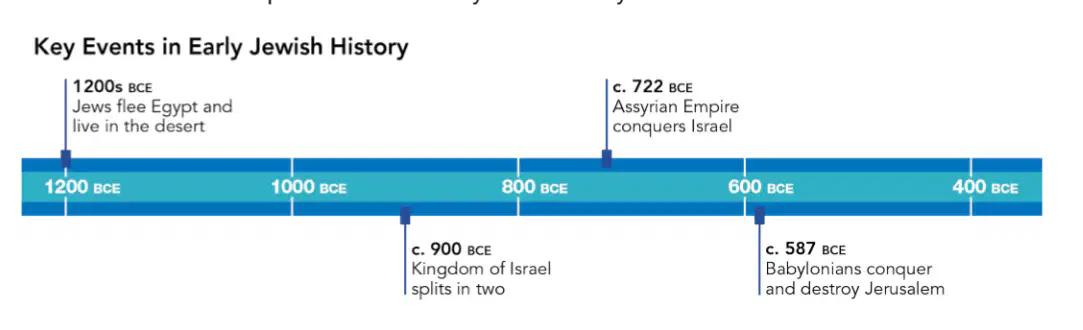
What date on the timeline marks the beginning of the Jewish Diaspora?
c. 1200 BCE
c. 900 BCE
c. 722 BCE
c. 587 BCE
Sumer is important in world history because it was
the world’s first civilization.
where human beings evolved.
where the first fishing villages developed.
the world’s largest empire.
Which of the following are included in the Ten Commandments? Choose the TWO correct answers.
A. “Remember the Sabbath day and keep it holy.”
B. “You shall not lie.”
C. “You shall not steal.”
D. “You shall obey your spiritual leader.”
When Judaism began, how was it different from other religions in the ancient world?
Judaism had sacred texts.
Judaism did not instruct its followers about how to lead their daily lives.
Judaism held that there was one God who set down laws about right and wrong.
Judaism held that there was good and evil in the universe.
What led to the conquest of Sumer?
the unification of city-states
the peace among city-states
the fighting among city-states
the wealth of city-states
What did Sumerian sculptors create that was different from earlier sculptures?
iron pieces
realistic statues of humans
hanging gardens
Assyrian-style statues
Which of the following correctly describe the Epic of Gilgamesh? Choose the TWO correct answers.
It was the important legal code written by Sumerian king, Gilgamesh.
It was written in cuneiform.
It is a myth, telling the story of a legendary hero named Gilgamesh.
It was written by Sumerian priests.
Read the excerpt from Hammurabi’s Code.
“If a man has knocked out the eye of a patrician [aristocrat], his eye shall be knocked out. . . If he has knocked out the eye of a plebeian [commoner] . . . he shall pay one mina of silver. If he has knocked out the eye of a patrician’s servant . . . he shall pay half his value.”
What does this quote illustrate about the nature of Hammurabi’s Code?
The law’s punishments did not encourage social order.
The law did not treat all members of society equally.
The law did not address private matters, such as taxes.
The law’s punishments encouraged social order.
What city became the center of Hammurabi’s Mesopotamian empire?
Babylon
Lagash
Ur
Umma
The official religion of the Persian Empire was Zoroastrianism, whose main belief is
people may worship many gods.
the universe is in a struggle between good and evil.
meditation is the path to enlightenment.
leaders should be buried in huge structures called pyramids.
What pattern did the laws in Hammurabi’s Code follow?
punishment, offense
punishment, explanation
offense, punishment
offense, explanation
Which of the following statements correctly describe the Great Royal Road? Choose the TWO correct answers.
It was constructed by Cyrus the Great.
It spanned rivers on bridges that swung from cables.
It was used to transport trade goods and tribute across the empire.
It allowed the Persians to create the fastest communication system of the ancient world.
How did Cyrus the Great’s treatment of the Jews of Jerusalem differ from that of the neo-Babylonians?
Cyrus destroyed Jerusalem, while the neo-Babylonians helped rebuild it.
Cyrus allowed the Jews to return to Jerusalem, while the neo-Babylonians forced them into exile.
Cyrus conquered all of Jerusalem, while the neo-Babylonians only destroyed the Jewish temple.
Cyrus banished the Jews from Jerusalem, while the neo-Babylonians allowed them to stay.
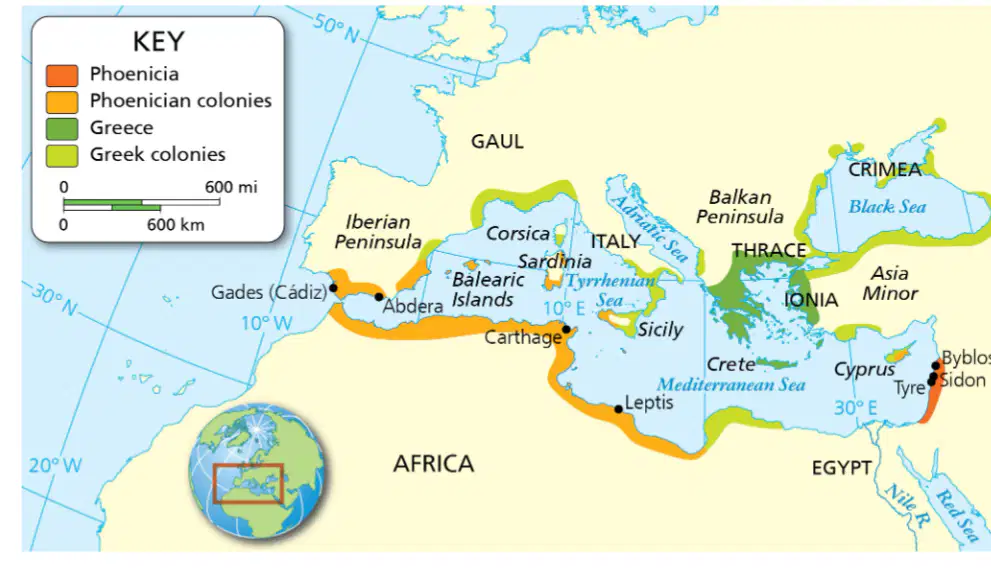
Look at the map.
What could BEST be inferred from the map?
Phoenicia was frequently at war with other empires.
Phoenicians traded with peoples in Africa and Europe.
The population of Phoenicia and its colonies was larger than that of Greece and its colonies.
Greece and its colonies benefitted from a better climate for agriculture.
The Phoenician alphabet was based on
syllables.
words.
vowels.
sounds.
Which of the following texts contains commentaries on the teachings of Moses?
the Writings
the Torah
the Hebrew Bible
the Talmud
The common set of values and beliefs shared by Judaism and Christianity is known as the
Old Testament.
Holy Bible.
Covenant.
Judeo-Christian tradition.
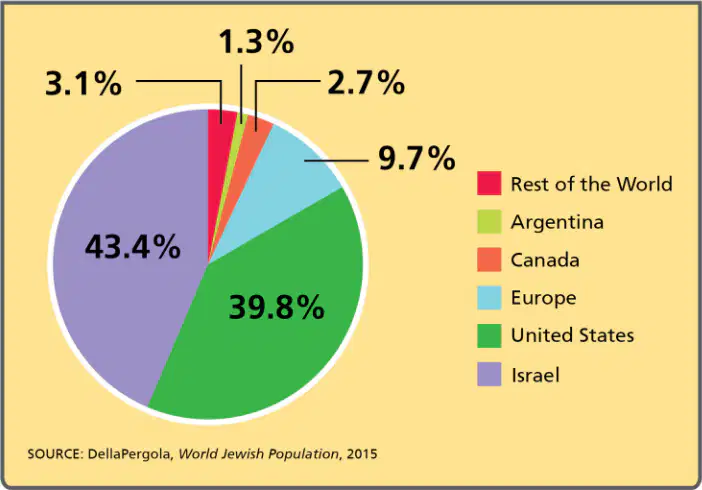
Outside of Israel, where do the largest number of Jews live today?
in other parts of Southwest Asia
in Europe and Russia
in Latin America
in the United States
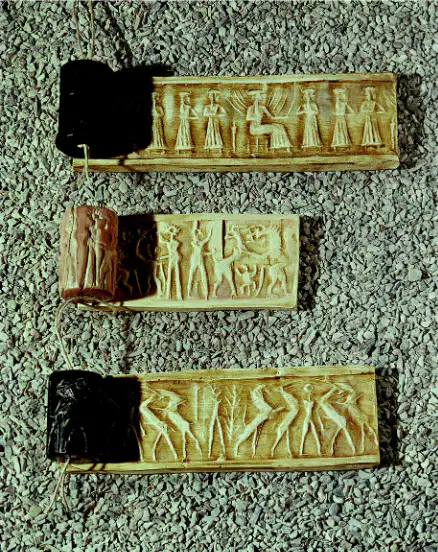
What Sumerian art form does the photograph show?
cylinder seals
stone stelae
ivory netsuke
cuneiform printing
What does the Jewish holiday of Passover commemorate? Choose the TWO correct answers.
the Exodus
Cyrus the Great allowing the Jews to return to Judah
the Diaspora
God freeing the Jews from slavery in Egypt
The Phoenicians' willingness to travel far for trade eventually led to the spread of their civilization because:
they established colonies and trading posts in distant lands.
they conquered large empires through warfare.
they isolated themselves from other cultures.
they focused only on local trade.

