
 Worksheets
Rules of Composition Test
Total questions: 30
Worksheet time: 42mins
The Rule of Thirds helps photographers:
Perfectly center the subject in the frame every time.
Create balanced, dynamic compositions.
Avoid using background detail.
Increase depth of field.
Leading lines can be created by:
Objects pointing toward the subject.
Using the flash setting.
Editing in a filter.
Cropping out the horizon.
A wide aperture (f/2.8) will most likely create:
Deep depth of field.
More noise in the photo.
Shallow depth of field with background blur.
Overexposure.
Analogous colors are:
Opposite each other on the color wheel to create a strong contrast.
Next to each other on the color wheel to create harmony.
Three colors at equal points on the color wheel to add texture.
Only used in black-and-white photography.
Shutter speed controls:
Motion and exposure time.
Color temperature.
File format.
White balance.
Negative space can make a photo feel:
Crowded and intense.
Calm or focused on a single subject.
Busy and unbalanced.
Washed out.
A Dutch angle is used when a photographer wants to:
Create a sense of tension or unease.
Emphasize balance and harmony.
Highlight symmetry.
Blur the background.
The Rule of Odds suggests:
Subjects should always appear in pairs.
Odd-numbered groupings are more visually appealing.
Even-numbered arrangements are most balanced.
Subjects should not overlap.
In asymmetrical balance, elements are:
Identical on both sides.
Different but still visually balanced.
Repeated evenly.
Arranged in patterns only.
Framing in photography can involve these techniques:
(Choose all correct answers.)
Cropping after taking the photo.
Using elements within the photo to surround the subject.
Editing the photo for brightness.
Placing the subject in the center.
A high ISO (such as 3200+) can be useful in:
Bright daylight.
Low-light conditions.
Fast action with lots of light.
Black-and-white editing only.
A high-angle shot often makes the subject appear:
Powerful.
Vulnerable.
Centered.
Blurred.
The Rules of Composition are designed to:
Limit creativity.
Guide how visual elements work together.
Increase megapixels.
Control file size.
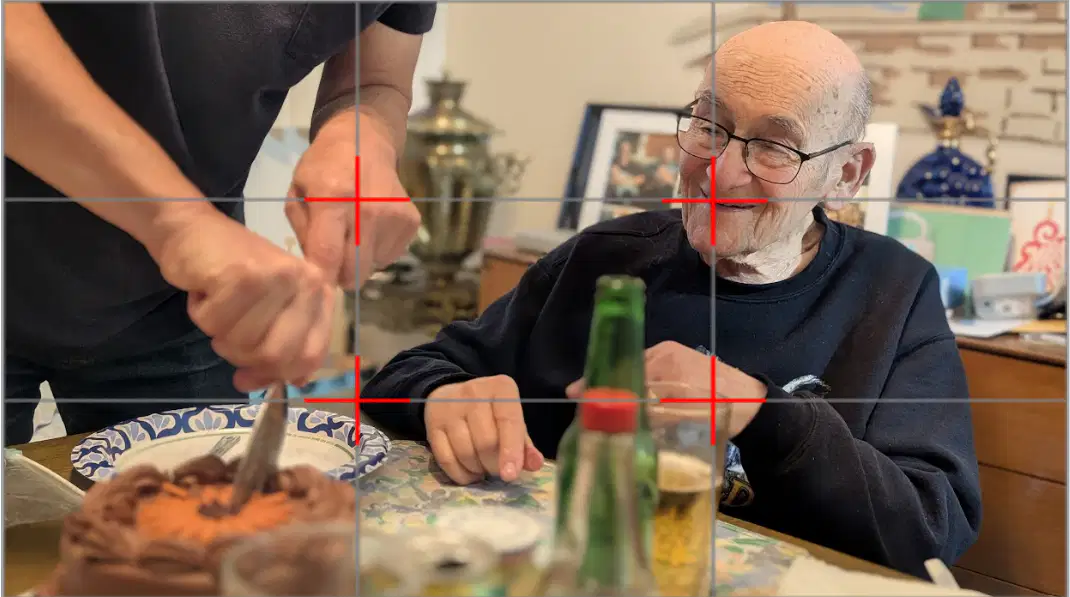
This photo shows a person’s face aligned with an intersection of a grid. Which of the following rules of composition does this demonstrate?
Framing
Leading Lines
Rule of Thirds
Depth of Field

The warm pinks and oranges of the sunset stand out against the dark colors of the foreground. What concept is being used?
Tone Balance
Color Balance
Pattern Balance
Symmetrical Balance

This photo captures a hummingbird in mid-air. Which camera setting made that possible?
Slow shutter speed
Wide aperture
Fast shutter speed
High ISO

A photo shows a long stretch of train tracks leading toward the forest and mountains beyond. What technique is this?
Rule of Odds
Leading Lines
Framing
Viewpoint

A castle is reflected imperfectly in the water. What does this demonstrate?
Symmetry
Asymmetry
Rule of Thirds
Pattern

The photographer took this shot from above, looking down on the subject. What is this angle called?
Eye-level
Worm’s eye view
Bird’s-eye view
Dutch angle

The background is blurred while the subject remains crisply in focus. Which setting caused this?
Narrow aperture
High ISO
Wide aperture
Slow shutter

What compositional rules are being used in this photograph?
Choose all correct answers.
Pattern
Negative Space
Fill the Frame
Motion Blur

In this image, one small pink object draws attention among muted tones. Which concept applies?
Color Balance
Rule of Odds
Pattern
Framing

In this photo of a group of swans, five cygnets (or baby swans) swim between their parents. Which rule OR rules apply?
Exposure
Rule of Odds
Asymmetrical balance
Pattern Balance

This photo captures a silver ball hanging from wires. The ball’s reflective surface shows an intersection, trees, and several people walking below, while the background outside the reflection is plain. Which photographic concept is best demonstrated in this image?
Asymmetry
Framing
Rule of Thirds
Pattern
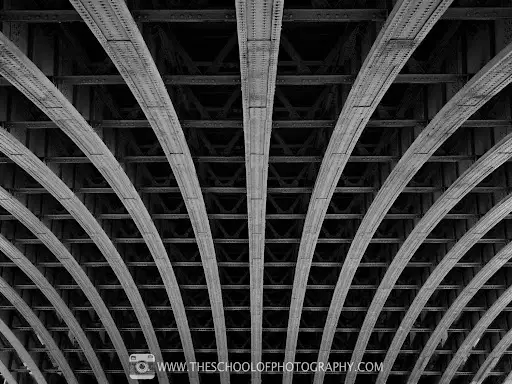
Balance in this photo is achieved through which of the following methods? Is it symmetrical, asymmetrical, or does it rely on patterns, color, or tone? Be specific!
(a)

Color or tone affects the mood of this scene from The Lord of the Rings by:
(a)

This photo has too much motion blur, putting the subject out of focus. What setting could the photographer have changed to improve the clarity of the image?
(a)
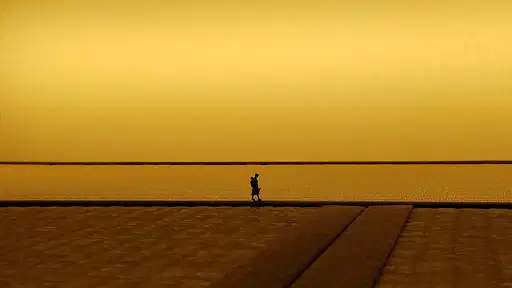
Analyze how the combination of framing, leading lines, and negative space is used to draw attention to the subject.
(a)

Identify at least two compositional rules shown in this photo and explain how they work together.
(a)

The use of light and dark (tone) in this image influences balance or emotion in the following way:
(a)

