
 Worksheets
Lesson 2.4 Changing State - Freezing 2025
Total questions: 17
Worksheet time: 9mins
1. As the water freezes, does the top surface of the water go up, go down, or stay the same?
goes up slightly
goes down slightly
stays the same
2. Assuming that no new water molecules entered the glass while the water was freezing, would you say that frozen water (ice) takes up more space than liquid water, less space, or about the same?
more space
less space
the same amount of space
3. If you think about the water molecules as liquid water freezes, would you say they get closer together, further apart, or stay at about the same distance from one another?
closer together
further apart
stay at the same distance from one another
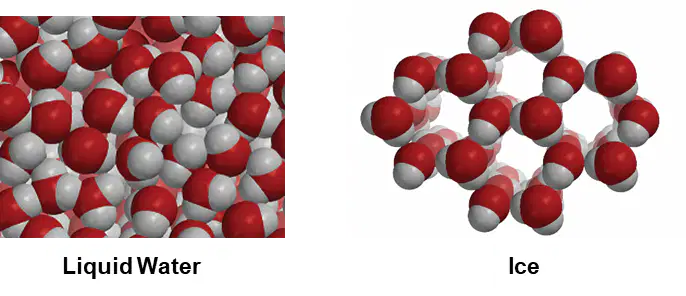
4. In these models of liquid water and ice, you can see that the water molecules in liquid water are very close together, but that the molecules in ice are arranged in a pattern that makes them further apart. This is why ice takes up more room in a container than the liquid water it came from. Sometimes in the winter when water gets into cracks in the road, the water freezes and the road breaks apart and forms a pothole. Explain why you think the freezing of water could cause this to happen.
5. In this experiment, a thin layer of ice forms on the outside of the can. Where do you think the water molecules came from that ended up frozen on the outside of the can?
they leaked through the can
they came from water vapor in the air
6. What happened to the speed of the water vapor molecules that came in contact with the cold can?
they slowed down
they stayed at the same speed
they sped up
7. What happened to the state of the water vapor molecules as they contacted the cold can?
the state changed from solid to liquid to gas
the state changed from gas to liquid to solid
the state changed from liquid to gas
8. When water freezes, the water molecules have slowed down enough that their ____________________ arrange them into fixed positions.
colors
numbers
attractions
molecules
9. Water molecules freeze in a ________________ pattern and the molecules are further apart than they were in liquid water.
triangular
pentaganol
hexagonal
octagonal
10. Even though the ice is cold, the molecules still have motion. They ____________ but cannot move past one another.
slide
vibrate
freeze
rotate
11. The change of state where a gas changes directly to a solid without becoming a liquid is called:
solidification
freezing
sublimation
deposition

12. The temperature at which a substance freezes is called its freezing point. The freezing point of water is 0°C (32°F). Corn oil and isopropyl alcohol have lower freezing points than water. This means that they need to be cooled to lower temperatures to make them freeze. Each liquid is made up of different molecules. The molecules of different liquids are attracted to each other by different amounts. The molecules have to slow down to different speeds before their attractions can take hold and organize them into fixed positions as a solid. Why do different liquids have different freezing points?
13. How does the temperature of liquid nitrogen compare to the temperature of liquid water?
liquid nitrogen is a lot warmer
liquid nitrogen is slightly warmer
liquid nitrogen is slightly colder
liquid nitrogn is a lot colder
14. Why do the air molecules condense in the balloon?

A student noticed a bottle of water had frozen in the refrigerator. He made the claim that the water expanded and caused the bottle to crack. What evidence can he use with a regular water bottle to support his claim?

A student noticed a bottle of water had frozen in the refrigerator. He made the claim that the water expanded and caused the bottle to crack. What justification (scientific reasoning) can the student use to support his claim. (Why would water expand?) Explain with molecules.
How do you feel about what you have learned in this lesson?
😊 Great! I am confident that I understand the material.
🙂 Good, but I still have a question. I will ask the teacher about it by email or in class.
😐 OK, but I need more practice. I will read through the lesson and re-watch some of the videos.
🤨 I need help. I will review the lesson and make a list of topics that are confusing to me. I will reach out to the teacher for help.

