
NEW
Font size
 Worksheets
2D Art Concepts and Terminology Study
Total questions: 60
Worksheet time: 30mins
Abstract art can be defined as:
Difficult to comprehend; not clear or precise in thought or expression.
A summary of the contents of a book, article, or formal speech.
Art that does not attempt to show a realistic representation of something.
The representation of form or figure in art.
Which of the following best describes an example of cultural appropriation?
Creating original artwork inspired by your own heritage.
Creating art from another culture without understanding its significance.
Respectfully learning about another culture’s customs and traditions.
Collaborating with artists from different backgrounds to create new work.
Which principle of design is used when an artwork guides the viewer’s eye along a path, creating a sense of action?
Movement
Balance
Contrast
Emphasis
Which best describes the main focus of a still life artwork?
Capturing the movement of animals in nature.
Arranging and depicting objects that do not move.
Painting famous historical events.
Drawing portraits of people in action.
Which of the following best describes a contour line in art?
A line that is always drawn with a ruler.
A line that shows the edges and boundaries of shapes or forms.
A line used only for shading purposes.
A line that represents the color of an object.
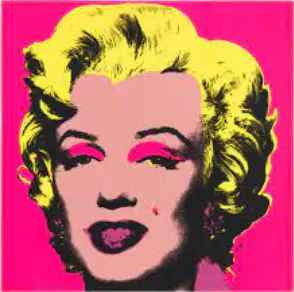
Which artist is famous for creating pop art portraits similar to the one shown above?
Jasper Johns
Andy Warhol
Claes Oldenburg
Roy Lichtenstein
What do we call the way shapes, colors, and lines are organized in a piece of artwork?
a composition
an illustration
a sketch
a critique
An artist statement is most useful for ____________.
Describing the steps taken to create an artwork
Explaining the meaning or intention behind an artwork
Listing the awards an artist has won
Convincing people to buy the artwork
The feelings of strength, determination, and passion are represented by the color:
Blue
Red
Yellow
Violet
Which art material consists of powdered pigments mixed with a binder such as gum or resin?
Pastel
Marker
Charcoal
Colored pencil
When an artist creates a picture of themselves, what is this type of artwork called?
A landscape
A self-portrait
A still life
A mural
The artistic movement that focuses on depicting everyday life and ordinary people as they truly are, without embellishment or fantasy, is known as ___________________.
Realism
Art Nouveau
Impressionism
Modernism
Which type of paint uses water as a solvent and is known for its transparent washes and delicate appearance?
Acrylic
Tempera
Watercolor
Gouache
The genre of art that depicts natural scenery such as mountains, valleys, trees, rivers, and forests, especially where the main subject is a wide view is called:
Earth portrait
Skyline painting
Landscape
Nature art
Which term describes a decorative design that is created by repeating shapes, lines, or colors?
Balance
Pattern
Emphasis
Contrast
Which type of artwork involves assembling different objects like magazine clippings, fabric, or photographs onto a surface to create a new image?
Sketch
Collage
Watercolor
Etching
Which painting medium consists of pigments mixed with an acrylic resin and dries rapidly?
Acrylic
Tempera
Watercolor
Gouache
Which style of painting emphasizes the artist's personal perception of a scene, using loose brushwork and vibrant colors instead of precise, realistic representation?
Surrealism
Expressionism
Impressionism
Realism
Which type of artwork is described as "works that represent inanimate objects"?
Portraits
Landscapes
Still lifes
Non-objective art
What is the main difference between representational art and abstract art?
Representational art contains no recognizable subject matter, while abstract art represents people.
Representational art moves away from realistic depiction, while abstract art is always realistic.
Representational art depicts real people, places, and things, while abstract art moves away from realistic depiction.
Representational art only includes landscapes, while abstract art only includes still lifes.
A student is analyzing a painting and notices it uses only shades of blue. Which color scheme is the student identifying?
Complementary colors
Monochromatic colors
Warm colors
Analogous colors
Which of the following best defines "Line" in the context of the elements of art?
A continuous mark made on a surface with a pointed tool or implied by the edges of shapes and forms
A color that is mixed with black
A shape that can be found in nature
A tool used to understand color relationships
If an artist wants to create a color by mixing equal amounts of two primary colors, what type of color will they produce?
Secondary color
Complementary color
Neutral color
Analogous color
Which of the following are recognized as traditional printmaking techniques?
Digital, Spray, Etching
Monoprint, Collagraph, Relief
Stencil, Airbrush, Transfer
Press, Paint, Scratch
If an artist wants to create a color by mixing equal amounts of two primary colors, what type of color will they produce?
Secondary color
Complementary color
Neutral color
Analogous color
An artist is planning a painting and wants to use colors that are direct opposites on the color wheel to create contrast. What type of colors should they use, and why might this choice be effective in their composition?
Complementary colors; because they create strong visual contrast and can make each other appear more vibrant
Primary colors; because they are the building blocks of all other colors
Analogous colors; because they blend smoothly and create harmony
Neutral colors; because they do not distract from the main subject
Which of the following is considered a warm color?
Blue
Green
Red
Violet
What is the main difference between physical/actual texture and visual/implied texture in art?
Physical texture is only seen, while visual texture is felt
Physical texture can be felt with your hand, while visual texture is an illusion created by value and other elements
Visual texture is rough, while physical texture is smooth
Visual texture uses only color, while physical texture uses only shape
Which element of art refers to the lightness or darkness of a color?
Form
Shape
Value
Texture
What is the term for colors that are next to each other on the color wheel and create a sense of harmony?
Triadic colors
Monochromatic colors
Analogous colors
Complementary colors
What is the definition of 'Unity' in art?
The feeling that all the parts of an artwork work together.
The use of bright colors to attract attention.
The repetition of shapes and lines in a pattern.
The technique of creating depth using perspective.
Which art term is described as 'A sense of movement created by repeating elements with some variation'?
Rhythm
Balance
Contrast
Emphasis
Value in art refers to:
The area around and within objects in an artwork
The feeling that the elements in an artwork are balanced
The lightness or darkness of a color, from white to black
A mark made on a surface that is longer than it is wide
What is the definition of 'Contrast' in art?
The strong differences between elements, like light and dark colors.
A technique of blending colors smoothly together.
The repetition of shapes or lines in a composition.
A method of creating texture using dots.
Which art term is defined as 'Making one part of an artwork stand out more than the others'?
Emphasis
Balance
Rhythm
Unity
What is the definition of 'Pattern' in art?
The repetition of shapes, lines, or colors in an organized way.
A single color used throughout a painting.
A random arrangement of objects in a composition.
The use of light and shadow to create depth.
Which art term refers to 'The relationship of the sizes of different parts of an artwork to each other'?
Proportion
Texture
Perspective
Contrast
What is the definition of 'Movement' in art?
The way your eye travels through an artwork, often guided by lines or shapes.
A technique used to create texture in a painting.
The use of bright colors to attract attention.
A method of mixing different media in one artwork.
Composition is
The artistic arrangement of the parts of a picture
the different values in a work of art
Using recycled materials in a piece of artowrk
An image combined of two different things or a compound.
The definition of Line is
a dot that went for a walk or the path of a moving dot
a straight thing
A never ending dash
A line that connects to itself
Shape is
a form with definite edges
a geometric form
A line that connects to itself
A form with an inside and an outside
Another word for shading is
Pencil
shadows
value
gray
Texture is
The lights and darks in an image
A work of art that has a lot of contrast
When something feels smooth
The way something feels or looks like it feels
Which is NOT an element of art?
Color
Sculpture
Space
Value
Which term refers to "Shapes that are mathematical"?
Organic Shapes
Geometric Shapes
Primary Colors
Implied Texture
What are "Primary Colors"?
Colors made by mixing two primary colors
The colors mixed to make all other colors
Shapes that are found in nature
The way something actually feels
Which of the following is NOT an element of art?
Line
Rhythm
Shape
Value
What does "Shading" refer to in art?
A gradual change from light to dark
The area occupied by an object
The way something actually feels
The language used to communicate in art
What are "Organic Shapes"?
Shapes that are found in nature
Shapes that are mathematical
The area occupied by an object
The way something actually feels
What is the term for a mark made by a point moving across a surface?
Line
Shape
Form
Space
A work of art depicting inanimate objects sitting on a surface.
Still Life
Land Art
Art Collective
Public Art
Art that uses a combination of materials and genres.
Kinetic Art
Mixed Media
Printmaking
Landscape
A rough, light, loose drawing .
Shading
Line Quality
Cropping
Sketch
A design that repeat itself.
Pattern
Texture
Pictogram
Symmetry
How you arrange the parts of your artwork.
Imagination
Composition
Foreground
Technique
When objects in the distance seem small, while objects in front are life-size.
Composition
Negative space
Perspective
Foreground

