
 Worksheets
Canada Test
Total questions: 29
Worksheet time: 18mins
children of French and native peoples
bilingual
speaking two languages
Métis
descendants of French and Indigenous peoples
aboriginal
original inhabitants of Canada
autonomy
self-governance
First Nations
Indigenous peoples of Canada
Which type of climate do much of the Northern Lands have?
subarctic
cold temperate
high mountain
tropical
How did the Quebec Act of 1774 protect French settlers?
It kept them from being deported to France.
It allowed them to keep their language, religion, and system of laws.
It built forts to protect them from the First Nations peoples.
It allowed them free trade with the First Nations peoples.
In what way did the Canadian government give the First Nations more power?
It guaranteed them 10 percent of the profits for their products.
It gave them more rights than other citizens have.
It created new parliamentary positions for them.
It created a new territory, Nunavut, for them.
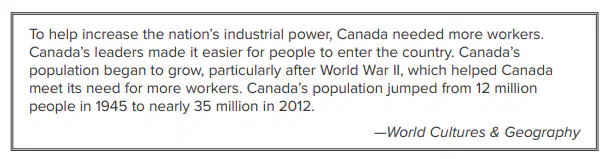
Based on the excerpt, what do you think is the best reason for the increase in Canada’s population after World War II?
More women entered the workforce.
There was more industry in Canada than anywhere else.
The workforce grew as a result of the increase in the number of immigrants.
More people were moving from urban areas to rural areas.
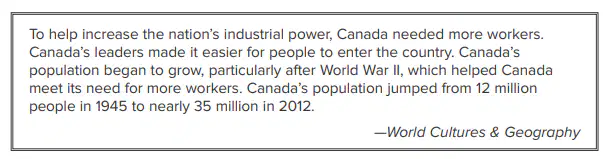
Based on the excerpt, what did Canada do to attract more people to live there?
It increased its number of farms.
It made it easier for people to enter the country.
It offered land grants to attract people.
It made it easier for people to leave the country.
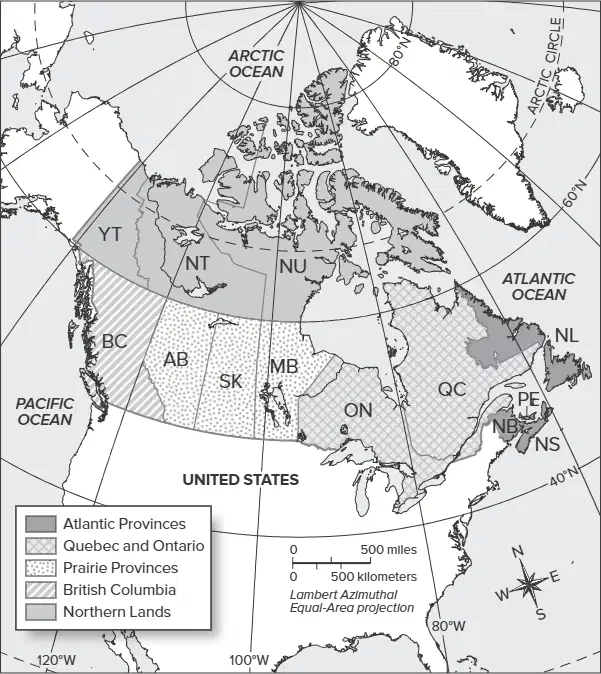
Based on the map, which region of Canada is bordered by the Arctic Ocean?
A. Northern Lands
B. Quebec and Ontario
C. Atlantic Provinces
D. British Columbia
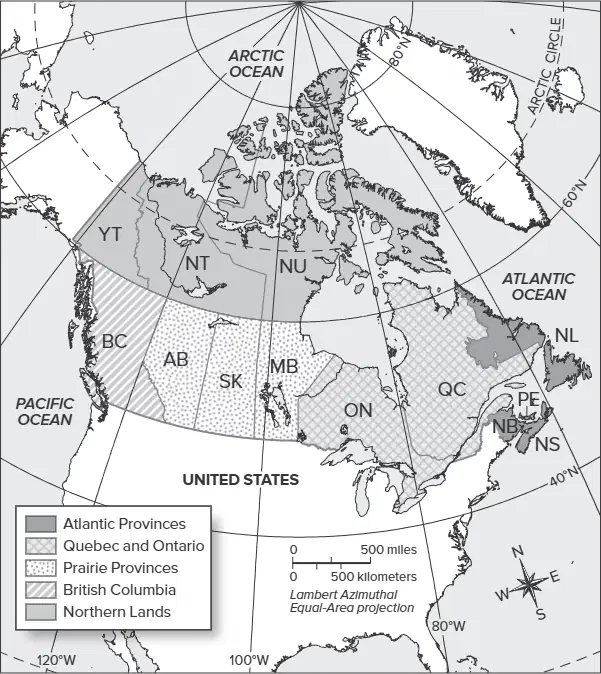
Based on the map, in what region is the absolute location of 80°N, 80°W?
Prairie Provinces
Northern Lands
Ontario and Quebec
Atlantic Provinces
In land size, Canada is the largest country in the world.
True
False
Nunavut is one of Canada's three territories.
True
False
The Vikings settled in what is now Quebec.
True
False
Canada did not become an industrial nation until 1900s.
True
False
Canada's king or queen is the same as the king or queen of the United Kingdom.
True
False
The border between Canada and the United States is not defended.
True
False
The Grand Banks is one of the world's great hatcheries.
True
False
The North West Mounted Police was created to help keep order in the western territories of Canada.
True
False
Newfoundland and Labrador was the first territory to join Canada as a province.
True
False
Canada is a member of the North Atlantic Treaty Organization (NATO).
True
False
Match the answer to the correct vocab word.
Tundra
Cold, treeless region
fishery
Area for catching fish
Archipelago
Group of islands
Territories
Regions under a government
Plateau
Flat elevated land
About what percentage of Canadians live within 150 miles of the Canada-U.S border?
What change is occurring in the Arctic Ocean because of climate change?
There are fewer tourists because it has turned warmer.
Less ice is forming, and there is more ship traffic in the region.
Which explorer claimed the St. Lawrence River?
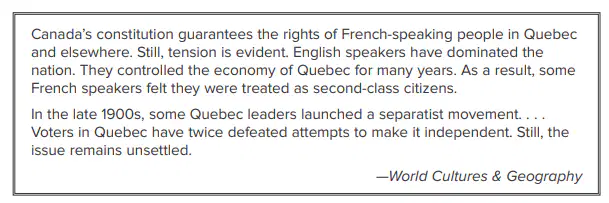
Based on the excerpt, why have the French-speaking people in Quebec and elsewhere been unhappy with their government?
They believe the French-speaking populations has been treated unfairly.
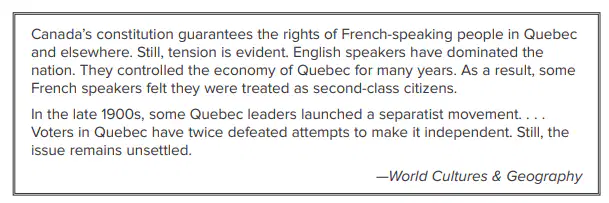
Based on the excerpt, what is the status of the separatist movement?
It passed after the second vote.
It is on appeal to Parliament
It has not been resolved
It is being presented for a third vote.
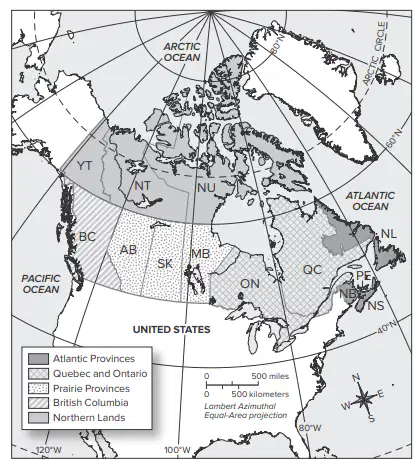
Based on the map, which region is not bordered by an ocean?
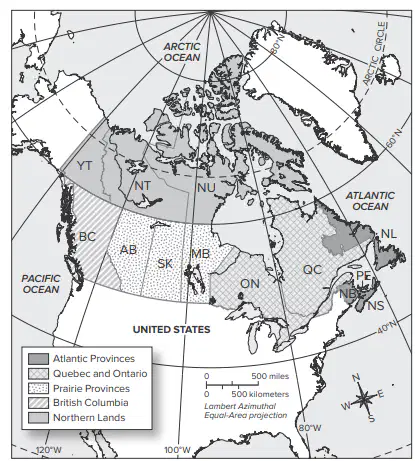
Based on the map, on the border of which two regions is the absolute location of 60N, 100W?
Why is the Grand Banks area important to Canada?
It brings in large amounts of revenue from the fishing industry
What was the main reason the English and French communities formed the Dominion of Canada?
They feared a takeover from the United States.
They wanted to settle their differences and become one nation.
A people's way of life often depends on the resources they have. How did the early First Nations people use their resources to live? Compare the lives of those who lived in the woodlands, on the Pacific coast, and in the far north. Use standard grammar, spelling, sentence structure, and punctuation.

