
 Worksheets
Los mandatos
Total questions: 115
Worksheet time: 57mins
What is the English translation of the Spanish word "mandato"?
a command
a question
a story
a letter
What are commands used for in language?
To describe objects
To order or tell someone to do something
To ask questions
To express feelings
When should you use “tú” commands?
When talking to a stranger
When talking to a teacher
When talking to a child, friend, or close relative
When writing a formal letter
Why is it important to use the correct form of commands when speaking Spanish?
It helps to show respect and clarity in communication
It makes sentences longer
It changes the meaning of nouns
It is only important in written Spanish
What is the purpose of 'los mandatos afirmativos (positivos)'?
To tell someone what to do
To ask someone a question
To describe an event
To tell someone what NOT to do
Which type of informal command would you use to tell someone what NOT to do?
Los mandatos negativos
Los mandatos afirmativos (positivos)
Los mandatos formales
Los mandatos interrogativos
If you want to instruct a friend to avoid a certain action, which type of command should you use according to the material?
Los mandatos negativos
Los mandatos afirmativos (positivos)
Los mandatos formales
Los mandatos descriptivos
What is the English translation of the Spanish command "¡Come tu cena!"?
Eat your dinner!
Drink your water!
Close the door!
Play with your friends!
Which of the following is an example of an affirmative tú command in Spanish?
¡Come tu cena!
Comiendo tu cena
Comer tu cena
Comes tu cena
What is the pattern for forming regular affirmative tú commands in Spanish?
Use the third person singular (él/ella) form of the verb
Use the infinitive form of the verb
Add -es to the verb stem
Use the first person singular (yo) form of the verb
Which command would you use to tell someone to open the door in Spanish?
Abre la puerta
Abres la puerta
Abrir la puerta
Abriendo la puerta
Based on the examples provided, what is the tú command form of the verb "jugar" (to play)?
Juega
Juegas
Jugando
Jugar
How do you turn an infinitive verb into an affirmative tú command in Spanish for regular verbs?
Change it to the él/ella form of the verb
Add -ando or -iendo to the verb
Use the infinitive as is
Add -es to the verb stem
What is the correct affirmative command form of the verb "descansar" (to rest) to complete the sentence: "_____ un rato."?
Descansa
Descanso
Descansas
Descansar
Which is the correct affirmative command form of the verb "evitar" (to avoid) for the sentence: "_____ la comida basura."?
Evita
Evitas
Evitar
Evito
Choose the correct affirmative command form of "comer" (to eat) to fill in the blank: "_____ más verduras."
Come
Coma
Comen
Comer
What is the correct affirmative command form of "correr" (to run) for the sentence: "¡_____ una milla!"?
Corre
Corro
Corres
Correr
What is the correct affirmative tú command form of the verb "bailar" in Spanish?
Baila
Bailas
Bailo
Bailamos
Which of the following is the correct affirmative tú command for the verb "correr"?
Corre
Corres
Corro
Corramos
Select the correct affirmative tú command form of the verb "escribir".
Escribe
Escribes
Escribo
Escribimos
If you want to tell a friend to dance, run, and write in Spanish using affirmative tú commands, which set is correct?
Baila, corre, escribe
Bailas, corres, escribes
Bailo, corro, escribo
Bailamos, corremos, escribimos
What is the correct tú command form of the verb "comer" (to eat)?
come
comas
comió
comiendo
Which of the following is an irregular tú command?
haz
juega
abre
camina
What is the tú command form of the verb "salir" (to leave)?
sal
sale
salga
salió
When attaching reflexive, direct, or indirect object pronouns to affirmative tú commands, what should you do?
Add an accent mark to keep the stress in the same place
Remove the pronoun
Change the verb ending to -ando or -iendo
Place the pronoun before the verb
Which of the following is the correct tú command for the verb "venir" (to come)?
ven
viene
vienes
venir
If you want to tell a friend to "sit down" in Spanish using a tú command, which form would you use?
Siéntate
Sentar
Sentarse
Sientas
Why do some tú commands require an accent mark when pronouns are attached?
To show that the stress remains in the same place
To indicate a question
To change the verb tense
To make the word longer
Which command would you use in Spanish to tell someone to "do exercise" if their legs hurt?
Haz
Descansa
Evita
Mantén
If someone is very tired, which command in Spanish means "rest for a while"?
Descansa
Juega
Haz
Ve
What is the correct Spanish command to tell someone to "avoid junk food" if they want to maintain their weight?
Evita
Compra
Mantén
Come
Which command would you use in Spanish to advise someone to "maintain a balanced diet" if they have bad eating habits?
Mantén
Receta
Ve
Haz
If someone feels sick, which Spanish command means "go to the doctor"?
Ve
Ayuda
Sal
Compra
What is the correct Spanish command to tell someone to "eat well every day" if they want to feel better?
Come
Pide
Evita
Haz
If someone has no energy, which Spanish command means "buy some vitamins at the pharmacy"?
Compra
Ve
Mantén
Descansa
What is the correct Spanish command to tell someone to "go out with your friends to have fun" if they are sad?
Sal
Busca
Haz
Come
Which of the following is the correct way to form an affirmative tú command in Spanish?
Use the infinitive form of the verb
Use the present indicative yo form of the verb
Use the present indicative él/ella/Ud. form of the verb
Use the past participle form of the verb
What is the affirmative tú command for the verb "dormir"?
Dormes
Duerme
Dorma
Dormiste
Which of the following is an irregular affirmative tú command?
come
habla
haz
bebe
Which of the following is the correct affirmative tú command for "beber"?
Bebo
Bebes
Beba
Bebe
If you want to tell someone to "take vitamins" using an affirmative tú command, which is correct?
Tomas vitaminas
Toma vitaminas
Tomar vitaminas
Tome vitaminas
What is the correct affirmative tú command for the verb "venir" (to come)?
Viene
Ven
Vienes
Vena
What is the correct affirmative tú command form of the verb "comer" (to eat)?
Eat: Come
Eat: Coma
Eat: Comes
Eat: Comemos
Which of the following is the correct affirmative tú command for the verb "beber" (to drink)?
Bebo
Bebes
Bebe
Bebemos
What is the irregular affirmative tú command form of the verb "salir" (to leave)?
Sal
Sale
Salga
Salgo
Which of the following is the correct way to say "Take vitamins" as an affirmative tú command in Spanish?
Tomas vitaminas
Toma vitaminas
Tome vitaminas
Tomar vitaminas
Which of the following is the correct affirmative tú command for "hacer" (to do/make)?
Hace
Haz
Haces
Hacer
If you want to tell someone to "wash your hands" using an affirmative tú command with a reflexive pronoun, which is correct?
Lávate las manos
Lavas las manos
Lávese las manos
Lavar las manos
What is the correct affirmative tú command for "venir" (to come)?
Ven
Vienes
Viene
Venir
What is the correct affirmative tú command for "mantener" (to maintain)?
Mantén
Mantienes
Mantene
Manténes
What is the irregular affirmative tú command form of the verb "decir"?
dice
di
decir
de
Which verb matches the affirmative tú command "haz"?
hacer
haber
hablar
hallar
If you want to tell someone to "go" in Spanish using the affirmative tú command, which word would you use?
vas
voy
ve
ido
Match the following irregular verb with its affirmative tú command: "tener".
ten
tiene
tener
tenes
Which of the following is NOT an irregular affirmative tú command listed in the material?
pon
sal
come
sé
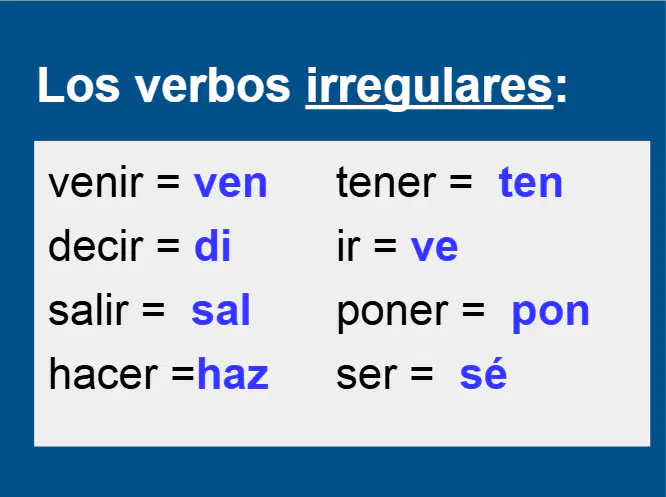
The phrase "Vin Diesel has ten weapons" is used as a mnemonic device. Which irregular tú commands does it help you remember?
ven, di, sal, haz, ten, ve, pon, sé
voy, das, sale, hace, tiene, va, pone, sabe
venir, decir, salir, hacer, tener, ir, poner, ser
vino, dijo, salió, hizo, tuvo, fue, puso, fue
What is the correct affirmative tú command form of the verb "hacer" to complete the sentence: "_____ ejercicio."?
Hace
Haz
Haces
Hizo
Which is the correct affirmative tú command form of the verb "ir" for the sentence: "_____ al doctor."?
Ve
Voy
Vaya
Vas
Choose the correct affirmative tú command form of "salir" to complete: "_____ con tus amigos."
Sal
Sale
Salga
Saliste
What is the correct affirmative tú command form of "ser" in the sentence: "_____ un paciente responsable."?
Soy
Sé
Sea
Ser
What is the correct affirmative tú command form of the verb "poner" in Spanish?
Pones
Pon
Poner
Pone
Which of the following is the correct affirmative tú command form of the verb "tener"?
Tienes
Tenga
Ten
Tener
Select the correct affirmative tú command form of the verb "hacer".
Haces
Hace
Haz
Hacer
If you want to tell a friend to "do it" in Spanish using the tú command, which verb form would you use?
Haces
Haz
Hacer
Hace
Which of the following is NOT an affirmative tú command for the verbs poner, tener, or hacer?
Pon
Ten
Haz
Tiene
According to the material, where should pronouns be attached in affirmative commands in Spanish?
At the beginning of the command
In the middle of the command
To the end of the command
Before the verb
Which of the following is an example of a reflexive pronoun being attached to an affirmative command?
Ponla aquí.
Siéntate aquí.
Tómalas.
Escribe la carta.
If you want to say "Take them!" referring to vitamins in Spanish, which is the correct way to attach the pronoun?
¡Tómalos!
¡Tómalas!
¡Tomarlas!
¡Tómales!
Which sentence correctly demonstrates the use of a direct object pronoun in an affirmative command?
¡Cepíllate los dientes!
¡Levántate temprano!
Ponla aquí.
Siéntate aquí.
Which of the following is an example of a negative tú command in Spanish?
¡Come mi pizza!
¡Habla!
¡No comas mi pizza!
¡Escribe en la pared!
According to the material, what is the English translation of "¡No escribas en la pared!"?
Don't eat the pizza!
Don't talk!
Don't write on the wall!
Don't run in the hallway!
Based on the examples, what is a common feature of negative tú commands for regular verbs in Spanish?
They always end in -ar
They start with "No" and use a specific verb ending
They use the infinitive form of the verb
They are always written in the past tense
How might you turn the infinitive verb "hablar" into a negative tú command, based on the pattern in the material?
No habla
No hablas
No hables
No hablar
What is the first step in forming negative commands (mandatos negativos) in Spanish?
Take the "yo" form of the verb
Add "no" in front
Drop the "o"
Add the opposite tú ending
When forming a negative tú command in Spanish, what do you do after taking the "yo" form?
Add "no" in front
Drop the "o"
Add the opposite tú ending
Change the verb to past tense
What is the final step in forming a negative tú command in Spanish, as shown in the example with "hablar"?
Add the opposite tú ending
Add "no" in front
Change the verb to the infinitive
Drop the "ar" ending
Which of the following is the correct negative tú command for "hablar"?
no hablas
no hablo
no hables
no hablar
What is the correct negative tú command form of the verb "descansar" in Spanish?
No descanses
No descansas
No descansa
descanséis
Which is the correct way to say "Don’t avoid healthy food" using the negative tú command for "evitar"?
No evitas la comida saludable.
No evites la comida saludable.
No evita la comida saludable.
No evitáis la comida saludable.
Choose the correct negative tú command form of "salir" to complete the sentence: "¡No ___ con tus amigos!"
salgas
sales
salga
salid
What is the correct negative tú command form of "beber" to complete the sentence: "No ___ café en la noche."
bebas
bebes
beba
bebéis
Negative Ud. command of pensar
Which is used to tell a group of people what to do?
tÚ
usted
ustedes
When using object pronouns with affirmative commands, you place the pronoun before the command.
True
False
To form an affirmative formal command with a pronoun, we _________ the pronoun to the verb.
To create formal and negative informal (tú) commands the first step is...
drop the -o
add the opposite ending
go to the yo form
Mi papá le grita a mi hermano ¡Corre!
My dad whispers to my sister: Run!
My dad talks to my brother walk!
My dad yells at my brother: Run!
My dad yells at my brother: Walk!
Change "escribir" to its Usted command.
Escriba
Escribe
Escribiendo
Escribaste
Cierra los ojos.
Close your eyes.
Open your eyes.
Close your ears.
Open your ears.
Which of the following is a negative formal command for "escribir" (to write)?
Escriba
No escribas
No escriba
Escriben
Which of the following is the correct indirect object pronoun for "to him"?
me
te
le
nos
How do you form a formal command for the verb "hablar" (to speak)?
Habla
Hable
Hablen
Hablas
Negative uds. command of hablar
Ud. command of llegar
Match the affirmative commands to the negative command that it matches.
camina
no camines
ve
no vayas
sé
no seas
bebe
no bebas
vive
no vivas
Match the affirmative commands to the negative command that it matches.
sal
no salgas
pon
no pongas
di
no digas
haz
no hagas
comienza
no comiences
(a) (hablar) - Uds.
Choose the correct negative formal command for "salir" (to leave).
No salgas
No sale
No salga
No salimos
How do you form a negative formal plural command for "comer" (to eat)?
No coman
No coma
No comas
No comemos
Select the correct formal command for "tener" (to have).
Tiene
Tenga
Tienen
Tengas
Which of the following is the correct formal plural command for "abrir" (to open)?
Abre
Abra
Abran
Abrid
Choose the correct formal singular command for "beber" (to drink).
Bebe
Bebo
Bebed
Beba

