wayground logo

Free Printable Worksheets

Font size

S
M
L
XL
Worksheets

Chapter 4 Practice Test

Total questions: 39

Worksheet time: 25mins
Name
Class
Date
1.
What gas is a reactant of photosynthesis
a)
carbon dioxide
b)
oxygen
c)
nitrogen
d)
hydrogen
2.
Are chloroplasts found in most plant cells?
a)
Yes, because they are necessary for photosynthesis.
b)
Yes, because they are necessary for cellular respiration
c)
No, because they are only found in animal cells.
d)
No, because they are replaced by mitochondria in most plant cells.
3.
Chloroplasts are at which level of hierarchical organization?
a)
Atoms
b)
Molecules
c)
Organelles
d)
Organs
e)
Organisms
4.
The molecules in the food we eat contain chemical energy stored in chemical bonds. Which statement BEST explains how this energy is released
a)
Cells burn food molecules, releasing energy as heat that powers movement while keeping the body at the correct temperature
b)
Chemical bonds in food molecules are broken, releasing energy and allowing cells to use the energy to make ATP
c)
Cells extract and capture the energy in food molecules all at once, then store it for later use
d)
Chemical bonds in food molecules are broken, allowing humans to make their own high energy sugars
5.
What property chlorophyll justifies why it is classified as a pigment?
a)
ability to absorb light energy
b)
green color
c)
reactivity with oxygen
d)
presence in chloroplasts
6.
What products of the light dependent reaction of photosynthesis are used in the light independent reaction (Calvin Cycle)
a)
ATP and NADPH
b)
Oxygen, ATP, NADPH, and Carbon Dioxide
c)
Light, water and carbon dioxide
d)
Water and Carbon Dioxide
7.
The light dependent reactions of photosynthesis take place in the _______________ The light independent reactions of photosynthesis take place in the _____________
a)
thylakoids, stroma
b)
storma, thylakoids
c)
The reactions can take place anywhere in the chloroplast
8.
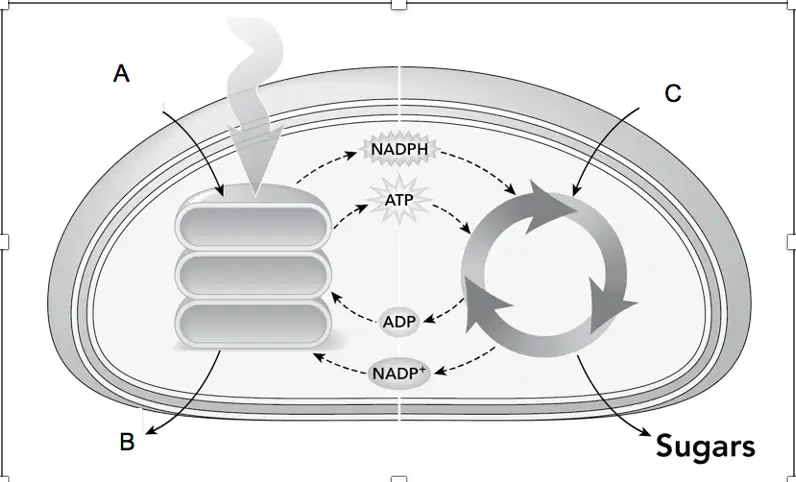
This diagram shows the relationship between the light dependent and light independent reactions of photosynthesis Where should water be included in this diagram?
a)
Reactant A
b)
Product B
c)
Reactant C
d)
Water is not involved in photosynthesis, and should not be included in the diagram
9.
Chlorophyll is a type of
a)
nucleotide
b)
hormone
c)
pigment
d)
carbohydrate
10.
During photosynthesis, cells capture sunlight using_____________, which is a type of _________________
a)
Thylakoids, Nucleotide
b)
Stroma, Carbohydrate
c)
NADPH, Hormone
d)
Chlorophyll, Pigment
11.
Photosynthesis relies on a compound called _____________ which is an electron _______________ that accepts and transfers high energy electrons
a)
ATP Synthase, Donor
b)
NADP+, Carrier
c)
Glucose, Sink
d)
DNA, Source
12.
Cells use a molecule called _________________ to store and release energy like a battery.
a)
ATP
b)
DNA
c)
RNA
d)
NADH
13.
Which of these in an out-put of the light independent stage of photosynthesis
a)
Sugars
b)
ATP
c)
Oxygen
d)
Carbon
14.
Which type of cells in a plant leaf contain a large number of chloroplasts, making them the primary site of photosynthesis?
a)
Epidemrnal cells
b)
Cuticle cells
c)
Mesophyll cells
d)
Vascular cells
e)
Stomata cells
15.
The energy in ATP is stored in chemical bonds between ___________ groups of the molecule, and the energy is released when the bonds are broken
a)
nucleotide
b)
sugar
c)
ribose
d)
phosphate
16.
What is ATP often referred to as in biology?
a)
The cell's structural unit
b)
The cell's genetic blueprint
c)
The cell's energy currency
d)
The cell's waste product
17.
Which of the following is NOT a cellular process that requires ATP?
a)
Passive transport
b)
Muscle contraction
c)
Cell signaling
d)
Active transport
18.
What category of biomolecules does ATP belong to?
a)
nucleic acids
b)
carbohydrates
c)
lipids
d)
proteins
19.
What are the three main components of an ATP molecule?
a)
Nitrogenous base, sugar, three phosphate groups
b)
Amino acid, fatty acid, glycerol
c)
Glucose, fructose, galactose
d)
Peptide bond, sulfide bridge, beta sheet
20.
Which of the following processes can be used by cells to generate ATP?
a)
Aerobic Respiration
b)
Anaerobic Respiration
c)
Fermentation
d)
All of the above
21.
How do plants primarily obtain the glucose needed to produce ATP through cellular respiration?
a)
Through photosynthesis
b)
By consuming other organisms
c)
By absorbing sunlight
d)
From atmospheric oxygen
e)
From soil based bacteria
22.
Which of the following organisms relies on cellular respiration to produce ATP from consumed glucose?
a)
Plants
b)
Animals
c)
Bacteria
d)
All of the above
23.
Why is the bond between the second and third phosphate groups in ATP significant for its function?
a)
It is an extremely strong bond that stores a lot of energy.
b)
It makes the ATP molecule extremely stable
c)
It contributes to the ATP molecule being unstable, leading to energy release.
d)
It allows ATP to easily bind to molecules like DNA
24.
What is the product when ATP is hydrolyzed and loses one phosphate group?
a)
ADP
b)
AMP
c)
Glucose
d)
Water
25.
Which molecule is MORE stable
a)
ATP
b)
ADP
c)
both are equally stable
26.
Plants do photosynthesis, but NOT cellular respiration
a)
True
b)
False
27.
Question Image

Match the letter in the diagram to its correct label.

a)

A

1.

Sunlight

b)

B

2.

Carbon Dioxide

c)

C

3.

Glucose

d)

D

4.

Water

e)

E

5.

Oxygen

28.

Select the organelle that performs photosynthesis.

29.

Process X represents ​ (a)   which occurs in the ​ (b)   . Process Y represents ​ (c)   which occurs in the ​ (d)   . Do both plant and animals cells complete cellular respiration? ​ (e)  

Choose from the below words
photosynthesis
chloroplast
cellular respiration
mitochondria
Yes, they do.
No, they do not.
30.

Label the following cellular processes and equations.

31.
Question Image

Match the following in the diagram

a)

B

1.

water

b)

C

2.

carbon dioxide

c)

K

3.

oxygen

d)

L

4.

sugar

32.

Click the location of the Light Reaction (look at your notes or the diagram you drew of the chloroplast)

33.

Chemical found in plants that reflect or absorb light.

a)

pigment

b)

chlorophyll

c)

thylakoid

d)

stroma

34.

During photosynthesis, which molecule acts as the main source of electrons for the light-dependent reactions?

a)

Oxygen

b)

Water

c)

Carbon dioxide

d)

Glucose

35.

Which of the following best describes the role of NADPH in photosynthesis?

a)

It breaks down glucose

b)

It stores genetic information

c)

It transports oxygen

d)

It carries high-energy electrons

36.

Which molecule is directly responsible for capturing light energy during photosynthesis?

a)

NADPH

b)

Chlorophyll

c)

Glucose

d)

ATP

37.

What is the main purpose of the light-dependent reactions in photosynthesis?

a)

To generate ATP and NADPH

b)

To produce glucose

c)

To release carbon dioxide

d)

To absorb water

38.

Which structure within the chloroplast is the site of the Calvin cycle?

a)

Stroma

b)

Outer membrane

c)

Thylakoid membrane

d)

Granum

39.

Label the following parts of the Light Independent Reaction (Calvin Cycle) of Photosynthesis: