
 Worksheets
Circular Motion & Universal Gravitation
Total questions: 35
Worksheet time: 33mins
The Alpha Centauri system is the closest star system to Earth and contains two primary stars, Alpha Centauri A (1.1 x 1030 kg) and Alpha Centauri B (0.91 x 1030 kg), orbiting each other. The two stars are 3.5 x 10¹² m apart. What are the gravitational forces between them?
4.18 x 10²² N
5.35 x 1024 N
2.50 x 10¹⁹ N
6.77 x 10²¹ N
Jupiter is the largest plant at 1.9 x 1027 kg and has almost 100 moons. One of its largest moons is Io at 8.93 x10²² kg. The distance between Jupiter and it's moon is 4.217 x 10⁸ m. What are the gravitational forces between them?
2.93 x 1030 N
1.13 x 10¹⁵ N
5.5 x 10¹³ N
6.4 x 10²² N

Calculate the force of attraction between Jupiter and Saturn. Jupiter has a mass of 1.898 x 1027 kg and Saturn has a mass of 5.683 x 1026 kg. The approximate distance between them is 7.786 x 10¹¹ m.
1.187 x 10²⁰
9.876 x 10¹⁹ N
2.345 x 10²⁰ N
3.786 x 10²⁰ N
Doubling the mass of an object...
...will double the force of gravity.
...will half the force of gravity.
...will quadruple the force of gravity.
...will quarter the force of gravity.
Halving the distance between two objects...
...will double the force of gravity.
...will half the force of gravity.
...will quadruple the force of gravity.
...will quarter the force of gravity.
Doubling the distance between two objects...
...will double the force of gravity.
...will half the force of gravity.
...will quadruple the force of gravity.
...will quarter the force of gravity.

How is the gravitational force between to objects related to their distance (radius apart)
They are directly proportional
They are inversely proportional
They do not affect each other
They are equal
How is the gravitational force between to objects related to their mass
They are directly proportional
They are inversely proportional
They do not affect each other
They are equal
As the distance between objects increases...
The smaller the force of gravity.
The larger the force of gravity.
Mass has no effect on the amount of gravity an object experiences.
The larger the mass of an object...
The smaller the force of gravity.
The larger the force of gravity.
Mass has no effect on the amount of gravity an object experiences.

The gravitational force between the two spheres is 40N.
Scenario: The distance between the two masses is then halved. What will the magnitude of the new force be when this happens.
20 N
40 N
80 N
160 N
Find the distance between two objects whose masses are m1 = 4,500 kg, and m2 = 8,700 kg; if the gravitational force between them is F = 2.0 x 10⁻⁸ N.
130565.25 m
361.34 m
0.19575 m
0.783 m
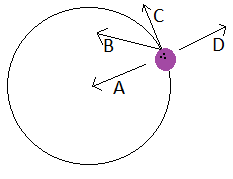
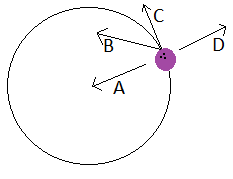

moving or tending to move toward a center...
centripetal force
centrifugal force
Tangent
Curvature
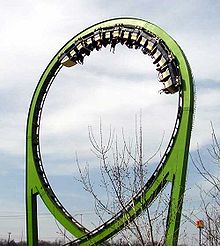

Suppose the speed of the car is 11.1 m/s (≈ 25 mph) and the radius of curvature (r) is 25 m; determine the magnitude of the centripetal force of the car if its mass is 1200kg.
533 N
5914 N
6056 N
12000 N
ω
tangential velocity
centripetal acceleration
period
angular velocity
walrus
Units on Angular velocity
rpm
rad/sec
rev/sec
s2m
30 seconds for 6 spins. Period = ___________
30 sec
0.2 sec
5 sec
6 sec
A rider on a Carousel is 2 meters from the center. The ride is spinning at 0.5 rad/sec. What is the tangential velocity of the ride?
4 m/s
1 m/s
2 m/s
0.5 m/s
A dog sits 1.5 m from the center of a spinning merry-go-round. The magnitude of the velocity is 1.5 m/s.
What is the magnitude of the dog’s centripetal acceleration?
3.9 m/s^2
2.8 m/s^2
1.5 m/s^2
11.5 m/s^2
What is the tangential velocity if the centripetal force is 150 N when a 3 kg toy plane flies in a 2 m radius circle?
10 m/s
100 m/s
225 m/s
15 m/s
What would the force between them be if the distance between them were doubled?

