
 Worksheets
chemistry revision
Total questions: 219
Worksheet time: 5hrs 33mins
Nitrogen, N, will form which of the following ions?
N
N-3
N-5
N+5
What will be the charge of a bromine ion?
+7
-7
-1
+1

Ionic bonding is between a
nonmetal and nonmetal
metal and nonmetal
metal and metal
Depends on the situation
Covalent bonding is between a
nonmetal and nonmetal
metal and nonmetal
metal and metal
It depends on the situation
How many different elements are in the C6H12O6
3
6
12
24


What is a covalent bond?
A bond between atoms where electrons are shared.
A bond between atoms where one atom gains an electron and another loses an electron.
A bond where electrons dance in a 123 pattern.
A bond between two atoms where they send each other special BFF messages.

Hydrogen atoms come together to form a _________________
Dancing bear
Hydrogen molecule
Carina molecule
Artemis molecule
An atom with 1 valence electron 'needs' a full shell, so it can either gain 7 electrons or lose 1. Which is more likely to occur?
lose 1 electron
gain 7 electrons
What two types of atoms make a covalent bond?
metal atom and metal atom
metal atom and non metal non atom
non metal atom and non metal atom
When an atom loses an electron, it becomes a _________.
noble gas
anion
cation
How many valence electrons does hydrogen have?
1
2
3
4
Low melting point and low solubility in water are general properties of ______________________ compounds
ionic
covalent
all
Where are the non-metals located on the periodic table?
all over
On the left side of the "staircase"
On the right side of the "staircase"
Which of the following describe ionic bonding?
It involves the transfer of electrons
It involves sharing of electrons.
It involves transfer of protons.
It involves sharing of protons.
From the periodic table, which pair of elements can combine to form ionic bonds?
Ca and O
H and N
H and Cl
Xe and Fe
Bond that is formed when electrons are equally shared.
non polar covalent bond
polar covalent bond
ionic bond
metallic bond
Which of the following pairs of atoms is most likely to form a covalent compound?
Ba and Cl
Na and O
Mg and Br
C and O
What is the chemical formula of Sulfur Hexafluoride?
S6F
S6F6
SF6
6SF
Which of the following is a correct lewis structure for carbon dioxide CO2?


7. Covalent compounds:
Share electrons
Transfer electrons
Neither
8. What happens when an atom loses an electron?
Neutral (no charge)
Positive Charge
Negative Charge
9. What happens when an atom gains an electron?
Neutral (no charge)
Positive Charge
Negative Charge
12. What elements generally make an ionic bond?
metal and nonmetal
2 or more nonmetals
metal
none of the above

What is a non-polar covalent bond?
transfer of electrons
is a bond where electrons are shifted to the more electronegative atom
Sea of electrons
is a bond where electrons are shared equally
As you look down a group, electronegativity
increases
decreases
As you look from left to right across a period, electronegativity
increases
decreases

Which element has the greater ionization energy?
Magnesium (Mg)
Phosphorus (P)

Which element has the greater ionization energy?
Iodine (I)
Chlorine (Cl)
H or F?


How many PROTONS does Silicon have?
14
28
42

Which of the following elements is most likely to have similar properties to those of sodium (Na)?
Magnesium (Mg)
Sulfur (S)
Francium (Fr)
Titanium (Ti)

In which group would an element that is not reactive most likely be located?
1
2
16
18

In which group would an element that is very reactive most likely be located?
1
5
15
18

Which of the following will have a higher electronegativity than arsenic (As)?
Carbon (C)
Neon (Ne)
Antimony (Sb)
Germanium (Ge)
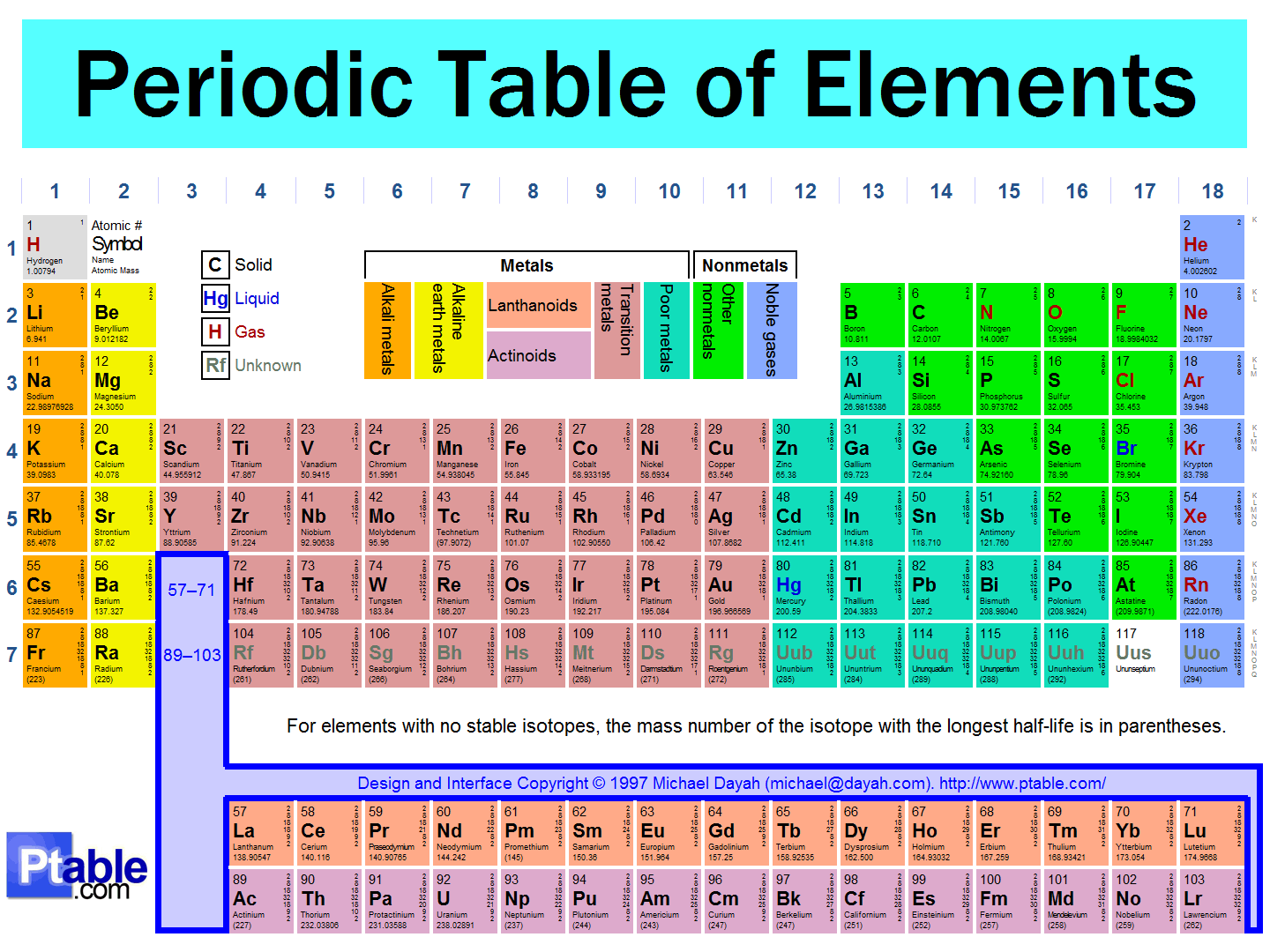
The vertical (up and down) columns in the Periodic Table are called
groups
towers
periods
atomic numbers
What happens to the atomic numbers as you move from left to right on the periodic table?
Increase
Decrease
Stay the same
Nothing
Which of the following elements is most likely to have similar properties to those of sodium (Na)?
Magnesium (Mg)
Sulfur (S)
Francium (Fr)
Titanium (Ti)
Which element is most likely to have six valence electrons?
Barium (Ba)
Carbon (C)
Oxygen (O)
Americium (Am)
Which element is located in period 4 and group 5?
Vanadium (V)
Zirconium (Zr)
Niobium (Nb)
Titanium (Ti)
In which group would an element that is very reactive most likely be located?
1
5
15
18


Group 3 elements have ____ electrons in their outermost shell.
1
2
3
4
The valence electrons of an atom do not experience the full attractive force of protons in the atom’s nucleus due to the presence of inner core electrons. The reduction in nuclear charge experienced by valence electrons due to inner core electrons is called the
ionization energy effect.
nuclear charge effect.
periodic law effect.
shielding effect.
Which of the following correctly completes the statement:
Cations are always _____ than the parent atom and anions are always _____ than the parent atom.
smaller; smaller
larger; smaller
smaller; larger
larger; larger
Which characteristic is not a periodic trend?
atomic radius
electron affinity
ionization energies
number of elements in a group
Which pair of words correctly completes the statement?
Alkali metals are highly ___ since they ___ easily to form ions.
nonreactive; lose 1 electron
nonreactive; lose 2 electrons
reactive; lose 1 electron
reactive; gain 1 electron
In the periodic table hydrogen is placed in Group 1A and helium is placed in Group 8A. The most likely reason for this is:
Hydrogen has one outer shell electron and helium has a full outer shell of electrons.
Hydrogen has one outer shell electron and helium has 8 electrons in its outer shell.
Hydrogen and helium are both metals.
Hydrogen and helium are both gases.
The metallic character of elements _____ across a period. Metals are good conductors of ______.
increases; electricity
decreases; heat
decreases; metalloids
remains the same; luster
Which of the following correctly completes the statement:
Cations are always _____ than the parent atom and anions are always _____ than the parent atom.
smaller; smaller
larger; smaller
smaller; larger
larger; larger
Based on their definitions, electron affinity could be considered the opposite of
shielding effect.
ionization energy.
nonmetallic character.
effective nuclear charge.
Which arrangement of the following Period 5 elements, from left to right, orders them with respect to their atomic size, from smallest to largest?
Rb; Sr; In; Sb; Te
In; Rb; Sb; Sr; Te
Te; Sb; In; Sr; Rb
In; Sb; Te; Rb; Sr
Which pair of words correctly completes the statement?
Alkali metals are highly ___ since they ___ easily to form ions.
nonreactive; lose 1 electron
nonreactive; lose 2 electrons
reactive; lose 1 electron
reactive; gain 1 electron
Select the element most likely to gain an electron
Bromine
Fluorine
Chlorine
Iodine
Select the element with the largest atomic radius
Potassium
Scandium
Gallium
Arsenic
Select the sequence that correctly orders from smallest to largest atomic radius
Sn, Y, Ru
Cu, Ga, Br
Al, S, Na
F, N, Li
Select the group that is the most reactive metals
Transition Metals
Alkali Earth Metals
Alkali Metals
Halogens
Select the element Alkali Earth Metal found in Period 4
Calcium
Potassium
Titantium
Krypton
Select the element with the largest atomic radius
Cesium
Lithium
Hydrogen
Potassium
Select the element with the highest electronegativity
Chlorine
Silicon
Argon
Magnesium
Select the element that is a nonmetal
Copper
Lead
Hydrogen
Sodium
What element is found in Group 5 period 4?
Zirconium
Magnesium
Strontium
Vanadium
Select all elements that are metals
Thallium
Hydrogen
Sulfur
Argon
Chromium
Select the element with the lowest ionization energy.
Barium
Beryllium
Magnesium
Strontium
What group contains elements with 7 valence electrons
Noble Gasses
Alkali Earth Metals
Halogens
Transition Metals
Which element is most likely to lose an electron?
Zinc
Arsenic
Bromine
Potassium
The periodic table is arranged by ______
Atomic Mass
Number of Electrons
Atomic Number
Atomic Weight
The period number of an element corresponds to...
The number of electrons
The number of valence electrons
The number of energy levels
The number of protons
The term valence electron refers to…
The total number of electrons in an atom
The electrons in the first energy level
The electrons in the outermost energy level
Electrons that are found in the nucleus
The group number of an element corresponds to...
The number of electrons
The number of valence electrons
The number of energy levels
The number of protons
Elements in Group 6 of the periodic table would have how many valence electrons?
2
6
8
Unable to tell from the given information
Elements located in groups 7 & 8 tend to be classified as ________________
Non-Metals
Metalloids
Metals
Noble Gases
Use the picture at right to answer the question. Given the Lewis Dot structure, which of the following elements could the unknown (X) represent?
B
C
K
Ca
Which element is located in Group 3, Period 2?
Magnesium
Lithium
Helium
Boron
What is the correct electron configuration for the element Oxygen?
1s2 1p4
1s22s2 2p4
1s22s2 2p6
1s22s2 2p6
Which element has the electron configuration 6s1 ?
Rb
Tl
He
Cs
Which element will have the largest atomic radius?
Ne
Li
Cs
Rn
Which element will have the smallest ionization energy?
Ne
Li
Cs
Rn
How many dots will be needed when drawing the Lewis dot diagram for the element carbon?
6
4
2
Like, a ton, dude.
What happens to the atomic numbers as you move from left to right on the periodic table?
Increase
Decrease
Stay the same
Nothing
Which of the following elements is most likely to have similar properties to those of sodium (Na)?
Magnesium (Mg)
Sulfur (S)
Francium (Fr)
Titanium (Ti)
If an element has 117 protons which group will it be in on the periodic table?
1
7
11
17
Which element is located in group 3?
Yttrium (Y)
Carbon (C)
Sodium (Na)
Lithium (Li)
Which element is located in period 4?
Zirconium (Zr)
Silicon (Si)
Beryllium (Be)
Iron (Fe)
Which element is most likely to have six valence electrons?
Barium (Ba)
Carbon (C)
Oxygen (O)
Americium (Am)
Which element is most likely to have three electron energy levels?
Argon (Ar)
Lithium (Li)
Boron (B)
Europium (Eu)
Which element is most likely to have six electrons in its 4th energy level?
Oxygen (O)
Selenium (Se)
Krypton (Kr)
Potassium (K)
In which group would an element that is not reactive most likely be located?
1
2
16
18
In which group would an element that is a gas most likely be located?
1
3
12
18
Which of the following elements is most likely a poor conductor of electricity?
Beryllium (Be)
Gold (Au)
Phosphorus (P)
Copper (Cu)
What is the atomic mass of an element with 16 protons, 13 neutrons, and 16 electrons?
13 amu
16 amu
29 amu
45 amu
How many neutrons are located in the nucleus of an atom that has 12 protons, 12 electrons, and an atomic mass of 28 amu?
12
16
28
40
The distance between nucleus and outermost shell occupied electron
Atomic Radii
Ionization Energy
Electronegativity
Electron Afinity
Oxidation Number
The energy it takes to remove one electron from an atom
Atomic Radii
Ionization Energy
Electronegativity
Electron Afinity
Oxidation Number
The tendency of an atom to attract a shared pair of electrons
Atomic Radii
Ionization Energy
Electronegativity
Electron Afinity
Oxidation Number
The amount of energy released when an electron is added to a neutral atom to form a negative ion
Atomic Radii
Ionization Energy
Electronegativity
Electron Afinity
Oxidation Number
The degree of oxidation (loss of electrons) of an atom in a chemical compound
Atomic Radii
Ionization Energy
Electronegativity
Electron Afinity
Oxidation Number
Which element has higher ionization energy?
Chlorine is higher than Sodium
Phosphorus is higher than Nitrogen
Silicon is higher than Carbon
Magnesium is higher than Aluminium
Which element has lower ionization energy?
Chlorine is lower than Sodium
Phosphorus is lower than Nitrogen
Carbon is lower than Silicon
Aluminium is lower than Magnesium
Which element has higher electron affinity?
Bromine is higher than Calsium
Chlorine is higher than Fluorine
Magnesium is higher than Beryllium
Sodium is higher than Aluminium
Which element has lower electron affinity?
Bromine is lower than Calsium
Chlorine is lower than Fluorine
Berylliumis lower than Magnesium
Aluminium is lower than Sodium
Which element is more metallic?
Sodium is more metallic than Aluminium
Fluorine is more metallic than Beryllium
Potassium is more metallic than Lithium
Chlorine is more metallic than Silicon
Which element is less metallic?
Sodium is less metallic than Aluminium
Beryllium is less metallic than Fluorine
Lithium is less metallic than Potassium
Chlorine is less metallic than Silicon

Metals
Nonmetals
Metalloids
Solids

How many NEUTRONS does an atom of Chlorine have?
17
18
19
35
Where on the periodic table can nonmetals be found?
Top
Bottom
Left
Right
Select the element Alkali Earth Metal found in Period 4
Calcium
Potassium
Titantium
Krypton
Select the element that is a metalloid
Gallium
Boron
Oxygen
Magnesium
Select the element that has 3 valence electrons
Calcium
Sodium
Aluminum
Sulfur
Select the element that is a nonmetal
Copper
Lead
Hydrogen
Sodium
What group contains elements with 7 valence electrons
Noble Gasses
Alkali Earth Metals
Halogens
Transition Metals
Definition of ionization energy is
The energy required to remove an electron
The energy required to add an electron
The ability to attract an electron
The distance from the nucleus to the outermost electron
Which of the following elements will most likely form cations?
Oxygen
Iodine
Magnesium
Sulfur
Which of the following scientist is credited arranging the periodic table according to Atomic Mass?
Mendeleev
Dalton
Ramsay
Seaborg
According to the Octet Rule, to achieve stability atoms attempt to fill the outer S and P orbitals. How many electrons are required to accomplish this?
2
4
6
8
Which of the following Groups on the Periodic Table has the lowest Electronegativity?
Group 1
Group 2
Group 16
Group 17
N or C?
Rank the following in order of increasing reactivity: Ge, K, Br, Ca (lowest to highest reactivity)
Ge, K, Br, Ca
K, Br, Ge, Ca
Br, Ge, Ca, K
Br, Ca, Ge, K
The metals are located
to the left of the stair step.
to the right of the stair step.
on and around the stair step.
The metalloids are located
to the left of the stair step.
to the right of the stair step.
on and around the stair step.
Metals are MOSTLY _____ at room temperature.
solid
liquid
gas
Nonmetals are MOSTLY _____ at room temperature.
solid
liquid
gas
Which of the following is a metal?
Calcium (Ca)
Neon (Ne)
Oxygen (O)
Sulfur (S)
Chlorine is what state of matter?
solid
liquid
gas
Nitrogen is a
metal.
nonmetal.
metalloid.
Most noble gases have _______ valence electrons.
1
2
7
8
Rank the following in order of increasing reactivity: Ge, K, Br, Ca (lowest to highest reactivity)
Ge, K, Br, Ca
K, Br, Ge, Ca
Br, Ge, Ca, K
Br, Ca, Ge, K
Group 2 on the Periodic Table contains the _____________________________. The oxidation number of these elements is _________________.
alkali metals, -2
alkaline earth metals, +2
halogens, +1
noble gases, -3
The statement that an electron occupies the lowest available energy orbital is
Hund's Rule
AUfbau principle
Bohr's law
The Pauli Exclusion principle
Which of the following rules requires that each of the p orbitals at a particular energy level receive one electron before any of them can have two electrons?
the Pauli exclusion principle
Aufbau principle
Hund's rule
The quantum rule
The atomic sublevel with the next highest energy after 4p is
4d
4f
5s
5p
In the electron configuration for scandium (atomic number 21), what is the notation for the three highest-energy electrons?
4s2, 3d1
3d3
4s3
4s2 4p1
What charge do electrons have?
Positive
Neutral
Negative
Which two particles are contained in the nucleus of an atom?
Protons and Neutrons
Protons and Electrons
Electrons and Neutrons

The electronic configuration of 17Cl is
2,8,8,1
2,8,6
2,8,8
2,8,7
Which of the following is the electronic Configuration of Sodium 11Na
2,8
2,8,1
2,1,8
8,1,2
Which one of the following does not represent the electronic configuration of an atom in its ground state?
1s2 2s2 2p3
1s2 2s2 2p4
1s2 2s2 2p6 3s1
1s2 2s2 2p6 3d1
Which one of the following is the electronic structure of a metal with a maximum oxidation state of +3?
1s2 2s2 2p6 3s1
1s2 2s2 2p6 3s2 3p4
1s2 2s2 2p6 3s2 3p1
1s2 2s2 2p6 3s2 3p6 3d10 4s2
The vanadium atom (atomic number 23) in its ground state has the electronic configuration:
1s2 2s2 2p6 3s2 3p6 3d3 4s2
1s2 2s2 2p6 3s2 3p6 3d2 4s3
1s2 2s2 2p6 3s2 3p6 3d1 4s2 4p2
1s2 2s2 2p6 3s2 3p6 3d2 4s2 4p1
The electron configuration of an atom is 1s22s22p6 The number of electrons in the atom is
3
5
6
10

Identify the rule that is being violated
Aufbau's Principle
Pauli's Exclusion Principle
Hund's Rule
Heisenberg uncertainty principle

All orbitals of equal energy (degenerate orbitals) are occupied by one electron before any single orbital is occupied by a second electron.
Aufbau Principle
Hund’s Rule
Pauli's Exclusion Principle
Core Notation

Which electron configuration belongs to Chlorine (Cl)?
1s22s22p63p5
1s22s22p63s23p7
1s22s22p63s23p6
1s22s22p63s13p7
What atom matches this electron configuration?
Zinc
Nickel
Copper
Germanium

Identify the rule that is being violated
Aufbau's Principle
Hund's Rule
Pauli's Exclusion Principle
Heisenberg uncertainty principle

What is incorrect about this orbital diagram?
Both arrows in the filled 2p box should be pointing the same direction
There is nothing incorrect with this diagram
In the there should only be 1 arrow in the first 2p box and one in the 2nd 2p box
All the arrows should be pointing the same direction.

Which rule is violated in the following orbital diagrams?
Hund's Rule
Aufbau Principle
Pauli's Exclusion Principle

Which rule is violated in the following orbital diagrams?
Aufbau Principle
Hund's Rule
Pauli's Exclusion Principle
Chemists can identify the composition of some unknown salts by conducting a flame test. When potassium salts are heated in a flame, a purple color is observed.
This is due to the movement of electrons between energy levels. What is the electron configuration of a potassium atom at ground state?
1s2; 2s2; 2p6; 3s2; 3p6; 4d1
1s2; 2s2; 2p6; 3s2;3p6; 3d1
1s2; 2s2; 2d6; 3s2; 3d6; 4s1
1s2; 2s2; 2p6; 3s2; 3p6; 4s1
1s22s22p63s23p64s23d10
Which one of the following is the electronic configuration of the bromine atom?
1s22s22p63s23p63d104s14p6
1s22s22p63s23p63d104s24p7
1s22s22p63s23p63d104s24p5
1s22s22p63s23p63d104s24p6
The vanadium atom (atomic number 23) in its ground state has the electronic configuration:
1s2 2s2 2p6 3s2 3p6 3d3 4s2
1s2 2s2 2p6 3s2 3p6 3d2 4s3
1s2 2s2 2p6 3s2 3p6 3d1 4s2 4p2
1s2 2s2 2p6 3s2 3p6 3d2 4s2 4p1
An atom with a charge of 2- will have...
2 more electrons than protons
2 more neutrons than electrons
2 more protons than electrons
2 electrons less than protons
Electronic configuration of boron
1s2 3s2 2p1
1s2 2s2 2p1
1s2 2s5 2p1
1s1 2s2 2p2
Electronic configuration of Neon
1s1 2s2 2p7
2s2 2p2 2p6
1s4 2s4 2p2
1s2 2s2 2p6
Which one of the following is the electronic configuration of the bromine ?
A. [Ar]4s23d104p5
B. 1s22s22p63s23p5
C. 1s22s22p63s23p64s24p5
D. [Ar]3s23d103p5
What is the electron configuration of a copper atom?
A. 1s22s22p63s23p63d9
B. 1s22s22p63s23p64s13d10
C. 1s22s22p63s23p64s23d9
D. 1s22s22p63s23p64s23d10
Which of the following is the electronic configuration for Mg2+ ion?
1s2 2s2 2p6
1s2 2s2 2p6 3s2 3p6
1s2 2s2 2p6 3s2 3p2
1s2 2s2 2p6 3s2
Which one of the following contains no unpaired electrons in the ground state?
Be
F
Si
N
What is the electron configuration of a copper atom (Z= 29)?
A. 1s22s22p63s23p63d9
B. 1s22s22p63s23p64s13d10
C. 1s22s22p63s23p64s23d9
D. 1s22s22p63s23p64s23d10
Which of the following is the electronic configuration for Mg2+ ion? (Z=12)
1s2 2s2 2p6
1s2 2s2 2p6 3s2 3p6
1s2 2s2 2p6 3s2 3p2
1s2 2s2 2p6 3s2