
 Worksheets
Earth's Uniqueness and Geological History
Total questions: 20
Worksheet time: 10mins
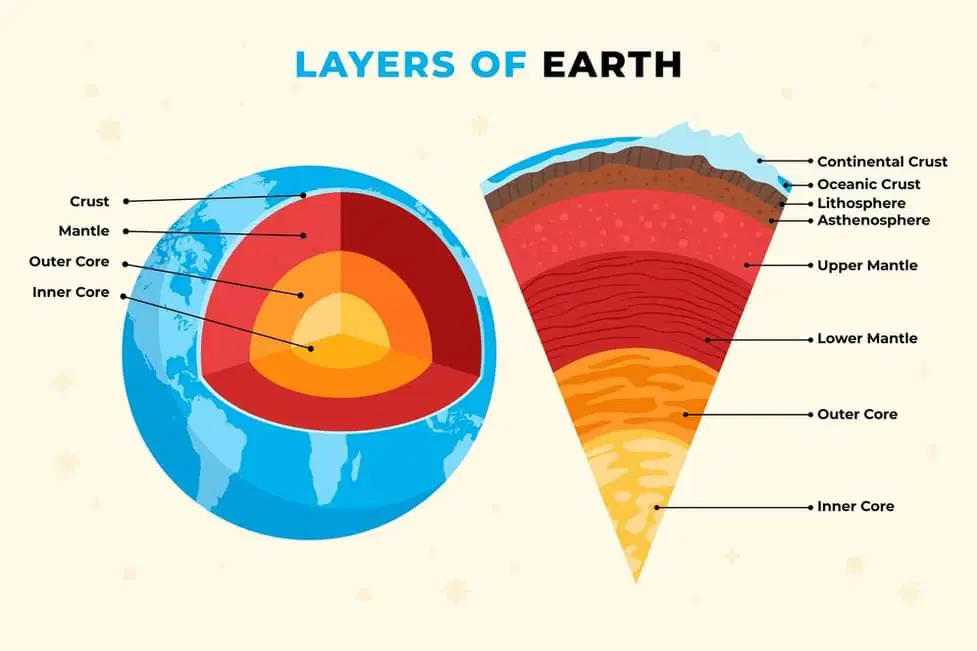
Which layer of the Earth has the highest temperature?
Crust
Mantle
Outer Core
Inner Core

Earth is called a habitable planet because…
It has no gravity
Its distance from the Sun is suitable for life
It has rings like Saturn
It has no atmosphere
According to geology, how many major eras/epochs is the development of the Earth divided into in this material?
Three
Four
Five
Six
What is the correct order of the four geological epochs introduced in this material, from oldest to youngest?
Mesozoic → Paleozoic → Neozoic → Archeozoic
Archeozoic → Paleozoic → Mesozoic → Neozoic
Neozoic → Mesozoic → Paleozoic → Archeozoic
Paleozoic → Archeozoic → Neozoic → Mesozoic
During the Archeozoic Era, a major event that began to occur was the formation of the Earth's crust. Which statement accurately describes one of the characteristics of this era?
The emergence of dinosaurs on land
The beginning of the formation of the Earth's crust
The complete formation of modern continents
The largest mass extinction
The time range of the Archeozoic Era in this material is…
4.5–2.5 billion years ago
450–250 million years ago
4.5–2.5 million years ago
45–25 million years ago
Which of the following is part of the process of forming the Earth's water and air systems that began during the Archeozoic Era?
Lithosphere and biosphere
Hydrosphere and atmosphere
Magnetosphere and ionosphere
Asthenosphere and mesosphere
The image shows stromatolites associated with cyanobacteria. What is the most logical strategic conclusion about early life in the ocean during the Archeozoic Era?
Early life was dominated by large vertebrate organisms
Early life consisted of photosynthetic microorganisms that formed layered structures
Early life only consisted of terrestrial plants
Early life did not affect the composition of the atmosphere
During the Paleozoic Era, the time span that occurred is approximately...
590–250 million years ago
700–400 million years ago
250–65 million years ago
100–10 million years ago
During the Cambrian period, an important event that occurred was...
The emergence of large vertebrate dinosaurs
The appearance of shelled invertebrate animals and life continuing in Gondwana
The migration of ancient humans to other continents
The emergence of modern flowering plants
Which period is marked by the emergence of jawless fish and several types of vertebrates?
Silur
Ordovician
Devonian
Permian
During the Silurian period, an important change that occurred was...
The emergence of the first mammals
The transition of life from water to land, as well as the emergence of ferns, scorpions, and mountains
The mass extinction of reptiles
The dominance of flowering plants
Which of the following best describes the development during the Devonian period?
Development of various types of fish and land plants
Appearance of modern birds
Increase in the number of mammals
Appearance of modern humans
During the Carboniferous period, the groups of animals that appeared include...
Birds and small mammals
Reptiles, giant insects, and amphibians
Jawless fish and jellyfish
Dinosaurs and pterosaurs
The Permian period is marked by...
Mass extinction of dinosaurs
Increase in the number of reptiles, insects, and the emergence of coniferous plants
Appearance of early humans and stone tools
Dominance of grass in vast grasslands

Determine the correct chronological order from beginning to end for the following Paleozoic events: (1) transition from water to land, (2) emergence of shelled invertebrates, (3) development of fish and land plants, (4) increase of reptiles and emergence of conifers.
(2) → (1) → (3) → (4)
(1) → (2) → (3) → (4)
(2) → (3) → (1) → (4)
(3) → (2) → (1) → (4)
During the Mesozoic Era, which stage is marked by the emergence of dinosaurs, marine reptiles, and large turtles?
Triassic
Jurassic
Cretaceous
Tertiary
Quaternary
The correct statement about the Jura stage in the Mesozoic Period is...
End of the life of giant animals
Reptiles thrived and large dinosaurs dominated the land
Emergence of signs of human life
The extinction of dinosaurs began
Appearance of modern mammals
The Neozoic era includes the Tertiary and Quaternary periods. The main change that marks the beginning of the Tertiary is...
Dominance of dinosaurs on land
Extinction of dinosaurs and the rise of mammals
Appearance of large marine reptiles
Formation of modern continents
Appearance of flowering plants
Why is the Quaternary considered the most important age for the emergence of human activity?
Because dinosaurs reached the peak of dominance
Because mammals first appeared
Because there are signs of human life and its activities developed
Because marine reptiles dominated the oceans
Because of the end of giant animal life

