
NEW
Font size
 Worksheets
Prejudice - Module 2D Lesson 10
Total questions: 28
Worksheet time: 14mins
What is the meaning of the Arabic word 'حُسْن' (Husn)?
good
bad
light
book
What is the meaning of the Arabic word 'سُوء' (Su')?
bad
good
light
friend
What is the meaning of the Arabic word 'ظَنّ' (Dhann)?
suspicion; assumption
happiness; joy
strength; power
patience; endurance
What is the definition of 'prejudice' as described in the passage?
A fair and reasoned opinion based on facts
A preconceived opinion not based on reason or actual experience
A positive attitude towards everyone
A legal judgment in court
According to the passage, what is an example of prejudice?
A person might come across a proud rich man and start believing that all rich people are proud, or a person may have a bad experience with someone from a particular culture and start believing that everyone from that culture is bad.
A person helps someone in need without expecting anything in return.
A person studies hard to achieve good grades in school.
A person enjoys learning about different cultures and traditions.
The effects of prejudice are dangerous and can last a long time if not controlled.
True
False
What does Islam teach about being prejudiced against others?
Islam teaches us not to be prejudiced against others and to always give people the benefit of the doubt.
Islam encourages us to judge others quickly based on appearances.
Islam teaches us to only trust people from our own community.
Islam allows us to be prejudiced if we feel threatened.
Fill in the blank: Husn adh-dhann means to think ________ and well of others, and su’ adh-dhann means to think ________ and suspiciously of others.
positively; negatively
negatively; positively
selfishly; kindly
carelessly; attentively
According to Imam Ja‘far as-Sadiq (a), what happens when a believer accuses his brother?
Faith in his heart is dissolved in the same way that salt is dissolved in water.
He is rewarded for his honesty.
He is forgiven immediately.
He gains respect among people.

The image at the bottom of the page showing hands holding paper cutouts of people conveys which message in relation to the passage?
It represents unity and togetherness.
It shows the importance of money.
It highlights technological advancement.
It depicts competition among people.
What did the potatoes in the game represent?
The children’s favorite foods
The people the children loved
The people the children hated
The teacher’s instructions
Read the passage below and answer the question: A nursery teacher decided to let her class play a game. She asked each child to bring in a plastic bag containing boiled potatoes, with each potato named after a person the child hates. The children had to carry the bag everywhere for a week. At the end, the teacher explained that the bad smell and burden of the potatoes represented the burden of hatred in one's heart. Why did the children start to complain during the week?
The potatoes were too heavy
The potatoes started to rot and smell bad
They wanted more potatoes
The teacher was strict
Fill in the blank: The teacher used the game to teach the children that carrying hatred in your heart is like carrying around _________.
rotten potatoes
a bag of gold
fresh flowers
a soft pillow
The main lesson the teacher wanted the children to learn from this activity is:
The importance of teamwork and cooperation.
How to memorize facts quickly.
The value of working alone.
How to win at any cost.
Read the passage below and answer the question: A nursery teacher decided to let her class play a game. She asked each child to bring in a plastic bag containing boiled potatoes, with each potato named after a person the child hates. The children had to carry the bag everywhere for a week. At the end, the teacher explained that the bad smell and burden of the potatoes represented the burden of hatred in one's heart.
True
False
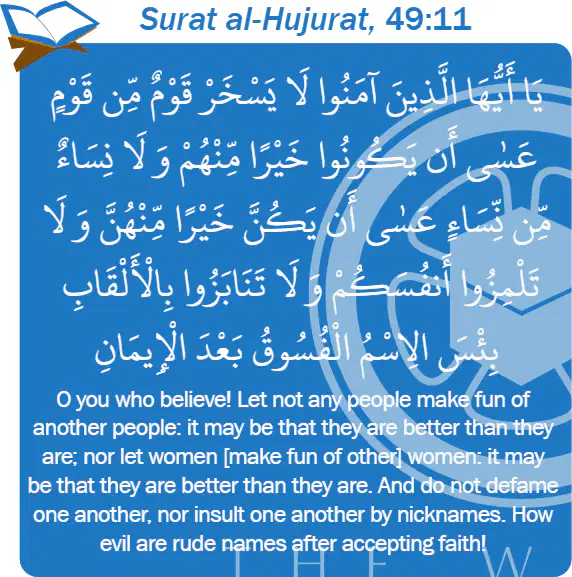
What is the main message for us in Surat al-Hujurat, 49:11?
We should not mock, insult, or belittle others.
We should always seek wealth and power.
We should avoid helping those in need.
We should only respect people from our own group.
According to Imam Zayn al-Abidin (a), how should we view a person younger than us?
As less experienced and less knowledgeable
As better than us because he has had less time than us to do bad deeds
As someone who needs our guidance
As equal to us
Fill in the blank: Imam Ali (a) has said: 'If someone thinks well and good of you then make what he thinks ______.'
come true
go away
seem false
disappear
According to the teachings in the passage, what should we do if others think bad of us?
We should not worry about what others think.
We should try to change their opinion.
We should confront them.
We should ignore everyone.
The Qur’an teaches the following about finding faults in others and judging them:
It discourages finding faults and judging others.
It encourages judging others to improve them.
It is neutral about judging others.
It commands to always point out others' faults.
What is prejudice?
Prejudice is to make a judgement based on a premature opinion without examining the facts.
Prejudice is always a positive attitude towards others.
Prejudice means accepting everyone without any bias.
Prejudice is a legal term for court decisions.
To avoid prejudice, we must always think the best of others and give them the benefit of doubt. This is known as ________.
husn adh-dhann
su' adh-dhann
ghibah
namimah
What does the Holy Qur’an warn us against?
The Holy Qur’an warns us against prejudice.
The Holy Qur’an warns us against kindness.
The Holy Qur’an warns us against honesty.
The Holy Qur’an warns us against charity.
What has Imam Zayn al-Abidin (a) taught us about thinking of others?
We must always think of others as better than us.
We should ignore the needs of others.
We should only think of ourselves.
We must never help others in need.
Prejudice is best defined as:
An unfair opinion or feeling formed without facts or knowledge.
A scientific method of investigation.
A legal decision made by a judge.
A positive attitude towards everyone.
The Qur'an warns us against prejudice because:
it promotes justice and equality among people.
it encourages people to judge others unfairly.
it supports discrimination based on race or status.
it allows favoritism in society.
According to the hadith of Imam Zayn al-Abidin (a), we should think of the following people as better than ourselves because:
They may have repented for their sins while we are unaware of our own faults.
They have more wealth and status than us.
They are more knowledgeable in worldly matters.
They pray more frequently in public.
The benefit of not judging others is:
It helps build understanding and acceptance.
It makes people more competitive.
It encourages spreading rumors.
It leads to more misunderstandings.

