
 Worksheets
Soal 1: Jaring-jaring Makanan Ekosistem Savana
Total questions: 52
Worksheet time: 39mins
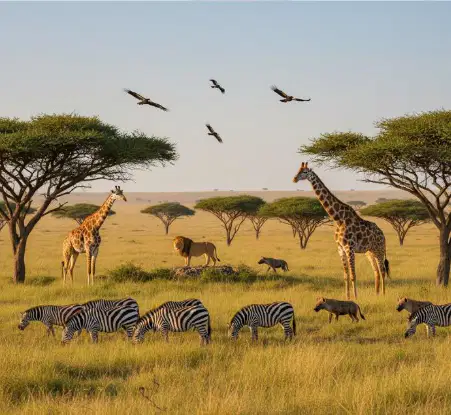
Dalam jaring makanan savana, rumput dan pohon akasia bertindak sebagai produsen; zebra dan jerapah adalah herbivora primer; singa dan hyena adalah karnivora puncak; dan burung nasar adalah pemakan bangkai. Jika sebuah penyakit menyebabkan penurunan drastis populasi zebra, apa dampak paling langsung terhadap ekosistem ini?
Peningkatan signifikan pada rumput karena lebih sedikit pemakan
Peningkatan populasi jerapah karena berkurangnya kompetisi
Penurunan populasi singa karena berkurangnya sumber makanan utama
Peningkatan populasi burung nasar karena banyaknya bangkai zebra
Penurunan pohon akasia karena jerapah yang kelaparan mengonsumsinya
Cyanide blocks cytochrome c oxidase, the terminal complex of the mitochondrial electron transport chain. Which outcome most directly explains the sharp drop in ATP from oxidative phosphorylation?
ATP synthase is inhibited by NAD+ depletion
The proton gradient cannot be maintained because electron flow stops
Glycolysis halts due to lack of glucose
Mitochondrial DNA replication is blocked
If the electron transport chain is inhibited by cyanide, what happens to NADH and FADH2 inside the mitochondrial matrix?
They are rapidly oxidized to regenerate NAD+ and FAD
They accumulate because they cannot donate electrons to the chain
They are exported and converted to lactate
They are broken down to release CO2
When aerobic respiration is blocked by cyanide, which pathway is most likely upregulated in animal cells to make limited ATP?
Alcohol fermentation
Lactic acid fermentation
Fatty acid β-oxidation
The urea cycle
Which statement about oxygen consumption during cyanide poisoning is most accurate?
Oxygen use increases to compensate for low ATP
Oxygen consumption stops because O2 cannot accept electrons at the chain’s end
Oxygen is replaced by NAD+ as the terminal electron acceptor
Oxygen consumption is unaffected
A patient with a Gram-negative bacterial infection does not improve on penicillin. Which structural feature best explains the reduced effectiveness of penicillin against this bacterium?
Absence of peptidoglycan in the cell wall
Presence of an outer membrane that limits penicillin access to peptidoglycan
Exclusive targeting of DNA replication by penicillin
Production of antibiotic-resistant endospores
A patient with a bacterial infection is treated with penicillin but shows no improvement. Lab results indicate the pathogen is Gram-negative. Which explanation best accounts for penicillin’s reduced effectiveness?
Gram-negative bacteria lack a peptidoglycan cell wall.
The outer membrane of Gram-negative bacteria blocks penicillin from reaching its peptidoglycan target.
Penicillin only inhibits bacterial DNA replication.
Gram-negative bacteria survive as endospores that resist all antibiotics.
Ribosomes in Gram-negative bacteria are structurally different so penicillin cannot bind.
Manakah pernyataan yang paling tepat menggambarkan bagaimana penumpukan plak di arteri koroner mempengaruhi tekanan darah dan beban kerja jantung?
Ini memperlebar lumen arteri, menurunkan tekanan darah dan meringankan beban kerja jantung.
Ini mempersempit lumen arteri, meningkatkan tekanan darah dan memaksa jantung bekerja lebih keras.
Ini tidak mengubah ukuran lumen tetapi mengurangi detak jantung.
Ini meningkatkan kandungan oksigen dalam darah, mengurangi kebutuhan untuk output jantung.
Atherosclerosis changes the arterial wall in which of the following ways?
It increases elasticity, allowing better accommodation of blood flow.
It causes hardening of the artery (arteriosclerosis), making the wall stiff and less elastic.
It dissolves the muscular layer, making the artery floppy and overly expandable.
It strengthens the artery so it can tolerate extremely high pressures without damage.
What is a serious complication when an atherosclerotic plaque ruptures in a coronary artery?
Formation of a thrombus that can fully block blood flow to the myocardium, leading to a heart attack.
Immediate widening of the artery, increasing oxygen delivery to the heart muscle.
Conversion of plaque into healthy tissue that restores normal flow.
Decreased blood clotting, preventing any blockage.
An expedition team finds an organism with these traits: body covered with hair, nurses its young (viviparous with mammary glands), breathes with lungs, and maintains a constant body temperature (homeothermic). Based on these characteristics, which class best fits this organism?
Aves
Reptilia
Amphibia
Mammalia
Pisces
A student wants to test how light intensity affects the rate of photosynthesis in Hydrilla. Which setup best isolates the independent variable while keeping other factors constant?
Place five setups under the same light intensity using different Hydrilla species.
Place five setups at different distances from the light source while keeping water temperature and the amount of Hydrilla the same.
Place five setups at the same distance from the light source but with different water temperatures.
Use one setup in bright light and one in darkness without controlling other variables.
Place five setups at different distances and with different amounts of Hydrilla.

A hypothetical graph shows antibody concentration over weeks after two exposures to the same antigen. The primary response has a slow, lower peak after the first dose; the secondary response has a faster, much higher peak after the second dose. Which statement best explains this difference?
In the primary response, antigen is destroyed only by phagocytes without antibodies.
The secondary response is mediated only by cytotoxic T cells, while the primary response is by B cells.
Memory B cells formed during the primary response enable faster and more massive antibody production upon the second exposure.
Antibodies made in the secondary response have lower affinity for the antigen.
Vaccination can only trigger a weak, short-lived primary response.
A patient with chronic kidney failure is most likely to develop which condition due to accumulation of nitrogenous waste products in the blood?
Uremia
Hypoglycemia
Leukocytosis
Jaundice
Hemophilia
Disruption of kidney function commonly leads to which homeostatic imbalance involving ions and pH?
Hyperkalemia and acidosis
Hypernatremia and alkalosis only
Hypocalcemia with respiratory alkalosis
Hyperchloremia with metabolic alkalosis
No change in electrolyte balance
Severe nephron damage in chronic kidney failure most directly reduces which normal renal process?
Urine production (leading to oliguria or anuria)
Bile secretion
Platelet formation
Insulin synthesis
Alveolar gas exchange
Which statement correctly distinguishes the effect of chronic kidney failure on erythropoietin (EPO)?
EPO production decreases, contributing to anemia
EPO production increases, causing polycythemia
EPO remains unchanged and does not affect red blood cells
EPO spikes only during dehydration episodes
EPO is produced mainly by the liver, not affected by kidneys
Why is hypertension, rather than hypotension, a common consequence of chronic kidney failure?
Retention of water and sodium increases blood volume
Decreased cardiac output directly lowers blood pressure
Loss of plasma proteins reduces oncotic pressure
Enhanced bicarbonate reabsorption lowers blood pH
Increased EPO elevates vascular resistance
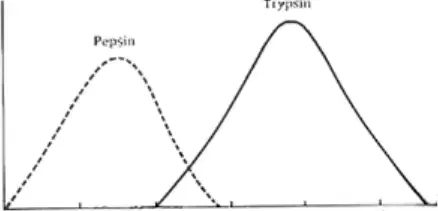
A graph compares pepsin and trypsin relative activity across pH. Pepsin peaks at about pH 2 and drops sharply beyond that. Trypsin peaks near pH 8 and is low in acidic conditions. Which conclusion best interprets the data?
Both enzymes have optimal activity at neutral pH (7).
Enzyme activity is unaffected by pH changes in the environment.
Each enzyme has a specific optimal pH; pepsin functions in acidic conditions while trypsin functions in basic conditions.
Pepsin will work maximally if moved to the basic environment of the small intestine.
Trypsin is more efficient than pepsin across all pH ranges.
Which statement best describes Type 1 Diabetes Mellitus?
An autoimmune disease that destroys pancreatic beta cells, reducing insulin production
A genetic disorder that increases glucagon secretion by alpha cells only
A dietary intolerance in which cells cannot absorb fructose
A viral infection that permanently increases insulin levels
In the absence of insulin, what is the most immediate effect on blood glucose regulation?
Glucose enters muscle and adipose cells more efficiently, lowering blood sugar
Glucose remains in the bloodstream, leading to hyperglycemia
Glucagon production stops, causing hypoglycemia
Glycogen stores in the liver increase rapidly
Which sequence best explains why diabetic ketoacidosis can develop in Type 1 Diabetes Mellitus?
Low glucagon → increased glucose uptake → ketone clearance
Autoimmune beta-cell destruction → low insulin → cells use fats/proteins for energy → ketone buildup
High insulin → increased lipogenesis → ketone suppression
Alpha-cell failure → reduced glucagon → ketone overproduction
Denitrifying bacteria (e.g., Pseudomonas denitrificans) live in anaerobic environments and use nitrate (NO3−) as the terminal electron acceptor, converting it to nitrogen gas (N2). If the entire population of these bacteria in an ecosystem were eliminated, what long-term outcome would be most likely?
A drastic decrease in atmospheric nitrogen (N2).
An increase in soil fertility because nitrate is not converted into gas.
The complete cessation of nitrogen fixation by Rhizobium.
Toxic accumulation of ammonia (NH3) in soils.
Nitrification by nitrite- and nitrate-oxidizing bacteria would stop.
A mountaineer acclimatizes for several weeks at 4,000 meters where the partial pressure of oxygen is low. Which long-term physiological adaptation most effectively increases oxygen-carrying capacity of the blood?
Permanent increase in breathing rate and heart rate
Decreased hemoglobin affinity for oxygen to ease tissue release
Increased erythrocyte (red blood cell) production stimulated by erythropoietin (EPO)
Thickening of alveolar walls to speed oxygen diffusion
Reduced total lung volume to raise intrapulmonary pressure
A study tested the effect of NPK fertilizer concentration on tomato plant height over 30 days. Treatments and average height increases (cm) were: Control 0 g/L = 12.5; 2 g/L = 25.8; 4 g/L = 34.2; 6 g/L = 35.1; 8 g/L = 28.6. Which treatment produced the greatest average increase in height?
0 g/L (Control)
2 g/L
4 g/L
6 g/L
8 g/L
Based on the data, which statement best describes the trend in plant height from 0 to 6 g/L NPK?
Height decreases steadily as concentration increases.
Height increases overall with each increase up to 6 g/L.
Height stays constant regardless of concentration.
Height increases only at 2 g/L then decreases.
Height increases only at 4 g/L then returns to control level.
What is the most supported estimate of the optimal NPK concentration for maximizing tomato plant height in this experiment?
0 g/L, because it avoids fertilizer stress
2 g/L, because it doubles the control growth
4 g/L, because it is the first high peak
6 g/L, because it yields the highest mean increase
8 g/L, because more nutrients always improve growth
Which conclusion about toxicity is best supported by the data?
No toxicity is observed at any concentration because all values exceed the control.
Toxic effects likely begin by 2 g/L because growth drops below the control.
A toxic or inhibitory effect appears at 8 g/L because growth declines compared with 4–6 g/L.
Toxicity is strongest at 6 g/L because it shows the maximum height.
Toxicity cannot be inferred because the control is the lowest.
Which inference about the statistical significance between 4 g/L and 6 g/L is most reasonable from the provided summary?
There is clearly no significant difference because the means are identical.
A significant difference is proven because 35.1 is greater than 34.2.
Significance cannot be determined without variability measures, though the increase is small.
They are significantly different because both exceed the control.
They are not significantly different because both are above 25 cm.
Which hormone’s sudden surge from the pituitary gland is the primary trigger for ovulation (release of the egg) in a normal menstrual cycle?
Estrogen
Progesterone
Luteinizing Hormone (LH)
Follicle-Stimulating Hormone (FSH)
After ovulation, what is the main function of the corpus luteum in preparing the uterus for implantation?
It decreases blood supply to the endometrium
It secretes high levels of progesterone to thicken and vascularize the endometrium
It releases FSH to stimulate new follicle growth
It inhibits all pituitary hormones to stop the cycle
During the follicular phase, high estrogen levels primarily do which of the following?
Suppress follicle growth and prevent ovulation
Promote endometrial thickening and provide positive feedback that leads to an LH surge
Cause degeneration of the corpus luteum
Directly trigger ovulation without pituitary involvement
Three identical samples of human red blood cells are placed into three different solutions: Solution A is 0.9% saline (isotonic), Solution B is pure water (hypotonic), and Solution C is 5% saline (hypertonic). What will most likely happen to the cells in Solutions B and C, respectively?
In Solution B the cells shrink (crenate); in Solution C the cells remain normal.
In Solution B the cells swell and lyse; in Solution C the cells shrink (crenate).
In Solution B the cells shrink (crenate); in Solution C the cells swell and lyse.
In both solutions the cells remain normal due to strong cell walls.
In Solution B the cells remain normal; in Solution C the cells swell and lyse.
In genetic engineering to produce human insulin, what is the primary advantage of using bacteria such as E. coli?
They have a large nucleus that easily accommodates foreign genes.
They reproduce very slowly, enabling better quality control.
Their cell walls are made of cellulose, protecting protein products.
They lack ribosomes, so they do not interfere with target protein synthesis.
They reproduce rapidly via binary fission, allowing mass protein production in a short time.
Which pair best represents characteristic Asiatic (Oriental) fauna found west of the Wallace Line in Indonesia?
Kangaroo and cuscus
Anoa and Komodo dragon
Bird-of-paradise and cockatoo
Sumatran elephant and orangutan
Maleo and tarsier
Which statement correctly explains why a reflex action occurs before you feel pain when touching a hot pan?
The cerebrum makes a rapid conscious decision to move the hand.
The reflex arc bypasses conscious processing in the cerebrum, enabling a faster response.
Pain receptors are inactive during reflex actions.
Muscles contract only after signals are processed in the brainstem.
Identify the correct sequential order of components in a typical reflex arc for withdrawing a hand from a hot object.
Receptor → Motor neuron → Sensory neuron → Spinal cord → Effector
Receptor → Sensory neuron → Spinal cord (integration center) → Motor neuron → Effector
Cerebrum → Sensory neuron → Spinal cord → Motor neuron → Effector
Receptor → Interneuron → Cerebrum → Motor neuron → Effector
Which component serves as the integration center in the reflex arc described?
Cerebrum
Brainstem
Spinal cord
Sensory receptor in the skin
During the reflex of pulling your hand away from heat, which neuron directly carries impulses from the spinal cord to the effector?
Sensory neuron
Motor neuron
Interneuron
Association neuron in the cerebrum
In the hot-pan reflex example, what is the effector that produces the response?
Pain receptor in the skin
Biceps muscle contracting to pull the hand away
Cerebrum processing pain
Spinal cord integrating the signal
Which statement best describes the role of the light-dependent reactions in relation to the Calvin cycle?
They consume CO2 to form glucose directly.
They produce ATP and NADPH that power the Calvin cycle.
They regenerate CO2 used by the Calvin cycle.
They release ATP and NADPH as waste products.
A plant experiences a blockage of the Calvin cycle due to lack of CO2. What is the most likely consequence for the light-dependent reactions?
They continue indefinitely because light is still available.
They speed up to compensate for the lack of CO2.
They eventually halt because ADP and NADP+ are not regenerated.
They start producing O2 from the breakdown of CO2.
During photosynthesis, the molecular source of the oxygen gas (O2) released to the atmosphere is best identified as originating from which process?
Reduction of CO2 in the Calvin cycle
Photolysis of water in the light reactions
Oxidation of glucose in mitochondria
Regeneration phase of the Calvin cycle
Carbon monoxide (CO) binds to hemoglobin (Hb) about 200–250 times more strongly than oxygen (O2). Which physiological process is most directly impaired when a person inhales CO-contaminated air?
Diffusion of O2 from alveoli into pulmonary capillaries
Contraction of the diaphragm and intercostal muscles during breathing
Transport of O2 by blood from the lungs to body tissues
Dissolution of CO2 in plasma for carriage back to the lungs
Production of ATP in mitochondria across all body cells

In Indonesian rivers where the invasive sapu-sapu fish (Pterygoplichthys pardalis) is introduced and faces few natural predators while reproducing rapidly, which long-term ecological impact is most likely?
An increase in biodiversity due to the arrival of a unique new species
Formation of a more stable and productive new ecosystem balance
A decline in native fish populations due to competition for food and space
Improved river water quality because the sapu-sapu cleans riverbeds
Rapid evolution of native fish to prey on sapu-sapu
Which statement best defines an autoimmune disease?
A condition where the immune system loses self-tolerance and wrongly attacks the body’s own cells and tissues
A condition where pathogens evade immune detection and infect host tissues
An inherited disorder where antibodies are never produced
A temporary allergy to harmless environmental substances
Which example correctly describes rheumatoid arthritis as an autoimmune condition?
Immune antibodies attack synovial membranes in joints, causing chronic inflammation
Cytotoxic T cells destroy beta cells of the pancreas, reducing insulin
Autoantibodies target neurons, leading to paralysis
IgE binds pollen and causes sneezing without tissue damage
Which option accurately explains type 1 diabetes mellitus as an autoimmune disease?
Cytotoxic T cells specifically destroy insulin-producing beta cells in the pancreas
B cells produce IgE that binds to allergens in the nasal epithelium
A viral infection destroys helper T cells, weakening immunity
Autoantibodies target red blood cells, causing anemia
Which statement about systemic lupus erythematosus (SLE) is most accurate?
It is marked by autoantibodies that can form immune complexes and attack multiple organs such as skin, kidneys, and heart
It is a localized joint disease with no antibody involvement
It is caused by HIV destroying CD4 helper T cells
It is an allergic reaction to harmless antigens like pollen
Which condition listed is NOT an autoimmune disease, according to the material?
Rheumatoid arthritis
Type 1 diabetes mellitus
Systemic lupus erythematosus
HIV/AIDS immunodeficiency
In an energy pyramid, only about 10% of energy is passed to the next trophic level. According to the Second Law of Thermodynamics and cellular processes, where does most of the remaining energy (about 90%) go?
It is destroyed and permanently removed from the ecosystem
It is stored as organic matter that decomposers cannot break down
It is released as heat during metabolism (cellular respiration)
It is converted into light energy via bioluminescence
It is transferred directly to decomposers without passing to higher trophic levels

Which statement best compares the final products of spermatogenesis and oogenesis in humans?
Spermatogenesis produces four functional sperm of similar size, while oogenesis typically yields one large ovum and two to three small polar bodies due to asymmetric cytokinesis.
Both processes produce four functional gametes of equal size after meiosis.
Spermatogenesis yields one large sperm and three polar bodies, while oogenesis produces four small ova.
Both processes produce one functional gamete and one polar body of equal size.

