Wayground logo

Free Printable Worksheets

Font size

S
M
L
XL
Worksheets

Ecology/Macro Review

Total questions: 25

Worksheet time: 40mins

Name
Class
Date
1.
An organism that lives by breaking apart dead organic matter into simpler parts is...
a)
scavenger
b)
consumer
c)
decomposer
d)
carnivore
2.
What type of growth is represented behind?
a)
exponential
b)
logistics
c)
a good kind
d)
representative
3.

Which of the following are examples of a density independent factors?

a)

forest fire

b)

seasonal cycles

c)

storms

d)

disease

4.
As a population grows, it will most likely stop growing at what size?
a)
Growth limit
b)
Exponential limit
c)
Carrying Capacity
d)
It won't stop growing
5.
What is indicated by the diagram?
a)
Food web
b)
Food chain
c)
Food map
d)
Food menu
6.
Which organism is likely to be at the beginning of a food chain for a pond?
a)
Sunfish
b)
Freshwater shrimp
c)
Paramecium
d)
Green Algae
7.

Which organisms have the most available energy in an energy pyramid?

a)

Producers

b)

Consumers

c)

Decomposers

d)

Detritivores

8.
Where do crickets get their energy?
a)
Cattails
b)
Marsh Grass
c)
Grasshoppers
d)
Shrews
9.
If additional snakes are introduced into this ecosystem, there will most likely be an immediate decrease in the _________.  
a)
hawk population
b)
rabbit population
c)
wildflower population
d)
grass population
10.
Which would be the appropriate term for an organism that eats a producer?
a)
scavenger
b)
decomposer
c)
secondary consumer
d)
primary consumer
11.
All of the following are consumers except
a)
Autotrophs
b)
Herbivores
c)
Heterotrophs
d)
Ominvores
12.

If there are 47,802 calories (energy) available at the producer level of this food chain, how many calories would be available at the tertiary consumer level?

a)

47.802

b)

478.02

c)

4.7802

d)

0

13.
Proteins are made of monomers called ___________
a)
Nucleotides
b)
Monosaccharides
c)
Amino Acids
d)
Glycerol and fatty acids
14.
DNA and RNA are examples of 
a)
Carbohydrates
b)
Lipids
c)
Proteins
d)
Nucleic Acids
15.
Nucleotides are monomers of
a)

Carbohydrates

b)

Lipids

c)

Proteins

d)

Nucleic Acids

16.
Monosaccharides are monomers of
a)
Carbohydrates
b)
Lipids
c)
Proteins
d)
Nucleic Acids
17.
Waxes, oils and fats are examples of
a)
Carbohydrates
b)
Lipids
c)
Proteins
d)
Nucleic Acids
18.

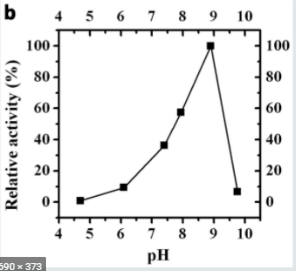
What is the optimal pH for this enzyme?

a)

6

b)

10

c)

9

d)

7

19.

Which of the following best explains why enzymes are necessary for reactions in our cells?

a)

The reactions are too slow to meet the needs of the cell if enzymes are missing.

b)

Enzymes supply the oxygen necessary for the reactions.

c)

Enzymes change reactants from solid to liquid during the reactions.

d)

The reactions take up too much space in the cell if enzymes are missing.

20.

The ____________________ mechanism describes how each substrate must fit into the enzyme.

a)

lock and key

b)

hammer and nail

c)

jigsaw puzzle

d)

seesaw

21.

What is the purpose of an enzyme?

a)

control how many reactions occur

b)

raise activation energy

c)

give permission for the reaction

d)

speed up chemical reactions

22.

Where do substrates bind to an enzyme?

a)

calcium channels

b)

active site

c)

receptor molecules

d)

voltage-gated channels

23.

What is the optimal temperature of this enzyme?

a)

60

b)

40

c)

70

d)

30

24.

Which enzyme represents the substrate?

a)

A

b)

B

c)

C

d)

D

25.

Which letter represents the enzyme?

a)

A

b)

B

c)

C

d)

D