
 Worksheets
The Great Depression Quiz
Total questions: 15
Worksheet time: 8mins
What contributed most to this newspaper headline:
"WALL STREET IN PANIC AS STOCKS CRASH"
overspending and buying stocks on margin
lack of people willing to invest in the stock market
too many people trying to buy stocks on the same day
foreign investors removing all their money from the stock market
The following shows a series of events related to the passage of the Hawley-Smoot Tariff of 1930:
High tariff rates led to a decrease in imports to the U.S.--> European nations raised tariff rates in retaliation/stopped buying U.S. goods --> All nations ended up with surpluses of unsold goods
Which consequence occurred as a result of all these events?
Europe's economic condition improved
The United States' stock market crashed
The global depression worsened
Global production rates increased
What was the immediate (the "spark") that caused the Great Depression?
(Remember, there is a difference between long-term causes and the short term starter)
reduced production after WWI
foreclosures of farms due to the Dust Bowl
strict government regulations on businesses
crash of the stock market
Which of the following states saw the greatest surge in population as a result of the Dust Bowl?
Kansas
Oklahoma
California
Tennessee
What government activity resulted from the Dust Bowl of the 1930s?
teaching farmers about soil conservation
paying builders to make roads and bridges
assigning soldiers to defend national borders
requiring factory owners to limit working hours
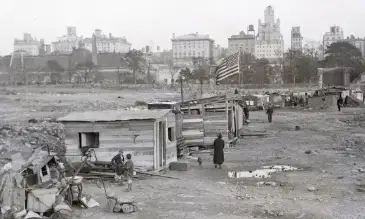
This photograph was taken in New York City's Central Park in 1933.
This photograph is evidence of which situation in the nation in the early 1930s?
Public housing programs established as a part of the New Deal helped many people survive the Great Depression
The majority of victims of the Dust Bowl traveled to northeastern cities such as New York looking for work
"Hoovervilles" sprang up in urban areas as many people lost their homes as a result of the Great Depression
Public works programs that were part of the New Deal helped bring better sanitation and electricity to urban areas
How did men and women respond differently to the challenges of the Great Depression?
Men often deserted their families to look for work, while women did what they could to keep families together
Men and women both gave their children up for adoption at extremely high rates
Men stuck with their children, while women often fled hoping their children would be better off with "one less mouth to feed"
Men grew depressed and rejected work opportunities, while women took on any job they could
By referring to shantytowns as "Hoovervilles," what message were the American people trying to convey?
Their support for the government's handling of the Depression.
Their respect for the president and his economic policies.
Their anger at the lack of government intervention to end the Depression.
Their patriotism and support for the president's foreign policy initiatives.
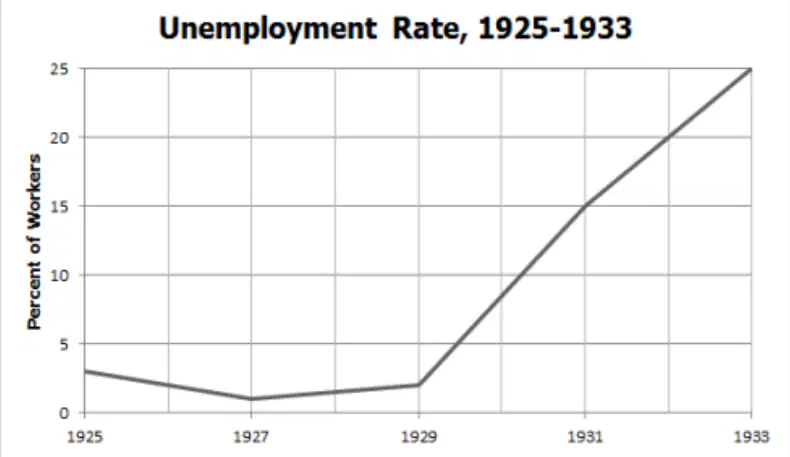
Background Info: This graph shows the percentage of UNEMPLOYED workers from 1925-1933.
Question: The data in this graph supports which conclusion about this time period?
President Roosevelt's New Deal programs were effective at increasing employment
It took several years for the nation to feel any effects from the stock market crash.
President Hoover's policy of "Rugged Individualism" did not solve the country's economic problems.
The effects of the stock market crash were limited to only those who had invested in the market,

These excerpts demonstrate what difference between President Hoover and President Roosevelt?
Hoover wanted to institute social programs to help citizens; Roosevelt wanted to hire more government employees
Hoover wanted to lessen the role of government in regulating the economy; Roosevelt wanted to increase it.
Hoover wanted to weaken the military powers of the president; Roosevelt wanted to expand them.
Hoover wanted to expand the rights of minority groups; Roosevelt wanted to prioritize economic issues
This is a statement made by Dwight D. Eisenhower about an event he witnessed in 1932.
"The whole scene was pitiful. The veterans were ragged, ill-fed, and felt themselves badly abused. To suddenly see the whole encampment going up in flames just added to the pity"
The group mentioned in this statement wanted to accomplish what goal?
end the practice of buying on margin
obtain jobs in government agencies
change laws that were hurting agriculture
receive their promised bonuses early
A Social Darwinist would most likely agree with which president's economic policies?
Herbert Hoover
Franklin D. Roosevelt
Harry Truman
Teddy Roosevelt

Based on this "U.S. Unemployment" graph from 1928-1940, which statement is true?
The New Deal programs ended the Depression and resulted in full employment
The New Deal programs helped the economy but did not end the Depression
The New Deal programs were a complete failure and did not help unemployment
The New Deal programs had no effect on the economic conditions of the nation

Which New Deal organization built this structure?
Civilian Conservation Corps
National Recovery Administration
Tennessee Valley Authority
Works Progress Administration

What action by President Roosevelt exemplifies this statement?
He used deficit spending and increased government regulations to improve the economy
He enforced voting laws and ensured that minority groups were allowed to participate in the democratic process
He reduced federal spending and authorized state governments to create public service jobs
He restructured the military and reduced the power of the government to intervene in global conflicts

