
Font size
 Worksheets
TKA-PAP ENGLISH TEST
Total questions: 20
Worksheet time: 14mins
King Hung Vuong VI had a beautiful daughter. He did not want her to marry just any prince. So, he made an announcement that he was looking for the right husband for her. Many princes came from faraway lands, but none of them was a good match for the princess.
Son Tinh was the Spirit of the Mountain, and Thuy Tinh was the Spirit of the Waters. One day, they both appeared as young noblemen and asked to marry the princess. They were equally talented, powerful, and respected. The King found it hard to choose, so he decided to give them a test. He said that the one who brought the proper wedding gifts first the next morning would marry his daughter.
The next day, Son Tinh arrived early with his gifts. The King kept his promise and gave the princess to him. Thuy Tinh was angry about losing. He challenged Son Tinh to fight for the princess. But Son Tinh refused, believing he had already won fairly. Furious, Thuy Tinh used his power to call the rivers and streams to rise. Soon, the land was covered with floods that destroyed crops and homes.
Son Tinh stayed calm in his mountain palace. Whenever the water rose, he made his mountains higher. After many days of fighting, Thuy Tinh grew tired and ordered the waters to retreat. Still, he never accepted his defeat. Every year, he tried again to attack, and this is how monsoons came to Vietnam.
Which of the following outlines shows the correct main points of the story?
King Hung Vuong VI wanted the best husband for his daughter.
Many princes came but none was suitable.
Son Tinh and Thuy Tinh both wanted to marry her.
The King gave them a test.
Thuy Tinh arrived first with the wedding gifts.
The princess was given to Thuy Tinh.
King Hung Vuong VI had a beautiful daughter.
He announced he was looking for the right husband.
Son Tinh and Thuy Tinh appeared and asked to marry her.
The King gave them a test with wedding gifts.
Son Tinh arrived first and married the princess.
Thuy Tinh attacked with floods but was defeated.
King Hung Vuong VI asked his daughter to choose her husband.
The princess liked both Son Tinh and Thuy Tinh.
The King delayed his decision for many days.
Finally, he asked them to fight each other.
Thuy Tinh lost the battle and left the land.
The country never suffered from floods again.
King Hung Vuong VI searched for a husband for his daughter.
Son Tinh and Thuy Tinh wanted to marry her.
The King gave them a challenge.
Thuy Tinh lost the test and became angry.
He called the waters to rise and destroy the land.
Son Tinh drowned in the floods.
The King wanted a nobleman for his daughter.
He invited many princes to the palace.
Son Tinh and Thuy Tinh competed for the princess.
Son Tinh refused the challenge of gifts.
The King chose Thuy Tinh as the winner.
Thuy Tinh ruled peacefully without floods.
King Hung Vuong VI had a beautiful daughter. He did not want her to marry just any prince. So, he made an announcement that he was looking for the right husband for her. Many princes came from faraway lands, but none of them was a good match for the princess.
Son Tinh was the Spirit of the Mountain, and Thuy Tinh was the Spirit of the Waters. One day, they both appeared as young noblemen and asked to marry the princess. They were equally talented, powerful, and respected. The King found it hard to choose, so he decided to give them a test. He said that the one who brought the proper wedding gifts first the next morning would marry his daughter.
The next day, Son Tinh arrived early with his gifts. The King kept his promise and gave the princess to him. Thuy Tinh was angry about losing. He challenged Son Tinh to fight for the princess. But Son Tinh refused, believing he had already won fairly. Furious, Thuy Tinh used his power to call the rivers and streams to rise. Soon, the land was covered with floods that destroyed crops and homes.
Son Tinh stayed calm in his mountain palace. Whenever the water rose, he made his mountains higher. After many days of fighting, Thuy Tinh grew tired and ordered the waters to retreat. Still, he never accepted his defeat. Every year, he tried again to attack, and this is how monsoons came to Vietnam.
Why did Thuy Tinh attack Son Tinh after the wedding?
He was jealous of Son Tinh’s victory
He believed the King had lied to him.
He thought the princess loved him more.
He wanted to show off his power to the king.
He had promised to fight until death.
King Hung Vuong VI had a beautiful daughter. He did not want her to marry just any prince. So, he made an announcement that he was looking for the right husband for her. Many princes came from faraway lands, but none of them was a good match for the princess.
Son Tinh was the Spirit of the Mountain, and Thuy Tinh was the Spirit of the Waters. One day, they both appeared as young noblemen and asked to marry the princess. They were equally talented, powerful, and respected. The King found it hard to choose, so he decided to give them a test. He said that the one who brought the proper wedding gifts first the next morning would marry his daughter.
The next day, Son Tinh arrived early with his gifts. The King kept his promise and gave the princess to him. Thuy Tinh was angry about losing. He challenged Son Tinh to fight for the princess. But Son Tinh refused, believing he had already won fairly. Furious, Thuy Tinh used his power to call the rivers and streams to rise. Soon, the land was covered with floods that destroyed crops and homes.
Son Tinh stayed calm in his mountain palace. Whenever the water rose, he made his mountains higher. After many days of fighting, Thuy Tinh grew tired and ordered the waters to retreat. Still, he never accepted his defeat. Every year, he tried again to attack, and this is how monsoons came to Vietnam.
What does the phrase “kept his promise” in the text mean?
Forgot about his decision.
Changed his mind about the wedding.
Did what he had promised to do.
Delayed the marriage for many days.
The King asked the princes to bring more gifts.
King Hung Vuong VI had a beautiful daughter. He did not want her to marry just any prince. So, he made an announcement that he was looking for the right husband for her. Many princes came from faraway lands, but none of them was a good match for the princess.
Son Tinh was the Spirit of the Mountain, and Thuy Tinh was the Spirit of the Waters. One day, they both appeared as young noblemen and asked to marry the princess. They were equally talented, powerful, and respected. The King found it hard to choose, so he decided to give them a test. He said that the one who brought the proper wedding gifts first the next morning would marry his daughter.
The next day, Son Tinh arrived early with his gifts. The King kept his promise and gave the princess to him. Thuy Tinh was angry about losing. He challenged Son Tinh to fight for the princess. But Son Tinh refused, believing he had already won fairly. Furious, Thuy Tinh used his power to call the rivers and streams to rise. Soon, the land was covered with floods that destroyed crops and homes.
Son Tinh stayed calm in his mountain palace. Whenever the water rose, he made his mountains higher. After many days of fighting, Thuy Tinh grew tired and ordered the waters to retreat. Still, he never accepted his defeat. Every year, he tried again to attack, and this is how monsoons came to Vietnam.
What is the main lesson of the story?
There is more than one correct answer. Click on every correct answer!
Accept defeat gracefully to prevent harm to others.
Be fair and follow the agreed rules in competitions.
Choose peaceful solutions rather than angry reactions.
Prepare honestly and present your gifts properly.
Respect leaders’ decisions and community agreements.
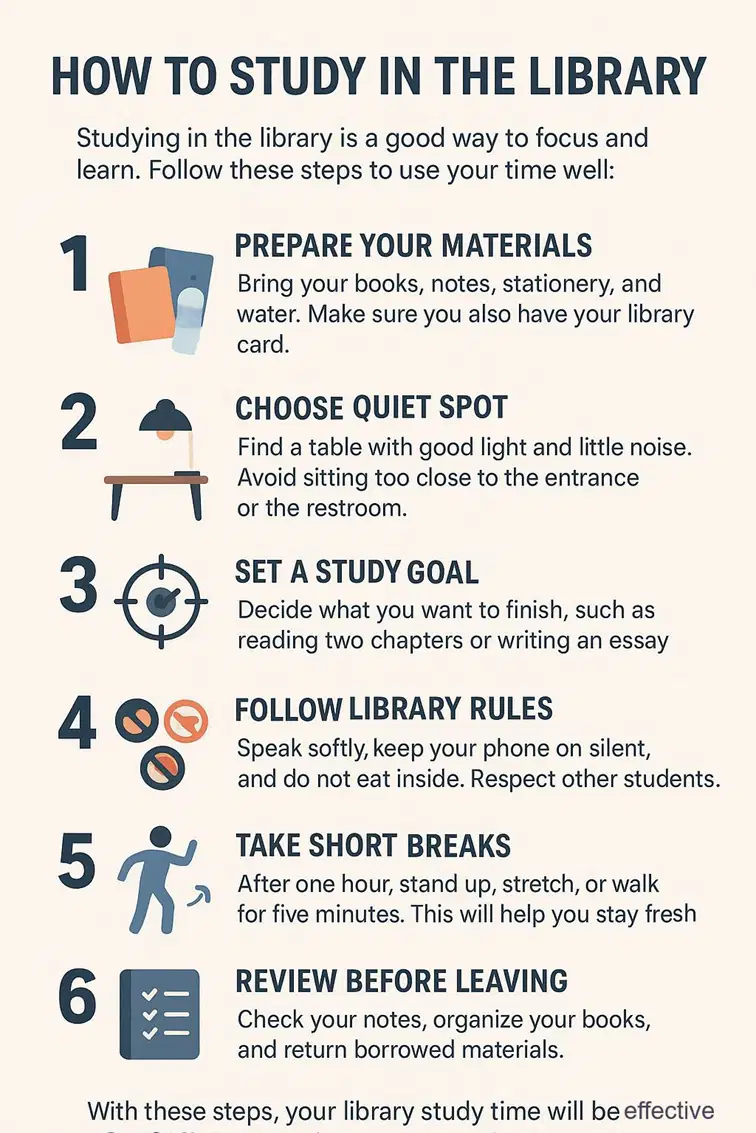
How can we decide a certain table is perfect for studying according to the text?
There is more than one correct answer. Click on every correct answer!
It has good lighting
It provides white noise
It is located near the entrance
It is far from the toilet
It provides stationery

Who needs to read this infographic?
The students of that school
People who happen to visit the school
The librarian of another school
The headmaster of that school
Parents who come to pick up their kids
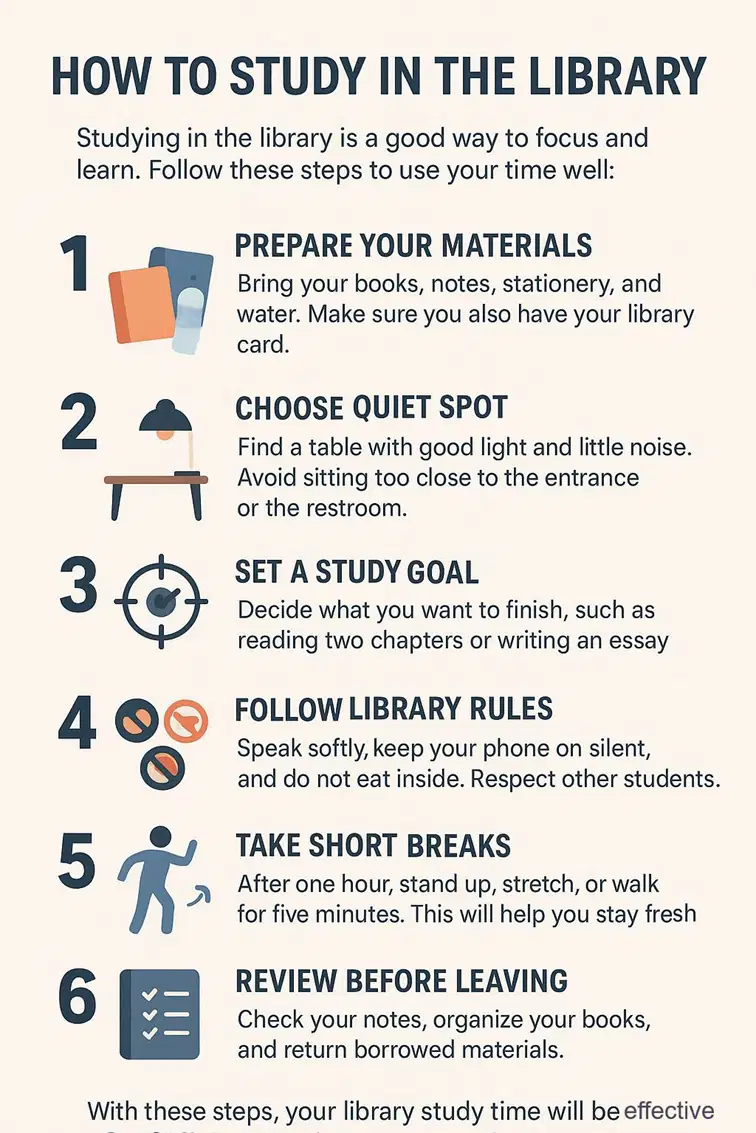
Which actions show disrespect for other students?
There is more than one correct answer. Click on every correct answer!
Speaking loudly to friends.
Keeping the phone silent.
Eating snacks at the desk.
Playing music in the corner.
Moving chairs noisily.

You find this infographic in front of your school library. What will you do before your next visit to the library?
Making sure that I bring my water bottle and lunch with me.
Bringing the books and stationery that I will use.
Organizing the book that I borrowed from the library.
Walking for five minutes so I can focus more when studying.
Making sure you look fresh because you will meet other students.
Exploring Bali's Natural Wonders
Bali, a beautiful island in Indonesia, is known for its stunning landscapes and rich culture. While many come for the beaches and temples, the island also offers natural attractions that amaze nature lovers from around the world. From national parks and waterfalls to terraced rice fields, Bali is full of natural beauty.
In the west lies West Bali National Park, a peaceful area filled with green forests, calm mangrove swamps, and colorful coral reefs along the sea. The air is fresh, and the scenery feels untouched. One of the park’s most special sights is the Bali Starling—a rare white bird with bright blue around its eyes. Its soft song adds magic to the quiet forest. Visitors can walk along clear paths and enjoy the rich variety of plants and animals in this protected area.
Heading north, travelers find the scenic Munduk Waterfall, surrounded by green hills and forests. Water flows gently over rocky cliffs into a cool clear pool. Mist rises into the air, mixing with the calming sound of falling water. The walk to the waterfall passes through narrow paths lined with coffee and clove trees. Their fresh scent fills the air, offering a pleasant and peaceful experience. Munduk is the perfect place to relax and enjoy Bali’s natural charm.
Near the cultural center Ubud, the famous Tegalalang rice terraces stretch across the hills in green steps. These terraces are shaped by generations of farmers who work the land by hand. In the morning, mist rises above the fields, and sunlight reflects off the water in the paddies. Farmers in wide-brimmed hats plant rice carefully, their feet sinking into the soft earth. Water flows gently through small canals, keeping the fields healthy and green. The quiet surroundings and slow rhythm of farm life create a peaceful and inspiring scene.
These natural wonders highlight Bali's dedication in preserving its environmental and cultural treasures. By exploring these sites, tourists not only experience the island's scenic beauty but also support ongoing conservation efforts, helping to ensure that Bali's wonders last for future generations.
The text mainly talks about Bali’s …
wildlife species and nature lovers
unique cultural treasures and sites.
stunning nature and remarkable sites.
generations and cultural conservation.
scenic beauty and local farming practices.
Exploring Bali's Natural Wonders
Bali, a beautiful island in Indonesia, is known for its stunning landscapes and rich culture. While many come for the beaches and temples, the island also offers natural attractions that amaze nature lovers from around the world. From national parks and waterfalls to terraced rice fields, Bali is full of natural beauty.
In the west lies West Bali National Park, a peaceful area filled with green forests, calm mangrove swamps, and colorful coral reefs along the sea. The air is fresh, and the scenery feels untouched. One of the park’s most special sights is the Bali Starling—a rare white bird with bright blue around its eyes. Its soft song adds magic to the quiet forest. Visitors can walk along clear paths and enjoy the rich variety of plants and animals in this protected area.
Heading north, travelers find the scenic Munduk Waterfall, surrounded by green hills and forests. Water flows gently over rocky cliffs into a cool clear pool. Mist rises into the air, mixing with the calming sound of falling water. The walk to the waterfall passes through narrow paths lined with coffee and clove trees. Their fresh scent fills the air, offering a pleasant and peaceful experience. Munduk is the perfect place to relax and enjoy Bali’s natural charm.
Near the cultural center Ubud, the famous Tegalalang rice terraces stretch across the hills in green steps. These terraces are shaped by generations of farmers who work the land by hand. In the morning, mist rises above the fields, and sunlight reflects off the water in the paddies. Farmers in wide-brimmed hats plant rice carefully, their feet sinking into the soft earth. Water flows gently through small canals, keeping the fields healthy and green. The quiet surroundings and slow rhythm of farm life create a peaceful and inspiring scene.
These natural wonders highlight Bali's dedication in preserving its environmental and cultural treasures. By exploring these sites, tourists not only experience the island's scenic beauty but also support ongoing conservation efforts, helping to ensure that Bali's wonders last for future generations.
Which parts of the text best support the description of Bali as a "Bali is full of natural beauty"?
There is more than one correct answer. Click on every correct answer!
A peaceful area filled with green forests, calm mangrove swamps, and colorful coral reefs along the sea.
These terraces are shaped by generations of farmers who work the land by hand.
Water flows gently over rocky cliffs into a cool, clear pool. Mist rises into the air, mixing with the calming sound of falling water.
In the morning, mist rises above the fields, and sunlight reflects off the water in the paddies.
Farmers in wide-brimmed hats plant rice carefully, their feet sinking into the soft earth.
My Experience as an Intern at a Sports Club
Last summer, I had the opportunity to work as an intern at a local sports club. It was my first time working in a professional sports environment, and I was both nervous and excited. The internship went through a few phases, starting from orientation until finally jumping in to help during practices and games.
On my first day, I met the head coach, who welcomed me and explained my tasks. I had to set up cones for drills, bring water for the players, and check the training schedules. The first few days were challenging because I was not used to the morning routine. Every morning I had to wake up early, arrive on time, and follow instructions carefully. I worried about making mistakes, but the coaches were kind and guided me.
In the second month of my internship, I was trained to handle emergency situations. I got the chance to put that knowledge into practice when something unexpected happened. During football practice, a player fell and hurt his ankle. Everyone stopped, and I quickly ran to get the first aid kit. I helped the coach assess the injury and ensured the player stayed calm while we got him seated safely. Luckily, it wasn’t serious, but the experience reinforced an important lesson: staying alert and prepared during emergencies can make a big difference.
At the end of my internship, the coaches held an evaluation and reflection session where they shared the results of their feedback. They highlighted my strengths in teamwork, responsibility, and communication, and even gave me a club T-shirt as a gift. I felt proud because I had improved in these areas. It was a great experience, and
I hope to work in a sports club again in the future.
During the internship, what did the writer do every morning?
Made schedules and explained them to the coaches.
Played football with the team and got the first aid kit.
Prepared a club gift, guided the coaches, and gave t-shirts.
Woke up early, arrived on time, and followed the instructions.
Set up cones, brought water, and checked emergency schedules.
My Experience as an Intern at a Sports Club
Last summer, I had the opportunity to work as an intern at a local sports club. It was my first time working in a professional sports environment, and I was both nervous and excited. The internship went through a few phases, starting from orientation until finally jumping in to help during practices and games.
On my first day, I met the head coach, who welcomed me and explained my tasks. I had to set up cones for drills, bring water for the players, and check the training schedules. The first few days were challenging because I was not used to the morning routine. Every morning I had to wake up early, arrive on time, and follow instructions carefully. I worried about making mistakes, but the coaches were kind and guided me.
In the second month of my internship, I was trained to handle emergency situations. I got the chance to put that knowledge into practice when something unexpected happened. During football practice, a player fell and hurt his ankle. Everyone stopped, and I quickly ran to get the first aid kit. I helped the coach assess the injury and ensured the player stayed calm while we got him seated safely. Luckily, it wasn’t serious, but the experience reinforced an important lesson: staying alert and prepared during emergencies can make a big difference.
At the end of my internship, the coaches held an evaluation and reflection session where they shared the results of their feedback. They highlighted my strengths in teamwork, responsibility, and communication, and even gave me a club T-shirt as a gift. I felt proud because I had improved in these areas. It was a great experience, and
I hope to work in a sports club again in the future.
What are the best words to describe the writer’s personality during the internship?
There is more than one correct answer. Click on every correct answer!
Careful and ready to help
Confident and enjoys working alone
Responsible and willing to learn
Friendly and works well with others
Creative and likes to try new things
My Experience as an Intern at a Sports Club
Last summer, I had the opportunity to work as an intern at a local sports club. It was my first time working in a professional sports environment, and I was both nervous and excited. The internship went through a few phases, starting from orientation until finally jumping in to help during practices and games.
On my first day, I met the head coach, who welcomed me and explained my tasks. I had to set up cones for drills, bring water for the players, and check the training schedules. The first few days were challenging because I was not used to the morning routine. Every morning I had to wake up early, arrive on time, and follow instructions carefully. I worried about making mistakes, but the coaches were kind and guided me.
In the second month of my internship, I was trained to handle emergency situations. I got the chance to put that knowledge into practice when something unexpected happened. During football practice, a player fell and hurt his ankle. Everyone stopped, and I quickly ran to get the first aid kit. I helped the coach assess the injury and ensured the player stayed calm while we got him seated safely. Luckily, it wasn’t serious, but the experience reinforced an important lesson: staying alert and prepared during emergencies can make a big difference.
At the end of my internship, the coaches held an evaluation and reflection session where they shared the results of their feedback. They highlighted my strengths in teamwork, responsibility, and communication, and even gave me a club T-shirt as a gift. I felt proud because I had improved in these areas. It was a great experience, and
I hope to work in a sports club again in the future.
What will the writer most likely do after finishing the internship?
Considering a career in a sports medicine
Stop working and focus only on school
Look for another chance to work in a sports club
Study medicine to become a doctor
Train as a professional football player
Social Media Harms Teen Mental Health
In today’s world, social media is a big part of many teenagers’ daily lives. While it has some benefits, such as staying connected with friends, meeting new people, and learning about interesting topics, it also brings serious problems. I strongly believe that social media harms teen mental health, and we must pay more attention to this issue before it becomes even worse.
First, social media often makes teenagers compare themselves to others in an unhealthy way. When teens see pictures of people who seem perfect, they feel that they are not good enough. These feelings can lower self-esteem and lead to sadness, anxiety, or even depression. The problem is that many of these online posts are edited, filtered, or fake, but teens still feel pressure to look or live the same way. They may think that their own life is boring or not successful, which is simply not true.
Second, too much time on social media affects sleep and study habits. Many teenagers use their phones late at night, checking messages or watching videos, which reduces sleep time and quality. Without enough sleep, teens cannot focus well in class, and their grades may suffer. This can increase stress and worry about the future, making them feel overwhelmed.
Finally, online bullying, or cyberbullying, is another serious danger. Unlike face-to-face bullying, it can happen at any time and be shared with many people. Victims of cyberbullying often feel alone, scared, and helpless, and in some cases, it leads to serious mental health problems.
In conclusion, although social media has some good uses, its harm to teen mental health is much greater. Teenagers need support from parents, teachers, and society to use it wisely. Schools should teach students how to use social media in healthy ways, and parents should guide their children to take breaks and spend time offline. By doing this, we can help protect young people’s mental health in this digital age.
What will happen if teenagers have poor sleep quality?
There is more than one correct answer. Click on every correct answer!
Teenagers' grades could drop.
Teens struggle to focus in class.
Teens are likely to feel stressed.
Teenagers will be more confident
Teens will become mentally strong.
Social Media Harms Teen Mental Health
In today’s world, social media is a big part of many teenagers’ daily lives. While it has some benefits, such as staying connected with friends, meeting new people, and learning about interesting topics, it also brings serious problems. I strongly believe that social media harms teen mental health, and we must pay more attention to this issue before it becomes even worse.
First, social media often makes teenagers compare themselves to others in an unhealthy way. When teens see pictures of people who seem perfect, they feel that they are not good enough. These feelings can lower self-esteem and lead to sadness, anxiety, or even depression. The problem is that many of these online posts are edited, filtered, or fake, but teens still feel pressure to look or live the same way. They may think that their own life is boring or not successful, which is simply not true.
Second, too much time on social media affects sleep and study habits. Many teenagers use their phones late at night, checking messages or watching videos, which reduces sleep time and quality. Without enough sleep, teens cannot focus well in class, and their grades may suffer. This can increase stress and worry about the future, making them feel overwhelmed.
Finally, online bullying, or cyberbullying, is another serious danger. Unlike face-to-face bullying, it can happen at any time and be shared with many people. Victims of cyberbullying often feel alone, scared, and helpless, and in some cases, it leads to serious mental health problems.
In conclusion, although social media has some good uses, its harm to teen mental health is much greater. Teenagers need support from parents, teachers, and society to use it wisely. Schools should teach students how to use social media in healthy ways, and parents should guide their children to take breaks and spend time offline. By doing this, we can help protect young people’s mental health in this digital age.
Which of the following additional facts would most likely make the text more persuasive?
There is more than one correct answer. Click on every correct answer!
Research data showing the number of teenagers experiencing anxiety or depression because of social media.
Personal stories from teenagers who feel happier after reducing their social media use.
Statistics about how many teenagers use social media every day.
A list of the most popular social media platforms among teenagers.
Expert opinions from doctors or psychologists about the dangers of social media for mental health.
Social Media Harms Teen Mental Health
In today’s world, social media is a big part of many teenagers’ daily lives. While it has some benefits, such as staying connected with friends, meeting new people, and learning about interesting topics, it also brings serious problems. I strongly believe that social media harms teen mental health, and we must pay more attention to this issue before it becomes even worse.
First, social media often makes teenagers compare themselves to others in an unhealthy way. When teens see pictures of people who seem perfect, they feel that they are not good enough. These feelings can lower self-esteem and lead to sadness, anxiety, or even depression. The problem is that many of these online posts are edited, filtered, or fake, but teens still feel pressure to look or live the same way. They may think that their own life is boring or not successful, which is simply not true.
Second, too much time on social media affects sleep and study habits. Many teenagers use their phones late at night, checking messages or watching videos, which reduces sleep time and quality. Without enough sleep, teens cannot focus well in class, and their grades may suffer. This can increase stress and worry about the future, making them feel overwhelmed.
Finally, online bullying, or cyberbullying, is another serious danger. Unlike face-to-face bullying, it can happen at any time and be shared with many people. Victims of cyberbullying often feel alone, scared, and helpless, and in some cases, it leads to serious mental health problems.
In conclusion, although social media has some good uses, its harm to teen mental health is much greater. Teenagers need support from parents, teachers, and society to use it wisely. Schools should teach students how to use social media in healthy ways, and parents should guide their children to take breaks and spend time offline. By doing this, we can help protect young people’s mental health in this digital age.
Which statements from the text support the author’s argument that social media harms teen mental health?
There is more than one correct answer. Click on every correct answer!
"When teens see pictures of people who seem perfect, they feel that they are not good enough."
"Many teenagers use their phones late at night, which reduces sleep time and quality."
"Schools should teach students how to use social media in healthy ways."
"Social media helps teens stay connected with friends and learn about interesting topics."
"Victims of cyberbullying often feel alone, scared, and helpless."
Social Media Harms Teen Mental Health
In today’s world, social media is a big part of many teenagers’ daily lives. While it has some benefits, such as staying connected with friends, meeting new people, and learning about interesting topics, it also brings serious problems. I strongly believe that social media harms teen mental health, and we must pay more attention to this issue before it becomes even worse.
First, social media often makes teenagers compare themselves to others in an unhealthy way. When teens see pictures of people who seem perfect, they feel that they are not good enough. These feelings can lower self-esteem and lead to sadness, anxiety, or even depression. The problem is that many of these online posts are edited, filtered, or fake, but teens still feel pressure to look or live the same way. They may think that their own life is boring or not successful, which is simply not true.
Second, too much time on social media affects sleep and study habits. Many teenagers use their phones late at night, checking messages or watching videos, which reduces sleep time and quality. Without enough sleep, teens cannot focus well in class, and their grades may suffer. This can increase stress and worry about the future, making them feel overwhelmed.
Finally, online bullying, or cyberbullying, is another serious danger. Unlike face-to-face bullying, it can happen at any time and be shared with many people. Victims of cyberbullying often feel alone, scared, and helpless, and in some cases, it leads to serious mental health problems.
In conclusion, although social media has some good uses, its harm to teen mental health is much greater. Teenagers need support from parents, teachers, and society to use it wisely. Schools should teach students how to use social media in healthy ways, and parents should guide their children to take breaks and spend time offline. By doing this, we can help protect young people’s mental health in this digital age.
What is the most prominent impression you gain from the text?
There is more than one correct answer. Click on every correct answer!
Social media makes teenagers unhappy because they compare their lives to unrealistic images online.
Teenagers should completely stop using social media to protect their mental health.
Using social media too much can disturb teenagers' sleep and make it harder for them to focus at school.
Cyberbullying is a serious problem on social media and can make teenagers feel lonely and scared.
The text explains that social media has only negative effects without any positive sides.
The Lion's Share
One day, a lion, a fox, a jackal, and a wolf went hunting together. All day long they tried hard, but could not find anything satisfactory. It was only in the late afternoon that they could catch a deer. The four beasts surrounded the poor animal and killed it as fast as they could. Then they decided to share their food.
The lion was the lord of the jungle and superior to all in strength. Hence, the other creatures agreed when he proposed to share the food for all.
Placing one of its paws upon the dead animal, the lion said,
"You see, as a member of the hunting party, it is my right to receive one of these portions."
The others nodded in agreement.
"But then, I am also the King of Beasts. So I must receive a little bit more". he declared.
The others looked uneasily at each other.
"And besides, I was leading the hunt. So I deserve a little more extra". he proclaimed.
The others mumbled something, but it could not be heard.
"As for the fourth share, if you wish to argue with me about its ownership, let's begin, and we will see who will get it."
"Humph," the others grumbled. They walked away with their heads down. They knew it was pointless to argue about their shares.
You may share the labors of the great, but you can not share the spoil.
Where was the story set?
in the lion's house
at the fox's room
at the jungle
at the river

What should you do after boiling water ?
pour the hot water into the cup
put two spoons of coffee and sugar into the cup
stir it gently
take two spoons of salt
Last holiday, I went to Paris. I visited museums and sat in public gardens. A friendly waiter taught me a few words of French. Then he lent me a book. I read a few lines, but I did not understand a word. Every day, I thought about postcards. My holidays passed quickly, but I did not send any cards to my friends. On the last day, I made a big decision, I got up early and bought thirty seven cards. I spent the whole day in my room, but I did not write a single card!
Whom did the writer meet in Paris?
A man take him to French
A man that give him thirty seven cards
A man that lent him a book
A man that worked in museum
A man that give him a job

