
 Worksheets
Sea-Floor Spreading (ESS2.A.1) Ch. 17
Total questions: 18
Worksheet time: 11mins
What is the longest chain of mountains in the world?
The system of mid-ocean ridges.
The Himalayas.
The Andes.
The Rocky Mountains.
What is sonar?
A device that bounces sound waves off underwater objects and then records the echoes of these sound waves.
A type of underwater plant.
A method for measuring air pressure.
A tool used for digging soil.
At a mid-ocean ridge, what happens when molten material rises from the mantle and erupts?
The molten material then spreads out, pushing older rock to both sides of the ridge.
The molten material cools instantly and forms mountains far from the ridge.
The molten material sinks back into the mantle without affecting the crust.
The molten material causes the ridge to collapse and disappear.
What is the process called that continually adds new material to the ocean floor?
Sea-floor spreading.
Subduction.
Erosion.
Continental drift.
What are deep-ocean trenches?
Deep underwater canyons where the ocean floor sinks beneath a deep-ocean trench and back into the mantle.
Shallow areas of the ocean where coral reefs are found.
Large underwater mountains formed by volcanic activity.
Flat, sandy regions on the ocean floor.
What is subduction?
The process by which the ocean floor sinks beneath a deep-ocean trench and back into the mantle.
The process by which mountains are formed from colliding plates.
The process by which magma rises to form new crust at mid-ocean ridges.
The process by which weathering breaks down rocks on the Earth's surface.
True or False: The Atlantic Ocean is shrinking because its mid-ocean ridge is producing less ocean crust than is being swallowed by trenches.
True
False
The processes of subduction and sea-floor spreading can change the size and shape of the oceans by:
causing ocean basins to expand or shrink over time
making the oceans completely disappear
turning oceans into deserts
preventing any changes in ocean size or shape
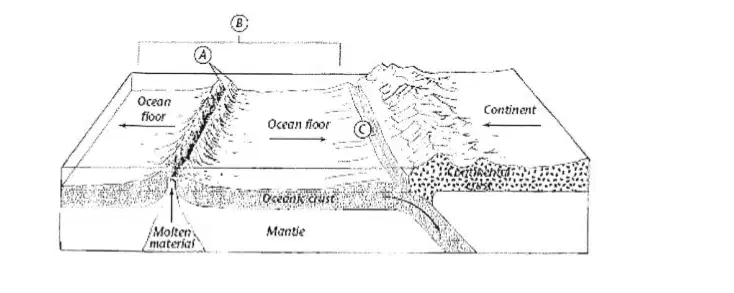
The feature of the ocean floor shown at A is called:
Mid-ocean ridge
Abyssal plain
Continental shelf
Ocean trench
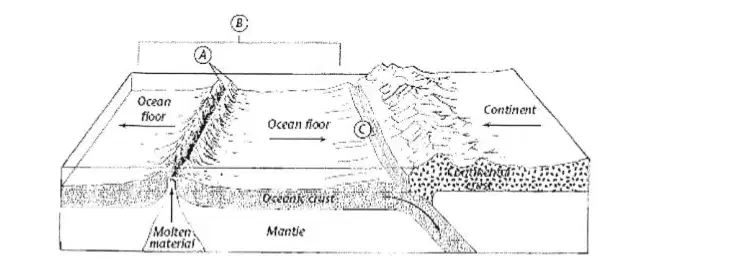
Old oceanic crust is affected as new molten material rises from the mantle in which of the following ways?
It is pushed away and eventually recycled back into the mantle.
It becomes thicker and forms new land masses.
It remains unchanged and stays at the ocean floor.
It rises to the surface and forms mountains.
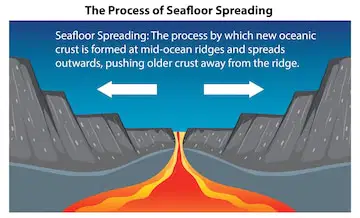
Three kinds of evidence scientists have found to support the idea of ocean floor spreading from the ridge are:
magnetic stripes on the ocean floor, age of rocks, and evidence from drilling samples
movement of continents, volcanic eruptions, and tidal waves
formation of mountains, earthquakes, and river erosion
changes in ocean currents, weather patterns, and fish migration
A device that scientists use to map the ocean floor is _________________ .
sonar
barometer
microscope
telescope
The feature on the ocean floor at C is called a(n) _________________?
deep-ocean trench
mid-ocean ridge
continental shelf
seamount
The process that continually adds new material to the ocean floor is called _______________.
sea-floor spreading
subduction
continental drift
erosion
The process by which the ocean floor sinks into the mantle is called _________________.
subduction
evaporation
erosion
uplift
A chain of underwater mountains along which sea-floor spreading occurs is a ________________________.
mid-ocean ridge
trench
continental shelf
abyssal plain
Match the ocean floor features to their descriptions
Continental Shelf
An area of shallow water at the beach
Ocean Trench
A deep valley at the bottom of the ocean
Continental Slope
A drop off after the continental shelf
Abyssal Plain
An area of deep under water flat land

