
Font size
 Worksheets
7th Grade Unit 3 Review
Total questions: 20
Worksheet time: 13mins
Which of the following was a characteristic of the Spanish Colonial Era in Texas?
Forts were built to protect American Indian tribes in Texas.
American Indian tribes were discouraged from settling in Texas.
Missions were built to confirm Spanish claims to the land in Texas.
Spanish explorers negotiated treaties to trade and travel safely in Texas.
Which of the following best describes the defining characteristics of the Age of Contact era in Texas history?
Anglo and Spanish settlers established colonies in Texas.
American Indian tribes were driven out of Texas by French settlers.
Spanish explorers and French explorers both claimed land in Texas.
Spanish colonists abandoned exploration of Texas after not finding any gold.
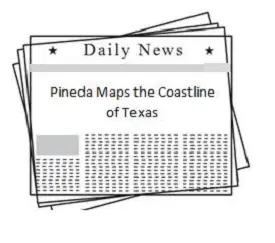
During which year does the event of the headline occur?
1519
1607
1658
1718
Which major Texas city was founded by Spanish colonists in 1718?
Corpus Christi
El Paso
Laredo
San Antonio
Which of these explorers landed at Matagorda Bay while searching for the mouth of the Mississippi River?
Rene-Robert Cavelier Sieur de La Salle
Hernando Cortés
Álvar Núñez Cabeza de Vaca
Francisco Vásquez de Coronado
Which motivation led early European explorers to investigate the Americas?
Desire to find gold
Desire to spread democracy
Desire to leave overcrowded cities
Desire to escape government monarchies
Furthermore, we were traveling without an interpreter, unable to speak to the Indians, and therefore had a difficult time communicating with them. I added that we did not know what we wanted from the land, and that we were entering a land for which we had no description, without knowing what kind of place it was, nor by what people it was inhabited, nor in which part of it we were. Moreover, we did not have sufficient provisions to enter an unknown land. Since little remained on the ships, each man could receive for the journey inland no more rations [supplies] than one pound of biscuit and one of bacon. I said that I thought we should set sail and seek a harbor and a land more suitable for settlement, since what we had seen so far was as desolate [empty] and as poor as any that had ever been found in those regions.
—The Relation of Álvar Núñez Cabeza de Vaca (1542)
How did Cabeza de Vaca’s written account influence future Spanish exploration in the region of Texas?
It emphasized the need for military reinforcements for expeditions to the area.
It highlighted the need for interpreters to communicate with Indigenous people in the area.
It illustrated the importance of planning and securing resources for survival in unfamiliar terrain.
It demonstrated the importance of building alliances with rival European powers before entering the region.
We named this island the Isle of Misfortune. The people we found there are tall and well built. They have no weapons other than bows and arrows, which they use with great skill. . . . The women do the hard work. They live on this island from October through February. They live on the roots that I mentioned, pulled from under water in November and December. They have cane weirs [structures built in the water used to trap fish] but there are no fish left by this season; from then on they eat the roots. At the end of February, they move on to other places to find sustenance, because at that time the roots are beginning to sprout and are not good.
—The Relation of Álvar Núñez Cabeza de Vaca (1542)
Based on this excerpt, how did Indigenous people living in the region of Texas adapt to their environment for survival?
They built tools to help them gather food.
They stored fish to use throughout the winter.
They dug irrigation canals to water their crops.
They traded with other tribes for fresh food and water.
Why did the Spanish decide to move Mission La Bahia from the coast to along the Guadalupe River?
There was a lack of fresh water resources in the coastal area.
There were constant threats of French attacks on the mission.
There were conflicts with American Indian tribes in the region.
There was a growing need for more grazing land for the cattle herds.
Which group likely viewed the construction of new Spanish missions with suspicion?
Catholic priests
American Indian tribes
Conquistadors
Anglo settlers
Fray Damián Massanet and Alonso De León led a successful expedition for Spain into East Texas in 1690. This expedition came about because the Spanish were concerned about —
settlers going missing in the region
slave rebellions occurring in the region
Indian tribes attacking missions in the region
French forces establishing settlements in the region
Which Spanish Catholic priest cooperated with French authorities in Louisiana to bring missions to East Texas?
José de Escandón
Francisco Hidalgo
Antonio Margil de Jesús
Fray Damián Massanet
The meaning of places can change drastically through time. There is no better example of this transition than the remains of the mission complex established by Franciscan missionaries as Mission San Antonio de Valero in 1718. Known today as The Alamo, this Spanish mission complex was the first of the San Antonio missions founded. . . . The mission eventually became a community of Spanish, Mexican, and American Indian Catholics.
—Mission San Antonio de Valero, The Alamo—Spanish Colonial Missions of the Southwest Travel Itinerary
nps.gov (accessed April 10, 2025)
Why was this mission originally established AND what effect did it have on the Indigenous people in the area?
Think about the question carefully. Then record your answer.
The Spanish word vaquero refers to a —
cowboy
mayor
sheriff
soldier
Many cities in Texas, such as El Paso and San Antonio reflect the cultural legacy of —
France
England
Portugual
Spain
In what way did the building of missions in Texas change the culture of the region?
Farming methods were changed.
Large areas of forests were cut down.
New religious traditions were introduced.
Rivers in southern parts of Texas were polluted.
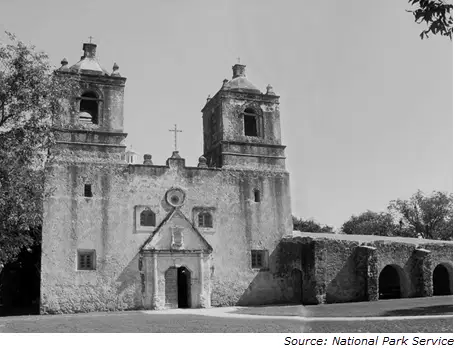
The image below is of a church in San Antonio.
Based on its design and features, which cultural influence is most clearly reflected in the architecture of this church?
Pueblo Indian architecture
German architecture
Spanish architecture
Czech architecture
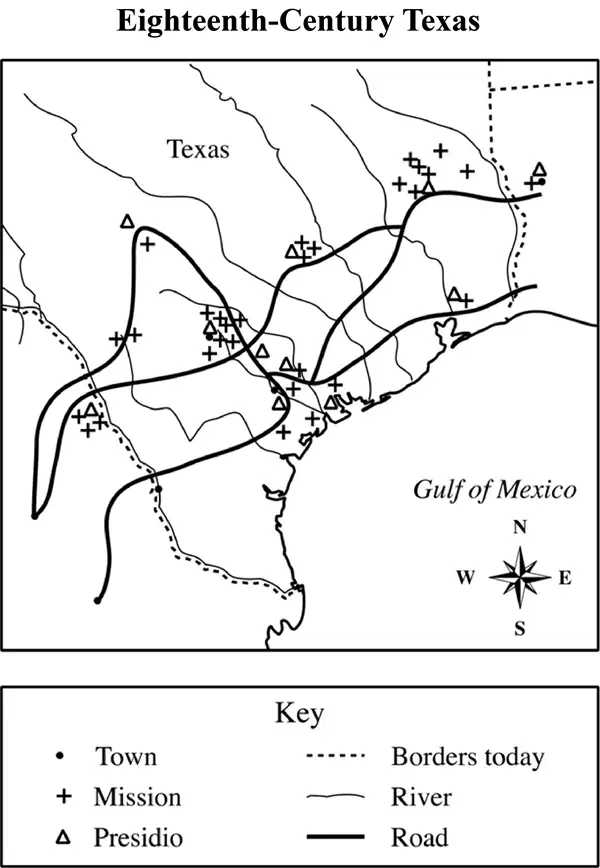
Which generalization about the establishment of towns is best supported by evidence on the map?
Towns were mainly located along the Rio Grande River.
Towns developed in the mountainous regions of Texas.
Towns were well established before the building of the missions.
Towns tended to grow near the location of missions and presidios.
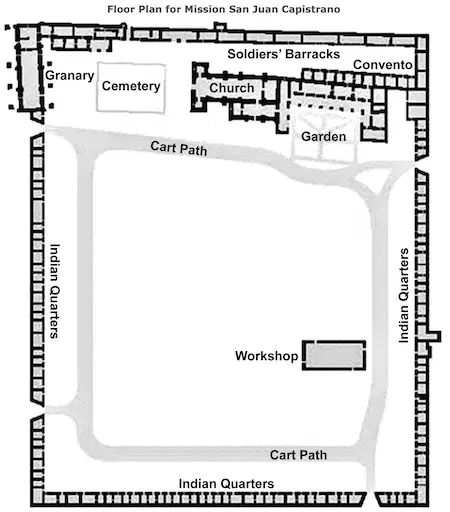
Which evidence best supports the conclusion that the diagram is a mission?
There are barracks and a workshop.
There is a plaza and a cemetery.
There is a cemetery and a path.
There are Indian quarters and a church.
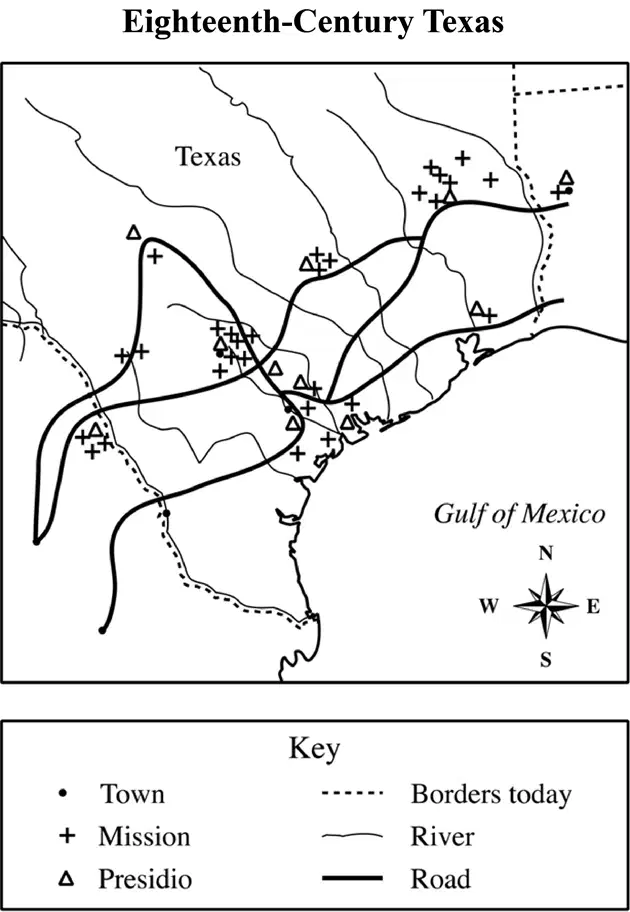
Analyzing the map above, which physical geographic feature influenced where the missions and presidios were built in Texas?
rivers
mountains
cities
heavy rainfall

