
 Worksheets
Industrialization Test H
Total questions: 30
Worksheet time: 15mins
What time span is indicated for the Industrial Age on this slide?
1776–1800
1800–1876
1876–1900
1900–1920
Which phrase best identifies the main topic introduced on the slide?
The Digital Revolution
The Industrial Age
The Agricultural Era
The Information Age
What cause-and-effect relationship is most directly stated in the content?
Rapid growth in manufacturing led to the U.S. becoming an industrial leader.
Immigration caused a decline in industry.
Agriculture replaced manufacturing as the main sector.
Military victories caused factories to close.
Which phrase indicates the approximate time when the United States achieved industrial leadership?
Early 1800s
Mid-1890s
Late 1700s
Early 2000s
Which material is produced more quickly using the Bessemer process described?
Aluminum
Steel
Copper
Tin
Who developed a way in the 1850s to make steel quickly and cheaply?
Alexander Graham Bell
Henry Bessemer
James Watt
Thomas Edison
Which term best describes business leaders like Cornelius Vanderbilt mentioned in the content?
Inventors
Farmers
Entrepreneurs
Politicians
Which statement best explains the relationship between consolidation and speed in the railroad industry described here?
Consolidation led to faster travel by unifying routes and management
Consolidation slowed travel due to larger bureaucracies
Speed had no connection to consolidation
Consolidation only affected ticket prices
Who is credited with the invention of the electric light bulb according to the passage?
Nikola Tesla
Thomas Edison
Alexander Graham Bell
James Watt
During which historical period was Thomas Edison described as an important inventor?
The Renaissance
The Second Industrial Revolution
The Great Depression
The Space Age
Which of the following is listed as one of Edison's inventions besides the light bulb?
The telegraph
The motion picture camera
The steam engine
The radio
Which pair correctly matches Edison with something he developed, based on the text?
Edison — telephone
Edison — first power plant
Edison — internal combustion engine
Edison — airplane
According to the passage, approximately how many patents did Thomas Edison hold?
More than 100
Exactly 500
More than 1,000
About 50
According to the slide, what caused the use of electricity to spread quickly?
Government mandates
Increased competition among electric companies
Discovery of coal
Invention of the steam engine
Which economic concept is illustrated by the statement that competition increased among electric companies?
Monopoly
Barter system
Market competition driving innovation and adoption
Price controls by the government
Which inference is most supported by the slide’s text about electricity’s spread?
Lower costs and improved service likely resulted from competition.
Government bans forced companies to merge.
Electricity was less useful than gas lighting.
Factories closed due to unreliable power.
In which month and year was the telephone patented, according to the text?
January 1870
March 1876
July 1888
December 1865
Which invention is directly connected to earlier telegraph technology by its nickname in the passage?
Radio
Telephone
Typewriter
Phonograph
What type of fuel powered the first automobile invented by the Duryea brothers in the U.S.A.?
Steam
Electricity
Gasoline
Diesel
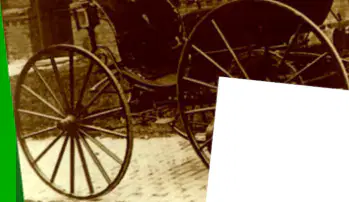
Based on the images, which feature distinguishes early automobiles shown from modern cars?
Use of four wheels
Enclosed cabins with air conditioning
Large spoked wheels and open carriage-style bodies
Presence of seatbelts
What type of flight did the Wright brothers achieve first?
Unpowered gliding
Powered flight
Supersonic flight
Commercial passenger flight

Which set lists three major inventions of the 1800s with their inventors?
Telephone — Alexander Graham Bell; Lightbulb — Thomas Edison; Steel process — Henry Bessemer
Telephone — Thomas Edison; Lightbulb — Alexander Graham Bell; Steel process — Eli Whitney
Airplane — Wright brothers; Radio — Samuel Morse; Steel process — Nikola Tesla
Steam engine — Henry Ford; Telegraph — Guglielmo Marconi; Lightbulb — Orville Wright
Some figures in the cartoon have their bodies or bags labeled with industries like 'steel' or 'copper.' What does this labeling most likely represent?
They are tourists from different cities.
They symbolize powerful industrial trusts.
They are members of a sports team.
They are news reporters covering a story.
Which phrase in the content suggests businesses can make their own decisions?
Government regulation
Free enterprise
Public management
Central planning
According to the material, what term describes Americans who started their own businesses to become rich?
Industrial workers
Entrepreneurs
Investors
Philanthropists
What primary goal motivated many Americans during this time period to start their own businesses?
To avoid taxes
To become rich
To work fewer hours
To serve in government
Which phrase best describes the legal status of corporations?
They have no legal rights separate from owners
They have many of the same legal rights as individuals
They exist only as informal agreements
They cannot own property or enter contracts
If an investor owns more stock in a corporation, which outcome is most directly affected according to the material?
Their voting rights for government offices
Their percentage of the company’s profits
The company’s tax rate
The market price of all shares
According to the material, what are stockholders in a corporation personally responsible for regarding business debts?
They are fully responsible for all corporate debts
They are responsible only up to the amount of their personal assets
They are not personally responsible for the debts of the business
They are responsible only if they sell their shares
If a corporation fails, what is the maximum financial loss to stockholders described in the material?
All of their personal property
Only the money they invested
Half of their investment
Their investment plus any interest owed

