
 Worksheets
Chapter 5 & 6 Test
Total questions: 18
Worksheet time: 9mins
Name
Class
Date
1.
Scientists have classified the sea otter as a keystone species in communities along the Pacific coast of North America. This classification depends on which property of the sea otters?
a)
Sea otters have the highest population in the community.
b)
Sea otters act to maintain a wide variety of other populations in the community.
c)
Sea otters are the largest, most massive members of the community.
d)
Sea otters provide food for all of the predators of the community.
2.
Walleyes and northern pike are both species of fish that live in freshwater lakes. Many lakes maintain large, healthy populations of both of these fish species year after year. Which statement about walleyes and northern pike is MOST USEFUL in explaining how they are able to live together in the same habitat?
a)
The two species are adapted to eat different types of food
b)
The two species are adapted to eat the same types of food
c)
The two species have different ranges of tolerance to oxygen content in water
d)
The two species have different ranges of tolerance to temperature
3.
A lake is home to many native fishes and aquatic plants. Which of these events is MOST likely to threaten the biodiversity of the lake ecosystem?
a)
a 20% increase in the population of one of the native fish species
b)
the arrival of migrating birds that prey on the native fishes
c)
the introduction of a nonnative fish species that has no natural enemies in the lake
d)
a storm that temporarily swells the lake and floods the surrounding land
4.
Sara is mapping trees in a section of land. She observes that some of the trees are clumped together, some are uniformly separated, and some appear to be spaced randomly. What is she describing?
a)
the population density
b)
the population distribution
c)
the population growth
d)
the population outline
5.
Thomas is describing an example of secondary succession. Which of the following events is MOST USEFUL for him to include?
a)
Lichens begin growing on rocks that formed from a volcanic eruption.
b)
Many fishes die in a pond when oxygen levels decrease.
c)
The populations of wolves and rabbits change in a cyclical pattern.,
d)
Small plants and animals return to the land after a forest fire.
6.
Murray is observing a bacterial colony that is growing in agar in a Petri dish. Agar is processed seaweed. Murray calculates that the population doubles in size every 32 hours.
Which conclusion is supported by Murray's observations?
a)
The agar and air in the Petri dish are providing all of the resources needed by the bacteria.
b)
The bacterial colony is growing in all regions of the agar in the Petri dish.
c)
The bacterial colony will continue doubling in size indefinitely.
d)
The agar and air in the Petri dish are limiting factors on the growth of the bacterial colony.
7.
Limiting factors that operate more strongly when population density is high, such as competition, disease, stress from overcrowding, and predation, are called _________?
a)
density independent limiting factors
b)
keystone species
c)
climax community
d)
density dependent limiting factors
8.
Which of the following describes a benefit of biodiversity to an ecosystem?
a)
decreases the energy flow through the ecosystem
b)
allows the ecosystem to withstand environmental changes
c)
increases the maximum number of trophic levels
d)
increases the maximum biomass of the ecosystem
9.
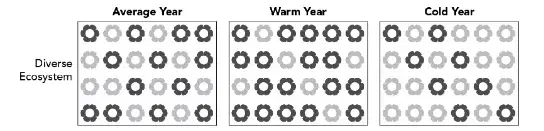
In this model, the dark and light wheel-like shapes represent different members of an animal species in an environment. The members have different tolerance to an unusually warm climate and an unusually cool climate.
Which conclusion about biodiversity is MOST STRONGLY supported by this model?
a)
Biodiversity involves varitions within a species, but not among several species.
b)
Biodiversity has no or little effect on the survival of a species to many environmental changes.
c)
Biodiversity may help species to survive either warmer or cooler temperatures, but not both.
d)
Biodiversity may help a species survive a variety of environmental changes.
10.
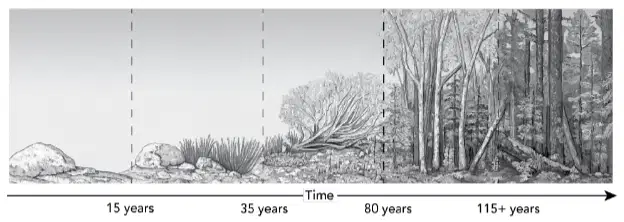
Zoe is studying a mountainous region where a glacier is melting and retreating. She constructs the timeline to show her prediction of how the region will change over time.
Why are the changes in the diagram classified as primary succession and not secondary succession?
a)
The process results in the appearance of a climax community.
b)
Many intermediate communities appear before the climax community.
c)
The climax community appears after hundreds of years.
d)
The process begins with pioneer species growing on bare rock.
11.
Which of the following events would be MOST LIKELY to permanently disturb the climax community that Zoe predicts will arrive?
a)
a fire that burns down half of the trees in the community
b)
the introduction of grasses and other small plants
c)
the spread of an invasive fungus that kills the oak trees
d)
the arrival of deer that feed on the leaves of the trees
12.
A rabbit population is affected by parasitism and disease, both of which are density-dependent limiting factors. Which statement describes the effects of parasitism and disease on the rabbits?
a)
Parasites and disease weaken or kill a constant percentage of the rabbit population, regardless of its density.
b)
As the density of the rabbit population increases, parasites and disease weaken or kill a greater percentage of rabbits.
c)
As the density of the rabbit population increases, parasites and disease weaken or kill a lesser percentage of rabbits.
d)
Parasites and disease weaken or kill mostly the youngest and oldest rabbits, and not the rabbits of average age.
13.
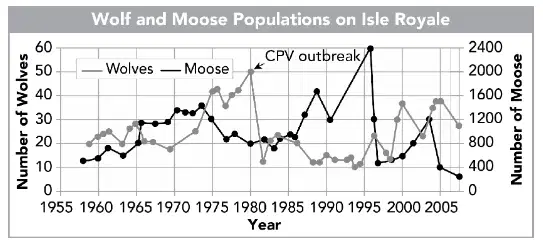
The graph shows the changing populations of wolves and moose in Isle Royale National Park. Wolves are predators, and moose are their prey.
Which of the following pairs of populations is most likely to increase and decrease in a similar pattern to the wolves and moose?
a)
Moose and balsam fir, which are the favorite food plants of moose
b)
Very old wolves and young wolf pups
c)
Moose and the beneficial bacteria that live in the digestive tracts of moose
d)
Male wolves and female wolves
14.
A hurricane blows across a Caribbean island. The storm flattens trees, and it downs or washes away a large number of plants and animals. As a result of the storm, the carrying capacity of the island is temporarily reduced for many of the island species.
How is the storm classified as a limited factor?
a)
The storm is a density-independent limiting factor, because its effect depends on the size and density of a population.
b)
The storm is a density-dependent limiting factor, because its effect depends on the size and density of a population.
c)
The storm is a density-independent limiting factor, because population size and density do not alter the storm's effect.
d)
The storm is a density-dependent limiting factor, because its effect depends on the strengths of its wind and rainfall.
15.
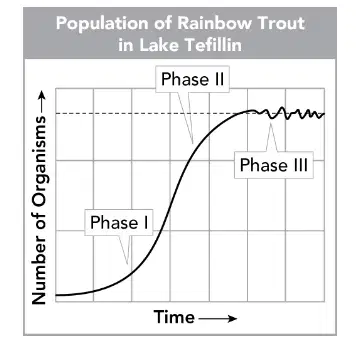
Lake Tefillin is a large freshwater lake that is popular for recreation. One year, the managers of the lake introduce a population of rainbow trout to the lake. The graph shows the growth of the population over several years.
Which best describes the growth pattern of the rainbow trout?
a)
Exponential growth, because the lake provides unlimited resources to the population.
b)
Logisitical growth, because the effect of limiting factors increases with the population size.
c)
Exponential growth, because limiting factors are always affecting the population.
d)
Logistic growth, because the lake provides unlimited resources until the population reaches carrying capacity.
16.
The first species to populate an area during succession is a ________________.
a)
keystone species
b)
climax species
c)
endangered species
d)
pioneer species
17.
A species that if removed from an ecosystem could cause the entire ecosystem to collapse is called a ______________.
a)
keystone species
b)
climax species
c)
endangered species
d)
pioneer species
18.
A climax community does not change once it has been established.
a)
True
b)
False
100 %

