
 Worksheets
Gravitational Forces
Total questions: 15
Worksheet time: 8mins
Consider Kepler’s second law. What would happen if the distance between an orbiting body and a star decreased?
The velocity of the orbiting body would initially increase, then decrease.
The velocity of the orbiting body would decrease.
The velocity of the orbiting body would initially decrease, then increase.
The velocity of the orbiting body would increase.
What is the orbital velocity of a satellite 3450 km above the Earth’s surface? Recall that the radius of Earth is 6378.1 km.
6368 m/s or 6370 m/s (both are acceptable based on rounding)
4500 m/s
8000 m/s
12000 m/s
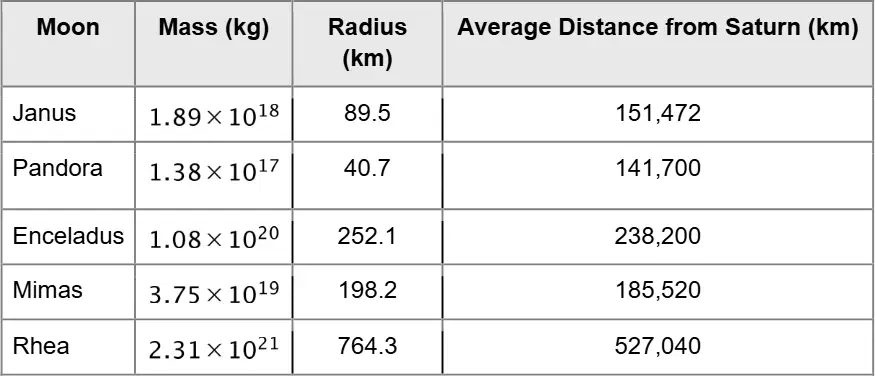
Order the moons by gravitational strength at the surface, from least acceleration due to gravity to greatest acceleration due to gravity.
A. Rhea, Enceladus, Mimas, Janus, Pandora
B. Pandora, Rhea, Janus, Enceladus, Mimas
C. Pandora, Janus, Mimas, Enceladus, Rhea
D. Enceladus, Pandora, Janus, Rhea, Mimas
If a space shuttle with a mass of 75,000.0 kg is 1000.00 km from the surface of Mars, what gravitational force would the space shuttle experience due to Mars? The mass of Mars is approximately 0.641710 \times 10^{24} kg and its radius is 3396.20 km. Enter your answer here. (Use the formula: F=G∗m1∗m2/r2 )
166,200 N
1,662,000 N
16,620 N
66,200 N
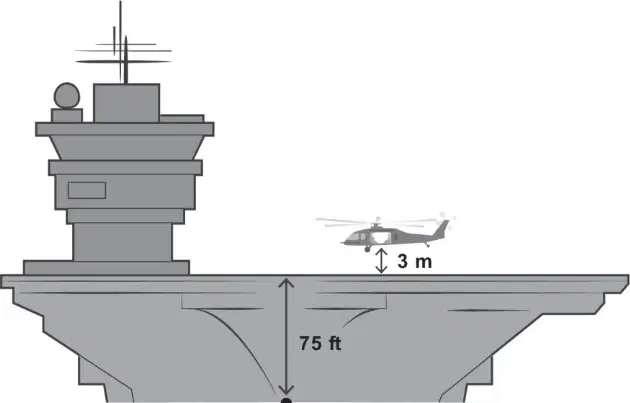
A helicopter is hovering 3 meters above an aircraft carrier. The magnitude of the gravitational pull between the helicopter and the aircraft carrier is 0.10000 N. Given that the mass of the aircraft carrier is about 99.000 million kg, what is the mass of the helicopter? The distance from the surface of the aircraft carrier to its center is approximately 75 ft.
12,824 kg
20,268 kg
10,119 kg
13,600 kg
Convert 75 ft to meters using the conversion factor 1 ft = 0.3048 m. What is the result of the conversion?
22.86 m
24.38 m
20.50 m
18.75 m
What is the value of the gravitational constant (G) given in the worksheet?
6.67 × 10^{-11} N·m^2/kg^2
9.81×10⁻¹¹N⋅m2/kg2
3.00×10⁻⁸N⋅m2/kg2
1.00×10⁻¹⁰N⋅m2/kg2
Which formula is used to calculate the gravitational force (F) between two masses?
F = m1×m2/r2
F=Gm1m2/r2
F=Gm1/r2
F=Gm2/r2
What is the rearranged formula to solve for m2?
m2=(Gm1)(Fr2)
m2=Fr2Gm1
m2=Gr2Fm1
Fm1Gr2
The mass of a beehive is approximately 24.0 kg. The mass of an adult honey bee is 100.0 mg. If the honey bee is 2.00 miles from the hive, what is the magnitude of the gravitational force on the bee?
4.98 × 10⁻¹⁷ N
1.55 × 10⁻²⁰ N
1.54 × 10⁻¹⁶ N
5.00 × 10⁻¹³ N
The mass of a beehive is 24.0 kg. The mass of an adult honey bee is 100.0 mg. The distance between them is 2.00 miles. What is the magnitude of the gravitational force on the bee?
1.55 × 10⁻²⁰ N
2.45 × 10⁻¹⁸ N
3.67 × 10⁻²² N
7.89 × 10⁻¹⁹ N
If the mass of a single raindrop in a cloud is 0.0340 g, what is the gravitational force that the raindrop experiences due to the cloud once it has fallen 7.00 km from the center of mass of the cloud? Assume that the mass of the cloud is 511,000 kg.
1.62 × 10⁻¹³ N
2.37 × 10⁻¹⁷ N
1.70 × 10⁻¹⁰ N
2.30 × 10⁻¹¹ N
Choose the option that correctly identifies the missing terms, in order of their appearance in the sentences. Consider Kepler’s _____ law, which describes the period of non-circular orbits. If the mass of the orbited object is increased by a factor of 64, then the semimajor axis would need to increase by a factor of _____ to keep the orbital period unchanged.
A. second; 4
B. third; 4
C. second; 8
D. third; 8
Consider a celestial body orbiting a star. Read each of the sentences that describe changes to variables in Kepler’s third Law. Choose the option that correctly pairs each sentence with causing the orbital period T of the celestial body to decrease, increase, or remain unchanged.
A. T increases: 1, 2; T decreases: 3, 6; T remains constant: 4, 5
B. T increases: 5, 6; T decreases: 3, 4; T remains constant: 1, 2
C. T increases: 4, 2; T decreases: 3, 5; T remains constant: 1, 6
D. T increases: 5, 6; T decreases: 2, 3; T remains constant: 1, 4
What is the instantaneous velocity of Titan, a moon of Jupiter, if the mass of Jupiter is 1.9000×1027 kg and the semimajor axis of Titan’s orbit is 1.2200×10⁶ km ?
10,195 m/s
5,200 m/s
15,000 m/s
2,800 m/s

