
 Worksheets
25-26 WAVES TEST REVIEW
Total questions: 25
Worksheet time: 15mins
Which of the following is a characteristic of a mechanical wave but not a characteristic of an electromagnetic wave?
The wave needs a medium to transmit energy.
The wave maintains a constant speed within a medium.
When the amplitude of the wave increases, the speed of the wave increases.
When the frequency of the wave increases, the wavelength of the wave decreases.
Some wave characteristics depend upon how the wave is produced. Other wave characteristics depend upon the properties of the medium. Which one wave characteristic is solely dependent upon the properties of the medium and independent of the type of wave?
wavelength
frequency
amplitude
time
speed
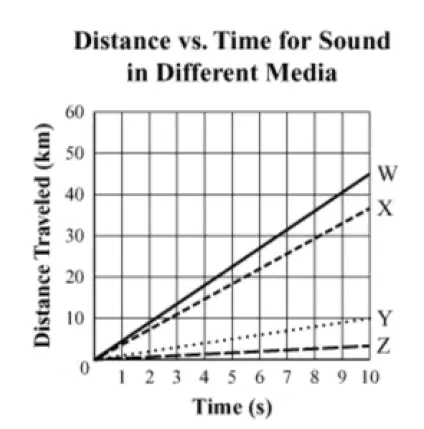
Students are studying how sound travels in different media. The graph below shows the distance that sound travels over a period of time in four different media, W, X, Y, and Z. The media include all three states of matter. Based on the data in the graph, the students calculated the velocities of the sound in the four media. Which of the following conclusions can the students make based on their calculations?
A. Medium Z is most likely a gas
B. Medium Y is most likely a solid
C. Media W and X are most likely liquids
D. Medium W is most likely a gas and medium X is most likely a liquid
Three wave properties are listed below. • Property 1: transverse • Property 2: travel at the speed of light through a vacuum • Property 3: travel faster through solids than through gases Electromagnetic waves have which of these properties?
only property 1
only properties 1 and 2
only properties 2 and 3
only property 3
A wave with a wavelength of 1.6 m is generated in a pond with a frequency of 30.0 Hz. What is the speed of this wave?
0.533 m/s
18.75 m/s
4.8 m/s
48.0 m/s
Which of the following describes a difference between electromagnetic waves and mechanical waves?
Only mechanical waves have long wavelengths.
Only mechanical waves require a medium to travel.
Only electromagnetic waves have a range of frequencies.
Only electromagnetic waves transfer energy from one place to another.
Which of the following best describes the difference between a compression and a rarefaction in a sound wave?
A. Compressions are areas of spread apart particles and rarefactions are areas of tightly packed particles.
B. Compressions are the highest point on the wave and rarefactions are the lowest point.
C. Compressions are the lowest point on the wave and rarefactions are the highest point.
D. Compressions are areas of tightly packed particles and rarefactions are areas of spread apart particles.
Which of the following statements describes the motion of air particles as a sound wave moves across a room?
The air particles move in circles inside the sound wave.
The air particles move across the room with the sound wave.
The air particles move back and forth, parallel to the direction of the sound wave.
The air particles move back and forth, perpendicular to the direction of the sound wave.
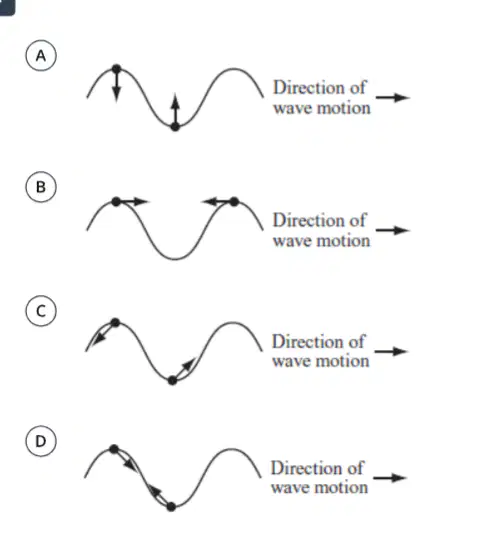
Which of the following diagrams represents the motion of particles in a transverse wave?
Diagram A: Arrows are perpendicular to the direction of wave motion
Diagram B: Arrows are parallel to the direction of wave motion
Diagram C: Arrows are at an angle to the direction of wave motion
Diagram D: Arrows are at an angle to the direction of wave motion
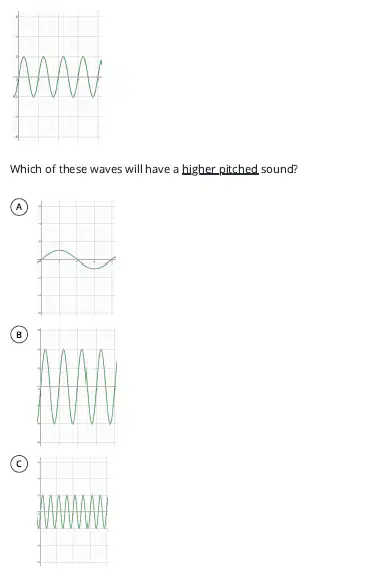
Which of the waves below the first wave in the diagram will have a higher pitched sound than the top wave.
A. [Diagram A]
B. [Diagram B]
C. [Diagram C]
As the frequency of an electromagnetic wave increases, which of the following will decrease?
energy
wavelength
period
velocity
A wave is moving through a medium. A point on the medium is undergoing many up and down oscillations in a short amount of time. This is conclusive evidence that the wave has a relatively high____.
wavelength
frequency
amplitude
time period
speed
5 complete waves pass a point every 1 second. What is the time period of the wave?
4 s
0.25 s
1 s
0.20 s
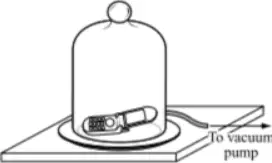
The diagram below shows a cell phone inside a glass jar that is sealed and connected to a vacuum pump. The vacuum pump is turned on and removes the air from inside the jar. Which of the following statements explains what happens when someone calls the cell phone?
The signal does not reach the phone because sound needs a medium to travel through.
The signal does not reach the phone because the signal needs a medium to travel through.
The phone receives the signal and can be heard because both the signal and sound can travel in a vacuum.
The phone receives a signal but cannot be heard because the signal can travel in a vacuum, but sound cannot.
Which property of waves explains why a straight flower stem may look bent when placed in a glass of water?
absorption
diffraction
reflection
refraction

Compare the frequency and wavelength of the wave on the guitar string to the frequency and wavelength of the sound waves in the air. Which of the following statements is correct?
HINT: Remember frequency determines pitch and speed changes because of different medium - THINK ABOUT THIS BEFORE YOU ANSWER.
The frequency is the same for both, but the wavelength is longer in air than on the string.
The frequency and wavelength are both the same for the string and the air.
The frequency is higher in air, and the wavelength is shorter on the string.
The frequency is lower in air, and the wavelength is longer on the string.
Draw the speed triangle on your paper. Use it to answer the question below:
Wavelength = 10 m and wave speed is 100 m/s, what is frequency?
Draw the speed triangle on your paper. Use it to answer the question below:
Wavelength = 150 m and wave speed is 2 m/s, what is frequency?
Draw the speed triangle on your paper. Use it to answer the question below:
Frequency = 150 Hz and wave speed is 2 m/s, what is the wavelength?
0.01333 m
0.1 m
1 m
0.5 m
Draw the speed triangle on your paper. Use it to answer the question below:
Wavelength = 15 m and frequency is 10 m/s, what is the wave speed
Select all that are true (choose two)
Wavelength undergoes regular change
Wavelength is constant unless energy is added or taken away which could be done by the medium it travels through.
Waves have a regular pattern
Waves travel at a random pattern
Waves do not have an amplitude.
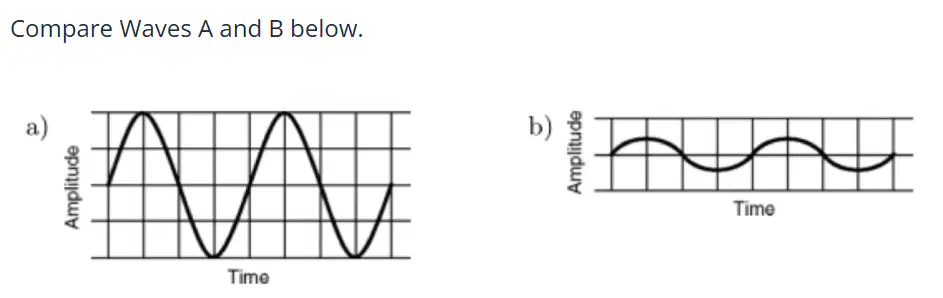
Which of the following statements correctly identifies the differences between these waves?
Choose all that apply - 2.
Wave A has a smaller amplitude than Wave B.
Wave A has a smaller wavelength than Wave B.
Wave A has a larger amplitude than Wave B.
Wave A has a larger wavelength than Wave B.
Both waves have the same wavelength
Waves transport energy along a medium. Which one wave property is an indicator of the amount of energy transported by a mechanical wave?
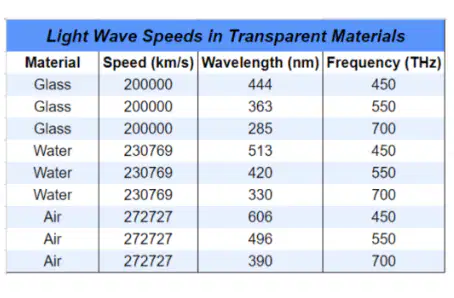
Based on the data in the table, when wave speed decreases wavelength (a) .
Based on the data in the table, light travels (a) in liquids than in solids. .

