
 Worksheets
The Engineering Process
Total questions: 40
Worksheet time: 23mins
Engineers must build a model of a design to find out how well it actually works. What is another word for this model?
prototype
design
conclusion
product
Refrigerators, pencil sharpeners, and backpacks are just a few items that engineers designed. What is meant by the word design?
to take plans and drawings and make a prototype using them
to brainstorm ideas about how to solve an engineering problem
to conceive an idea and prepare plans and drawings for it to be built
to take materials such as wood and metal and shape them into something
A cellular phone is designed to help people communicate. How would a cellular phone be classified?
as a tool
as a system
as a process
as a product
Metersticks, screwdrivers, and calculators are all used to shape, build, or produce other things. How can these objects be grouped?
as tools
as designs
as systems
as processes
Trains, railways, and safety signals at rail crossings all work together to move goods and people from place to place. What do all of these parts make up?
a design
a model
a process
a system
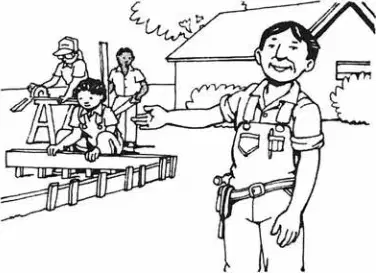
Mr. Ruiz and his crew are working at a construction site. Based on evidence in the picture, what can you claim?
Feedback is being used in a designed system.
Tools are being used during a technology process.
An output is being used to build a technology product.
A designed system is being used to design technology.
Mr. Sharpe is concerned because the old wooden steps outside his house are becoming loose. He wants to design a safer set of steps. What should Mr. Sharpe do first?
record test data
design a solution
build a prototype
brainstorm solutions
A company wants to build a new type of spaceship for transporting astronauts to the moon. What should the company do first?
build a model
identify needs
test the prototype
evaluate the design
Camille’s family has several glass bowls that need to be protected during a move. Camille designs a way to pack the bowls. What would be the best way to test her design?
make a prototype and test it using an egg
make a prototype and test it using a rock
make a prototype and test it using the bowls
make a prototype and test it using a plastic ball
An engineer has designed and built a prototype to improve the brake system of a car. What is the next step that the engineer should take in the process?
Test the working prototype.
Make sketches of the prototype.
Evaluate the design for revision.
Collect and analyze the test results.
A company decides to design and produce a new type of ice skate. Which of the following should the company do first?
evaluate the new skate design
build a prototype of the skates
identify a need for new skates
test the design of their new skates
Lonni drops a carton of eggs while helping her father unload groceries. She decides to make a new type of carton that would protect the eggs better. What is the first step Lonni should take in the design process?
build the design
build a prototype
identify the problem
brainstorm a solution
Errol wants to design and build a structure that will protect tomato plants from heavy rains while still letting in sunlight. He comes up with four ideas. Which one would best help him meet his design goal?
a wooden case
mosquito netting
a clear plastic box
a cardboard covering
Every technology has some risks. For example, cars cause some types of air pollution. Which best shows technology and its risk?
cell phones: air pollution
light bulbs: wrist injuries
dishwasher: risk of disease
computer games: less exercise
Students in a class are designing a model amusement park ride. A cart slides along a rail until it hits a barrier and stops. How might the students prevent damage to the cart when it hits the barrier?
make the rail smoother so the cart rolls faster
make the barrier of concrete so it won’t break
increase the cart’s speed as the cart approaches the barrier
make the barrier out of foam to absorb the cart’s impact
Jacob has noticed that when he opens his bedroom door, the doorknob hits the wall. He decides to design something to absorb the force of the opening door. He has identified the problem. What is the next step in his design process?
Set a purpose.
Brainstorm solutions.
Take notes on his design.
Sketch a possible solution.
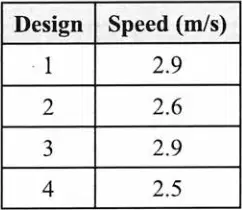
A student is designing a new model airplane. The table shows the student’s data when testing the designs. To develop the fastest design, what should the student do next?
Use Design 1 because it had the fastest speed.
Use Design 3 because it had the fastest speed.
Choose another design that will give better results.
Combine elements from Design 1 and Design 3 and test again.
Tan designed a three-foot-tall wooden house for his kitten. Then he realized that the kitten could not scratch its claws against the smooth wooden walls. Tan decided to glue some carpeting on the outside of the kitten’s house. What did Tan
glued carpeting to the outside so the kitten could scratch its claws
painted the house a different color
added a door for the kitten
made the house taller
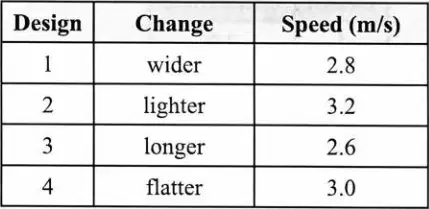
A company plans to make a new type of snow sled. The company makes several changes to its design and then measures how fast each model slides down a snowy hill. The table shows the average speeds of several tests of each design.
1
2
3
4
Olivia and Diane designed two different toy cars. They made one prototype red and the other blue. The red car moved faster, but the blue one traveled farther. To decide which prototype is best, what do Olivia and Diane need to review?
test data
design goals
redesign process
brainstorming results
What did the company do?
made a plan
tested a prototype
evaluated solutions
communicated results

During which step do you create a physical, interactive representation of your solution?
Prototype
Ideate
Test
Define

After testing and evaluating your prototype design you would __________.
imagine and plan
improve the design
build a prototype
test and evaluate

Match the following steps of the engineering design process
1st
Define the plroblem
2nd
Do your research
3rd
Develop a possible solution
4th
Design your solution
5th
Build a prototype
Before you create your design, you must research to find out about existing solutions to similar problems, and to avoid _____________ that were made in the past.
successes
mistakes
lessons
requirements
Why is it super important to have a crystal-clear definition of the problem before we dive into brainstorming solutions?
It makes it a breeze to sell the final product
It helps focus the team's efforts on relevant solutions, like a laser!
It's not important; brainstorming is a wild ride with or without it
It ensures the prototype will work perfectly, no hiccups!
Once you've figured out what problem you want to tackle, you need to _________.
do your research
build a prototype
design your solution
test your solution
Imagine you're a detective in the world of engineering and design. What's the first crucial step in solving the mystery of creating something awesome?
To pick the coolest team of inventors and creators.
To ensure the treasure at the end is worth a fortune.
To figure out exactly what puzzle needs cracking.
To select the shiniest tools and materials for crafting your invention.
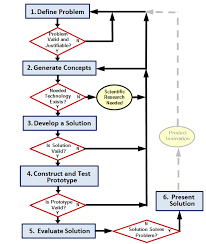
Why are there arrows going in all directions here?
To show that many ideas come from everyone
To show that the chart is incomplete
To show that you can go back to previous steps if needed
A working build of the project you test is called?
Variable
Creation
Evidence
Prototype
An engineer has just finished building a prototype of a lawn tractor that is powered by the sun. Which of the following should be the next step in the design process?
Test the prototype and evaluate its performance.
Ask for the funding to build more copies of the prototype.
Build a second prototype that is different from the first.
Make changes to the prototype that will increase its performance.
How many times should you go through
the steps in the engineering design process
before you are finished?
1
5
10
as many times as needed
In which step of the Engineering Design Process do you learn from your mistakes and make your design better?
ASK
IMPROVE
IMAGE
CREATE
The engineering design process is an iterative process. This means
The engineering design process can not be used in all areas of engineering.
New ideas or information might make an engineer repeat parts of the process over and over
An engineer has to go through every step of the process twice before the solution is any good

This is the step where you begin to build your design.
Ask
Imagine
Plan
Create
Improve

