
NEW
Font size
 Worksheets
Industrial Revolution Test Review
Total questions: 23
Worksheet time: 12mins
What was a contributing cause of the Irish famine?
A 50% reduction in the amount of farmland.
A shortage of farmers due to population loss.
Farming methods that promoted the spread of the potato fungus.
Increased use of pesticides.
During the Irish famine, the reliance on a single crop made the population vulnerable to disease. The spread of a potato fungus led to widespread hunger and a sharp decline in the population. Many families left their homes in search of better opportunities. By the 1960s, Ireland's population was much lower than before the famine.
What was one major result of the Irish famine
Large numbers of Irish people migrated to other countries.
The use of crop rotation increased in Ireland.
Ireland's population quickly recovered after the famine.
The Irish government encouraged people to grow more potatoes.
What was one major goal of the Meiji Restoration in Japan during the late 19th century?
To adopt Western technology and ideas.
To return to feudal rule.
To expand Japanese territory into Europe.
To isolate Japan from foreign influence.
Which factor most contributed to the start of the Industrial Revolution in Great Britain during the late 18th century?
Abundant natural resources and a large labor force.
Strict government control over trade.
Widespread opposition to technological innovation.
Mandatory worker unions in all industries.
During the 19th century, which two countries experienced the most significant growth in the number of large cities (population over 100,000)?
Austria and Belgium
Great Britain and Germany
Netherlands and Sweden
Switzerland and Norway
Which field are Adam Smith, Thomas Malthus, and Karl Marx most closely associated with?
Political revolutions.
Economic thought.
Scientific discoveries.
Artistic movements.
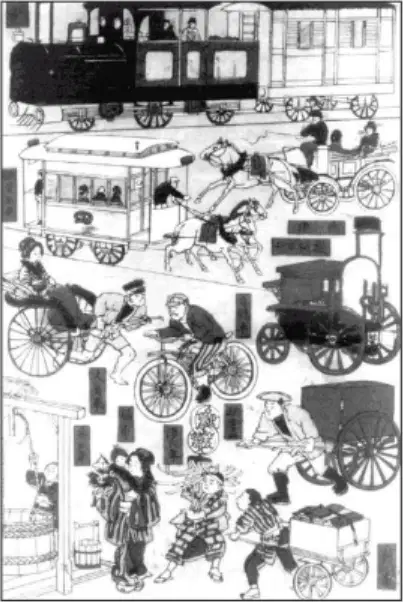
The technological advancements depicted in this wood block print are most closely associated with which era in Japanese history?
Heian court
Tokugawa shogunate
Meiji Restoration
United States occupation
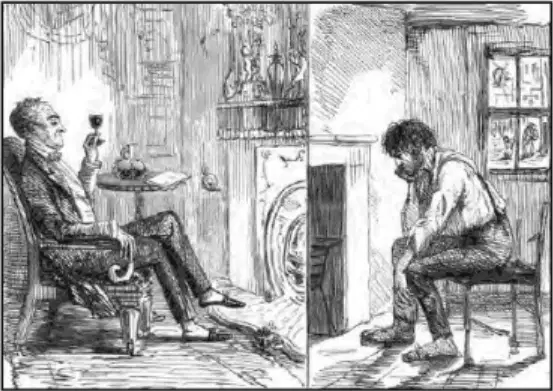
According to this cartoon, which economic approach is most responsible for the contrast between the wealthy man and the working man?
Laissez-faire
universal suffrage
limiting immigration
public sanitation laws
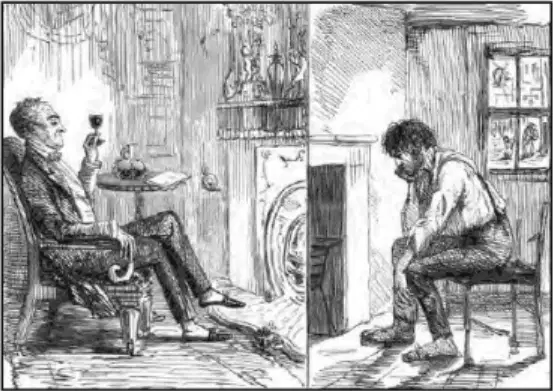
During a recent labor strike at a local factory, workers like Oliver stopped working to demand better conditions. Based on the situation shown in this cartoon, which statement reflects the overall effect of labor strikes on workers?
Workers get to take a well-earned vacation.
Workers are deprived of their income and suffer hardships.
Employers can manage their businesses from home.
Employers generally meet workers’ demands quickly.
Harper recently moved to a city where the buildings are covered in soot, the air is thick with smoke from factories, and the river is discolored and smells unpleasant due to waste from nearby industries. Which problem is Harper experiencing in this city?
economic inequality
urban pollution
lack of child labor laws
poor transportation systems
What did Adam Smith believe about the government's involvement in economic matters?
The government should set prices for all goods and services.
The government should control all business activities.
The government should interfere as little as possible in business affairs.
The government should own all businesses.
What was one result of Adam Smith’s economic theories in 18th and 19th century England?
Factories were required to provide safe working conditions.
Industrialists accumulated greater economic influence.
Labor laws were strictly enforced by the government.
Trade unions were legalized for all workers.
Ava is a child working in a factory during the Industrial Revolution. Which condition is she most likely to face?
Long working hours
Access to quality education
High wages
Safe and healthy workplaces
During the Industrial Revolution, Jackson noticed that many of his friends worked long hours in factories instead of going to school. Why was child labor so common during this time?
Factories needed cheap and easily controlled labor.
Children were required to attend school full-time.
There were strict laws preventing child labor.
Most families were wealthy and did not need extra income.
What was one thing that happened in response to the conditions of child labor?
Marx wrote The Communist Manifesto.
Garibaldi organized the Red Shirts.
Charles Darwin developed The Origin of the Species.
Atatürk joined the Young Turks.
In a rapidly growing city during the Industrial Revolution, more and more people are moving into crowded neighborhoods, leading to increased health problems. Which characteristic of the Industrial Revolution most directly contributed to the health concern Isla observed?
urban population growth
improved communication
new power sources
trade union movement
In a city where contaminated water was causing widespread illness, which action would most effectively address this specific public health concern?
installation of electric lighting in poor neighborhoods
burning herbs to purify the air
improvements in required water treatment
relocation of government offices
Nora moves to a rapidly growing city where she notices increased urbanization, overcrowded living conditions, and the collapse of close family ties. These changes are most characteristic of
Acculturation.
Industrialization.
Social Reform.
Racial integration.
Which event was a major cause of the large-scale migration of Irish people to other countries in the 1800s?
religious persecution
famine
industrialization
political revolution
Which factor most contributed to the start of the Industrial Revolution in Great Britain during the 18th century?
Abundant natural resources
Strict social hierarchy
Dependence on imported food
Lack of navigable rivers
Jackson is studying how transportation and manufacturing changed in Great Britain during the Industrial Revolution. He learns that two natural resources played a key role in these changes. Which pair of natural resources did Jackson discover were used to change transportation and manufacturing in Great Britain during the Industrial Revolution?
gold and salt
diamonds and petroleum
copper and tin
coal and iron ore
Which factor contributed most directly to the start of the Industrial Revolution in England?
abundance of natural resources
strict government regulations
lack of available workers
limited access to waterways
In the 19th century, Evelyn is living in a western European city during the Industrial Revolution. She notices a major change happening around her. What is an important result of this period that Evelyn would most likely observe?
the gap between the wealthy and the poor decreased
urbanization increased rapidly
the supply of unskilled labor decreased
migration to rural areas increased

