
 Worksheets
Simple Machines Short Quiz
Total questions: 18
Worksheet time: 10mins
Gears are wheels with teeth
True
False
An inclined plane is an example of a force multiplier
True
False
Two connected gears always turn in opposite directions
True
False
The fulcrum of a wheel is called the axle
True
False
A fan is an example of a speed multiplier
True
False
A driving gear always turns in the same direction as the driven gear next to it
True
False
Multiple pulley systems use less rope than single pulleys
True
False
Single pulleys reduce the effort needed to lift something
True
False
Which of the following is not a machine?
A hammer
A broom
A tennis racquet
A photograph
The turning point of a lever can be described as:
The centre
The load
The fulcrum
The base
The resistance that a lever works against is called the:
Load
Effort
Fulcrum
Force
The push or pull on a lever, needed to cause movement, is called the:
Effort
Load
Force
Fulcrum
A ramp is:
A machine
Not a machine, but is used by machines
A fourth-order lever
A device involving rollers used to move heavy objects
When you serve in a game of tennis, the racquet is being used as:
a force multiplier
a speed multiplier
an inclined plane
a mechanical advantage
Which of the following is NOT an example of an inclined plane?
A sprocket
A screw
A ramp
A wedge
A pulley is:
a type of gear
a wheel and axle
a type of load
a speed multiplier
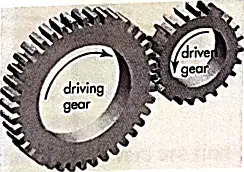
In the arrangement below, the driven gear will move:
faster, in the opposite direction to the driving gear
slower, in the opposite direction to the driving gear
slower, but in the same direction as the driving gear
faster and in the same direction as the driving gear
at the same speed, but in the opposite direction to the driving gear
Rate your understanding of simple machines from a scale of 1 to 4
1
(I don't understand it yet, and I need help)
2
(I sort of understand it, and I need more practice)
3
(I understand it, and I can do it on my own)
4
(I understand it, and I can teach/help others about it)

