
 Worksheets
Bundle 1 Test Chemical Reactions
Total questions: 41
Worksheet time: 21mins
Name
Class
Date
1.
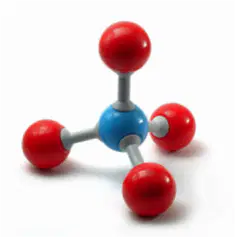
This is a picture of a methane molecule, CH₄ What color is/are the Hydrogen atoms?
a)
blue
b)
red
c)
gray
d)
yellow
2.
How many hydrogen atoms are needed to bond with nitrogen to create one molecule of ammonia, NH₃?
a)
1
b)
2
c)
3
d)
4
3.
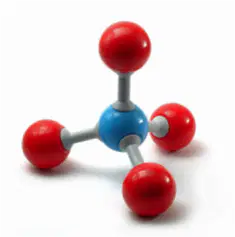
This is a picture of a methane molecule, CH₄ What color is/are the Carbon atoms?
a)
blue
b)
red
c)
gray
d)
yellow
4.
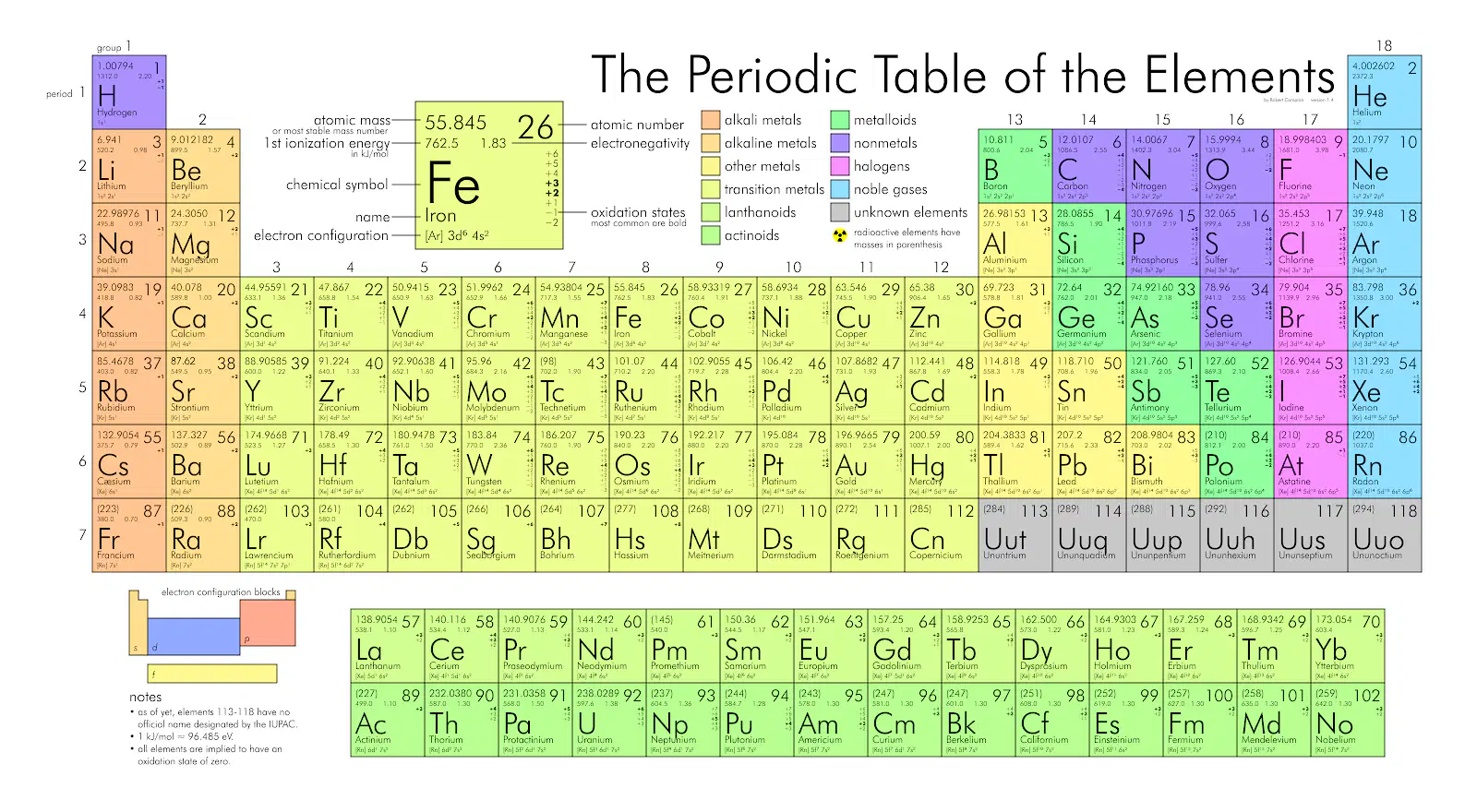
What is the symbol for the element Silver?
a)
Au
b)
Ag
c)
Si
d)
Sl
5.
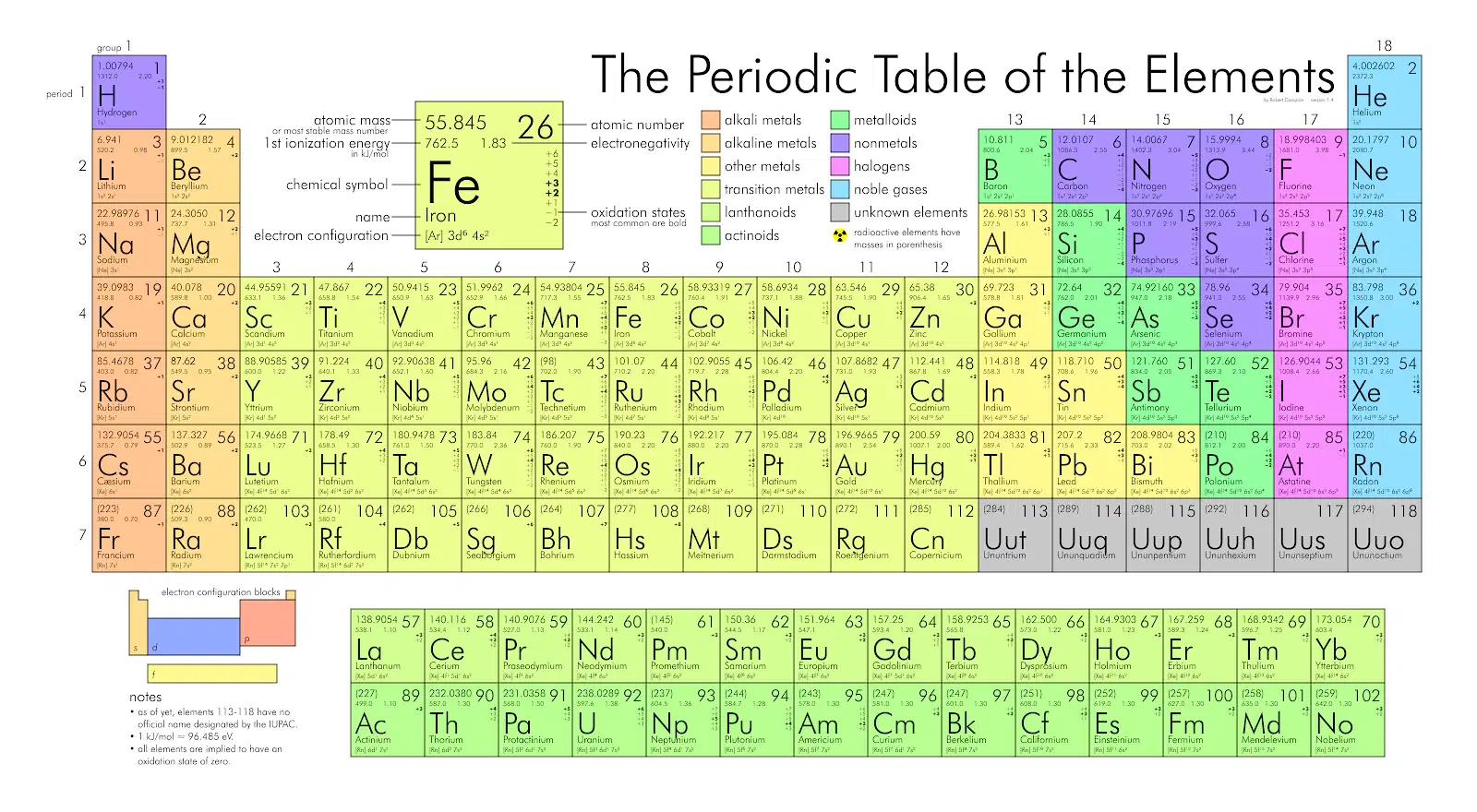
What is the symbol for the element Lead?
a)
Le
b)
Ld
c)
Pb
d)
Fl
6.

Graphite is a soft, dark material often used as a lubricant. Diamond is often a clear, hard crystal. Which of the following best explains the difference in these materials?
a)
The arrangements of the atoms of each one
b)
The elements of which each one is made
c)
The number of atoms each one is made of
d)
The size and shape of the individual atoms
7.
Which of the following best explains the relationship between molecules and atoms?
a)
Atoms are molecules that have a charge.
b)
Atoms have smaller parts, called molecules
c)
Molecules are made up of two or more atoms
d)
Molecules are atoms that have no mass
8.
If one carbon atom chemically combined with one oxygen atom, which of the following chemical formulas would it represent?
a)
Co
b)
C₂0
c)
CO₂
d)
CO
9.
A _______________ is a solid substance that forms and separates from a solution and may indicate that a chemical reaction has occurred
a)
precipitate
b)
color
10.
Which of the following is the best description of the results of a chemical reaction?
a)
A new substance with different properties is formed
b)
The substance changes from liquid to solid at a low temperature
c)
The reaction can be reversed to get back the original substance
d)
The substance seems to disappear after dissolving in water.
11.
A _____________ increase or decrease and the production of light are both signs that a chemical reaction may have occurred
a)
evidence
b)
temperature
c)
reaction
12.
Hydrogen and oxygen react to form water. At an atomic level, how do we know that a chemical reaction has occurred?
a)
Hydrogen molecules are negative and oxygen positive
b)
Hydrogen molecule are positive and oxygen negative
c)
The hydrogen and oxygen atoms regroup into a new molecule.
d)
Oxygen atoms are much larger than hydrogen atoms
13.
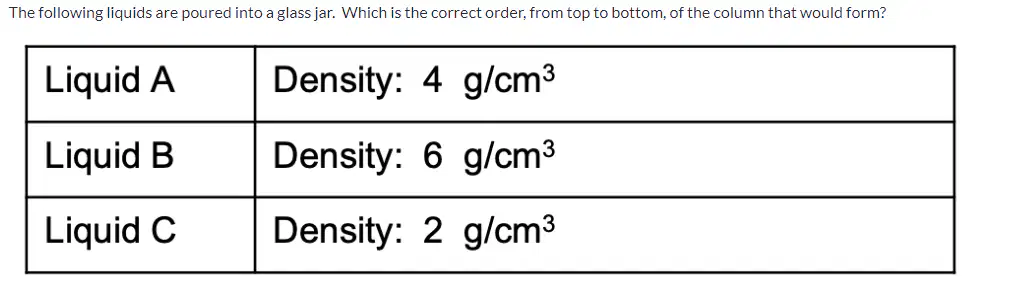
Untitled Question
a)
Liquid C, A, B
b)
Liquid C, B, A
c)
Liquid B, A, C
d)
Liquid B, C, A
14.
Rust forming on a piece of iron is an example of which of the following:
a)
A physical change because the process can't be reversed
b)
The natural process of decay as metallic ions age
c)
A chemical change because oxygen atoms from the atmosphere bonded with the iron atoms
d)
a violation of the laws of physics because new mass has been created
15.
Which of the following statements is true?
a)
Cutting paper is an example of a chemical reaction because a new substance is formed and the process cannot be undone
b)
freezing water is an example of a chemical reaction because a new substance is formed and the process cannot be undone
c)
Burning paper is an example of a chemical reaction because a new substance is formed and the process cannot be undone
d)
Melting ice is an example of a chemical reaction because a new substance if formed and the process cannot be undone
16.
In a chemical process, atoms that make up a substance are regrouped into different _____________ to form new substances with different properties
a)
molecules
b)
precipitate
c)
temperature
17.
Substances giving off a smell, or ______________ while being combined is also an indicator of a chemical reaction.
a)
odor
b)
reactant
c)
waves
18.
When you combine two different liquids you notice that a white solid has formed in the liquid. Has a chemical reaction taken place?
a)
Yes
b)
No
c)
How am I supposed to know
d)
I am clueless
19.

a)
Zinc
b)
Lead
c)
Tin
d)
Iron
20.
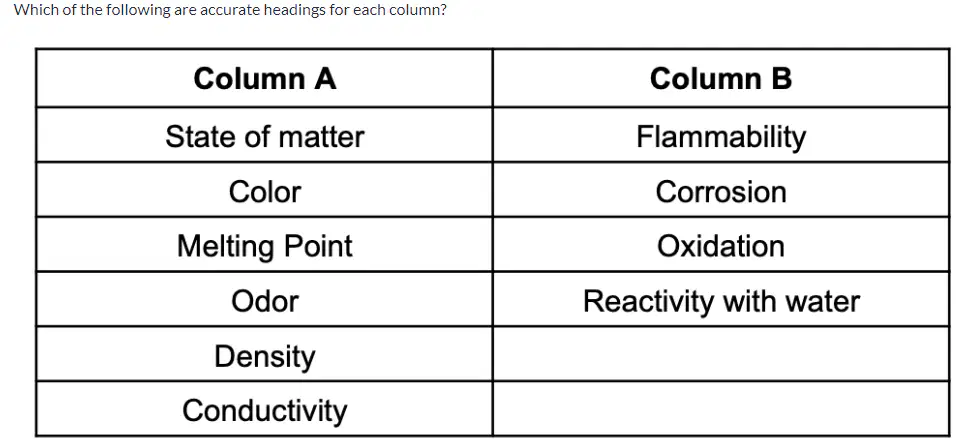
a)
Column A= Physical Properties; Column B= Chemical Properties
b)
Column A= Chemical Properties; Column B = Physical Properties
c)
Column A= Observable Properties; Column B = Non-observable properties
d)
Column A = Non-Observable Properties; Column B = Observable Properties
21.
An unexpected change in ________________ is a sign that a chemical reaction may have occurred.
a)
size
b)
color
c)
the amount of atoms
22.
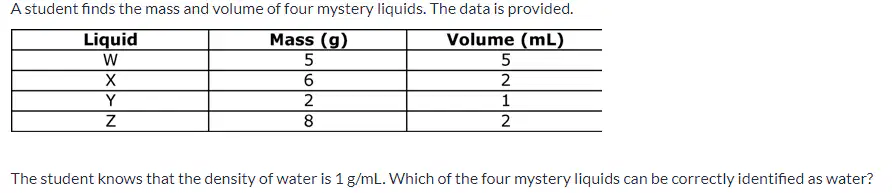
Use the formula for density to solve this!
a)
W
b)
X
c)
Y
d)
Z
23.

Untitled Question
a)
Nylon fibers
b)
Glass
c)
Paper
d)
Ceramic
24.
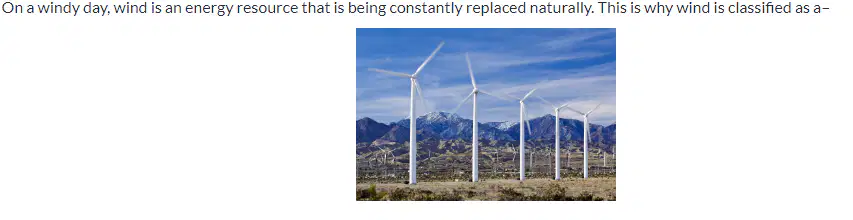
a)
synthetic resource
b)
renewable resource
c)
nonrenewable resource
d)
natural resource
25.

a)
made of natural materials
b)
take several days to produce
c)
are very costly to produce
d)
exist in the same state of matter
26.
Food, wool, and leather come from which natural resource?
a)
Animals
b)
Water
c)
Minerals
d)
Forest
27.
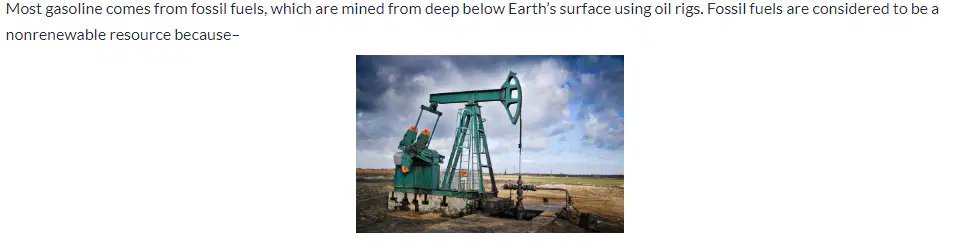
a)
they can be made from other resources
b)
there are alternative resources to using them
c)
the resource can be replaced in a short amount of time
d)
it takes millions of years to replace the resource
28.

a)
plants can be grown in a short amount of time
b)
plants are mixed together to create them
c)
they are used to help illness
d)
they are man-made
29.
Which of the following best describes a synthetic material?
a)
Petroleum is refined through a chemical process to produce plastic that is carved into a figure.
b)
A tree is cut down, carved into a shape, then burned to add color
c)
Sand is struck by lightning causing it to turn into glass that is then carved into a figure.
d)
Volcanic glass (obsidian) is carved and polished into a sculpture
30.
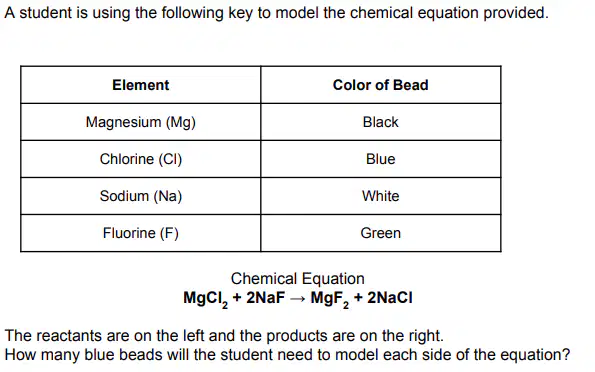
Untitled Question
a)
1 for the products and 1 for the reactants
b)
2 for the products and 2 for the reactants
c)
2 for the products and 1 for the reactants
d)
1 for the products and 2 for the reactants
31.
Students want to gather evidence for the claim that the number of atoms present before a chemical reaction is equal to the number of atoms present after the chemical reaction. They decide to react vinegar and baking soda in a sealed plastic bag. Which of the following would provide the evidence the students need?
a)
The mass of the plastic bag, baking soda, and vinegar before the reaction was equal to the mass after the reaction
b)
Bubbles were produced during the reaction, which meant that a gas was being produced
c)
The plastic bag did not change in any way, indicating that it was not involved in the reaction
d)
The mass of the baking soda was exactly equal ot the mass of the vinegar used to create the chemical reaction
32.
Which of the following is true regarding the atoms involved in a chemical reaction?
a)
The same number of each type of atom will always be present before and after a chemical reaction takes place
b)
Some of the atoms present before the reaction will always be lost during a chemical reaction
c)
Some of the atoms will always be changed into a different type of atom by a chemical reaction
d)
During a chemical reaction, atoms will always be combined into much larger molecules
33.
Which of the following atomic models of chemical reactions correctly demonstrates the Law of Conservation of Matter?
a)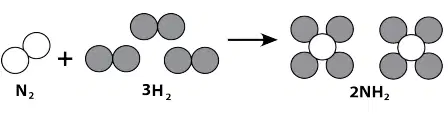
Option 1
b)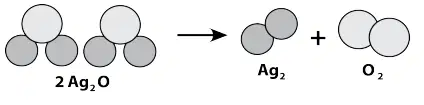
Option 2
c)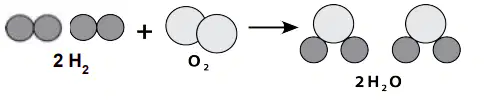
Option 3
d)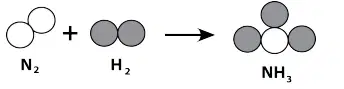
Option 4
34.
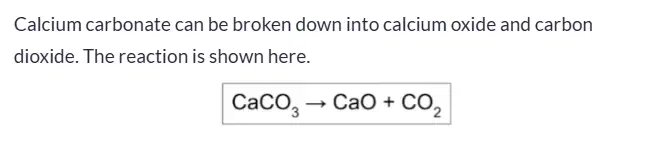
How many atoms of oxygen can be found on the reactant side?
a)
3
b)
2
c)
1
d)
0
35.
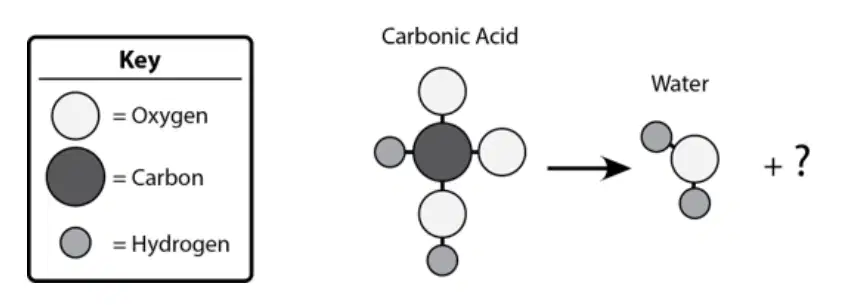
In a chemical reaction known as decomposition, carbonic acid breaks down into water, and what other compound?
a)
A
b)
B
c)
Option 3
d)
Option 4
36.
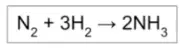
Which of the following models correctly depicts the reaction shown here?
a)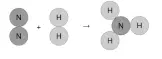
A
b)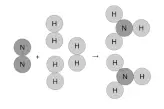
B
c)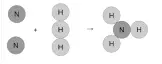
C
d)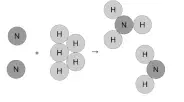
D
37.
Which of the following observations most likely indicates a chemical reaction has occurred?
a)
Breaking a glass
b)
Melting of ice
c)
Evaporation of water
d)
A change in color
38.
What happens to the atoms during a chemical reaction?
a)
They become smaller
b)
They lose their mass
c)
They disappear completely
d)
They are rearranged to form new substances
39.
Which formula represents a molecule formed by two hydrogen atoms and one oxygen atom?
a)
O2H
b)
H2O2
c)
HO2
d)
H2O
40.
Which of the following is an example of a chemical change?
a)
Melting ice
b)
Dissolving sugar in water
c)
Burning wood
d)
Breaking glass
41.
Which of the following best describes a natural material?
a)
Cotton harvested from plants
b)
Ceramic shaped and fired in a kiln
c)
Glass produced in a factory
d)
Plastic made from petroleum
100 %

