
NEW
Font size
 Worksheets
Globalization and Political Geography
Total questions: 42
Worksheet time: 21mins
Which resource type refers to the skills of the workforce that affect economic activity?
Human resources
Natural resources
Capital resources
Transportation networks
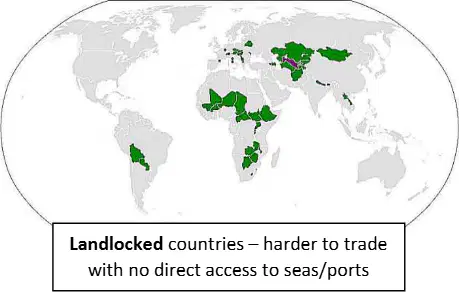
Why do landlocked countries often face more difficulty trading internationally compared to coastal and island countries?
They have fewer natural resources
They lack direct access to seas and ports
They have weaker cultural values
They are farther from shipping lanes by law
Which factor best explains why countries like Singapore or the United States often become major trade centers?
Membership in cultural alliances
Strong access to major ports and coastlines
High agricultural output only
Isolation from communication networks
Comparative advantage suggests countries should primarily do which of the following?
Make everything they need to be self-sufficient
Make goods they are good at producing and import what they cannot make as well
Avoid specializing to stay flexible
Export only raw materials
Which pair correctly matches an example country with a focus that illustrates specialization from comparative advantage?
Japan — coffee agriculture; Brazil — microchips
Japan — technology and electronics; Brazil — agriculture (coffee)
Japan — shipbuilding only; Brazil — steel only
Japan — oil exports; Brazil — automobiles
A government invests heavily in new technologies and easier access to startup funds. Which resource category is being strengthened to influence economic activity?
Human resources
Natural resources
Capital resources
Cultural values
A new canal dramatically shortens shipping routes between oceans and improves internet cable connectivity across regions. At which Depth of Knowledge level would you justify the most significant trade impact of this project by citing specific access benefits?
DoK 1: Recall
DoK 2: Skill/Concept
DoK 3: Strategic Thinking
None of the above
Which statement best explains why nations must trade according to this lesson?
Trade increases cultural diversity within a single nation.
Unequal distribution of resources means countries need goods they lack.
Trade is required to maintain a country’s military strength.
Most countries have an excess of all key resources.
Which of the following is listed as a key resource whose lack can limit economic growth?
Tourism
Water
Gold jewelry
Skilled sports teams
Which group is correctly matched with its purpose as described in the lesson?
OPEC — alliance of oil-producing countries coordinating and stabilizing oil markets
ASEAN — military defense pact for European nations
USMCA — organization that sets global trade rules for all countries
EU — group that fixes oil prices for the world
According to the material, which is an advantage of economic unions?
Restricted access to foreign labor
Smaller markets for goods
Access to natural, human, and capital resources without restrictions
Higher tariffs among member countries
Which global organization is noted for influencing world economies by setting trade rules and offering financial support to nations?
North Atlantic Treaty Organization (NATO)
World Trade Organization (WTO) and International Monetary Fund (IMF)
United Nations Children’s Fund (UNICEF)
Organization of American States (OAS)
A political dispute causes blockages in the Suez Canal. Based on the lesson, what is the most likely immediate effect on global trade?
Increased migration into Europe
Delay in global shipping and potential price increases
Rapid growth of new factories in Africa
An immediate drop in oil demand worldwide
Which example from the lesson best illustrates how conflicts can disrupt interdependence?
Opening new universities in ASEAN countries
Sanctions raising prices worldwide
Sharing a common currency in the EU
Expanding tariff-free trade under USMCA
Which term best describes the increasing connectedness and interdependence of world cultures and economies?
Industrialization
Globalization
Urbanization
Localization
Transportation networks primarily move which of the following?
Ideas and data
Goods and people
Money and stocks
Weather systems
Which statement explains how advances in transportation, communication, and technology affect global interaction?
They make interactions slower and more expensive.
They make interactions easier, faster, cheaper, and more reliable.
They have no effect on global cooperation.
They limit cultural diffusion.
A T-shirt uses cotton from India, is sewn in Vietnam, and sold in the United States. This example best illustrates which concept?
Domestic production
Global supply chain
Trade embargo
Barter system
Which practice is most closely associated with sustainable trade?
Prioritizing the lowest wages to cut costs
Ignoring shipping emissions to speed deliveries
Using renewable resources and reducing pollution
Banning international cooperation
Why do communication networks (internet, phone, satellites) matter for global trade?
They transport raw materials across oceans.
They move information and ideas that coordinate trade.
They replace the need for transportation networks.
They only affect local markets.
A company wants to map economic interdependence to plan its logistics. Which map type would best show major shipping lanes, canals, and ports?
Climate map
Resource map
Transportation map
Population density map
Which statement best defines political divisions?
Ways humans organize and govern areas of Earth’s surface
Natural regions created by mountains and rivers
Only the borders of sovereign countries
Areas used exclusively for military control
Which of the following is NOT listed as an example of a political division?
Nations
States
Biomes
Counties
Border disputes can arise due to cultural differences. Which set correctly lists cultural factors mentioned?
Language, religion, culture
Ethnicity, weather, language
Religion, climate, vegetation
Language, elevation, rainfall
Which example matches a border dispute involving competing claims of sovereignty over a territory in Western Africa?
Syria vs. Israel over the Golan Heights
Western Sahara vs. Morocco
China vs. Taiwan
India vs. Pakistan over Kashmir
What is one economic reason for border disputes mentioned in the material?
Competition for resources
Desire to speak a common language
Need to preserve historical monuments
Seeking new trade partners only
How can physical geography influence borders according to the text?
Mountains, rivers, or deserts can make borders easier to defend
Flat areas always make borders permanent
Oceans prevent any border disputes
Deserts force countries to merge
Which pairing correctly identifies the region of the dispute between India and Pakistan highlighted in the material?
Golan Heights in the Middle East
Western Sahara in Western Africa
Kashmir in South Asia
Taiwan in Southeast Asia
Which of the following is a reason nations may come into conflict?
Shared language and heritage
Boundary and territorial disputes
International humanitarian aid
Peacekeeping missions
Which example best illustrates competition for scarce resources as a source of conflict?
Disagreements over oil, water, or minerals
Countries joining the Commonwealth of Nations
The Peace Corps sending volunteers abroad
UN Peacekeepers assisting with ceasefires
What is the main purpose of humanitarian initiatives like the Red Cross and Red Crescent?
To promote a shared language
To provide disaster relief and medical aid
To negotiate territorial boundaries
To regulate trade agreements
Which organization is an example of a problem-solving alliance focused on maintaining peace and security in conflict areas?
Francophone world
United Nations (UN) Peacekeepers
Commonwealth of Nations
Peace Corps
The Antarctic Treaty is best described as an international agreement that
creates a military alliance among southern nations
regulates the governance of Antarctica for peaceful research and environmental protection
promotes French language and culture worldwide
resolves all boundary disputes in the Southern Hemisphere
Which situation most clearly reflects a cultural difference leading to conflict?
Competing claims to fishing rights
French-speaking citizens in Quebec seeking to preserve their language and culture
Disputes over river access for trade
Competition for fertile land
How can geography influence whether nations cooperate or fight?
Shared membership in the British Empire guarantees peace
Access to key features like rivers, coastlines, or mountain passes can shape cooperation or conflict
Participation in the Peace Corps prevents disputes
Cultural alliances eliminate resource competition
Which statement best explains why water can become a source of international conflict?
Water never crosses political borders, so countries compete locally.
Rivers, lakes, and aquifers often flow through multiple countries, creating shared-use issues.
Most countries have unlimited freshwater within their borders.
Only oceans provide drinking water, not rivers or lakes.
Which is a listed reason for conflict over water resources?
Abundant rainfall in all regions
Uneven distribution of water
Excessive hydropower potential everywhere
Equal access guaranteed by geography
In the Nile River example, what is the main cause of tension described?
Egypt’s dam reduces Ethiopia’s water.
Ethiopia’s dam project affects Egypt’s downstream access.
Sudan diverts the Nile into the Sahara.
Mediterranean salinity changes the Nile’s flow.
Which pair correctly matches a river with the parties involved in its water conflict?
Jordan River — Israel vs. Jordan vs. Palestine
Colorado River — Turkey vs. Syria vs. Iraq
Tigris and Euphrates — U.S. and Mexico
Nile River — U.S. and Canada
Which option is an example of international cooperation over water listed in the material?
Building separate, uncoordinated dams on shared rivers
Joint management of the Great Lakes between the U.S. and Canada
Military control of riverbanks to restrict access
Cancelling all treaties to allow free use
A landlocked country seeking reliable water access would most likely depend on which strategy mentioned?
Direct access to oceans
Agreements with neighboring countries
Natural desalination of lakes
Relocation near a volcano
Which scenario best illustrates how pollution can lead to water conflict?
A country upstream releases industrial waste that degrades water quality for downstream farmers and fishers.
Two countries receive equal rainfall and share data openly.
A lake entirely within one country is protected by strict national laws.
An upstream nation increases forest cover along riverbanks.

