
Font size
 Worksheets
Unit 2 Assessment Practice
Total questions: 24
Worksheet time: 12mins
Mark the correct answer. 1. Germanic languages such as Dutch and English evolved from languages spoken in
northern and western Europe.
eastern Europe and western Asia.
Scandinavia and southern Asia.
North Africa and southern Europe.
Which belief is shared by followers of Judaism, Christianity, and Islam?
a belief that all living things have souls
a belief that the Quran is the holiest book
a belief that there is only one god
a belief that humans are reincarnated
Which three language groups do the primary languages spoken in modern Europe fall into?
Khmer, Munda, or Vietic
Romance, Slavic, or Germanic
Mande, Bantu, or Atlantic
Semitic, Berber, or Cushitic
The three primary religions of Europe are:
Christianity, Islam, Judaism
Hinduism, Buddhism, Christianity
Islam, Hinduism, Sikhism
Judaism, Buddhism, Shintoism
What was France most interested in during the negotiation of the Treaty of Versailles at the end of World War I?
reducing the strength of the German navy
helping the German economy recover quickly
weakening Germany to prevent future attacks
convincing Germany to join the League of Nations
What motivated many Russians to support the Bolshevik Communists during the Russian Revolution of 1917?
the economic downturn of the Great Depression
the arrest of Bolshevik leader Vladimir Lenin
the devastation caused by World War I
the harsh terms of the Treaty of Versailles
Which of the following were effects of World War I that led to conflict in Europe?
A) Spread of communism
B) Increase in global trade
C) Rise of Nazism
D) Treaty of Versailles
How did Nazi propaganda contribute to anti-Semitic actions in Germany during the 1930s?
It helped Jews escape to other countries
It encouraged Jews to protest the government
It protected Jewish businesses from violence
It blamed Jews for Germany's economic problems and war losses
What was the Cold War mainly about?
A. A global battle for territory in Asia
B. A war between Germany and the Soviet Union
C. A military alliance between Germany and France
D. A conflict over political ideologies between the U.S. and the U.S.S.R.
The Berlin Wall was built in 1961 for which reason?
To prevent East Germans from fleeing to West Berlin
To unite East and West Berlin
To promote tourism in Berlin
To commemorate the end of World War II
What type of government does Austria have?
parliamentary republic
absolute monarchy
federal monarchy
single-party state
military dictatorship
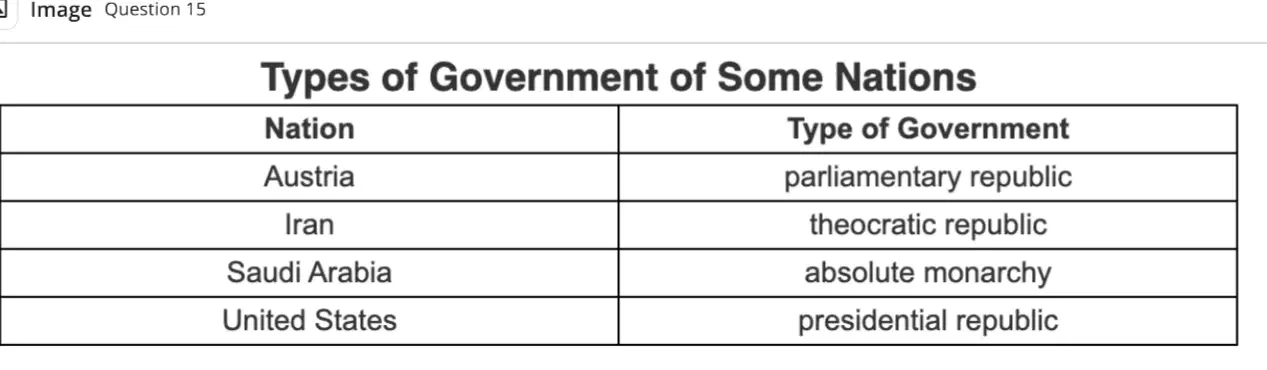
What type of government does Iran have?
theocratic republic
constitutional monarchy
federal republic
parliamentary democracy
What type of government does Saudi Arabia have?
absolute monarchy
constitutional monarchy
federal republic
parliamentary democracy
What type of government does the United States have?
presidential republic
absolute monarchy
parliamentary democracy
theocracy
Based on the chart, in which nation does an elected body of lawmakers determine the head of government?
Austria
United States
Iran
Saudi Arabia
In which type of government do citizens have the least amount of political power?
Republic
Presidential democracy
Parliamentary democracy
Autocracy
Which of the following are features of a parliamentary democracy?
There is only one political party
Citizens vote for members of parliament
Prime minister is chosen by parliament
Citizens vote directly for the prime minister
Which of the following accurately describes the British government?
It is only a constitutional monarchy and an autocracy.
It is a parliamentary democracy and a constitutional monarchy.
It is a presidential democracy and a constitutional monarchy.
It is only a parliamentary democracy and an autocracy.
In modern-day China, political authority is held by a single party. The government controls most aspects of public life, and citizens cannot freely choose leaders in competitive elections. What type of government does China have based on this description?
Parliamentary democracy
Autocracy
Constitutional monarchy
Presidential democracy
In which region or regions illustrated on the graphic do most national economic systems belong?
1
2
3
1 and 3
In which region or regions illustrated on the graphic did the economies of the soviet republics of the Soviet Union belong?
1
2
3
1 and 3
During the Cold War, in which region or regions illustrated on the graphic did the economies of Western European nations generally belong?
1
2
3
1 and 3
Which would most likely be a characteristic of a nation with a traditional economy?
a large and highly skilled workforce
a location near major economic powers
an abundance of valuable natural resources
a lack of industrial development
How are the economies of the United Kingdom, Germany, and Russia different?
The German economy is more market-leaning than the UK and Russian economies.
The Russian economy is more market-leaning than the UK and German economies.
The German economy is more command-leaning than the UK and Russian economies.
The Russian economy is more command-leaning than the UK and German economies.

