
 Worksheets
Mesoamerica Civilizations
Total questions: 37
Worksheet time: 19hrs 30mins
A successful civilization is often characterized by which of the following?
Strong leadership and organization
Lack of resources
Frequent conflicts
Absence of laws
Define the term 'Civilization:'
A complex human society that has developed urban development, social stratification, forms of government, and symbolic systems of communication such as writing.
A small group of nomadic people who rely solely on hunting and gathering.
A society that exists without any form of government or written language.
A temporary settlement established for seasonal activities.
Define the term 'City-states:'
A city that with its surrounding territory forms an independent state.
A large country with many cities under one government.
A rural area with no central government.
A group of villages ruled by a king.
Define the term 'Hieroglyphs'.
A system of writing using symbols or pictures used in ancient Egypt and other cultures.
A type of ancient Egyptian architecture.
A traditional Egyptian musical instrument.
A ceremonial dance performed by Egyptian priests.
Define the term 'Chinampas':
A type of Mesoamerican agriculture which used small, rectangular areas of fertile arable land to grow crops on the shallow lake beds in the Valley of Mexico.
A traditional Andean textile weaving technique.
A ceremonial platform used in Mayan temples.
A type of ancient irrigation canal found in Mesopotamia.
Define the term 'Quipu'.
An ancient Inca device for recording information, consisting of variously colored threads knotted in different ways.
A traditional Japanese musical instrument made of bamboo.
A type of ancient Egyptian writing system using pictographs.
A ceremonial mask used by Native American tribes.
Define the term 'Terraces:'
Step-like landforms created on slopes to allow farming on hilly or mountainous terrain.
Underground channels used for irrigation in deserts.
Circular pits dug to collect rainwater in dry areas.
Tall structures built to store harvested crops.
Fill in the blank: One important part of a civilization is having large ______ or towns.
cities
rivers
mountains
forests
Fill in the blank: A civilization has an organized ______ and laws.
government
forest
festival
animal
Fill in the blank: A civilization has a ______ system for communication.
writing
cooking
dancing
painting
Fill in the blank: Art and ______ are important parts of a civilization.
architecture
weather
sports
furniture
Fill in the blank: Farming and ______ are important for a civilization's development.
trade
dancing
singing
painting
Fill in the blank: Civilizations have religious ______.
beliefs
vehicles
recipes
rivers
Fill in the blank: Social ______ are different groups of people with different jobs in a civilization.
classes
buildings
tools
animals
Where did the Maya civilization live?
Central Mexico
Southern Mexico, Guatemala, Belize, parts of Honduras and El Salvador
Along the Andes Mountains in South America
Where did the Aztec civilization live?
Central Mexico, with their capital Tenochtitlan (now Mexico City)
Southern Mexico, Guatemala, Belize, parts of Honduras and El Salvador
Along the Andes Mountains in South America
Where did the Inca civilization live?
Central Mexico
Southern Mexico, Guatemala, Belize, parts of Honduras and El Salvador
Along the Andes Mountains in South America (Peru, Ecuador, Chile)
All three civilizations chose places near ________, valleys, or forests.
mountains
deserts
oceans
islands
Most early civilizations began near rivers because rivers provide:
Fresh water for drinking and farming
Fertile land (good soil) for crops
Easy transportation for trade
Gold and silver
Match the civilization to its location:
Central Mexico
Aztec
Southern Mexico, Guatemala, Belize, parts of Honduras and El Salvador
Maya
Along the Andes Mountains in South America (Peru, Ecuador, Chile)
Inca
Which civilization is described as the oldest of the three civilizations?
The Maya
The Aztec
The Inca
The Olmec
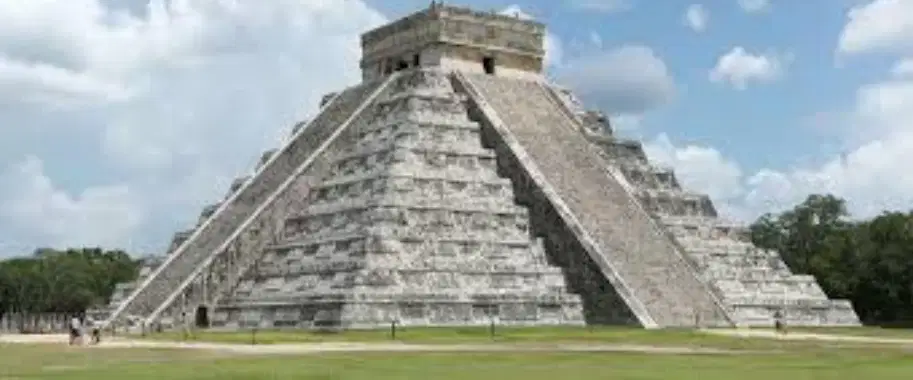
What type of structures did the Maya build?
Castles
Pyramid temples
Skyscrapers
Domes
The Maya created a writing system using pictures called _________.
hieroglyphs
cuneiform
alphabet
kanji
Who were great mathematicians who invented the number zero?
The Greeks
The Romans
The Maya
The Egyptians
The Maya studied the stars and created accurate _________
calendars
maps
weapons
temples
What was unique about the location of the Aztec capital city?
It was built on an island in a lake.
It was located in a desert.
It was built on top of a mountain.
It was situated in a dense forest.
What were the floating gardens created by the Aztecs called?
Chinampas
Terraces
Pueblos
Cenotes
What did the Aztecs use as money?
Cacao beans (chocolate)
Gold coins
Silver bars
Corn tortillas
Feathered hats

What famous site did the Inca build high in the mountains?
Chichen Itza
Machu Picchu
Great Wall
Stonehenge
The Inca used rope bridges to cross deep valleys.
True
False
What was the name of the counting system invented by the Inca using knotted strings?
Abacus
Quipu
Hieroglyphics
Cuneiform
The Inca were master farmers who grew food on ________ terraces.
mountain
river
desert
forest
Which civilization is known for advanced mathematics, writing, and astronomy?
Maya
Inca
Roman
Viking
Which civilization engineered floating gardens and built a city on a lake?
Aztec
Inca
Maya
Olmec
Which civilization built cities and roads in the mountains without using wheels?
Inca
Aztec
Maya
Olmec
Fill in the blank: Many of their inventions are still used today, such as the _______, road system, and farming practices.
calendar
telephone
microscope
television
Which of the following foods did they grow that we still eat today?
Corn
Chocolate
Potatoes
All of the above

