
 Worksheets
Potential and Kinetic Energy
Total questions: 35
Worksheet time: 1hrs 10mins
Which object will have the largest value for its potential energy?
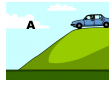
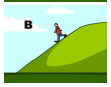
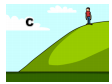
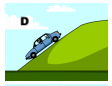
Energy stored because of gravity is called:
Gravitational Potential Energy
Kinetic Energy
Mechanical Advantage
Chemical Energy
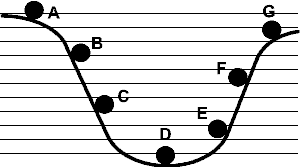
At which point does the ball has the greatest gravitational potential energy (GPE)?
A
G
D
C
G
Which would have the LEAST gravitational potential energy (GPE)?
A ball sitting on the ground
Moon viewed from the Earth
An airplane flying 30,000 feet above the ground
A rock sitting on top of Mt. Everest

At which position does the child on the swing have the most gravitational potential energy?
W
X
Y
Z
What is the gravitational potential energy (GPE) of a 1 kilogram book that is 1 meter above the ground?
g = 9.8 m/s2
9.8 Joules
1.0 Joule
0.10 Joule
11.8 m/s2

A cheetah can run briefly with a speed of 31.0 m/s. Suppose a cheetah with a mass of 47.0 kg runs at this speed. What is the cheetah’s kinetic energy?
1457 Joules
22,584 Joules
15 Joules
45,167Joules
Potential energy depends on the ________ and ________ of the object.
Height (position)
Mass
Speed
Friction
Kinetic energy depends on the ________ and ________ of the object.
Height (position)
Mass
Speed
Friction
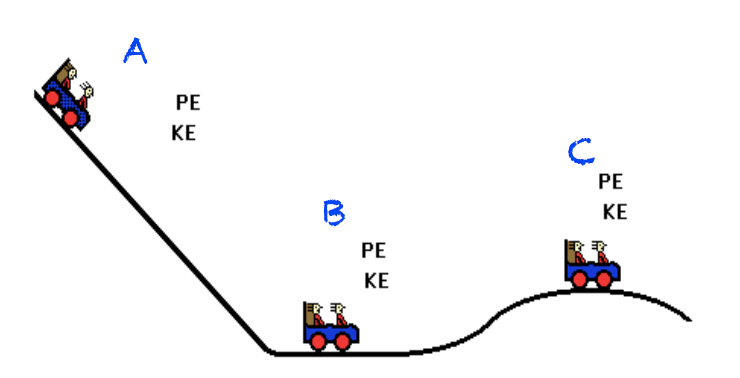
The coaster at B is at -
Maximum PE, Minimum KE
Minimum PE, Minimum KE
Minimum PE, Maximum KE
Maximum PE, Maximum KE
Which of the following has the largest kinetic energy?


Do you think the skater will make it over the first hump, based on the PhET lab? (No friction on the track)
No, because his potential energy will be converted to thermal energy.
No, because he doesn't have enough potential energy.
Yes, because all of his potential energy will be converted to kinetic energy.
Yes, because some of his energy will be potential and some kinetic.

Do you think the skater will make it over the first hump, based on the PhET lab? (No friction on the track)
No, because his potential energy will be converted to thermal energy.
Yes, because all of his potential energy will be converted to kinetic energy
No, because he doesn’t have enough potential energy
Yes, because some of his energy will be potential and some kinetic

In the next moment, the KE part of the pie graph gets larger, then ...
The skater is increasing the height above the ground.
The skater is decreasing the height above the ground.
There is no way to tell

In the next moment, when the KE piece of the pie graph gets larger, then ...
The PE part stays the same
The PE part gets larger too
The PE part gets smaller
There is no way to tell

In the next moment, the KE piece of the pie graph gets larger, then
The skater will be going faster
The skater will be going slower
There is no way to tell

A Simple pendulum hanging freely and at rest is vertical because in that position
Kinetic energy is zero
potential energy is zero
potential energy is minimum
Kinetic energy is minimum
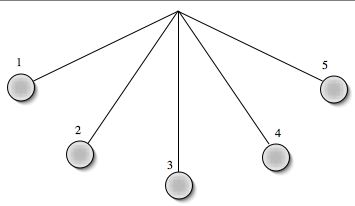

How high must a 20kg box be lifted to give it 784J of potential energy?
3.98 km
392 m
3.92 m
3
A leaf has fallen off a tree and hit the floor of the woods. Why is PEg = 0 J ?
The leaf is no longer being acted upon by gravity.
The leaf no longer has any height off the ground.
The leaf no longer has any mass.
The leaf does not have 0 J of PEg.
What happens to the PEg of a rock that sits on the edge of a cliff as it starts to fall?
The rock loses PEg and gains KE.
The rock loses KE and gains PEg.
The rock retains all its PEg and gains KE
The rock retains both PEg and KE
How could you increase the gravitational potential energy of an object without changing its mass and gravity?
Make the object larger
Lower the object towards the ground
Raise the object farther off the ground
Allow the object to roll on the ground

You throw a ball into the air as shown in the diagram. At what point does the ball have the most gravitational potential energy?
W
X
Y
Z

