
 Worksheets
11/12- Exit Ticket
Total questions: 28
Worksheet time: 21mins
How many ATP molecules are produced during the first stage of cellular respiration?
2
4
6
8
What is the name of the hydrogen carrying molecules created during glycolysis?
ATP
NADH
FADH2
CO2
What is glycolysis and where does it occur in the cell?
It is the process of breaking down glucose in the mitochondria.
It is the process of breaking down glucose in the cytoplasm.
It is the process of synthesizing glucose in the cytoplasm.
It is the process of synthesizing glucose in the mitochondria.
Why is glycolysis considered anaerobic?
It requires oxygen to occur.
It does not require oxygen to occur.
It produces oxygen as a byproduct.
It consumes oxygen during the process.
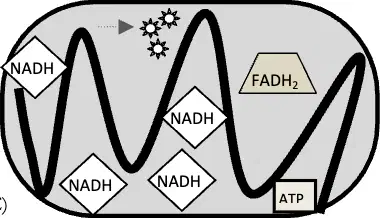
What happens to pyruvic acid during the Krebs cycle?
It is converted into glucose.
It is converted into carbon dioxide.
It is converted into oxygen.
It is converted into water.
Considering that glycolysis produces two pyruvic acid molecules per glucose molecule, how many total CO₂ molecules will be produced from the complete breakdown of each glucose molecule?
2
4
6
8
Compare the amount of energy available to cells resulting from aerobic respiration and anaerobic respiration.
Aerobic respiration produces slightly more ATP than anaerobic respiration
Aerobic respiration produces many times more ATP for cells than anaerobic respiration
Anaerobic respiration produces more ATP than aerobic respiration
Both processes produce the same amount of ATP
How many carbon atoms (C) are there in one molecule of glucose?
3
4
5
6
How many carbon atoms (C) are there in one molecule of pyruvic acid?
2
3
4
5
What happens to glucose after it crosses the cell membrane into the cytoplasm of the cell?
It is converted into ATP
It is broken down into pyruvic acid
It is stored as glycogen
It is converted into CO₂
Where does glycolysis occur in the cell?
Inside the mitochondria
Outside the mitochondria
In the chloroplast
In the nucleus
Name the H-carrying molecules produced during the Krebs cycle.
NADH and FADH₂
ATP and CO₂
Glucose and Oxygen
Water and Oxygen
Formulate an explanation for why the Electron Transport Chain is an aerobic process rather than an anaerobic process like glycolysis.
It requires oxygen to complete the process.
It produces more ATP than glycolysis.
It occurs in the cytoplasm.
It does not involve NADH.
Which part of the process produces the most ATP?

Which of the following structure is where cellular respiration occurs in the cell?
nucleus
cytoplasm
mitochondria
vacuoles

What type of Energy does Cellular Respiration create?
ATP
Water
Carbon Dioxide
Oxygen

A single glucose molecule is turned into (a) pyruvate molecules.
Click the step of cellular respiration in which simple sugar is broken down and 2 ATP are produced.
Which step is Glycolysis?
Which step is the Krebs cycle?
Which step is the Electron Transport Chain?
In glycolysis, (a) is split into 2 molecules of (b) .
2 (c) are made and there is a net gain of 2 (d) .

Letter D represents....
ATP
Glycolysis
Krebs Cycle
Fermentation

In the Kreb's Cycle, what is pyruvate used to produce?
Oxygen
Energy Molecules
Carbon Dioxide
Glucose
The second stage of cellular respiration is
the calvin cycle
the carbon cycle
the krebs cycle
the kelvin cycle
How much of the glucose is left after the Krebs cycle?
0%
25%
50%
75%

The Krebs cycle takes place in the (a) of a cell?
This image is showing Photosynthesis and Cellular Respiration. Label reactants and products of the processes shown.
Water & Carbon Dioxide
Chloroplast
Oxygen & Glucose
Mitochondria
ATP
Sun

