
 Worksheets
Second Quarter English 5 Reviewer
Total questions: 20
Worksheet time: 10mins
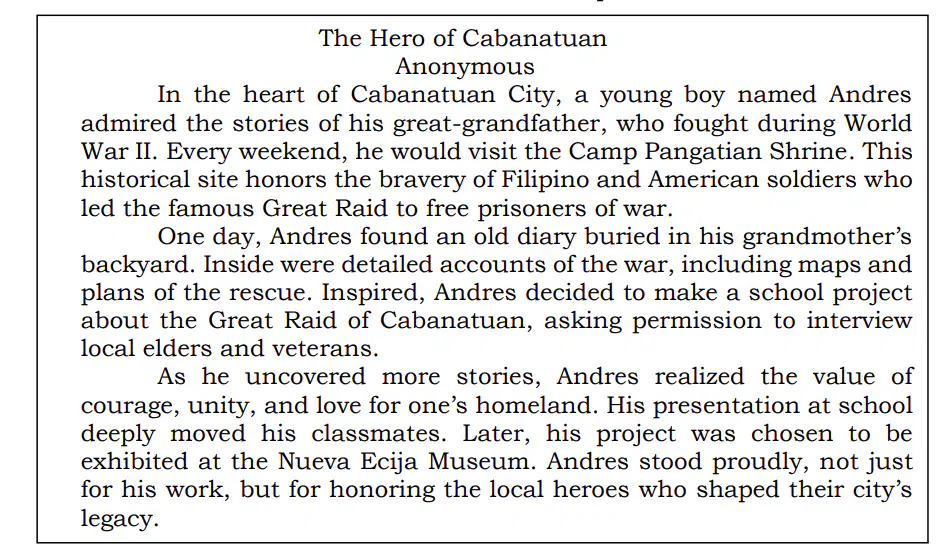
Read the story entitled “The Hero of Cabanatuan ”carefully. Then, choose the letter of the best answer for each question.
Which of the following best describes the setting of the story?
in a war camp in Mindanao
in a remote village during ancient times
inside Andres' school during a competition
in Cabanatuan City, with visits to historical places
Read the story entitled “The Hero of Cabanatuan ”carefully. Then, choose the letter of the best answer for each question.
Who is the main character in the story?
Andres, a young boy
Andres’ great-grandfather
a soldier from World War II
the mayor of Cabanatuan City
Read the story entitled “The Hero of Cabanatuan ”carefully. Then, choose the letter of the best answer for each question.
What is the main problem or conflict in the story?
Andres lost the diary he had found.
The museum rejected Andres’ project
Andres struggled to finish his math homework.
Andres wanted to honor the forgotten heroes of Cabanatuan.

Arrange the events in the story in the correct order: I. He interviewed veterans. II. Andres visited Camp Pangatian Shrine. III. He found an old diary in the backyard.
II – III – VII – I – VI – V – IV
II – III – VII – V – IV – I – VI
III – II – V – VII – IV – VI – I
II – V – IV – VII – III – VI – I
What type of plot did the story use?
circular – the story ends where it began.
in medias res – the story starts in the middle of an action.
sequential – events happen in time order from beginning to end.
flashback – the story starts in the present, then goes back to the past.
The trees danced as the wind blew gently. What does the sentence suggest?
The trees made sounds.
The wind helped the trees enjoy themselves.
The trees were moving like people enjoying music.
The trees were dancing and showing feelings because of the wind.
Rico said, “My backpack weighs a ton!” What does this expression try to tell us?
His backpack is made of stone.
He is joking that his bag is very heavy.
He uses it to carry many books, papers, and tools.
He carries such a big and heavy bag that it feels like it weighs one thousand pounds.
Liza cleaned the whole classroom even though no one asked her to. She arranged the chairs, swept the floor, and arranged the books neatly on the shelf. What does this tell you about Liza?
She is very shy.
She likes working alone.
She is helpful and responsible.
She is trying to avoid class every day.
Ella’s pet dog went missing. She posted pictures on social media and asked her neighbors for help. Then she saw a familiar dog at the park far from home. What will Ella most likely do next?
Go home and watch TV.
Get angry at her friends.
Call the dog’s name and go closer.
Ignore the dog and continue walking.
Many learners now bring reusable bottles and containers to school. Some classes plant trees or collect plastic waste. Even teachers help by organizing clean-up drives every Friday. What is the main idea of the paragraph?
Planting trees is a fun activity.
Teachers are helping with clean-up.
Students are bringing bottles to school.
The school is doing many activities to care for the environment.
During lunch, Carlo shares his food with classmates who forget to bring theirs. On rainy days, he brings extra umbrellas in case someone needs one. His teacher often praises him for being kind and helpful. What is the main idea of the paragraph?
Carlo brings too much food.
Carlo is a kind and helpful student.
Carlo likes being praised by his teacher.
Carlo forgets his umbrella on rainy days.
In school, Miguel led a project to sort recyclables. Students separated paper, plastic, and metal and delivered them to the recycling center. Their efforts reduced waste and taught them the importance of recycling. Which sentence best summarizes the story?
Miguel led the recycling project.
Miguel collected trash for the school playground.
Miguel and the students threw all the trash into one bin.
Miguel and his classmates learned about recycling and sorted materials for proper disposal.
Lianne forgot to bring her project on the day it was due. She felt nervous and worried. Instead of making excuses, she told her teacher the truth and promised to bring it the next day. Her teacher appreciated her honesty and allowed her to submit it the next morning without any penalty. Is the event in the story likely to happen in real life?
Yes, because Lianne used magic to convince her teacher.
No, because students are never allowed to speak to teachers.
Yes, because students can forget things, and teachers can be understanding.
Yes, because Lianne recited a spell she read in a fairy tale book, which made her teacher instantly forgive her and forget about the project.

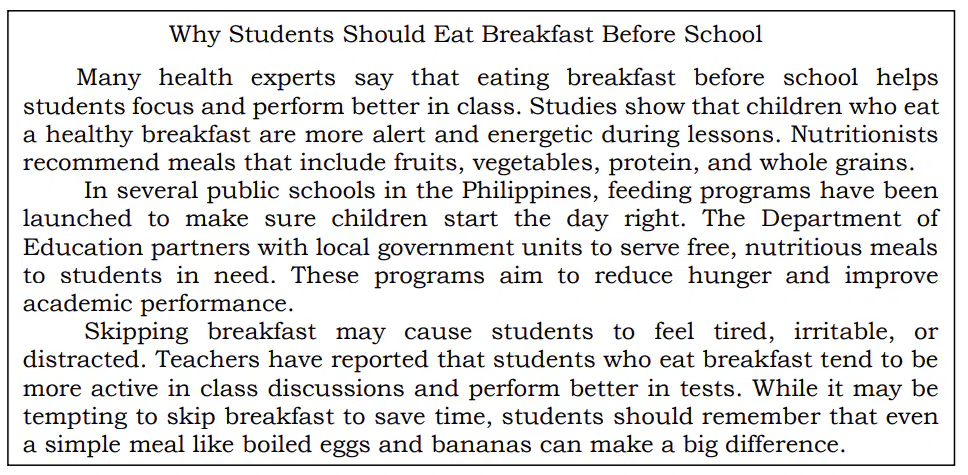
Read the passage entitled “Why Students Should Eat Breakfast Before School” carefully.
What is the topic of the text?
Food trends among students
What makes Filipino breakfasts delicious
The benefits of eating breakfast before school
Why lunch is the most important meal of the day
Read the passage entitled “Why Students Should Eat Breakfast Before School” carefully.
What text type best describes the passage?
explanation
narrative
news report
persuasive
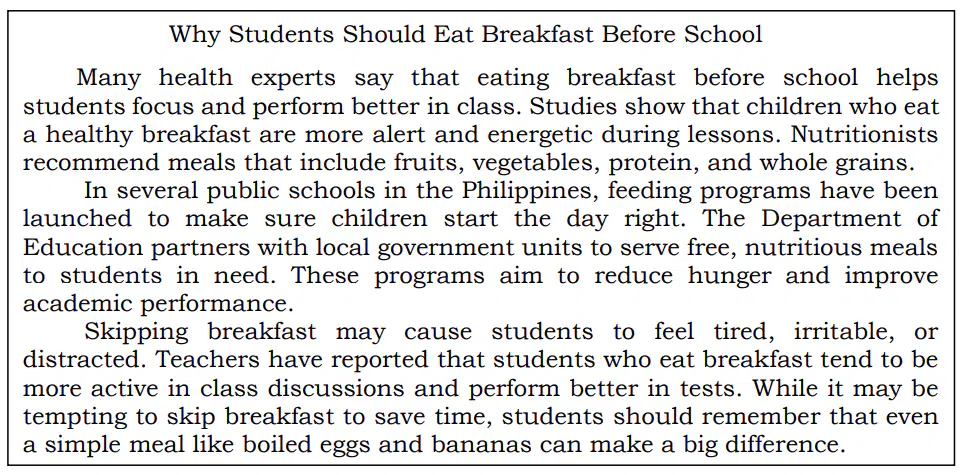
Read the passage entitled “Why Students Should Eat Breakfast Before School” carefully.
What is the author’s main purpose in writing the text?
to entertain students with a funny story
to explain why breakfast is important before school
to describe how students spend lunch breaks in school
to inform students about the school feeding programs
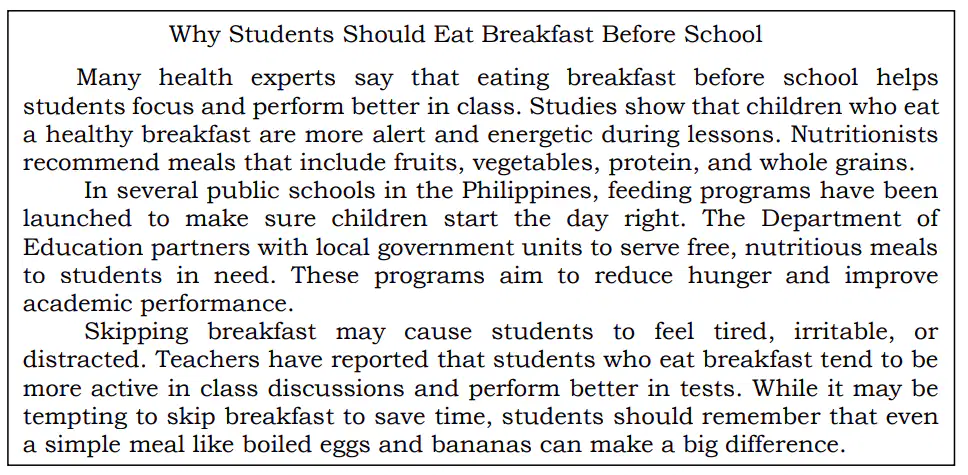
Read the passage entitled “Why Students Should Eat Breakfast Before School” carefully.
Which sentence shows the author’s purpose clearly?
Eating chips during break time is fun.
Feeding programs serve free nutritious meals.
Many health experts say that eating breakfast before school helps students focus and perform better in class.
Students enjoy singing and dancing before school and become more active in class discussions.
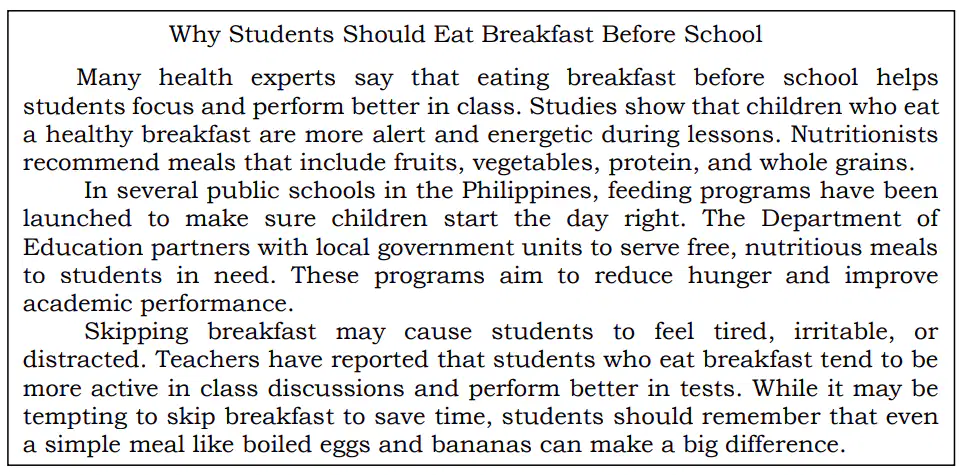
Read the passage entitled “Why Students Should Eat Breakfast Before School” carefully.
Which of the following is a valid generalization about the school feeding programs?
They serve fast food to students.
They are for high school students only.
They help improve focus and reduce hunger.
They are available in every town and in all schools.
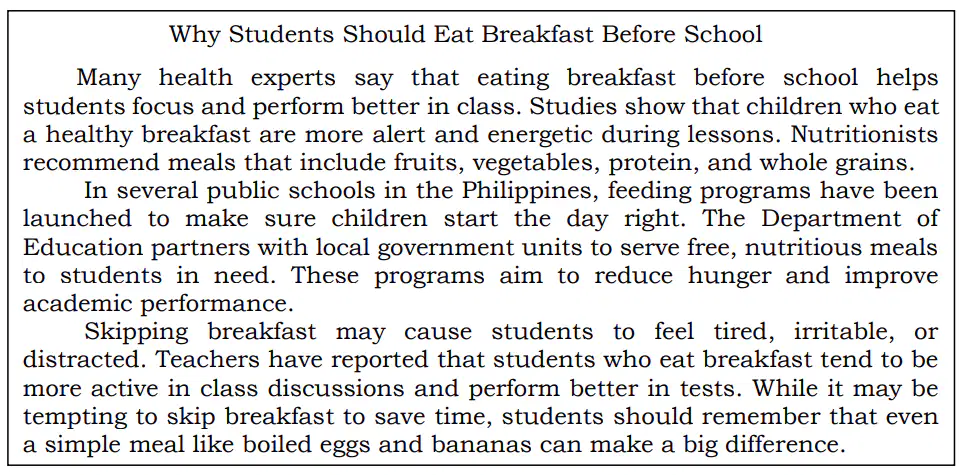
Read the passage entitled “Why Students Should Eat Breakfast Before School” carefully.
What is a good summary of the second paragraph?
The government gives money to parents.
Feeding programs help students who cannot eat at home.
Students are required to eat a delicious meal during break.
Eating breakfast helps students focus and do better in school.
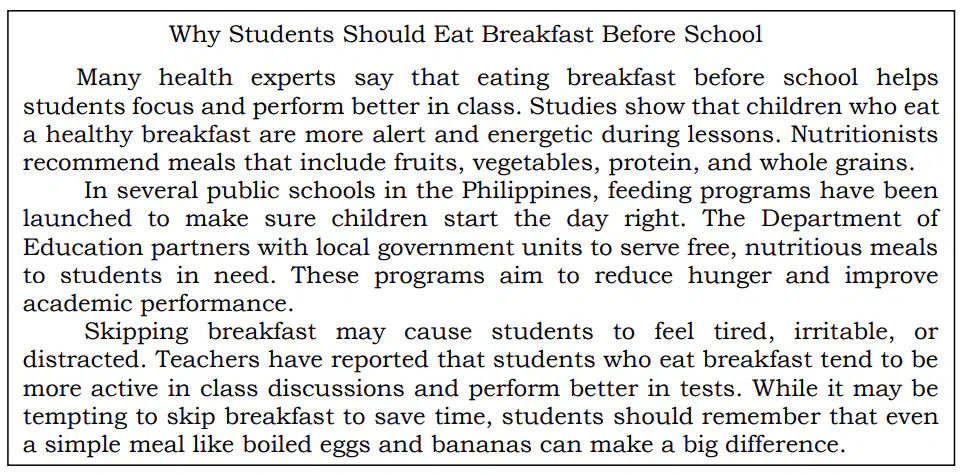
Read the passage entitled “Why Students Should Eat Breakfast Before School” carefully.
Which sentence from the text is a fact?
Eating breakfast is boring.
Skipping breakfast is better than skipping lunch.
Teachers believe breakfast is the key to success.
Studies show children who eat breakfast are more alert in class.

