
 Worksheets
Quarter 1 Review (Duplicate 02)
Total questions: 26
Worksheet time: 13mins
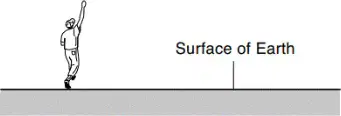
The diagram below represents the path of a ball after it has been thrown. Letters A, B, C, and D represent different locations in the path that the ball traveled. At which location did the ball have the greatest potential energy?
A
B
C
D
Gravity is the major force that
keeps planets in their orbits
affects melting of a solid
keeps sunlight in Earth's atmosphere
affects evaporation of water from oceans
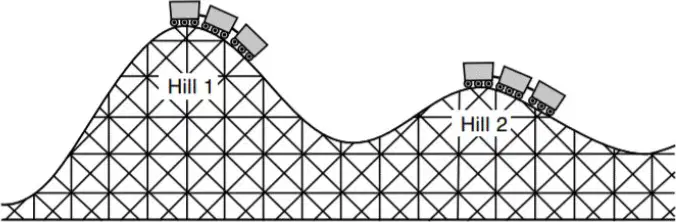
The diagram below represents a roller coaster at two positions on the roller coaster track. Compared to the potential energy of the roller coaster at the top of hill 1, the potential energy of the roller coaster at the top of hill 2 is:
less because the roller coaster is at a lower elevation
less because the roller coaster is on a more gentle slope
greater because the roller coaster is at a lower elevation
greater because the roller coaster is on a more gentle slope
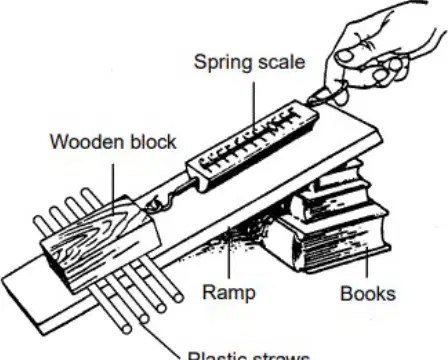
The plastic straws were placed under the wooden block to:
decrease the mass of the block
decrease the amount of friction
increase the surface area of the ramp
increase the gravitational attraction of the block
The Law of Conservation of Energy states that energy cannot be created or destroyed, but energy can change
its total mass
its total volume
from one form to another
from one state of matter to another
A child is sitting in a sled at the top a snowy hill. Which statement is true regarding the position of the child?
The child has no potential energy.
The energy is changing from potential to kinetic.
The energy is changing from kinetic to potential.
The child has only potential energy.
As Henry is exercising, he pushes against a beam with a force of 25 newtons. The beam does not move. Which statement is true?
The beam exerts less than 25 newtons of force against Henry.
The beam exerts a force of 25 newtons against Henry.
The beam exerts more than 25 newtons of force against Henry.
The beam does not exert any force against Henry.
If two objects have a strong gravitational attraction even though they are not very close together, it is likely that they have
large volumes
high pressures
large masses
high temperatures
Which statement is true about objects that are at rest (not moving)?
Objects at rest will not move unless a force acts on them.
Very light objects begin to move without a force acting on them.
Objects at rest move unless an outside force holds them in place.
Very heavy objects will not move even when a very strong force acts on them.
A force that resists or works against motion is
gravity
destructive
friction
power
Force is best defined as:
energy lost by an object in motion
how fast an object moves
a push or pull exerted upon an object
density of an object
Acceleration is:
a change in the speed at which an object moves
a change in the distance that an object moves
the amount of force required to stop an object in motion
the potential energy of an object
What is friction?
the force of gravity
the force that resists motion when two objects come in contact with each other
the force of wind against an object
the force of weightlessness
A tennis ball is hit with a tennis racket. Compared to the force of the racket on the ball, the force of the ball on the racket is
smaller
larger
the same
As the mass of a body increases, its gravitational force of attraction on the Earth
decreases
increases
remains the same
Gravity and inertia affect the motion of a roller coaster by:
Gravity pulls the coaster down while inertia keeps it moving along the track.
Inertia pulls the coaster down while gravity keeps it moving along the track.
Both gravity and inertia stop the coaster from moving.
Gravity and inertia have no effect on the roller coaster's motion.
As a roller coaster goes up the lift hill, there is an increase in which of the following?
kinetic energy
gravity
potential energy
elastic energy
Potential energy is
the energy an object has due to its position
the energy an object has due to its motion
the energy an object has when it is brand new
the energy used to study for a test
Which statement about energy is true?
Energy can be destroyed.
Energy can be created.
Energy cannot change form.
Energy cannot be created or destroyed, but its form can change.
As an object falls freely near the Earth's surface, the loss in gravitational potential energy of the object is equal to its
loss of height
loss of mass
gain in velocity
gain in kinetic energy
Kinetic energy is greatest when a roller coaster
is at the top of a hill.
is at the bottom of a hill.
has not yet started moving.
has just left the bottom of a hill.
A bicycle speeds up as it moves along a flat road. What happens to the bicycle’s kinetic energy during this time?
It decreases.
It increases.
It remains the same.
Which choice best describes kinetic energy?
energy of motion
energy of nutrition
energy of objects
the total energy of an object
Which force is responsible for slowing down a moving car when the brakes are applied?
Friction
Potential energy
Gravity
Inertia
What happens to the potential energy of a ball as it is lifted higher above the ground?
It turns into kinetic energy
It increases
It stays the same
It decreases
When a soccer ball is kicked and starts moving, which type of energy increases?
Potential energy
Kinetic energy
Thermal energy
Chemical energy

