
 Worksheets
Standard 5.4 (Globalization 1990-2011)
Total questions: 23
Worksheet time: 24mins

____________ is the growing trend towards expansion and integration of worldwide trading networks.
Which of the following is an example of globalization?
A company sourcing materials from different countries and selling products around the world.
In the 1990s, the European Common Market developed into the European (a) to provide (b) cooperation. They promoted (c) , trade and the development of European (d) . The majority of members adopted a common currency called the (e) .
In 1994, the North American Free Trade Agreement (a) , attempted to increase (b) by eliminating trade barriers in the (c) Hemisphere, specifically trade barriers between the US, (d) and Canada.

Agreed upon in 2015, the _______________ is an international treaty to limit global warming. The goal is to move to renewable energy. Nations set emissions reduction goals and report on their progress.
Paris Climate Agreement
Rio Climate Declaration
As a result of global trade agreements such as (a) and the WTO, US industries are experiencing greater (b) . Many companies began to (c) to (d) where labor costs were cheaper. This caused a rise in (e) for some American workers.
Progress Check Question:
"Since labor is cheaper in Mexico, many manufacturing industries withdrew part of their production from the high-cost United States. Between 1994 and 2010, the U.S. trade deficits with Mexico totaled $97.2 billion. In the same period, 682,900 U.S. jobs went to Mexico. Almost 80% of the losses were in manufacturing. The hardest-hit states were California, New York, Michigan, and Texas. They had high concentrations of the industries that moved plants to Mexico. These industries included motor vehicles, textiles, computers and electrical appliances."
Progress Check Question:
Which of the following is the BEST description of the passage?
a supporting argument for the Great Society
a supporting argument of the Reagan tax cuts
a criticism of the Bush administration's stimulus checks
a criticism of the North American Free Trade Agreement
Satellite and (a) communication promoted the outsourcing of some jobs to places such as (b) . Globalization and mechanization caused a loss of (c) in the US and a continued shift to jobs in the (d) .
The competition for jobs continues as an influx of (a) are willing to work for lower (b) . There is a decline in membership to (c) because of the loss of jobs and increased competition from (d) , immigrants and mechanization. There was a big population shift to the (e) states.
Categorize how the economy changed during The Cold War to after The Cold War.
manufacturing
service industry
making things in factories with an assembly line
jobs were done in the US
jobs like banker, computer programmer, teacher, nurse
increased outsourcing factory jobs to other countries

This president served from 1993-2001
*Democrat
*introduced welfare reform
*fought to balance the budget and stimulate the economy
Who is he?
Ronald Reagan
Describe one of Bill Clinton's goals during his term and why he was unable to achieve it.

President Bill Clinton was charged by the House for Perjury and Obstruction of Justice.
Why was he not removed from office?
The Senate voted him guilty but decided to give him a warning instead of firing him.
The Senate did not get enough votes to find him guilty so he was acquitted and remained in office.
The House voted to stop the process before the Senate could even hold a trial.
Bill Clinton introduced a deficit reduction plan that included:
*increasing taxes and cutting __________________
*established the earned income tax credit
During Bill Clinton's presidency, he was very (a) in reducing American debt. (b) brought low (c) . When Clinton left the office in 2001, there was a (d) and the (e) was shrinking.

After the attack of the World Trade Center on September 11, 2001 by al Qaeda, the US sent military forces to overthrow the Taliban in Afghanistan because they harbored al Qaeda. This was called ______________________________.
How did the US justify the invasion of Iraq after the terrorist attacks of September 11, 2001?
The US had suspicion of the presence of weapons of mass destruction and links to terrorism.
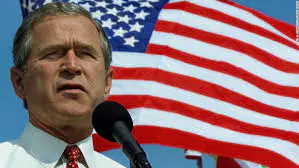
Describe the Bush Doctrine.
The Bush Doctrine said the US would make no distinction between terrorists and the governments that harbored them.
When Afghanistan refused to give up Osama Bin Laden, the US launched air strikes.
This is an example of which doctrine in action?

President George W. Bush accused Iraq, Iran and North Korea of harboring terrorists and developing _________________.
After the terrorist attacks of September 11, 2001, America created a more assertive foreign policy.
Match the following initiatives to the correct descriptions.
federal law to deter and punish terrorism in the US
created to provide better protection of the US at home
Examples: TSA, ICE and Cybersecurity
Examples: increased surveillance, identification security, and in-depth searches in terrorism
Progress Check Question:
"As a result of the tragic events of September 11, our government is examining possible responses, including military action. Polls show that most Americans favor military action, but there are those of us who believe the United States is capable of being held to a higher standard. If we believe, like the terrorists who struck the World Trade Center....that our cause is just, and that innocent lives may be to be lost to extract "justice," then we become moral cowards, defining justice in terms of retribution and revenge and we perpetuate a cycle of violence all too familiar to those who perpetrated the brutal actions of September 11..."
-Joyce Neu, 2001
Progress Check Question:
Which of the following BEST describes the position of the author of this passage?
She wants the military to invade Afghanistan.
She supports stopping the spread of communism.
She opposes the ideas behind America's "War on Terror."
She considers the United States to be a leading superpower.
Progress Check Question:
Which portion of the passage BEST demonstrates that many Americans will support the American invasion of Afghanistan?
As a result of the tragic events of September 11, our government is examining possible responses, including military action.
Polls show that most Americans favor military action.
There are those of us who believe the United States is capable of being held to a higher standard.
Progress Check Question:
Source 1
President George W. Bush, Speech on Global Economy (2006)
"The expansion of trade has brought opportunity and prosperity to millions of Americans. Our businesses sell their products to people all over the world, and open markets mean better jobs and lower prices for consumers here at home."
Source 2
AFL-CIO Statement on Outsourcing (2010)
"Global trade agreements and outsourcing have sent thousands of American manufacturing jobs overseas. Corporations profit from lower wages abroad, while American workers face unemployment and declining wages."
Progress Check Question:
Based on the two sources, which conclusion best explains the debate over America's participation in globalization?
Outsourcing completely eliminated U.S. participation in the global economy and halted trade with foreign nations.
Globalization guaranteed equal prosperity for American and foreign workers without economic disruption.
Both business leaders and labor unions fully supported free trade as the only path to national economic growth.
Globalization expanded markets and consumer access but deepened divisions over job losses and wage inequality in the U.S. workforce.

