
 Worksheets
9 Semantics: Introduction
Total questions: 63
Worksheet time: 32mins
Which statement best defines semantics as presented in the section?
The study of how sounds are produced in language
The study of conventional linguistic meaning in words, phrases, and sentences
The analysis of individual speakers’ intentions on particular occasions
The investigation of social factors influencing language use
In semantic analysis, what does the focus on conventional meaning imply?
Meanings are determined by private speaker intentions in specific contexts
Meanings are negotiated only through conversation
Meanings are what competent users of a language generally share about words and structures
Meanings are fixed by formal logic alone
Which example from the anecdote illustrates a practical concern of semantics?
Determining whether quince preserves count as gel, liquid, or aerosol
Measuring the acoustic properties of speech at an airport
Translating quince into multiple languages
Teaching airline staff pronunciation rules
Which task aligns most closely with doing semantics, according to the text?
Explaining how to articulate a difficult consonant cluster
Describing the shared linguistic meaning that allows users to behave as if they know what words and sentences mean
Cataloging regional slang used by TSA agents
Predicting how a specific speaker wants a term to be taken on one occasion
Which statement best defines referential meaning as described in the lesson?
Subjective feelings or reactions associated with a word
Widely accepted, literal components of meaning that dictionaries describe
Personal memories linked to a word for an individual
Contextual cues that determine sentence intonation
Which of the following is an example of associative (emotive) meaning rather than referential meaning for the word needle?
Thin, sharp, steel instrument
Tool used in sewing
Association with pain or illness
A small, pointed object
Why is the sentence “The hamburger ate the boy.” considered odd according to the text?
It violates English word order rules.
It uses an ambiguous verb.
It is syntactically well-formed but violates referential properties required by the verb ate.
It contains a pronoun-antecedent disagreement.
Which pair of sentences illustrates how referential properties determine compatibility with the verb ate?
The table listens to the radio. / The radio listens to the table.
The boy ate the hamburger. / The hamburger ate the boy.
The horse is reading the newspaper. / The newspaper is reading the horse.
The boy reads the hamburger. / The hamburger reads the boy.
According to the passage, what referential property must the subject of ate have to make sense?
Being edible
Being animate and capable of eating
Being grammatical in NP-V-NP order
Being concrete rather than abstract
Which statement best defines semantic features as used in linguistic analysis?
They are phonetic variations that mark dialects.
They are basic components of meaning like [+human] or [+animate].
They are syntactic rules governing word order.
They are morphological processes such as inflection and derivation.
According to the instructional text, which noun would be odd as the subject in the sentence: "The ________ ate all the food" if the verb requires the feature [+animate]?
boy
horse
hamburger
woman
In the example "The ________ is reading the newspaper," which semantic feature is required of the noun to fit appropriately?
[+animate]
[+equine]
[+human]
[+female]
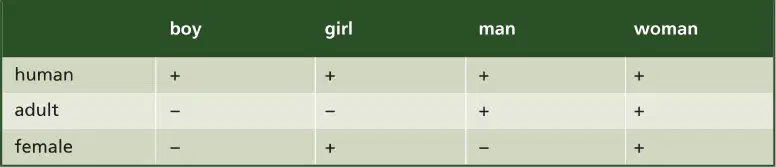
Componential analysis treats features like [+human], [+adult], and [+female] as components. Based on Table 9.1, which word is specified as [+human], [+adult], and [+female]?
boy
girl
man
woman
When the feature [human] is replaced with [equine] in componential analysis, which set is suggested as analogous for analysis?
puppy, kitten, dog, cat
colt, filly, stallion, mare
calf, cow, bull, ox
ewe, lamb, ram, goat
Which term refers to “the entity that performs the action” in a sentence?
Theme
Agent
Patient
Instrument
In the sentence “The boy kicked the ball,” which noun phrase is the Theme?
The boy
kicked
the ball
the boy kicked
Which example illustrates a non-human Agent affecting a Theme, as described in the material?
The boy kicked the ball.
The wind blew the ball away.
The ball was red.
The dog chased the boy.
According to the section, which statement best distinguishes Agent from Theme?
Agent is always human, Theme is always non-human.
Agent is the doer or causer of the action; Theme is the entity involved in or affected by the action or simply described.
Agent is the entity described without action; Theme is the action performer.
Agent and Theme are interchangeable labels for any noun phrase.
In the sentence “The dog chased the boy,” which role does “the boy” play?
Agent
Theme
Instrument
Location
Which sentence best illustrates the semantic role of instrument as defined in the section?
Mary saw a fly on the wall.
She squashed the bug with the magazine.
“Gee thanks,” said George.
She borrowed a magazine from George.
In the sentence The woman feels sad, which semantic role does the noun phrase The woman fill?
Agent
Experiencer
Theme
Instrument
Which preposition is often a clue that a following noun phrase functions as an instrument in English?
to
with
from
on
In We drove from Chicago to New Orleans, which option correctly matches roles to the prepositional phrases?
from Chicago = Goal; to New Orleans = Source
from Chicago = Location; to New Orleans = Location
from Chicago = Source; to New Orleans = Goal
from Chicago = Instrument; to New Orleans = Theme
Which line in the illustrated scenario marks George as the SOURCE?
Mary saw a fly on the wall.
She borrowed a magazine from George.
She handed the magazine back to George.
“Gee thanks,” said George.
According to the definitions, which option correctly identifies the LOCATION?
on the wall in Mary saw a fly on the wall
George in “Gee thanks,” said George.
the magazine in She squashed the bug with the magazine
from George in She borrowed a magazine from George
Which statement reflects the idea that a single entity can appear in several semantic roles within a scenario?
George is always the agent in every line.
George appears only as a source and never as an agent.
George can be the source in one sentence and the goal in another.
George is the instrument used to squash the bug.
Which statement best defines synonymy as presented in the material?
A relation in which words have opposite meanings
A lexical relation where two or more words have very closely related meanings and can often substitute for each other
A morphological process that creates new words by adding affixes
A phonological pattern in which words rhyme
Which pair exemplifies synonymy according to the examples provided?
deep/shallow
broad/wide
tree/pine
answer/reply in all contexts
Why is it recommended to think of many pairs as "close synonyms" rather than assuming total sameness?
Because synonyms always come from different languages
Because the sound patterns differ across dialects
Because one word in a pair may be appropriate in a sentence while the other would be odd due to contextual nuances
Because dictionaries prohibit complete equivalence
Which sentence illustrates a difference in formality between synonymous choices described in the text?
He purchased a large automobile versus He bought a big car
She walked quickly versus She ran fast
They arrived late versus They came later
We studied hard versus We studied difficult
Which example from the material shows that regional variation affects synonymous pairs in English?
broad agreement versus wide agreement
doctor versus physician
candy, chips, diaper, gasoline in American English versus sweets, crisps, nappy, petrol in British English
cab versus taxi
Which statement best defines antonyms as presented in the lesson?
Two words with similar meanings used in the same context
Two forms with opposite meanings
A word and its morphological variant
Words that belong to the same grammatical category
Which pair illustrates gradable antonyms, characterized by opposites along a scale and usable in comparatives?
male/female
enter/exit
long/short
married/single
According to the explanation, which sentence shows why the negative of one member of a gradable pair does not necessarily imply the other?
Undress means ‘do the reverse of dress.’
My car isn’t old doesn’t have to mean My car is new.
Parents aren’t alive means parents are dead.
Raise is the reverse of lower.
Non-gradable antonyms (complementary pairs) are identified using a “negative test.” Which outcome matches this test?
If one member is negated, the other must be true.
Negating one member makes both members false.
Negating one member has no effect on the other.
Negating one member creates a comparative scale.
Which pair exemplifies reversive antonyms as defined in the material?
rich/poor
true/false
pack/unpack
hot/cold
Which statement correctly describes hyponymy?
It is a relation where two forms are perfect opposites.
It is meaning inclusion, where one term’s meaning is included in another.
It is a morphological process that reverses meaning.
It is a relation restricted to adjectives only.
Based on the hierarchical diagram of living things, which term is the immediate superordinate of schnauzer?
dog
animal
terrier
creature
Which pair are co-hyponyms with insect as their shared superordinate?
ant and cockroach
parrot and duck
rose and banyan
pine and fir
Which statement best illustrates the "is a kind of" relation captured by hyponymy as discussed in the text?
"Creature is a kind of schnauzer."
"Yorkie is a kind of dog."
"Cook is a kind of bake."
"Plant is a kind of rose."
According to the text, which set correctly matches verbs as co-hyponyms with their superordinate?
punch, shoot, stab → cook
bake, boil, fry, grill → injure
punch, shoot, stab → injure
microwave → injure
Which term refers to the most characteristic instance of a category, such as robin for the category bird?
Hyponym
Prototype
Superordinate
Polysemy
According to the text, why might sparrow be judged a better example of bird than penguin?
Sparrow is taxonomically closer to penguin
People categorize by resemblance to a clear example, not by technical features
Sparrows are more common worldwide
Penguins are not hyponyms of bird
Given the category label furniture, which item does the text say people recognize faster as a better example?
Bench
Stool
Chair
Desk
Which pair illustrates homophones as defined in the text?
bat (animal) – bat (sports)
pen (writing) – pen (enclosure)
bare – bear
race (speed) – race (ethnic group)
What is the defining property of homonyms according to the passage?
They sound the same but are spelled differently
They share a form but have unrelated meanings and histories
They are technical terms within a category
They are words that resemble a category prototype
A student claims that the two meanings of pen (writing instrument vs. enclosed space) must be related because they are spelled the same. Based on the text, what is the best evaluation of this claim?
Correct; identical spelling always signals related meaning
Incorrect; these are homophones with different pronunciations
Incorrect; these are homonyms whose same form is accidental and meanings are unrelated
Partially correct; they are related through the superordinate category 'object'
Which statement best defines polysemy as presented in the lesson?
Two different words that sound alike but have unrelated meanings
A single word with multiple related meanings, treated as one entry
Two different words with identical spelling but unrelated meanings
A figure of speech that replaces one word with another for effect
According to the explanation, how can a dictionary help distinguish homonymy from polysemy for a given form?
Polysemous words have multiple separate entries; homonyms have one entry with numbered meanings
Both polysemous words and homonyms always have multiple entries
Polysemous words have a single entry with numbered meanings; homonyms have separate entries
Dictionaries cannot indicate the difference
Which set correctly classifies items as treated in most dictionaries, according to the text?
face, foot, get as homonyms; bat, mail as polysemous
bat, mail, mole, sole as homonyms; face, foot, get, head, run as polysemous
run and bat as homonyms; head and sole as polysemous
All listed items are polysemous
The word date illustrates what key point in the text?
Homophones always lead to a single dictionary entry
A form can be both homonymous (thing we can eat vs. point in time) and have polysemous senses within one of those meanings
Words with more than two meanings are always homonymous
Polysemy only applies to concrete nouns
In the riddle What has four legs, but only one foot?, which lexical relation enables the solution a bed?
Homophony of leg/foot
Polysemy of leg and foot
Homonymy of bed
Metaphor unrelated to lexical relations
Why is the comic version Mary had a little lamb, some rice and vegetables humorous, based on the lesson?
It uses rhyme to create humor
It relies on homophones between lamb and rice
It exploits the polysemy of lamb to shift from an animal to a small amount of meat
It depends on the homonymy of Mary
Which statement best defines metonymy as presented in the material?
A relationship between words based on overall similarity of meaning
A relationship between words based on close connections in everyday experience where one stands for another
A process of forming new words by adding prefixes and suffixes
A method of comparing two unlike things using like or as
Which example illustrates a container–contents relation in metonymy?
car/wheels
bottle/water
king/crown
house/roof
Why do phrases like "The White House has announced" make sense according to the text?
They are literal descriptions of buildings speaking
They rely on personification rather than linguistic relations
They rely on metonymy, where a place stands for the people associated with it
They are idioms whose meanings cannot be inferred
Which pairing exemplifies the whole–part relation in metonymy?
car/wheels
can/juice
the President/the White House
king/crown
According to the material, what is collocation?
The study of word origins through historical texts
The organization of words by grammatical class
Words that frequently occur together in use
A type of figurative language based on similarity
What role does corpus linguistics play in studying collocation?
It creates metaphors by comparing unrelated concepts
It uses a large computerized collection of texts to find how often specific words or phrases co-occur
It teaches pronunciation by recording native speakers
It replaces dictionaries by listing all possible meanings of words
What is a concordance in linguistic study?
A dictionary of synonyms organized by frequency
A listing of each occurrence of a word (or phrase) in a corpus with its surrounding words
A grammar describing how sentences are formed
A translation guide across multiple languages
In a concordance, the term “key word in context” (KWIC) refers to
The most frequent word in the language overall
The word being studied shown with surrounding words
A word’s dictionary definition only
A list of collocations without examples
Based on the concordance lines for the key word ‘sarcastic’ (Figure 9.2), which collocate most commonly co-occurs and signals interpersonal evaluation?
polite
rude
happy
neutral
Which statement best captures the section’s claim about context and meaning?
Word meanings are fixed and unaffected by usage context.
Context primarily affects pronunciation, not meaning.
Understanding what words and phrases mean is tied to the contexts in which they are typically used.
Context matters only for rare or technical vocabulary.

