
 Worksheets
EDW: 8th Grade: World Geo: EV: Q2T3:History&Culture of US/Canada
Total questions: 95
Worksheet time: 57mins
North America's first ________ (people who left their homes countries to settle permanently in other) may have come from Asia thousand of years ago
Mayans
Immigrants
Travelers
European settlers
The descendants of this first settlers were called ___________?
Native Americans
How long ago did the first immigrants move into North America?
16,000 to 20,000 years ago
How many people in the U.S. today are Native American?
Over 5 million
The main culture of the United sates and Canada come from which three groups of settler who arrived after 1500 AD.
Europeans, Africans, and Asians
It's the mixing of different peoples and cultures that has given the United States and Canada unique __________?
diversity
uniformity
identities
isolation
Why do immigrants come to the U.S.? (Pull factors)
Better economics
Today where do most immigrants come from?
Asia and Mexico
About ____% of the worlds population-more than 366 million people live in the United States and Canada
3%
5%
6%
4%
since the 1970s, the fastest-growing areas in the United States have been the mild climate areas of the South and the Southwest called the _______?
Why is the South and South west (Sunbelt area) the fastest growing area since the 1970?
new industrial/ economic growth
appealing climate
abundance of resources
_____% of Canadians live in a narrow strip of land along the US-Canada border.
Most Canadians live in the Great Lakes region and along the St. Lawrence River in Canada's two major industrial provinces of ______ and _______.
Pockets of population are also found in the southern sections of Canada in the ___________ and Pacific coast of ________?
Prairie Provinces, British Columbia
What is the population density of the United States?
90 people per square mile
What is the population density of Canada?
4 people per square kilometer
Why is the population density of the United States much higher than that of Canada?
The population density of the United States is much higher than that of Canada due to a larger population and being more suitable.
is the growth of cities
_________ allowed /forced people to move to the cities
Mechanized agriculture
The North American regions have large _____ population, with about 3/4 of the people living in or near ________ and small towns.
Many of the urban areas in the United Sates and Canada consist of a central city, nearby neighborhoods, and outlying communities called ________?
A central city and its surround suburbs are often called a _________ ?
Home to about 44 million people, this megalopolis—nicknamed ______ includes the cities of Boston, New York, Philadelphia, Baltimore, and Washington, D.C
Boswash
Home to about 44 million people, this megalopolis—nicknamed Boswash—includes the cities of Boston, New York, Philadelphia, Baltimore, and Washington, D.C. These cities ae so close to one another that their surrounding areas overlap to form a single urban area called a ________?
How did mechanized agriculture allow or force people to move to the cities?
Define urban sprawl?
List negative impacts of urban sprawl?
Increased traffic congestion
Loss of agricultural land
Pollution
The largest East Coastal city is ______, an is one of the world's leading center for ______?
New York City, oversea trade
_________ located on the west coast, is the largest ______ city in North America?
San Francisco, bridge
Seattle, fishing
Vancouver, ice
Los Angeles, port
_________, the largest city in British Columbia, is a year round warm water port, and handles nearly all the trade between Canada and Asia.
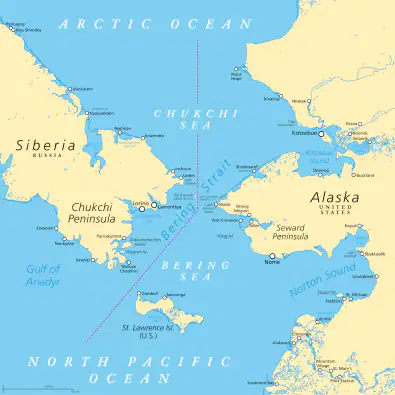
The _____ separates the Northwestern part of North America from the northeastern part of Asia

A _______ is a narrow passageway connecting two large bodies of water.
Who were the first people that lived in the cold tundra of the Arctic, relied on animals such a caribou for fur and food.
Mongolians
Inuits
Aboriginals
Samis
What shaped the lives of Native Americans PRIOR to European immigration on the Pacific Coast?
The mild climate and natural resources of the Pacific Coast (fish/large trees).
What shaped the lives of Native Americans PRIOR to European immigration in the high desert regions of present day Arizona, New Mexico, Colorado and Utah?
Agriculture & Hunting adaptation due to arid environment which lead to fewer resources
What shaped the lives of Native Americans PRIOR to European immigration in the Great Plains?
The nomadic lifestyle centered around buffalo hunting for food and clothing.
European migration to the United States and Canada begun in the late _____?
1500s
What did most early European settlers came from England, France, and Spain in search of what?
farmable land
Religious and political freedom
valuable minerals
Is the widespread transfer of plants, animals, precious metal, commodities, culture, human populations, technology, diseases and ideas between the New World (the Americas) in the Western Hemisphere and the Old World (Africa-Eurasia) in the Eastern Hemisphere.
The settlers in the ______ English colonies made their living by fishing, shipbuilding and manufacturing and trade.
Northern
The first permanent English settlement is _________, Virginia in 1607
The _______ English colonies were agricultural, raising cash crops grown to be sold or trade.
By the 1600's these southern English colonies produced surpluses of cash crops on large plantation using _______ labor.
enslaved Afrcian
The French came to North America not to settle, but to make money in the _______ and then return to France.
fur trade
(beaver pelts)
The French founded _______ and settled along the Mississippi River to the Gulf of Mexico and in New Orleans.
Quebec
The lands _______ of the Mississippi River were part of the Spanish Empire that included much of South America and all of Central America and Mexico.
In 1565 Spain set up the first European settlement in present day _________ , Florida.
Most Spanish settlements in the present U.S. were in the ______-Texas, New Mexico, Arizona and California.
Why did the New England colonies depend on shipbuilding and fishing rather than agriculture?
The New England colonies depended on shipbuilding and fishing due to rocky soil, short growing season, cold winters and abundance of natural resources..
How are the pull factors for the English settlers and French settlers different?
English settlers were motivated by religious freedom and money, while French settlers focused on trade and alliances.
Match the following to their correct answers:
French & English fought over land & trade in North America
1754-1763 French &Indian War (7year War)
Relation between American colonies & Great Britain worsened as the British government extended control
1765-1784
American Revolution
Agreement with France; nearly doubled U.S. land size gaining control of the Mississippi River
1803
Louisiana Purchase
The treaty of Guadalupe Hidalgo gave U.S., California, Utah, Nevada & parts of Colorado, Wyoming, Arizona and New Mexico.
1846-1848
Mexican-American War
The idea that the U.S. is destined to expand its control.
1846-1869
Westward Expansion
Match the following correctly:
Economic expansion from agriculture to machine driven factories.
1870-1900
Industrialization
Large numbers arrived from Europe & Asia, mostly in Northeast cities like NYC, Cleveland, Detroit, Chicago
1870-1900
Immigration & Urbanization
Protecting social welfare, promoting moral improvement
1900
Progressivism
Policy of extending power & influence over smaller, weaker nations through political, economic & military force
1800-1900
American Imperialism
Maintained neutrality until the last two years, England as a superpower
1917-1918
World War I
In 1787 a group of leaders drafted a plan of government for the U.S. called the _______.
the Constitution created a national government and gave it certain powers while reserving other powers for the ________.
Name the three parts of the Constitution?
Match the following parts of the Constitution to its definition.
introduction of the constitution, explains the goals. We the people
Preamble
Organizes the government, Establishes different parts of the government
Article (7)
Changes the Constitution, Frist 10 amendments, 17 additional amendments
Amendments (27)
What are the goals of the Constitution according to the Preamble?
Besides the structure of the government, what other topics do the Articles outline?
The relationship between the states, federal government, interstate commerce, foreign affairs, and the creation of a common currency.
The government of the United States is a ____________ in which people elect those who govern them.
The national government of the United States has ______ separate and distinct branches of government.
Name the three branches of government?
Organize these options into the right categories
Enforce Laws
President, Vice President, Presidential Cabinet
Create Laws
Congress, Senate, House of Representatives
Interprets the Laws
Supreme Court (9 Justices) & other law courts
The United States has the worlds largest and most diversified economy. Its success is due to vast (a) , skilled (b) and a (c) political system.
America sustains a _____________ economic system: privately owned resources, technology, businesses; businesses operate for profit with little government control
capitalist free enterprise
America is an agricultural and industrial giant due to _______ soil and early farm _________.
fertile; mechanization
America is an agricultural giant:
World's corn
40%
cotton
20%
wheat, cattle, hogs
10%
crop farming
Midwest, South
livestock ranching
West
Match the following areas that became associated with certain products
Detroit
automobiles
Seattle
aircraft
Silicon Valley (Northern California)
computers
Advances in ______ and computers revolutionized industry in the 1990s.
electronics
America has a _________ economy, one where the production of goods/manufacturing declines and the production of services goes up. Manual labor jobs and blue collar jobs are replaced with technical and professional jobs.
What are some of the post-industrial economy jobs.
(Manual labor jobs and blue collar jobs are replace with technical and professional job)
information processing
transportation
medicine
education
The U.S. accounts for more than 10% of the worlds ________ (goods sold to another country), such as raw materials, agricultural products, manufactured goods.
American is know for _______ automobiles, electronics, machinery, and apparel(clothing).
America is the home of many _________ (corporations that conduct business all around the world)
What does NAFTA stand for?
The __________ (NAFTA) was established in 1994. Between the United States, Canada and Mexico, NAFTA eliminated trade barriers among the three countries.
In 2020 NAFTA was ______ by the Unites States-Mexico-Canada Agreement (USMCA), a more balanced trade agreement with great benefits for American workers.
America is consider to be a _______ country.
What is gross domestic product (GDP)?
What determines developed and developing countries?
Developed and developing countries are determined by economic, social, and demographic factors.
when did terrorism become a concern for the U.S.?
1900
1990
2025
1975.
Why were Afghanistan and Iraq targets for the U.S. post 9-11.
Afghanistan was targeted for harboring al-Qaeda; Iraq was targeted for suspected Weapons of Mass Destruction (WMD) and terrorism ties.
According to many experts, what is the biggest threat to America today?
Domestic extremism
America is a nation of ________, which make it unique in the world setting.
________ ancestry accounts for 70% of the population followed by 18% Hispanic, 13% African American, 5% Asian and 1% Native American.
While there is no official language in America, English is dominant with _______ being the second most common language.
Why is Spanish the second most common language in America?
While there is no official religion in America, 85% of its people are ________, 56% Protestant, 28% Catholic, with Jews and Muslims accounting for 2% each.
The first artist in North America were the _________, with their pottery, weaving, and carvings.
Native Amercians
True American styles flourish in the 1800s and can be seen via literature, landscape, ______ an _________ (skyscrapers).
painting, architecture
_________ became the film-making center of the United States?
Atlanta, Georgia
Hollywood, California
Chicago, Illinois
New York, New York
_______ become the center for theater and Broadway in the U.S.?
American music developed with influences from various groups. _________, blues, gospel, rock-n-roll have African American origins.
Almost _______ of working age American are employed, and almost half are women.
More than 10% of Americans live in ______?
poverty
middle class
upper class
millionaires
Kids age 6-16 are ________ to attend school (compulsory education); 90% attend public schools, which are free though secondary school; America has over 2,300 4 year public and private colleges and universities.

