
Font size
 Worksheets
The Early Republic
Total questions: 53
Worksheet time: 52mins
A precedent is an event or decision that serves as an (a) for future, similar circumstances.
Why did the Federalists pass the Alien and Sedition Acts?
To protect the government from its critics and enemies.
To protect the president.
To help French-born people become American citizens faster.
To allow for more Federalists newspapers.
What amendment did the Sedition Act violate?
1st
2nd
3rd
4th
Which of the following statements reflects the significance of Marbury v. Madison?
It confirmed the Supreme Court’s power to declare acts of Congress unconstitutional.
It meant that the Supreme Court had to hear every case brought before it.
It allowed for presidents to appoint judges at midnight.
It established judicial review.
Which of the following is the primary reason why Lewis and Clark were sent on their expedition in 1803?
To carefully map out the Mississippi River.
To invite Native American chiefs to Washington DC.
To find a water route to the Pacific Ocean.
To find former French fur traders.
Which president dealt with the XYZ Affair?
Washington
Adams
Jefferson
Madison
Which president asked for a declaration of war against Britain?
Adams
Jefferson
Madison
Monroe
Which American leader gained importance during the War of 1812?
William Henry Harrison
Oliver Hazard Perry
Andrew Jackson
Zebulon Pike
Which fort did the British bombard for over 24 hours, resulting in an American victory and the American national anthem?
Fort Defiance
Fort Hull
Fort Phoenix
Fort McHenry
Which statement describes one result of the War of 1812?
Great Britain lost control of Canada
The United States gained control of the Oregon Territory
The United States stopped trading with Britain and France
Great Britain stopped the practice of impressment.
The period in which American felt a sense of unity was known as the
Mr. Madison's War
Era of Good Feelings
Protectionism
The War Hawks
Taxes placed on foreign goods in order to protect American businesses. Supported in the North, but despised in the South.
Free Enterprise
Money
Extra Money
Tariffs
Which of these was a precedent set by the first President of the United States, George Washington
the popular election of the President
the tradition of only serving two terms
naming the nine Justices to the Supreme Court
addressing the Chief Executive as a "Your Highness"


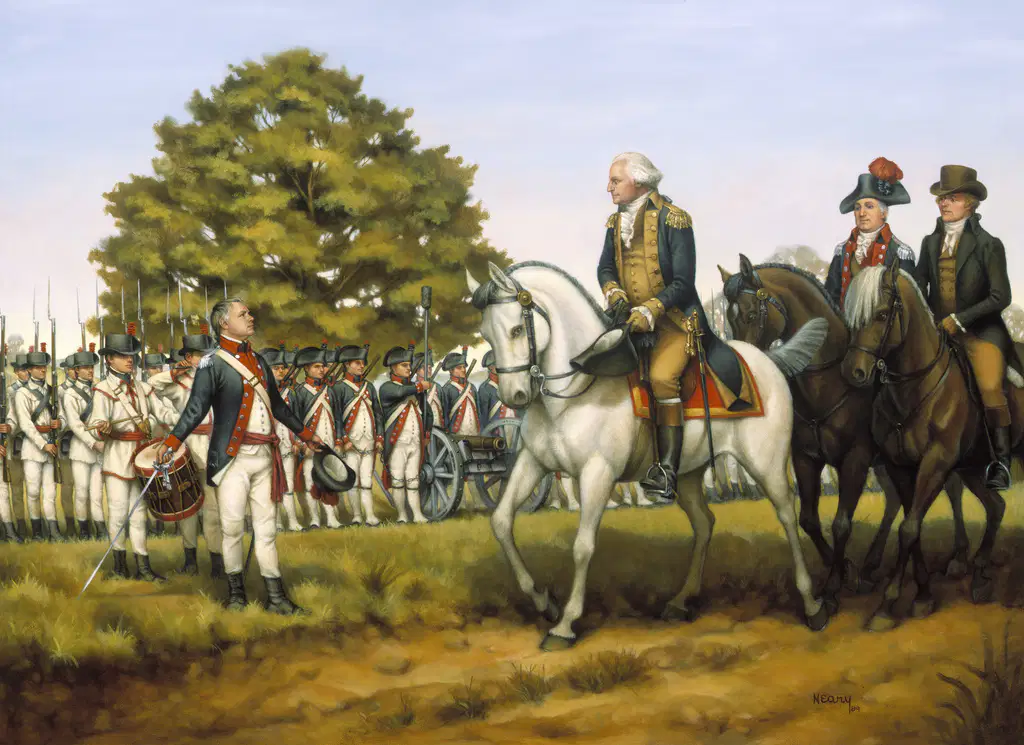
Which statement BEST describes a major result of the Whiskey Rebellion?
The new government halted the production of whiskey.
People learned that the new government would execute violent protestors.
The new government proved too weak to respond in times of crisis.
People realized that the new government would not tolerate violent protests

In George Washington's Farewell Address, what is he telling the future leaders of the America to avoid?
Colonial Settlements
Protective Tariffs
Permanent Alliances
Territorial Disputes
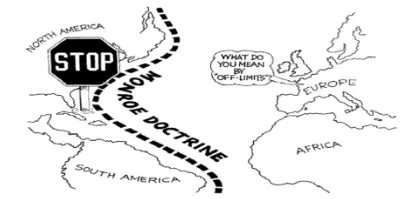
The U.S. foreign policy illustrated in this political cartoon was intended to -
Prevent further European colonization of the Western Hemisphere by European Nations
Deter Spain from inciting revolution in former U.S. colonies.
Encourage European powers to invest in Latin America.
Keep the war between France and Spain from spreading to Latin America.

Thomas Jefferson passed the Embargo Act in 1807 which states?
The U.S. cannot trade with any foreign nation
Imports to the United States is limited to 20%
Jefferson authorizes the U.S. to industrialize
Trade with Britain is prohibited
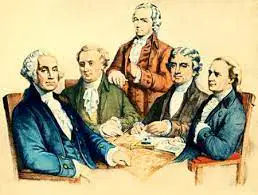
George Washington’s Domestic challenges were building a new government, creating a court system and a financial plan that would generate the new nation’s revenue, and creating a cabinet of advisors to address these issues. Foreign policy issues were how to stay out of the European affairs; he created the Proclamation of Neutrality (1793)
FALSE
TRUE
What is Popular Sovereignty?
Being popular in the world
People voting and having a say in their governments’ decisions
People voting
The act of the 20th amendment and its rules
Which of the places are considered a port city?
Denver, Memphis, and St. Louis
St. Louis, Pittsburgh and Chicago
New Orleans, Charleston, Boston
Atlanta, Chicago, and Dallas
What was the outcome of the Gibbons vs Ogden case?
It upheld state rights over federal rights
It expanded federal power over interstate commerce
It limited the power of the federal government
It was a victory for state sovereignty
The Constitution created _____ branch(es) of government
one
two
three
four
McCulloch v. Maryland was about whether a state could _______ a U.S. bank.
tax
issue
nullify
ratify
McCulloch v. Maryland was about whether the Constitution lets Congress start a _____.
tax
national bank
privatized education system
war
The first political parties resulted from arguments between _________________ and Jefferson.
Washington
Madison
Burr
Hamilton
Jefferson's party was the ____________________________.
Democratic-Republicans
Federalists
Whigs
Tories
Arguments over the _______________________ led to the formation of the first political parties.
Neutrality Proclamation
Treaty of Paris
Bank of the United States
ratification of the Constitution
What type of people supported the Democratic-Republican party?
farmers
bankers
wealthy elite
businessmen
What clause in the Constitution was used to justify the Bank of the United States?
Supremacy
Elastic
Treasury
Financial
What party wanted a STRICT interpretation of the Constitution?
Democratic-Republicans
Federalists
Whigs
Democratic
How did Washington feel about political parties?
He felt they were divisive and did not like them.
He always sided with Hamilton.
He always sided with Jefferson.
He felt they were necessary for a healthy democratic republic.


The French Navy became aggressive and kidnapped our sailors, forcing them to fight, this is called....
impressment
forced fighting
french fries
french press

Close reading the map, with the Missouri Compromise, what state was allowed to enter as a free state?
Missouri
Maine
Kentucky
Alabama

Close reading the map, where was the Missouri Compromise line?
36-30 degrees north in the Louisiana Purchase
46-40 degrees north in the Louisiana Purchase
56-50 degrees north in the Louisiana Purchase
Why was it important to Southern senators to have an equal number of slave and free states? It was mainly an ...
Issue of respect.
Issue of equal balance in voting power.
Issue of tax revenue.
Issue of future elections.

Close reading the map, with the Missouri Compromise, what state was allowed to enter as a slave state?
Missouri
Maine
Kentucky
Ohio

