
NEW
Font size
 Worksheets
Assessment: The Decline of Feudalism
Total questions: 18
Worksheet time: 9mins
Why was Thomas Becket killed?
He helped the French defeat the English.
He led the nobles in trying to take power.
He sided with the Church against the king.
He tried to stop the peasants from rebelling.
Which of these was a reform made by King Henry II of England?
Trials were held before a royal judge.
Ordinary people elected their rulers.
Nobles had to let their serfs go free.
England paid soldiers to be in the army.
What was the purpose of Magna Carta?
to make the Church weaker
to give the king more power
to strengthen common law
to protect the rights of nobles and Church
Habeas corpus means that people cannot be held indefinitely in jail unless
they want to.
they are charged with a crime.
the king orders it.
the Church requests it.
What action by an English king gave ordinary people a voice in government?
calling the Model Parliament
putting a seal on Magna Carta
issuing the Constitutions of Clarendon
closing Canterbury Cathedral
How did political changes in England weaken feudalism?
Serfs had to live on the land that they farmed.
Nobles lost power to the king or common people.
Constant conflict led to a loss of social order.
Authority in government was given to the Church.
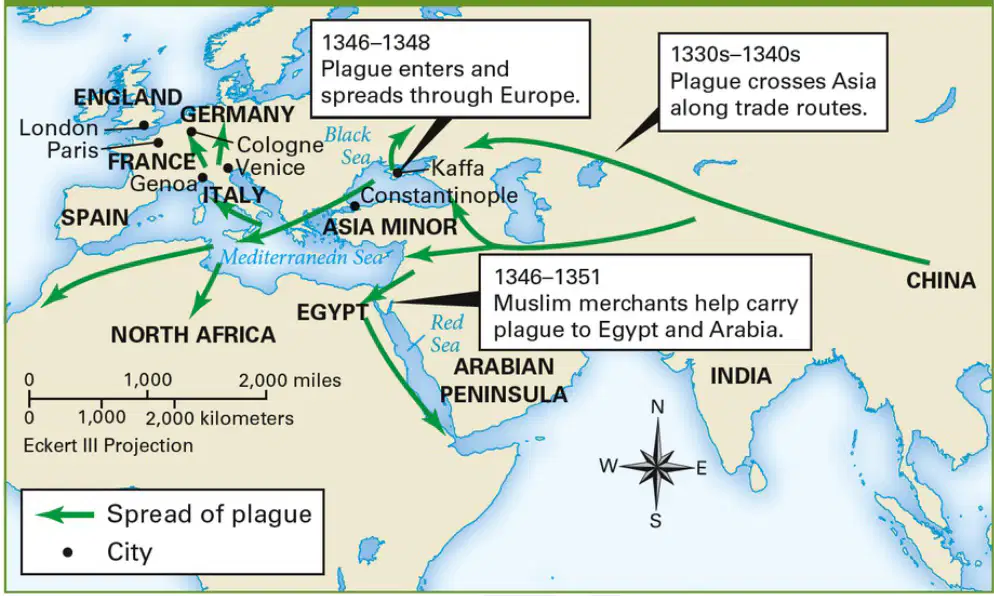
What was one human activity that contributed to the spread of the bubonic plague?
bathing too often
trading with Asia
eating rotten food
keeping mice as pets
How did the plague make life harder for Jews in Europe?
They had to move into the big cities.
They got sick more than other people.
They were often blamed for the disease.
Their food was not always safe to eat.
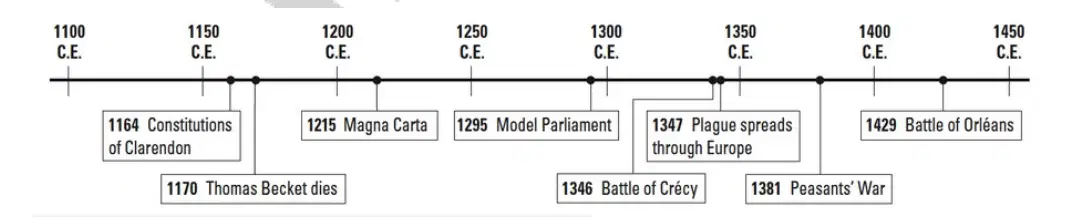
What is one reason why the battle in 1429 had a different outcome from the battle in 1346?
Joan of Arc led the French.
The English had heavy armor.
The French used the crossbow.
Peasants fought for the English.
How did the plague increase the power of the common people?
Sick people moved into the castles.
It created a shortage of workers.
Lords were more likely to die from it.
Monarchs accused lords of spreading it.
What technological advantage helped the English win many early battles of the Hundred Years’ War?
gunpowder
heavy armor
the longbow
larger horses
Which development in the Hundred Years’ War was partly a response to Joan of Arc?
loss of royal authority
increase in foot soldiers
more powerful weapons
stronger national identity
How did the Hundred Years’ War contribute to the decline of feudalism?
Hiring soldiers made monarchs less dependent on vassals.
Serfs ran away from the manors to fight in the battles.
Nobles insisted that monarchs consult them about new taxes.
England refused to let go of its claims to land in France.
Use the excerpt from Magna Carta (1215) to answer: Clause 38 states, “No bailiff for the future shall, upon his own unsupported complaint, put anyone to his ‘law,’ without credible witnesses brought for this purpose.” According to this clause, someone could not be tried for a crime unless there were what?
credible witnesses
a confession by the accused
a royal decree from the king
written evidence only
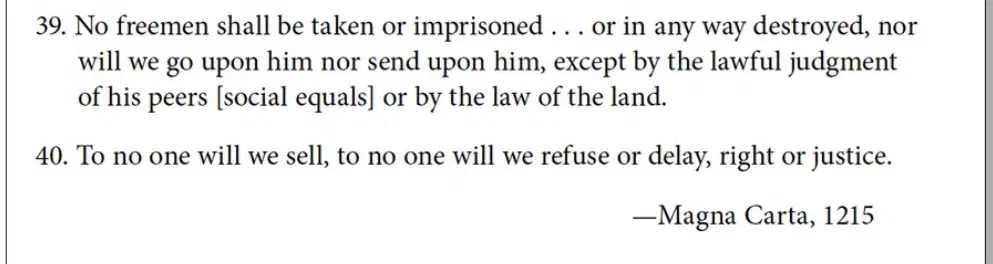
Use the excerpt from Magna Carta (1215) to answer: Which phrase in the excerpt suggests the idea of a trial by jury for someone charged with a crime?
lawful judgment of his peers
without credible witnesses
sell to no one
by the law of the land
Use the excerpt from Magna Carta (1215) to answer: Clause 40 declares, “To no one will we sell, to no one will we refuse or delay, right or justice.” What is the best summary of the meaning of this clause?
That all people are guaranteed jus6ce under the law
Only nobles will receive quick trials and fair treatment
The king may sell pardons to ensure order in the realm
Only Parliament has the power to make new laws
What conflict led to the Hundred Year War between France and England?
The English refused to give up their control of land in France.
In the early battles of the Hundred Year War, why did French soldiers struggle in battles against the English?
French soldiers were still using feudalist tactics, which included heavy armor that weighed them down.

