
 Worksheets
The BIG Idea & Objective: Introduction to Electricity
Total questions: 20
Worksheet time: 10mins
Which statement best captures the BIG Idea about electricity in this lesson?
Electricity is an essential part of modern life used for many applications.
Electricity is rarely needed outside of power plants.
Electricity is only useful for transportation systems.
Electricity is mainly a topic for advanced engineering research.
A student is listing everyday uses of electricity. Which set best matches the lesson’s examples of applications?
Lighting, heating, cooling, and refrigeration
Cooking, agriculture, mining, and banking
Transportation, sports, music, and art
Construction, medicine, law, and tourism
According to the lesson objective, what concept will students explore about electricity flow?
How electricity flows through different mediums
How electricity is stored only in batteries
How electricity cannot move through any materials
How electricity flow is identical in all materials
Which statement best defines electricity?
Energy from moving heat between objects
A form of energy resulting from the existence of charged particles
Force produced by magnets only
Light created by chemical reactions
According to the vocabulary, what are electrons in solids primarily responsible for?
Carrying positive charge through atoms
Acting as the primary carrier of electricity
Holding the nucleus together
Producing light in all materials
A student wants to increase the amount of electricity flowing through a simple circuit. Which quantity are they trying to increase?
Resistance
Current
Charge
Voltage
Which statement best defines a conductor in electrical terms?
A material that blocks electric current from flowing
A substance or material that allows electricity to flow through it
A device that stores electrical energy for later use
A material that conducts only when exposed to light
You are choosing a material to coat a wire so that electric current does not flow freely to your hand. Which type of material should you select?
Conductor
Insulator
Semiconductor
Power source
A phone’s microchip works because some parts conduct electricity only under certain conditions. Which term describes this kind of material?
Conductor
Insulator
Semiconductor
Voltage (measured in volts) is defined as which of the following?
The force that pushes electric current through a circuit
The total electrical energy stored in a battery
The rate at which energy is used by a device
The amount of electric charge in a wire
Amperage (measured in amps) refers to what?
The resistance to current in a circuit
The force that moves charges
The amount of electric current flowing through a circuit
The voltage drop across a component
A student increases the voltage applied to a simple circuit while keeping resistance the same. Based on the definitions provided, which outcome is most likely for the current (amperage)?
It increases because a greater push drives more current.
It decreases because voltage and current move in opposite directions.
It stays the same because voltage does not affect current.
It becomes zero because high voltage stops current flow.
In JavaScript, which control structure is used to run different code based on a true/false test?
If/Else statement
For loop
Delay function
Logical OR operator
A loop in programming is primarily used to:
Repeat a set of instructions multiple times
Pause the program for a fixed amount of time
Compare two values for equality
Translate code into machine language
Which statement best defines a component in an electric circuit?
Any part of a circuit, such as wires, switches, or diodes
Only the power source that provides voltage
The path that splits current into multiple branches
A device that measures current but is not part of the circuit
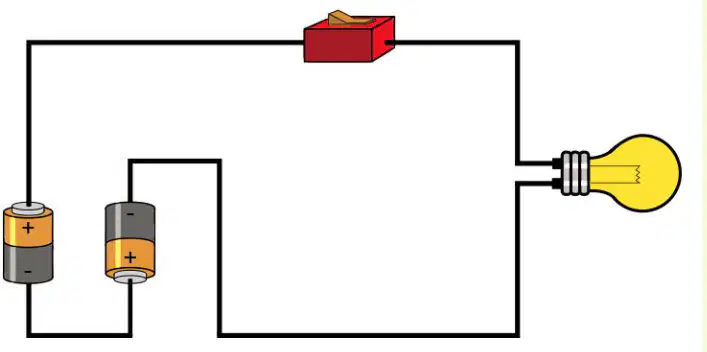
In a series-circuit, how does electric current travel?
Through each component along one pathway
Randomly jumping between components
Through separate pathways for different components
Only through the first and last components
A flashlight contains a battery, a switch, and a bulb. In circuit terms, what are these items collectively called?
Components
Branches
Loads only
Parallel paths
Which statement best defines a series-parallel circuit?
A network where all components are connected one after another in a single path
A circuit that combines both series and parallel connections to meet wiring needs
A circuit in which every component shares the exact same current at all times
A diagram that shows only resistors connected to a single battery
What is the primary function of a capacitor in an electronic circuit?
To store energy in the form of an electrostatic field
To convert electrical energy directly into light
To measure voltage across a component
To increase the current by reducing resistance to zero
A resistor is best described as which of the following?
A component that opens and closes a circuit on command
An electrical component that limits or regulates the flow of current
A device that stores charge for later use
A wire that guarantees equal voltage across every branch

