
 Worksheets
Unit 3 Land Based Empires Assessment — Extracted Questions
Total questions: 15
Worksheet time: 8mins
Which of the following accurately describes a significant difference between the Ottoman and Mughal Empires in the early seventeenth century?
The Mughals practiced religious tolerance toward non-Muslim subjects, while the Ottomans did not.
The Ottomans ruled over people who were predominately Muslim, while the Mughals did not.
The Mughals used gunpowder weapons to expand their territory, while the Ottomans did not.
The Ottomans made Shia Islam the official state religion, while the Mughals made Buddhism the official state religion.
Which of the following describes a major cause of the expansion of the Ottoman Empire in the fifteenth and sixteenth centuries?
The Ottoman Empire successfully pursued mercantilist economic policies.
Ottoman citizens unified by their recent conversion to Islam were strongly motivated to conquer.
Exploitation of artillery and small arms gave the Ottomans advantages over many of their political rivals.
The decentralized federalism of the Ottoman Empire encouraged competition and technological innovation.
From 1400 to 1750, Eurasian rulers sponsored the arts primarily for which of the following reasons?
To display power and legitimize their rule
To spend excess money collected in taxes
To encourage tourism and pilgrimages
To increase employment opportunities for struggling artists
“The state of monarchy is the supremest thing upon earth; for kings are not only God’s lieutenants upon earth, and sit upon God’s throne, but even by God himself are called gods. In the Scriptures kings are called gods, and so their power after a certain relation compared to the divine power.” King James I, speech to Parliament, England, 1610 The passage above is best understood in the context of which of the following?
European monarchs’ continued use of religion to legitimize political authority
The influence of Islamic political thought on Europe after the Crusades
The establishment of theocracies throughout Eurasia
The differential treatment of Protestants and Catholics in England
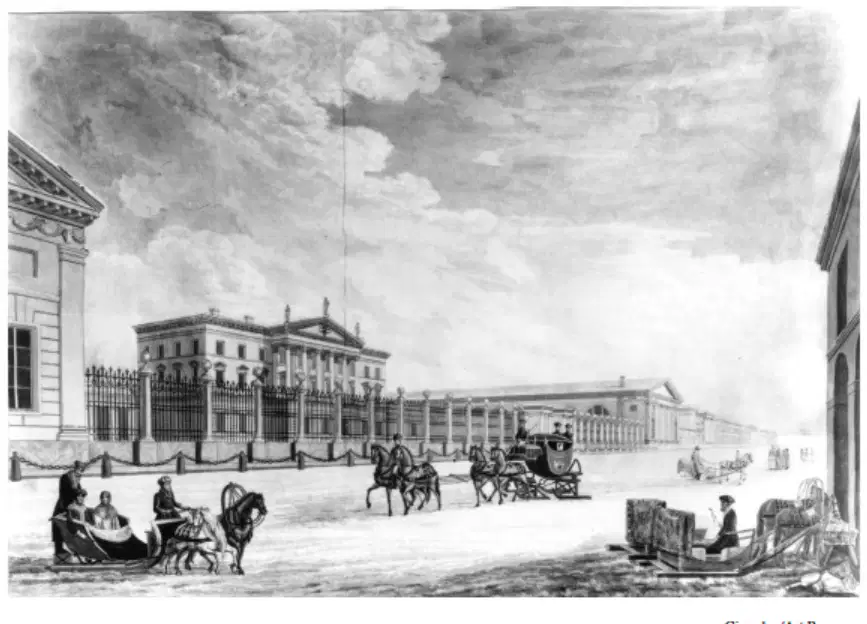
Which of the following world history processes was most responsible for the eighteenth-century cityscape of St. Petersburg, Russia, shown above?
Disease diffusion
World climate changes
Westernization
Democratization
Isolation
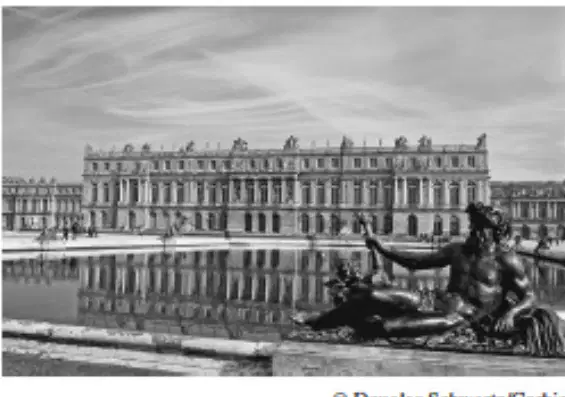
Which is the most likely reason that rulers during the seventeenth century built elaborate palaces such as the one at Versailles, France, shown above?
To demonstrate their wealth and power
To provide jobs for artists, architects, and builders
To create fortresses as a defense against invading armies
To glorify and demonstrate the power of the official state religion
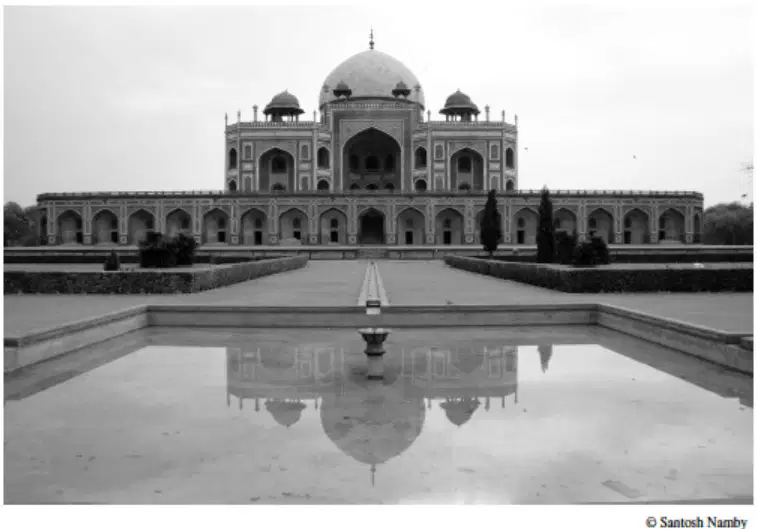
The photograph above of a sixteenth-century Mughal mosque in India built by Akbar is an example of which of the following?
Emergence of capitalist economies
Expansion of coercive labor systems
Creation of a global trade network
Cultural syncretism
“To the count of Katzenellenbogen, Ziegenhain, and Nidda, my gracious lord. Pope Leo X, in the bull in which he put me under the ban, condemned my statement that ‘to fight against the Turk is the same thing as resisting God, who visits our sin upon us with this rod.’ I still confess freely that this statement is mine. The popes and bishops called for war against the Turks in the name of Christ. Yet because Christ taught that Christians shall not resist evil with violence or take revenge, it is against His name. In how many wars against the Turks have the bishops and clergy prevented Christians from enduring heavy losses? Indeed, the king of Hungary and his bishops were beaten by the Turks at Varna* and more recently a German army would perhaps have fought with more success, if it had not contained priests. If I were an emperor, a king, or a prince in a campaign against the Turks, I would encourage my bishops and priests to stay at home and mind the duties of their office, praying, fasting, saying mass, preaching, and caring for the poor, as not only Holy Scripture, but their own canon law teaches and requires. To this I say Amen, Amen.” *a reference to a failed Christian Crusade launched against the Ottoman Turks in 1444 Martin Luther, German theologian, sermon addressed to a German prince, 1528 A historian interpreting the views expressed in the passage would likely explain that those views were most strongly influenced by Protestant desires to
promote religious war against fellow Christians
encourage the creation of a united German state free of papal influence
demonstrate that an individual’s destiny was predetermined by God
reform Christian society by adhering more closely to Biblical teachings
“To the count of Katzenellenbogen, Ziegenhain, and Nidda, my gracious lord. Pope Leo X, in the bull in which he put me under the ban, condemned my statement that ‘to fight against the Turk is the same thing as resisting God, who visits our sin upon us with this rod.’ I still confess freely that this statement is mine. The popes and bishops called for war against the Turks in the name of Christ. Yet because Christ taught that Christians shall not resist evil with violence or take revenge, it is against His name. In how many wars against the Turks have the bishops and clergy prevented Christians from enduring heavy losses? Indeed, the king of Hungary and his bishops were beaten by the Turks at Varna* and more recently a German army would perhaps have fought with more success, if it had not contained priests. If I were an emperor, a king, or a prince in a campaign against the Turks, I would encourage my bishops and priests to stay at home and mind the duties of their office, praying, fasting, saying mass, preaching, and caring for the poor, as not only Holy Scripture, but their own canon law teaches and requires. To this I say Amen, Amen.” *a reference to a failed Christian Crusade launched against the Ottoman Turks in 1444 Martin Luther, German theologian, sermon addressed to a German prince, 1528 A historian could best explain the arguments made in the passage regarding the pope and the clergy in the context of Protestant claims that the Catholic Church
had not adequately supported earlier Crusades against Muslims in the Holy Land
had become corrupted by power
had become too heavily influenced by Renaissance Humanism
had failed to convert Muslims living in Europe to Christianity
“To the count of Katzenellenbogen, Ziegenhain, and Nidda, my gracious lord. Pope Leo X, in the bull in which he put me under the ban, condemned my statement that ‘to fight against the Turk is the same thing as resisting God, who visits our sin upon us with this rod.’ I still confess freely that this statement is mine. The popes and bishops called for war against the Turks in the name of Christ. Yet because Christ taught that Christians shall not resist evil with violence or take revenge, it is against His name. In how many wars against the Turks have the bishops and clergy prevented Christians from enduring heavy losses? Indeed, the king of Hungary and his bishops were beaten by the Turks at Varna* and more recently a German army would perhaps have fought with more success, if it had not contained priests. If I were an emperor, a king, or a prince in a campaign against the Turks, I would encourage my bishops and priests to stay at home and mind the duties of their office, praying, fasting, saying mass, preaching, and caring for the poor, as not only Holy Scripture, but their own canon law teaches and requires. To this I say Amen, Amen.” *a reference to a failed Christian Crusade launched against the Ottoman Turks in 1444 Martin Luther, German theologian, sermon addressed to a German prince, 1528 A historian interpreting the passage would most likely explain that the audience of the sermon is an illustration of the fact that
papal alliances with the Holy Roman emperors led to widespread religious persecutions in Germany
the Protestant German nobility was wary of confronting the Ottomans without Catholic support
political support from the German nobility aided in the development of the early Protestant community
the Protestant German nobility adopted pacifist attitudes during religious disputes with their Catholic and Muslim opponents
“In the Name of God, the Merciful, the Compassionate. The Holy Qur’an says, ‘Rise not up against me, but come to me in surrender.’ This letter has been graciously issued by me Sultan Selim, the most glorious sovereign, the Caliph of God Most High in this world, hailed in victory, slayer of the wicked and of the infidel, guardian of the noble and the pious, the warrior in the path of God, the defender of the Faith, the standard-bearer of justice and righteousness—and is addressed to you, prince Ismail, the ruler of the kingdom of the Persians, the possessor of the land of tyranny and wickedness, the captain of the vicious, the chief of the malicious, the usurper of the throne of the ancient Persian kings. I have heard repeatedly that you have subjected the upright Muslims under your rule to your devious will, that you have undermined the firm foundation of the Faith, and that you no longer uphold the commandments and prohibitions of the Divine Law, but have incited your heretical faction to commit abominable deeds in the lands that you possess. Be informed, then, that both the opinion of the learned Islamic scholars and the consensus of the Sunni community agree that it is my obligation to extinguish and extirpate the evil heresy that you represent. But should you take up a course of repentance, become like one blameless, and return to the sublime straight path of Muhammad (Prayers and salutations be upon him), and should you proclaim your lands and their people part of my Ottoman state, then you shall be granted my royal favor and imperial protection and patronage.” Letter by the Ottoman Sultan Selim I to the Safavid Shah Ismail I, circa 1514 A historian would most likely interpret the rhetoric in the passage as evidence that rulers of imperial states in the period circa 1450–1750 continued to
use religious ideas to highlight their political legitimacy and attack the legitimacy of their enemies
prefer to resolve interstate conflicts through warfare rather than through diplomatic means
patronize religious establishments and preside over religious ceremonies
seek to unite forces to prevent the spread of secular ideas
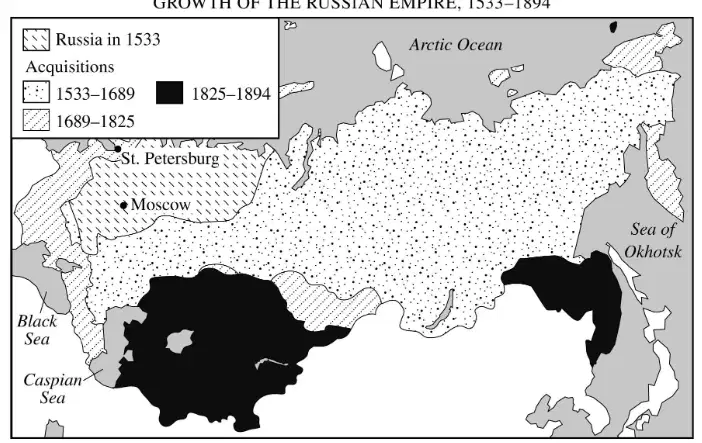
Which of the following empires in the period 1450–1750 engaged in a type of territorial expansion most similar to that depicted in Map 1?
The Spanish Empire
The Portuguese Empire
The British Empire
The Mughal Empire
Read the following passage and answer the question. "When we were in Canton, a port in southern China, we came across a woman who cried out in Portuguese 'Our Father, who art in Heaven, hallowed be thy name.' And because she could speak no more of our language, she very earnestly asked us in Chinese to tell her whether we were Christians. We replied that we were, and for proof we repeated all the rest of the Lord's Prayer which she had left unsaid. Being assured that we were Christians, she pulled us aside, and weeping said to us, 'Come along, Christians from the other end of the world, with your true sister in the faith of Jesus Christ.' Furthermore, she told us that she was named Inez de Leyria, and her father was a great ambassador from Portugal to the Emperor of China. The ambassador married her mother, a Chinese woman, and made her a Christian. Along with her, many were converted to the faith of Christ. During the five days we remained in her house, we made them a little book in Chinese, containing many good prayers." Account of Fernão Mendes Pinto, Portuguese explorer and merchant, circa The activities of Inez de Leyria's father as described in the passage best support which of the following conclusions about the period 1450–1750 C.E.?
The intensification of commercial and diplomatic activity across Eurasia was accompanied by increased missionary activity.
The arrival of Nestorian Christians along the Silk Roads introduced European missionaries to China.
Russian expansion in Asia encouraged Christian missionary activity in China.
The intensification of regional patterns of trade in the Indian Ocean spurred Chinese merchants to convert to Christianity.
Source 2: Sayings attributed to Guru Nanak, the founder of Sikhism, circa 1500 C.E. • “Oh God, the tongue of man has given Thee numerous names; but ‘the Truth’ is Thy real name from time immemorial.” • “We human beings are neither Hindus nor Muslims; but are bodies and soul of the Supreme Being; call Him Allah, or call Him Rama.” • “Everyone is chanting: ‘Rama, Rama’; but mere repetition is no remembrance of Rama. Only when the heart of man becomes saturated with God is such remembrance fruitful.” • “Worthless is caste and worthless an exalted name; for all humankind there is but a single refuge in God.” Source 2 indicates that all of the following were likely factors contributing to Sikhism’s popularity in India EXCEPT:
It offered a set of religious beliefs that combined elements of both Hinduism and Islam.
It advocated a direct and personal approach to God that paralleled Islamic beliefs.
It appealed to members of the lower socioeconomic strata by rejecting the rigid social hierarchy of Hinduism.
It offered a set of principles around which all Indians could rally in resisting British imperial encroachment
Which of the following was a method rulers in Eurasia used to legitimize and consolidate their power during the period 1450 C.E. to 1750 C.E.?
Developing professional militaries
Promoting free trade
Adopting the religious practices of minority groups
Enacting reforms to decrease economic and social inequalities

