
 Worksheets
POMS Africa 2025
Total questions: 32
Worksheet time: 17mins
What was the main purpose of apartheid in South Africa?
To legally separate races
To integrate different racial groups
To promote cultural exchange
To end colonial rule
Which region of Sub-Saharan Africa is known for its rainforests, thick vegetation, and major waterways?
Southern Africa
Central Africa
East Africa
West Africa
What was the primary goal of imperialism in Africa?
Sharing cultural values
Expanding democracy
Gaining power and resources
Promoting education
Which organization was formed to protest unfair laws in South Africa?
Rwandan Patriotic Front (RPF)
United Nations
African National Congress (ANC)
European Union
How did the Syrian government respond to peaceful protests at the beginning of the conflict?
By enacting reforms
By violently suppressing the demonstrators
By negotiating peace talks
By providing economic assistance
Which factor is MOST likely to have had the greatest impact on human settlement patterns in Sub-Saharan Africa?
Proximity to the region’s numerous coal mines
Political boundaries created during European colonization
Proximity to water sources needed for subsistence farming
Urbanization resulting from the growth of the oil industry in the region
Why might the soil in Sub-Saharan Africa become less fertile?
Due to excessive rainfall
Due to desertification
Due to volcanic eruptions
Due to urban sprawl
How does climate relate to population distribution?
Cold climates generally support more people than warm climates.
Hot climates generally support more people than cold climates.
Climate has little effect on where people live.
Moderate climates generally support the largest populations.
For which primary reason does language remain a vital element of culture in many societies today?
It determines which natural resources a country can produce.
It helps people communicate and share traditions across generations.
It limits trade and interaction between different regions.
It prevents cultural diffusion between groups.
The climate of Southern Africa can be described as —
Temperate
Rainy
Hot
Cool
What was a primary characteristic of the kingdom of Mali under Mansa Musa?
Lack of trade routes
Weak economic influence
Center of Islamic culture and education
Absence of gold resources
Which of the following was a cause of the Syrian uprising? Select TWO correct answers.
Lack of basic freedoms
Failed uprisings in Egypt and Tunisia
Difficult economic times
Terrorist attacks led by Christian extremists
Lack of religious tolerance by the national government
Which African country successfully resisted European colonization by 1914?
Nigeria
Ethiopia
South Africa
Zimbabwe
How have some countries in Sub-Saharan Africa used their mineral profits?
To build military forces
To create new deserts
To improve education and healthcare
To fund political campaigns
What natural resources are abundant in Southern Africa?
Gold, diamonds, and copper
Oil, coal, and iron
Timber, cocoa, and coffee
Silver, uranium, and aluminum
Which physical geographic factors affect settlement patterns and population distributions? Select TWO correct answers.
Landforms
Climate
Transportation
Homes
Employment
How did the Bantu Migration contribute to the spread of culture in Africa?
By conquering all of Africa
By sharing languages and knowledge of iron tools
By isolating themselves from other tribes
By focusing solely on hunting
What has been the impact of the Syrian Civil War on the country's political stability?
Improved diplomatic relations
Increased political stability
Decreased political stability
No impact on political stability
What long-term impact did European colonialism have on sub-Saharan Africa?
Enhanced cultural unity
Established lasting peace between groups
Created borders that divided cultural groups
Increased economic self-sufficiency
What does the term "Scramble for Africa" refer to?
The competition among African nations for independence
The European rush to colonize Africa
The African resistance movements against Europeans
The introduction of new crops in Africa
What is one of the main environmental challenges faced by countries in Sub-Saharan Africa?
Overpopulation
Erosion
Industrial pollution
Urbanization
What is one method mentioned to improve agricultural practices in Sub-Saharan Africa?
Using chemical fertilizers
Building more dams
Increasing the use of machinery
Implementing crop rotation

The image shown was most likely taken in which African country and is displaying what policy?
United States; Segregation
Egypt; Segregation
Israel; Apartheid
South Africa; Apartheid

Starting colonies to benefit a more powerful country is the basis of _____________.
imperialism
colonialism
missionaries
Pan-Africanism
merchant


A historian could best use this map to study which of the following topics?
World War I alliances
free trade
militarism
imperialism
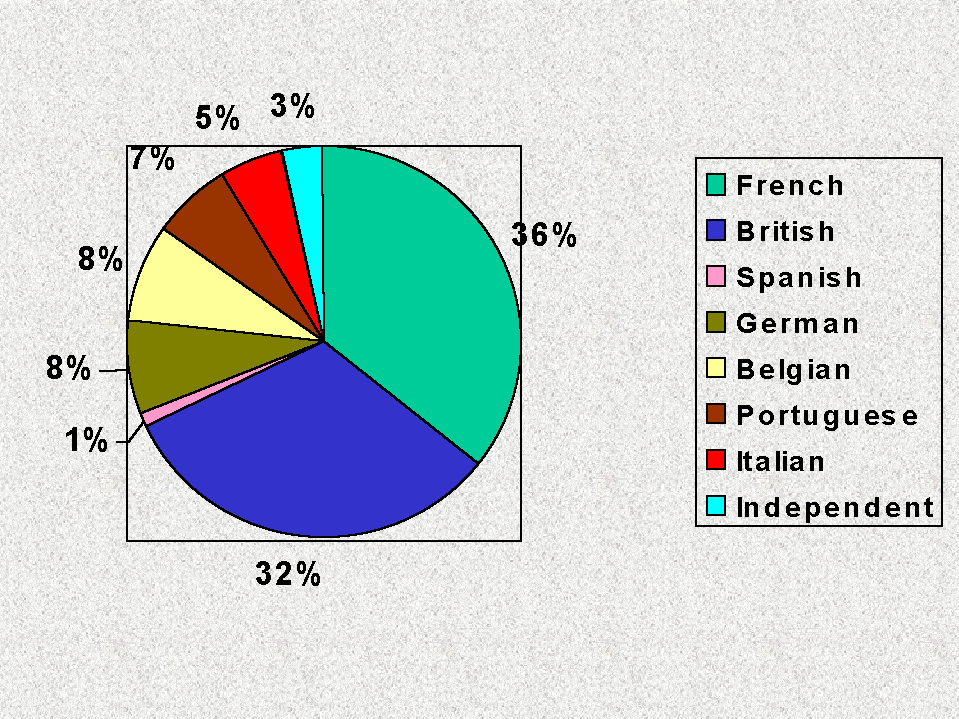
This likely represents
imperialism in Africa
imperialism in Asia
imperialism in the Americas
global imperialism

The measure of how crowded a place is is known as __________.
economic recovery
population density
demographics
worldwide census


A place in the country side
Urban
Rural
Metropolitan
Megapolis

Rural or Urban?
Rural
Urban

