
Font size
 Worksheets
Roaring 20s Quiz
Total questions: 19
Worksheet time: 13mins
What Years represent the Roaring Twenties?
1920-1927
1920-1928
1920-1929
1920-1930
US 6A: How did Prohibition under the Eighteenth Amendment affect U.S. society in the 1920s? Select THREE correct answers.
Rise in organized crime activities related to the illegal sale and distribution of alcohol.
It lead to an decrease in violent crimes and murders.
Rise of speakeasies and culture around the underground use of alcohol.
Foreign countries used the 18th Amendment as a model to pass similar laws.
Increased smuggling and bootlegging activity by regular citizens.
US 6A: What was one way the role of women in society changed during the 1920s?
They were granted the right to attend public schools.
They were allowed to own property.
They were allowed increased participation in the political process.
They were granted the right to serve in military combat units.
US 6B: How did Charles Lindberg affect the development of aviation in the United States?
Lindberg created the first domestic commercial airline company.
Lindberg showed that air travel was an acceptable form of transportation.
Lindberg lobbied Congress to invest federal funding into commercial airlines.
Lindberg demonstrated aerial maneuvers that could provide the military with an advantage.
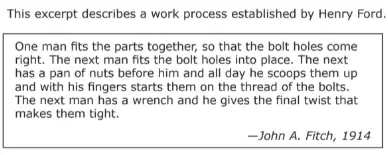
US 6B: Which results did Ford hope to achieve by implementing the process described in this excerpt?
Increased labor union membership
Reduced payroll taxes and employee benifits
Increased productivity and efficiency
Reduced numbers of employees quitting
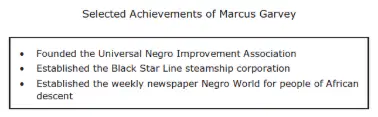
US 6B: How did Marcus Garvey MOST impact African Americans in the early 1900s?
By urging blacks to accept low-paying jobs and social inequality.
By promoting black cultural pride and economic independence.
By supporting the use of violence to overthrow government and win reforms.
By desegregating schools and urban neighborhoods.
US 16A: Which statements highlight President Warren G. Harding's domestic policies after World War I? Select TWO choices that correctly answer the question.
America is ready to encourage, eager to initiate, anxious to participate in any seemly program likely to lesson the probability of war...
I speak for administrative efficiency, for lightened tax burdens...for the omission of unnecessary interference of Government with business...
I wish for an America no less alert in guarding against dangers from within than it is watchful against enemies from without...
...Opportunity is calling not alone for the restoration, but for a new era in production, transportation and trade...
Believing in our higher standards, reared through constitutional liberty and maintained opportunity, we invite the world to the same heights.
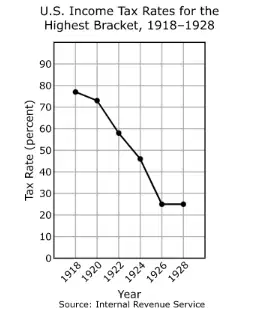
US 16A: In which way did the trend represented in this graph result in economic growth during this time period?
People paid higher interest rates on bank loans.
People had more money to spend on consumer goods.
The government reduced its deficit spending.
The government reduced regulations on stock market investments.
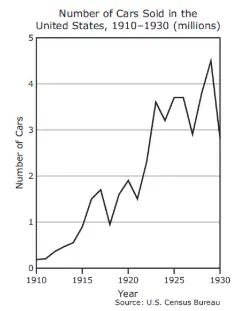
US 16A: Which reason BEST explains the change in the number of cars sold between 1910 and 1925?
Cars became more available because of the removal of tariffs after a global conflict.
Cars became more available because of the passage of antitrust laws.
Cars became more affordable because of the removal of wartime price controls.
Cars became more affordable because of the introduction of the assembly line.
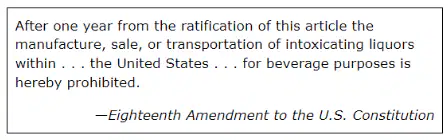
US 5A: Based on the excerpt and your knowledge of U.S. History, which long-term change in American society is reflected by the ratification of the Eighteen Amendment?
It reflected the government's shift to a more active role in the lives of citizens.
It reflected the country's eagerness to move past the hardships caused by World War I.
It reflected the government's desire to support foreign alcohol manufacturers.
It reflected the country's hope of increasing participation in religious organizations.
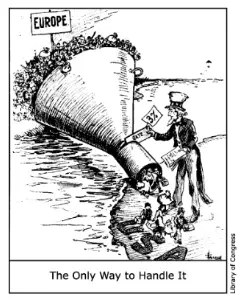
US 15C: Which statement explains the governmental action being portrayed by this 1921 political cartoon?
The passage of the Open Door Policy
The refusal to join the League of Nations
The passage of immigration quotas
The refusal to enter foreign military conflicts
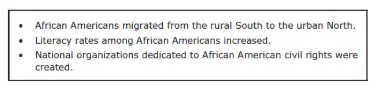
US 24A: The developments on this list contributed to what development of the 1920s and 1930s?
African American musicians developed rock and roll music based on African rhythms and beats.
African American painters of the Hudson River School focused on the beauty of nature.
African American architects created the Neoclassical style based on Roman and Greek models.
African American artists and writers celebrated their culture in a movement called the Harlem Renaissance.
US 24B: What is one similarity between the Harlem Renaissance of the 1920s and the Chicano Mural Movement of the 1960s and 1970s?
Both worked to achieve suffrage for women.
Both focused on the passage of anti-lynching laws.
Both secured rights for migrant farm workers.
Both generated cultural pride among minority groups.
US 24B:
This excerpt is from a play co-written by Zora Neale Hurston, a prominent contributor to the Harlem Renaissance:
Spanish moss drapes the trees...
The woods surround everything. Bull alligators can be heard booming like huge bass drums from the lake at night...
The houses are of raw, second grade lumber, unpainted, each with a porch and two to three rooms. Each man with a "family" is allotted a house for which he is docked about 50 cents a week...No fenced in yards, few flowers, and those poorly tended. Few attempts at any kind of decoration or relief of ugliness. Everyone lives temporary...
...The women of today may be forgotten tomorrow...
US 24B: Based on the excerpt and your knowledge of U.S. History, how did the Harlem Renaissance influence U.S. society?
It used various art forms to accurately depict the African American experience in America.
It limited the production of art that failed to portray American history and culture in a positive manner.
It discouraged African American artists from exploring inequality and discrimination in America.
It provided an opportunity for wealthy patrons to control the work of African American artists.
US 24B: Which statement from the excerpt provides evidence for the answer to Part A?
"Spanish moss drapes the trees"
"Bull alligators can be heard booming like huge bass drums from the lake at night"
"Each man with a 'family' is allotted a house for which he is docked about fifty cents a week"
"The woman of today may be forgotten tomorrow"
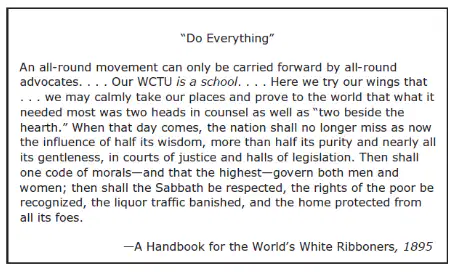
US 25D: How did the White Ribboners contribute to U.S. society during the late 1800s?
By winning the right to vote for African Americans and immigrants
By leading efforts to achieve prohibition and women's suffrage
By supporting the movement to end Reconstruction and Jim Crow
By establishing labor unions for women and children
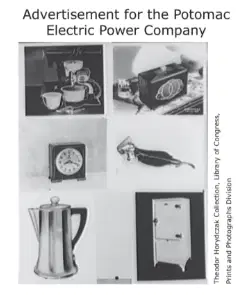
US 26A: The image supports which statement about U.S. society during the early 1900s?
Harmful economic cycles caused consumers to resist new technology.
The manufacture of new products encouraged consumers to resist new technology.
New technologies made daily life easier for consumers.
Consumers resisted change in favor of traditional products.
US 26B: Based on the excerpt, which statement describes the inventions of George Washington Carver?
They extended research efforts to prevent diseases.
They led to improvements in weapons technology.
They led to improvements in weapons technology.
They diversified the uses for agricultural products.
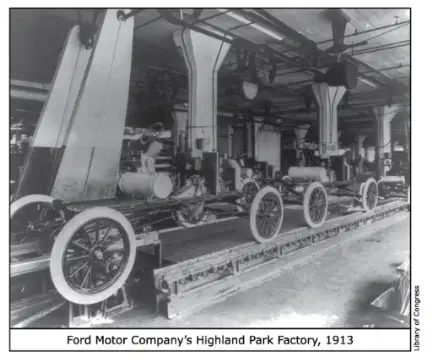
US 26C: Based on the photograph and your knowledge of U.S. History, how did the use of the manufacturing process shown affect the production AND sale of goods in the United States? Select THREE correct answers.
The assembly line enabled goods to be mass-produced at a level that was unprecedented.
Goods were now more affordable to more citizens.
Cars became more expensive to buy.
Standardized and interchangeable parts were produced.
Government regulations lead to a decrease in automotive production.
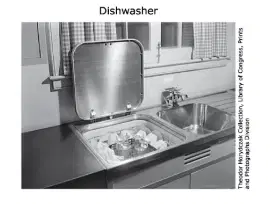
US 27A: Which statement describes a result of this innovation?
It forced consumers to buy large houses in order to make room for these appliances.
It decreased the need for consumers to clean their tableware after meals in restaurants.
It decreased the amount of time consumers spent completing household chores.
It forced consumers back to school in order to learn how to operate these appliances.

