
 Worksheets
Anatomy Test- 11/3/25
Total questions: 311
Worksheet time: 3hrs 36mins
Which statement best describes the primary function of the canine endocrine system?
Regulates hormones and metabolism throughout the body
Supplies oxygen directly to tissues via ducted glands
Filters waste products from blood to form urine
Controls voluntary muscle contraction through nerve impulses
Which gland is identified as the master gland because it regulates growth and influences other glands in dogs?
Thyroid gland
Pituitary gland
Adrenal glands
Pancreas
According to the overview, which pairing of gland and primary role is correct?
Thyroid — stress response and energy balance
Adrenal — controls metabolic rate
Pancreas — blood sugar control
Gonads — regulate breathing rate
A veterinarian suspects a dog’s blood sugar is poorly regulated. Based on endocrine roles, which gland is the most likely focus for diagnostic testing?
Pituitary gland for growth disorders
Thyroid gland for metabolic rate
Pancreas for insulin and glucose control
Adrenal glands for stress hormones

Refer to the diagram of the dog’s endocrine organs. Which labeled structure is responsible for producing reproductive hormones?
Thyroid gland near the neck
Adrenal glands near the kidneys
Gonads (testes or ovaries) in the reproductive tract
Pituitary gland within the brain
Which statement best describes the overall function of the canine nervous system?
It produces hormones to regulate growth.
It sends and processes body signals for coordination and response.
It digests nutrients and eliminates waste.
It transports oxygen to tissues through the bloodstream.
The central nervous system in dogs consists of which structures?
Brain and spinal cord
Cranial and spinal nerves
Heart and lungs
Cerebrum and cerebellum only
Which pairing correctly matches a key part of the canine nervous system with its primary role?
Cerebrum — balance and posture
Cerebellum — conscious thought and decision-making
Spinal cord — relays signals between brain and body
Sensory nerves — voluntary muscle control

According to the diagram of the canine brain and cranial nerves, which region is most closely associated with balance? Refer to the labeled brain regions.
Cerebrum
Brain stem
Cerebellum
Forebrain
Which list includes only examples of sensory stimuli detected and transmitted by sensory nerves in dogs?
Touch, pain, temperature, smell, taste, hearing
Touch, digestion, temperature, growth, balance
Smell, blood pressure, reflexes, hunger, mood
Taste, heartbeat, urination, bone growth, chewing
A veterinarian suspects a lesion that disrupts signal relay between the brain and the rest of the body without directly damaging the brain. Which structure is most likely affected?
Cerebrum
Cerebellum
Spinal cord
Inner ear
Recall: Which statement best describes the overall function of the canine digestive system?
It circulates oxygenated blood to tissues
It breaks down food and absorbs nutrients
It coordinates muscle movement via nerve signals
It filters metabolic wastes from the bloodstream
Recall: In dogs, which organ primarily transports chewed food from the mouth to the stomach?
Esophagus
Small intestine
Large intestine
Gall bladder
Skill/Concept: Match each organ to its primary role by selecting the option with the correct pairing for the small intestine.
Small intestine — Water absorption
Small intestine — Nutrient absorption
Small intestine — Produces bile
Small intestine — Begins mechanical chewing
Skill/Concept: Based on the listed major organs, which sequence best represents the normal pathway of food immediately after swallowing?
Mouth → Small intestine → Esophagus
Mouth → Esophagus → Stomach
Mouth → Liver → Pancreas
Mouth → Large intestine → Stomach
Strategic Thinking: If a dog shows poor nutrient uptake despite eating enough, which organ’s dysfunction is most directly implicated according to the overview?
Small intestine
Large intestine
Gall bladder
Anus
Strategic Thinking: A veterinarian suspects inadequate digestive enzymes. Which organs from the overview are most directly responsible for producing these enzymes?
Liver and pancreas
Stomach and colon
Esophagus and pharynx
Gall bladder and cecum
Which task directly involves safe handling of pills or liquids given by mouth to a dog?
Administer oral meds safely
Recognize endocrine issues
Monitor digestion
Assist with neurological exams
A veterinary assistant notices a dog with increased thirst, frequent urination, and hair loss patterns consistent with hormonal imbalance. Based on the listed duties, what is the most appropriate next focus?
Initiate an orthopedic assessment for bone fractures
Recognize endocrine issues such as diabetes or Cushing’s
Prepare for an ophthalmic (eye) pressure test
Begin a cardiac stress test to check for arrhythmias
When a dog presents with vomiting and diarrhea, which area of monitoring from the list should be prioritized by the assistant?
Neurological reflexes and gait
Respiratory rate and cough
Digestion and gastrointestinal signs
Muscle tone and joint range of motion
During a clinic visit, the veterinarian plans to evaluate a dog’s cranial nerve reflexes and limb proprioception. According to the assistant’s connection points, where should the assistant be prepared to help?
Assisting with neurological exams
Administering subcutaneous fluids
Conducting dental scaling
Applying external casts for fractures
Which pair correctly lists two major endocrine glands in dogs?
Thyroid and adrenal
Cerebrum and cerebellum
Lungs and trachea
Femur and tibia
In dogs, what is the primary function of the cerebellum?
Coordinating balance and fine motor control
Regulating breathing rate
Processing visual images
Producing digestive enzymes
Which set correctly lists two organs of the canine digestive system?
Stomach and intestines
Kidneys and bladder
Trachea and bronchi
Atria and ventricles
According to the Canine Summary, which set of body systems collectively maintains a dog’s energy and balance?
Endocrine, nervous, and digestive systems
Respiratory, circulatory, and skeletal systems
Integumentary, muscular, and urinary systems
Circulatory, reproductive, and lymphatic systems
A vet assistant is preparing for a routine canine exam. Based on the summary, which action best applies knowledge of system balance to patient care?
Linking appetite changes to possible endocrine–nervous–digestive interactions during the exam
Focusing only on coat color because it indicates energy balance
Ignoring digestive signs since they do not relate to the nervous system
Assessing balance solely through limb length measurements
Which statement best describes the primary function of the feline endocrine system?
Regulates body processes through hormones
Moves nutrients via the bloodstream
Provides structural support to organs
Generates electrical signals for muscle contraction
In cats, which gland is primarily responsible for regulating metabolism?
Pituitary gland
Thyroid gland
Adrenal glands
Pancreas
A veterinarian suspects a cat’s endocrine issue is related to chronic stress responses such as elevated heart rate and cortisol. Which gland is most likely involved?
Pancreas
Adrenal glands
Thyroid gland
Parathyroid glands
If a cat has difficulty maintaining stable blood sugar levels, which endocrine gland’s dysfunction should be investigated first?
Adrenal glands
Pituitary gland
Pancreas
Thyroid gland
The pituitary gland in cats plays a central role in which of the following?
Regulating growth and coordinating other hormones
Producing digestive enzymes for nutrient breakdown
Controlling voluntary movement and balance
Filtering wastes from the bloodstream
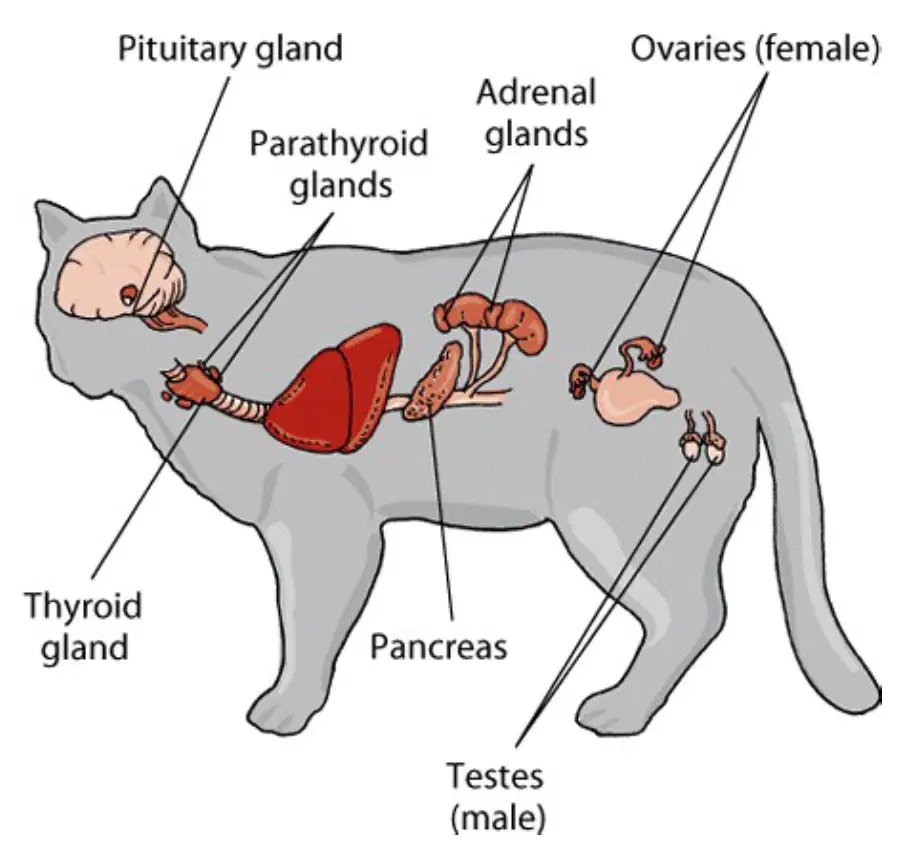
Refer to the diagram of the cat’s endocrine organs. Which labeled structure is most closely associated with stress responses?
Pituitary gland near the brain
Thyroid gland in the neck region
Adrenal glands near the kidneys
Pancreas along the digestive tract
DoK 1 — Which statement best describes the primary function of the feline nervous system?
Communication and control across the body
Breaking down nutrients for energy
Producing hormones for growth
Filtering wastes from the blood
DoK 2 — Based on the overview, which set correctly lists the central components of the feline nervous system?
Brain and spinal cord
Heart and lungs
Liver and kidneys
Stomach and intestines
DoK 2 — Which option best explains the role of peripheral nerves in cats according to the overview?
They coordinate movement by carrying signals to and from limbs.
They store energy for quick bursts of speed.
They produce antibodies to fight infection.
They digest proteins during periods of stress.
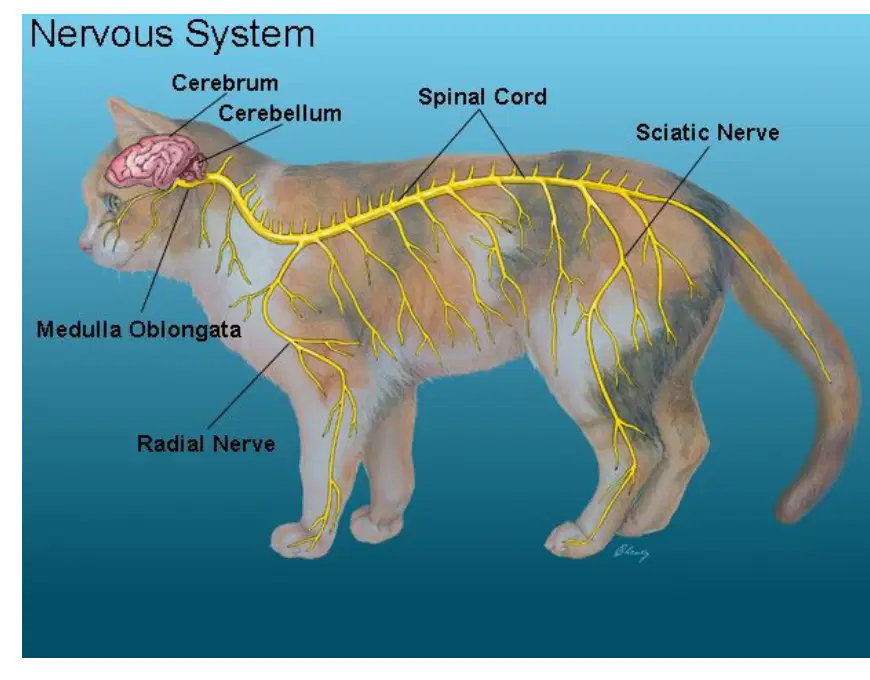
DoK 3 — A cat touches a hot surface and instantly pulls its paw back. Using the overview’s concepts, which explanation best accounts for this reaction?
A reflex pathway rapidly triggers withdrawal to maintain safety and balance.
The circulatory system increases blood flow, causing the paw to move away.
Hormones from the thyroid gland stimulate the muscles to retract.
The digestive system diverts energy from the stomach to the paw muscles.
Which statement best describes the overall function of the feline digestive system?
Convert food into energy by breaking down and absorbing nutrients
Pump oxygenated blood to all organs at a steady rate
Coordinate movement and posture through muscle contractions
Filter metabolic wastes from blood to produce urine
Which organ primarily initiates mechanical and chemical breakdown of food in a cat by using teeth and enzymes in saliva?
Mouth
Esophagus
Stomach
Pancreas
In cats, what is the main role of the esophagus during digestion?
Absorb nutrients and water
Move food to the stomach via muscular contractions
Release enzymes to break down carbohydrates only
Store bile for fat digestion
Which pairing correctly matches the organ with its function in the feline digestive system?
Liver — releases enzymes to break down proteins, fats, and carbohydrates
Pancreas — produces bile to aid in fat digestion and detoxifies the blood
Intestines — absorb nutrients and water
Stomach — transports food from mouth to intestines without mixing
A cat is classified as an obligate carnivore. What dietary implication follows from this classification?
It must include plant matter daily to obtain essential amino acids
It can survive on fungi and plants if meat is occasionally available
It must eat meat to survive because it cannot properly process nutrients from plants
It thrives best on a carbohydrate-rich diet with minimal protein
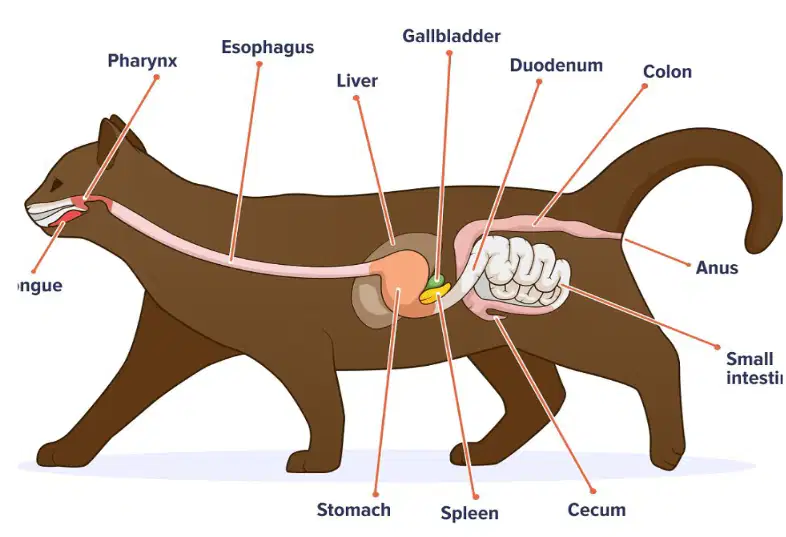
Which sequence best represents the pathway of food through the feline digestive tract as shown in the diagram?
Mouth → esophagus → stomach → small intestine → colon → anus
Mouth → pharynx → liver → spleen → colon → anus
Mouth → esophagus → pancreas → gallbladder → cecum → anus
Mouth → stomach → esophagus → duodenum → colon → anus
Which organ contributes enzymes that help break down proteins, fats, and carbohydrates in cats?
Pancreas
Liver
Gallbladder
Spleen
DoK 1 — According to the guidance for veterinary assistants, which pair of feline conditions should be recognized as part of basic disease awareness?
Diabetes and thyroid disease
Arthritis and ear mites
Heartworm and ringworm
Kidney stones and dental caries
DoK 2 — A cat presents with neurological or digestive issues. Which handling approach best aligns with the guidance for veterinary assistants?
Restrain firmly to prevent movement during evaluation
Handle gently to reduce stress and avoid exacerbating symptoms
Use loud vocal cues to keep the cat alert
Fast the cat immediately without assessment
DoK 3 — While monitoring a hospitalized cat, you must track key health indicators highlighted for veterinary assistants. Which combination best matches the recommended set to record each shift?
Stool, appetite, and hydration
Fur length, whisker symmetry, and coat color
Tail position, paw size, and litter brand
Sleeping position, meow pitch, and collar fit
According to the review, which gland primarily controls metabolism in cats?
Thyroid gland
Adrenal gland
Pituitary gland
Parathyroid gland
Based on the review prompt, what is the primary function of the nervous system in felines?
Coordinating and transmitting signals between body parts
Filtering waste products from the blood
Producing digestive enzymes in the stomach
Storing minerals within bones
The review asks about feline diet. Which option best describes what diet cats require?
Obligate carnivore diet rich in animal-based nutrients
Primarily herbivorous diet emphasizing leafy greens
Omnivorous diet with equal plant and meat intake
High-fiber granivorous diet focused on grains
According to the summary, which group of feline body systems is specifically noted as sensitive?
Endocrine, nervous, and digestive systems
Skeletal, muscular, and respiratory systems
Circulatory, integumentary, and urinary systems
Immune, reproductive, and lymphatic systems
A cat has a sensitive digestive and nervous system. Which caregiving approach best aligns with this sensitivity?
Provide balanced nutrition and handle the cat gently
Rotate diets frequently and encourage vigorous handling
Limit food variety and use loud stimuli to desensitize responses
Prioritize high-calorie treats over balanced meals to boost energy
Which statement best describes the overall function of the livestock endocrine system?
Controls growth, reproduction, and metabolism through hormones
Filters waste products from blood to maintain fluid balance
Provides structural support and movement via muscles and bones
Exchanges oxygen and carbon dioxide between blood and air
Which gland primarily regulates other glands and controls growth in livestock?
Thyroid gland
Pituitary gland
Adrenal glands
Pancreas
The thyroid gland sets metabolic rate. Which process is NOT directly listed as influenced by the thyroid in the overview?
Appetite
Heart rate
Digestion
Blood clotting
A veterinarian observes that a steer has trouble regulating blood sugar. Based on the overview, which endocrine organ is most likely involved?
Pituitary gland, which coordinates the immune response
Thyroid gland, which increases oxygen transport
Pancreas, which controls insulin and glucagon release
Adrenal glands, which directly digest carbohydrates
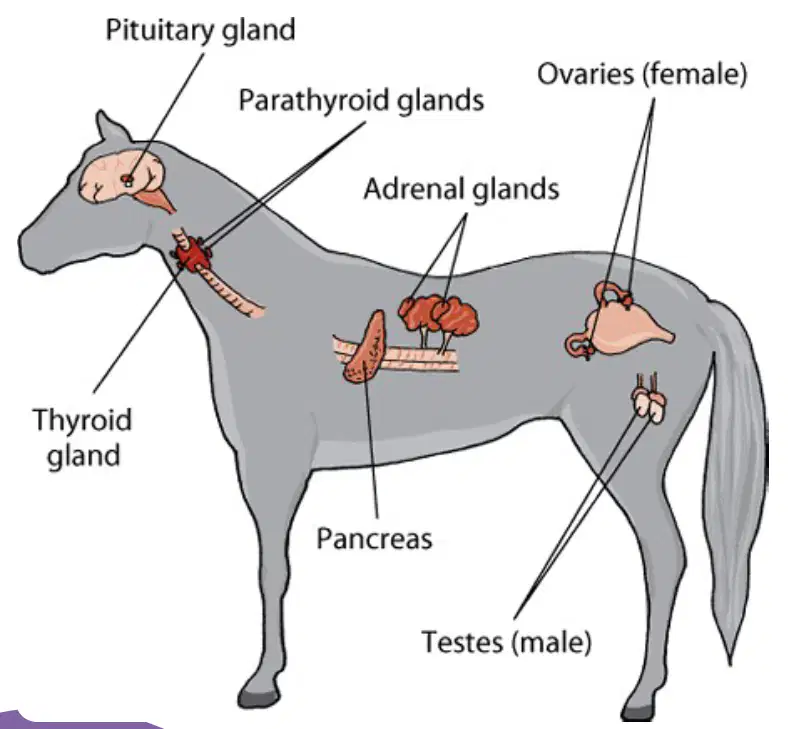
During a stressful transport, which glands help the animal manage stress, energy, and immune response?
Adrenal glands
Parathyroid glands
Gonads
Thyroid gland
Which pairing correctly matches the gland with its primary role in livestock, according to the overview?
Gonads — regulate blood sugar via insulin and glucagon
Adrenal glands — set metabolic rate affecting appetite and heart rate
Thyroid — regulates other glands and controls growth
Gonads — responsible for sexual development and reproduction
Which statement best describes a key function of the livestock nervous system?
Coordinating muscle movement and posture through motor control
Producing hormones that regulate growth and reproduction
Filtering metabolic wastes from blood to maintain pH
Synthesizing nutrients from cellulose in the rumen
Identify the primary parts of the livestock nervous system mentioned in the lesson.
Brain, spinal cord, and nerves
Cerebrum, cerebellum, and medulla only
Spinal cord, tendons, and ligaments
Brain, lymph nodes, and endocrine glands
Which option correctly pairs a function with whether it is voluntary or involuntary in livestock?
Breathing — involuntary; walking — voluntary
Heart rate — voluntary; chewing — involuntary
Pain perception — involuntary; digestion — voluntary
Touch sensation — voluntary; posture reflexes — voluntary
Reflexes in livestock primarily serve which role according to the overview?
Maintaining posture and coordinating muscle movement automatically
Increasing blood glucose during stress via hormonal release
Enhancing nutrient absorption in the small intestine
Regulating body temperature through sweating alone
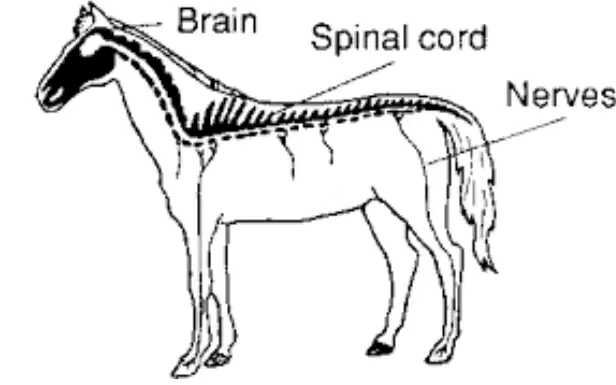
Refer to the labeled horse diagram. Which label indicates the pathway that relays signals between the brain and peripheral nerves along the back?
Spinal cord
Brain
Nerves
Cerebrum
DoK 1—Which livestock are highlighted as having a monogastric digestive system with a single-chambered stomach?
Cattle and sheep
Pigs and horses
Goats and deer
Cattle and goats
DoK 1—In the monogastric system, most nutrient and water absorption occurs primarily in which organ?
Stomach
Small intestine
Cecum
Rectum
DoK 2—According to the monogastric pathway described, what is the correct order immediately after food is swallowed?
Esophagus → stomach → small intestine → large intestine
Stomach → esophagus → small intestine → large intestine
Esophagus → small intestine → stomach → large intestine
Small intestine → stomach → esophagus → large intestine
DoK 2—Which statement best explains the roles of the large intestine components in pigs as described?
The cecum forms feces while the colon absorbs most nutrients
The colon ferments fiber while the cecum absorbs fatty acids
The large intestine absorbs remaining water; the cecum is prominent and the colon is coiled
Most chemical digestion occurs in the colon, which is straight rather than spiral
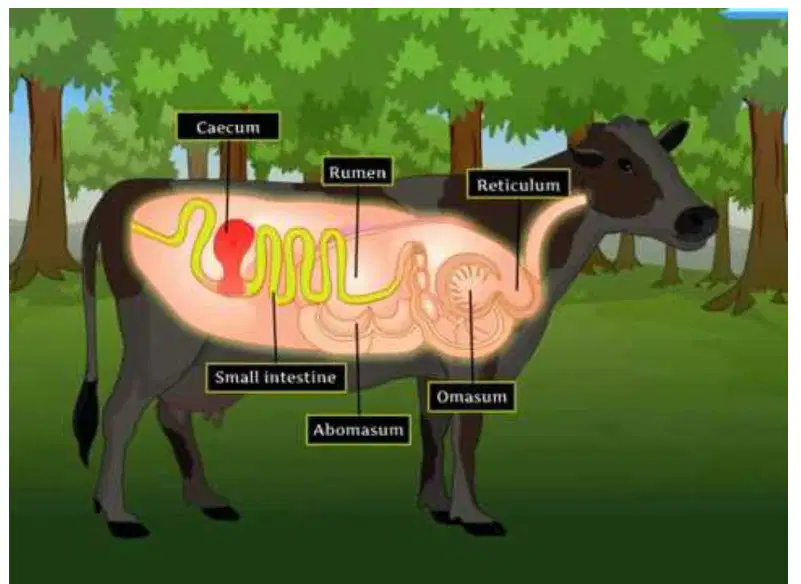
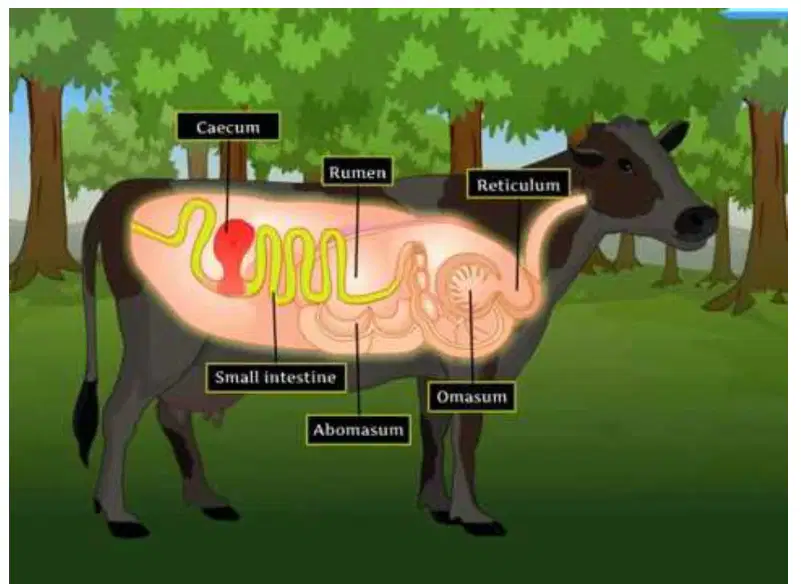
DoK 1—Which list correctly matches each ruminant stomach compartment to the key function stated?
Rumen—fermentation; Reticulum—traps foreign objects; Omasum—absorbs water; Abomasum—true stomach
Rumen—acidic digestion; Reticulum—fermentation; Omasum—traps objects; Abomasum—absorbs water
Rumen—water absorption; Reticulum—acidic digestion; Omasum—fermentation; Abomasum—traps objects
Rumen—traps foreign objects; Reticulum—fermentation; Omasum—true stomach; Abomasum—absorbs water
DoK 2—Which sequence correctly represents the ruminant digestive order provided, from mouth to intestines?
Mouth → esophagus → rumen → reticulum → omasum → abomasum → small intestine and large intestine
Mouth → esophagus → reticulum → rumen → omasum → abomasum → large intestine only
Mouth → rumen → reticulum → abomasum → omasum → small intestine → large intestine
Mouth → esophagus → omasum → abomasum → rumen → reticulum → intestines
DoK 3—A cow accidentally swallows a small metal staple while eating. Based on the stated functions, which compartment is most likely to trap it and why?
Rumen, because it is the site of acidic digestion that dissolves metal
Reticulum, because it is specialized for trapping foreign objects
Omasum, because it ferments material and creates a mat that catches debris
Abomasum, because it absorbs water and pushes heavy items aside
DoK 3—A student compares energy extraction from a high‑fiber pasture in a cow and a pig. Using the provided functions, which animal and compartment pairing primarily enables better use of fibrous plant material, and why?
Pig—stomach, because acidic digestion breaks down cellulose
Cow—rumen, because fermentation breaks down fibrous plant material
Pig—cecum, because it is large and coiled for extensive fermentation
Cow—abomasum, because water absorption extracts energy from fiber
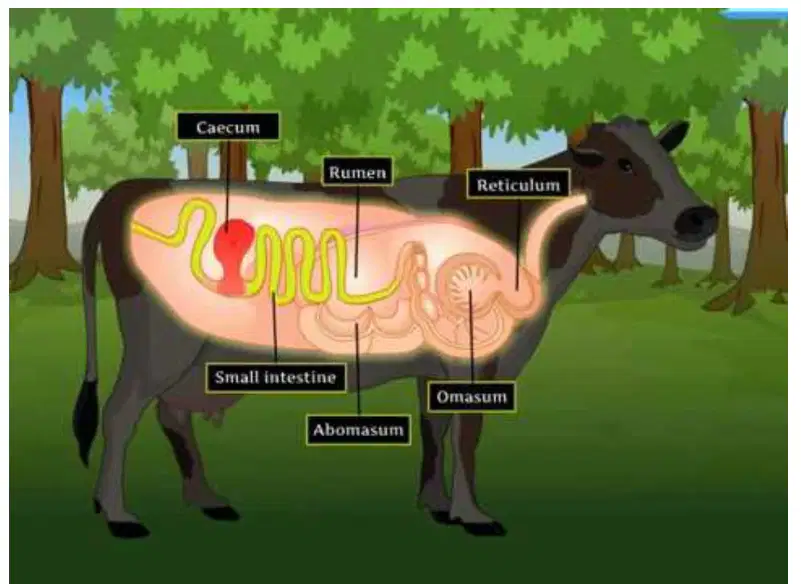
DoK 1 — Which routine observation specifically helps evaluate normal rumen function in cattle?
Counting breaths per minute only
Checking hoof growth rate
Watching for regular cud chewing and appetite
Measuring ear length
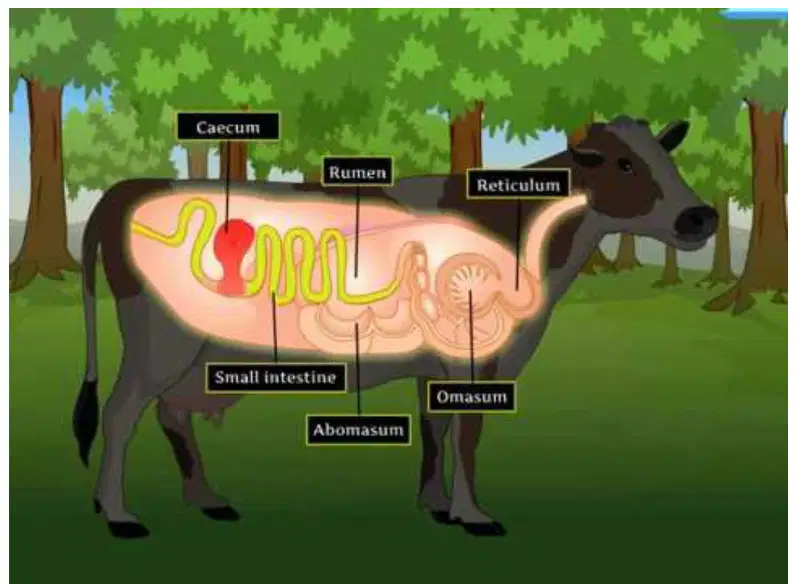
DoK 2 — A heifer stops eating, shows a distended left flank, and appears uncomfortable. Based on standard assistant duties, what should be recognized first?
Possible bloat or distress requiring prompt attention
Normal hormone cycling before estrus
Routine recovery from hoof trimming
Typical behavior during rumination
DoK 3 — You are assisting during an exam. The veterinarian asks for information that could inform reproductive management decisions. Which record would be most relevant to provide and why?
Feed delivery schedule, because it shows when hay bales were stacked
Hormone cycle tracking notes, because they document timing related to reproduction
Manure cleanup logs, because they indicate pen sanitation frequency
Ear tag order receipts, because they list animal ID numbers
DoK 2 — When preparing to restrain a cow for a physical exam, which assistant action best aligns with safe assistance practices from the lesson focus?
Stand directly behind the animal to control tail movement
Secure appropriate restraint and position yourself to avoid kicks
Approach quickly from the blind spot to minimize agitation
Leave gates open for easier animal movement
DoK 1 — Which set correctly lists the four parts of a ruminant stomach?
Rumen, reticulum, omasum, abomasum
Crop, proventriculus, gizzard, cloaca
Duodenum, jejunum, ileum, cecum
Pancreas, liver, spleen, kidney
DoK 2 — Which endocrine gland primarily regulates body growth in livestock through its hormones?
Thyroid gland
Pituitary gland
Adrenal gland
Pancreas
DoK 3 — What is the best explanation for why cud chewing (rumination) is important in ruminants?
It cools the animal during hot weather by increasing saliva evaporation.
It allows repeated chewing that reduces particle size and mixes saliva, improving microbial fermentation and nutrient digestion.
It stores extra feed in the reticulum for use during droughts.
It speeds feed directly to the abomasum, bypassing microbial action.
According to the summary, which statement best captures a foundational requirement for livestock health and production?
Livestock thrive mainly through genetic selection regardless of management.
Livestock rely on balanced systems that support health and production.
Livestock perform best when isolated from environmental inputs.
Livestock outcomes are determined solely by market demand.
A manager wants to improve animal care on a farm. Based on the summary, which action aligns most directly with this goal?
Prioritize understanding of body functions to guide daily care decisions.
Increase the number of animals without changing routines.
Reduce attention to physiology and focus only on feed costs.
Rely exclusively on traditional practices without examining animal systems.
According to the overview, which is the primary function of the canine skeletal system?
Heat production and posture
Hormone production and digestion
Framework, protection, and movement support
Electrical signaling and sensation
Which set lists the canine spinal regions in correct order from head to tail?
Cervical, thoracic, lumbar, sacral, caudal
Thoracic, lumbar, sacral, caudal, cervical
Lumbar, cervical, thoracic, caudal, sacral
Caudal, sacral, lumbar, thoracic, cervical
Which bone primarily protects the brain in dogs?
Scapula
Skull
Pelvis
Femur
Which structure supports the hind limbs in the canine skeleton?
Ribs
Pelvis
Radius and ulna
Scapula
Which statement correctly matches a canine long bone to its noted feature in the overview?
Femur — identified as the largest bone
Radius — forms the shoulder joint
Ulna — protects thoracic organs
Tibia — supports the forelimb
Which bones form the canine shoulder joint as described in the overview?
Scapula and humerus
Radius and ulna
Tibia and fibula
Femur and pelvis
What is the main role of the ribs in the canine skeletal system?
Generate heat
Protect organs
Anchor the forelimb
Store minerals only
Which pair provides forelimb support in dogs?
Tibia and fibula
Scapula and femur
Radius and ulna
Metatarsals and phalanges
According to the muscular system overview, which is a listed function of muscles?
Calcium storage only
Movement, posture, and heat
Blood filtration and pH balance
Neural signal transmission
Which muscle is correctly matched with its action in the overview?
Masseter — chewing
Trapezius — extends hip
Latissimus dorsi — extends stifle
Quadriceps — flexes forelimb
Which muscle group is identified as extending the stifle?
Gluteal
Quadriceps
Biceps femoris
Triceps brachii
Which muscle is listed as extending the forelimb?
Masseter
Trapezius
Latissimus dorsi
Triceps brachii
Which site is included among the canine intramuscular (IM) injection locations mentioned?
Hamstrings only
Epaxial muscles
Pectorals only
Orbicularis oris
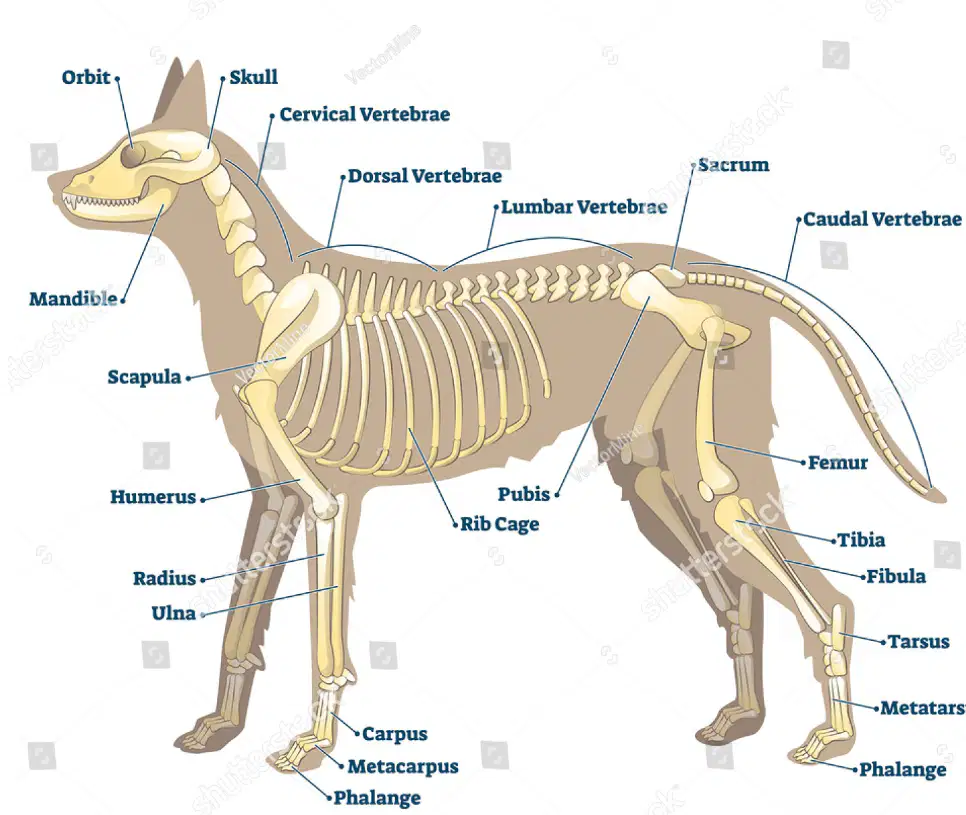
Based on the skeletal diagram of the dog, which labeled bones are in the hind limb?
Radius, ulna, carpus
Femur, tibia, fibula
Scapula, humerus, radius
Metacarpus, phalanges, carpus
A dog presents with a shoulder mobility issue. Which muscle from the overview is most directly associated with moving the shoulder?
Trapezius
Masseter
Quadriceps
Gastrocnemius
According to the focus of this lesson, which task directly applies knowledge of canine anatomy to medication administration?
Locating safe intramuscular (IM) injection sites
Tracking body weight changes over time
Measuring water intake during hospitalization
Recording kennel cleaning schedules
A veterinary assistant gently feels along a dog’s limb to check for irregularities after an accident. Which skill from this lesson are they using?
Palpating bones for fractures
Measuring range of motion only
Identifying dental plaque buildup
Counting respiratory rate only
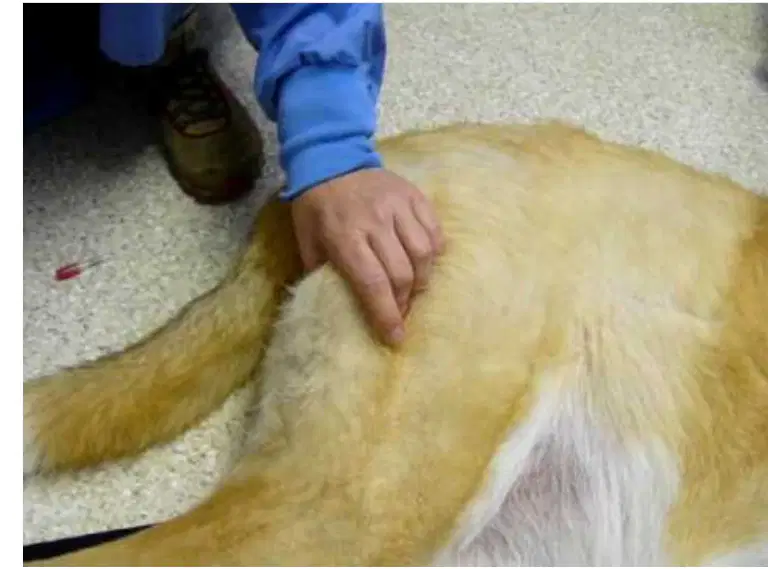
You observe a dog favoring one hind leg while walking and notice reduced muscle mass on that limb. Which paired conditions best match these observations?
Lameness and atrophy
Hydration and obesity
Hyperthermia and anxiety
Allergy and dermatitis
DoK 1 – Which set correctly lists three major bones found in the canine skeleton?
Femur, humerus, skull
Trapezium, sternum, coccyx
Radius, fibula, clavicle
Metacarpal I, talus, atlas only
DoK 2 – Which muscle group is most commonly selected for intramuscular (IM) injections in dogs due to accessible mass and safety?
Quadriceps group on the cranial thigh
Epaxial muscles along the lumbar spine
Biceps brachii of the forelimb
Gastrocnemius of the caudal crus
DoK 3 – In a canine hit-by-car scenario, why does pelvic assessment take on special importance during the initial trauma survey? Choose the best rationale.
Pelvic fractures always cause immediate paralysis of the forelimbs
The pelvis forms a rigid ring that, when fractured, can signal concurrent internal injuries and significant hemorrhage risk
Pelvic injuries are painless and therefore easy to miss unless prioritized
Isolated pelvic fractures are minor and rarely affect other body systems
According to the summary, what is the primary function of the canine skeletal system?
Movement and protection
Structure and support
Digestion and circulation
Thermoregulation and sensation
Which statement best describes the canine muscular system based on the summary?
It provides structure and support for the body framework.
It enables movement and contributes to protection.
It produces blood cells and stores minerals.
It regulates hormones and filters toxins.
A veterinary technician is planning a physical exam and safe restraint for a dog. Based on the summary, why is knowledge of both the skeletal and muscular systems important in this situation?
Because only the skeletal system affects restraint techniques
Because both systems are vital for exams and restraint
Because the muscular system is irrelevant during exams
Because neither system impacts handling decisions
Which statement best describes the primary function of the feline skeletal system?
Support, protection, and flexibility
Balance, coordination, and speed
Digestion, absorption, and excretion
Thermoregulation, hydration, and metabolism
About how many bones are found in the feline skeletal system?
150–170 bones
180–200 bones
230–250 bones
290–310 bones
Which bone is noted for allowing broad motion in cats?
Skull
Scapula
Pelvis
Clavicle
What feature of the feline spine is emphasized in the overview?
Extremely rigid for weight bearing
Flexible to enhance agility
Fused with the pelvis for stability
Shortened to reduce tail movement
Which pair of long bones is linked with limb strength in cats?
Radius and ulna
Humerus and femur
Tibia and fibula
Metacarpals and metatarsals
What characteristic of the feline clavicle is highlighted?
Fused to the sternum
Free-floating
Absent in adult cats
Articulates with the pelvis
Which statement best summarizes the function of the feline muscular system?
Balance, coordination, and speed
Support, protection, and flexibility
Gas exchange and circulation
Nutrient storage and detoxification
Which muscle is primarily associated with jaw strength in cats?
Trapezius
Masseter
Latissimus dorsi
Gastrocnemius
Which muscle group is linked to protection in the feline muscular system overview?
Abdominals
Quadriceps
Triceps brachii
Gluteals
Which two muscles are specifically connected to jumping according to the overview?
Latissimus dorsi and gastrocnemius
Masseter and trapezius
Biceps femoris and sartorius
Deltoideus and brachioradialis
Which muscle is identified with hind limb flexion?
Latissimus dorsi
Biceps femoris
Trapezius
Extensor digitorum communis
According to the overview, which locations are acceptable intramuscular (IM) injection sites in cats?
Masseter and trapezius
Quadriceps and epaxial muscles
Deltoideus and pectorals
Abdominals and intercostals
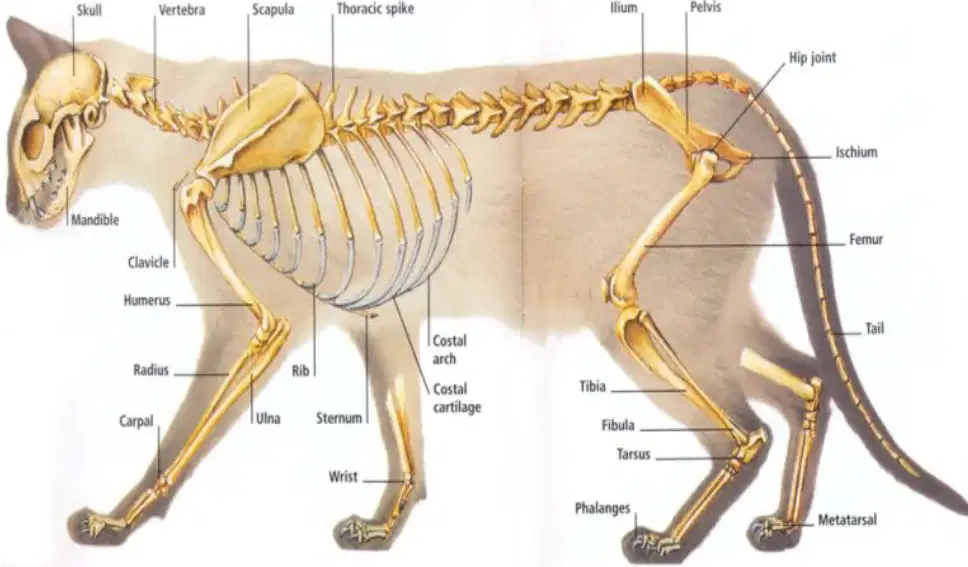
In the skeletal diagram, which structure is described as narrow in cats?
Skull
Pelvis
Scapula
Sternum
Which statement best contrasts the roles of the skull and scapula listed in the skeletal overview?
Skull enables broad motion; scapula provides jaw width
Skull contributes to a wide jaw; scapula allows broad motion
Both the skull and scapula are free-floating
Both the skull and scapula are primarily for protection only
A veterinarian wants to preserve shoulder mobility while planning surgery. Which bone’s role should be prioritized based on the overview?
Pelvis, because it is narrow
Scapula, because it allows broad motion
Clavicle, because it is free-floating
Femur, because it provides jaw strength
Which task directly relies on understanding a cat’s flexibility during handling?
Choosing appropriate restraint techniques
Calculating vaccine dosage by weight
Selecting suture material for surgery
Determining the color of the mucous membranes
A veterinary assistant is assigned to give an intramuscular shot to a cat. Based on best practice, where should the assistant focus?
On recognizing IM injection areas specific to felines
On locating superficial veins for IV delivery
On identifying the best site for subcutaneous fluids
On finding a place to apply a tourniquet for blood draw
A limping cat arrives after a fall. What should a veterinary assistant prioritize according to the learning goals?
Identify potential fractures or lameness before proceeding
Attempt immediate range-of-motion exercises to restore movement
Administer a broad-spectrum antibiotic without assessment
Ignore gait changes unless swelling is visible
According to the review prompt shown, which bone primarily allows a cat’s notable flexibility?
Clavicle (collarbone)
Femur (thigh bone)
Scapula (shoulder blade)
Ulna (forearm bone)
The slide asks to name two major feline muscles. Which pair best represents large, commonly referenced muscles in cats?
Masseter and biceps femoris
Trapezius and soleus
Pectoralis minor and sartorius
Obliquus internus and plantaris
The review asks why restraint should consider flexibility. What is the best rationale?
Flexible cats can twist out of holds, so restraint must prevent sudden rotation without causing injury.
Flexibility makes cats heavier, so restraint must support extra weight.
Flexible joints mean cats tire quickly, so restraint should be brief to avoid fatigue.
Flexibility reduces pain sensation, so restraint can be tighter without risk.
According to the summary, which combination primarily explains a cat’s agility?
Long whiskers and sharp claws
Skeletal structure working with muscular system
Large lungs and slow heart rate
Thick fur and flexible tail
You need to pick up an unfamiliar cat in a clinic. Based on the summary, what knowledge most directly helps ensure safe handling?
Understanding how feline skeletal and muscular features influence movement
Memorizing common cat coat color patterns
Knowing the average litter size for domestic cats
Recognizing popular cat breeds by appearance
Which statement best summarizes the primary function of the livestock skeletal system?
Movement, heat production, and posture
Structure, protection, and support of the body
Digestion, absorption, and excretion
Hormone production and immune defense
Which bone protects the brain in livestock?
Pelvis
Skull
Sternum
Scapula
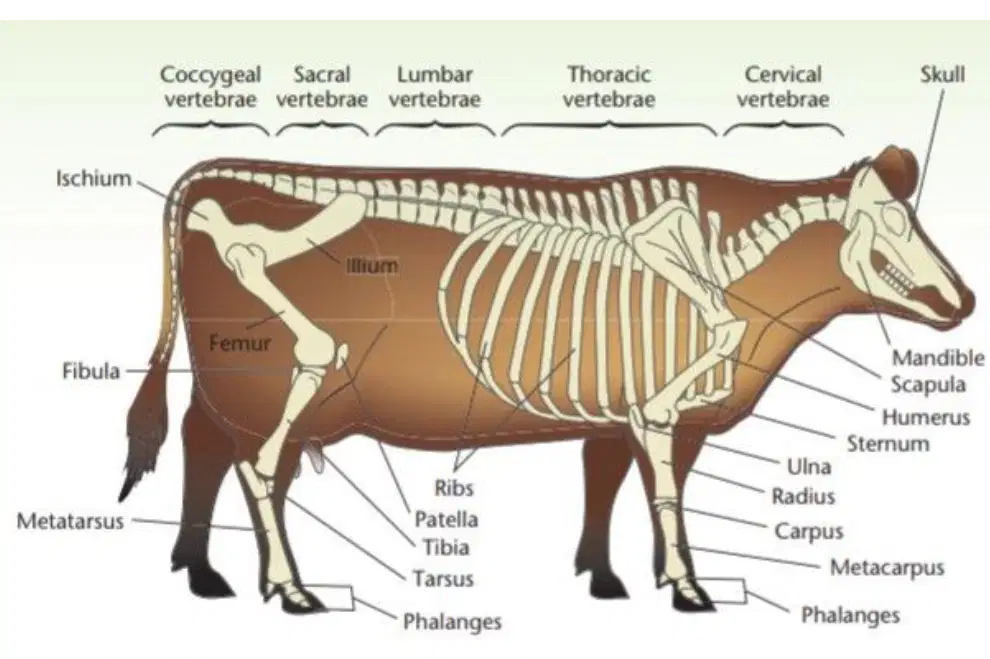
According to the skeletal diagram of the cow, which vertebrae are located closest to the head?
Lumbar vertebrae
Coccygeal vertebrae
Thoracic vertebrae
Cervical vertebrae
What is the primary role of the vertebral column in livestock?
Supports the back
Assists with birthing
Produces blood cells
Stores calcium exclusively
Which set lists main limb bones emphasized in the overview?
Femur, Tibia, Humerus
Scapula, Sternum, Ribs
Ulna, Radius, Carpus
Coccygeal, Sacral, Lumbar
Which bone group is associated with protecting thoracic organs in livestock?
Ribs
Metatarsus
Phalanges
Mandible
Which skeletal structure is specifically linked with weight bearing in the lower limb?
Scapula
Metatarsus/Metacarpus
Patella
Sternum
Which region of the pelvis is noted for functions in weight support and birthing?
Ilium
Ischium
Pelvis as a whole
Pubis only
Which statement best summarizes the function of the livestock muscular system?
Movement, posture, and meat production
Protection of organs and mineral storage
Gas exchange and pH regulation
Filtration and urine formation
Which muscle group primarily extends the stifle in livestock?
Biceps femoris
Quadriceps
Trapezius
Longissimus dorsi
Which muscle is described as a major back muscle in livestock?
Longissimus dorsi
Gluteal
Trapezius
Semimembranosus
Which site is listed as appropriate for intramuscular (IM) injections in livestock?
Loin (longissimus dorsi) only
Neck region
Abdominal obliques
Carpal flexors
A heifer needs an IM injection with minimal impact on high-value cuts. Based on the overview, which site is preferred?
Neck
Gluteal
Semimembranosus
Trapezius
Which pairing correctly matches a muscle with its listed action or region?
Gluteal—extends stifle
Biceps femoris—extends hip
Trapezius—back extensor
Quadriceps—flexes stifle

On the muscle diagram of the cow, which superficial muscle group is located over the hind limb and commonly used as an IM site?
Longissimus dorsi along the back
Gluteal group of the rump
Pectoral muscles of the chest
Deltoideus of the shoulder
According to the instructional slide, what is a primary reason to use proper intramuscular (IM) injection placement in livestock?
To avoid meat damage
To increase vaccine volume
To reduce feed intake
To speed up growth rates
A vet assistant observes a steer favoring a hind limb and suspects swelling near a joint. Based on the slide’s focus areas, which task best applies in this situation?
Detecting lameness and swelling
Determining carcass grading
Administering anesthesia for surgery
Measuring daily milk production
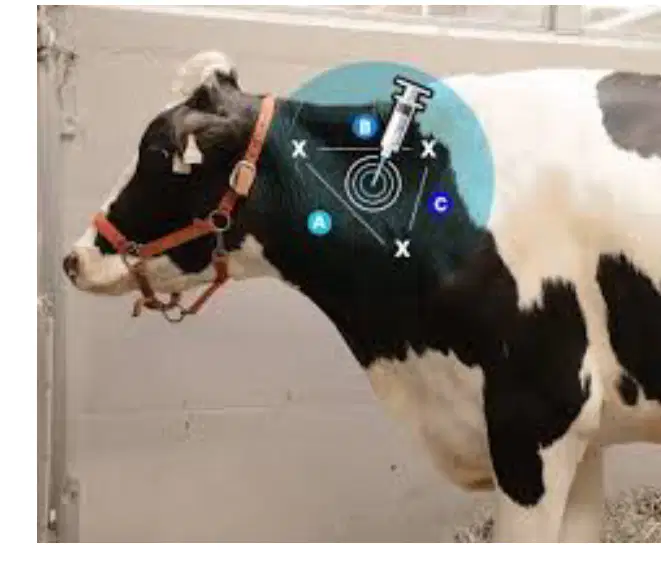
Refer to the images showing IM injection zones on cattle (neck highlighted with labeled boundaries; thigh and rump examples with target ovals and syringe icons). Which location aligns with best practice to protect valuable cuts?
Neck muscle injection within the designated triangle away from shoulder and spine
Injection into the center of the rump over the largest muscle mass
Injection deep into the thigh near the femur
Subcutaneous injection anywhere along the rib cage
Recall: In routine livestock lameness checks, which specific bone is commonly examined first for signs of pain or injury?
Cannon bone
Pelvis
Ribs
Skull
Skill/Concept: A producer needs to give an intramuscular (IM) injection while minimizing carcass damage. Which pair lists appropriate muscles typically used for IM injections in livestock?
Neck and ham (semitendinosus/semi-membranosus)
Loin and brisket
Forearm and cheek
Backstrap and flank
Strategic Thinking: Why is basic skeletal knowledge vital for livestock handlers when planning procedures like injections, hoof trimming, or injury assessment? Choose the best rationale.
It helps locate safe injection sites and interpret movement issues to prevent avoidable tissue or nerve damage.
It mainly increases growth rates without changing handling practices.
It eliminates the need for veterinary consultation in all cases.
It allows replacement of vaccines with supplements.
According to the summary, what is the primary function of the livestock skeletal system?
Movement and locomotion
Support and structural framework
Digestion and nutrient absorption
Temperature regulation
A handler plans a restraint technique that relies on understanding how animals initiate movement. Which body system’s function is most directly informing this plan?
Muscular system, because it generates movement
Skeletal system, because bones produce hormones
Circulatory system, because blood carries oxygen
Integumentary system, because skin senses touch
Which statement best explains why knowledge of BOTH the skeletal and muscular systems is emphasized for livestock care and restraint?
Either system alone determines animal temperament, so one can replace the other.
Skeletal support and muscular movement interact, guiding safe positioning and controlled handling.
Muscles protect internal organs while bones power motion, so restraint should target organs.
Only the skeletal system matters for care, but the muscular system is useful for exercise planning.
Which statement best describes how the skeletal and muscular systems work together in animals?
Bones produce electrical impulses that directly cause movement without muscles.
Muscles attach to bones and contract to move joints, allowing the body to move and maintain posture.
Joints stretch ligaments to fuel muscles with oxygen, producing movement.
Muscles harden into bones during growth, which is what enables motion.
Which pairing correctly lists one major bone and one major muscle relevant to common domestic animals?
Femur and biceps brachii
Alveoli and triceps surae
Nephrons and masseter
Iris and quadriceps femoris
Why is knowledge of major bones and muscles important for veterinary assistants?
It allows them to perform surgeries independently without supervision.
It helps them assist with exams, restraint, and communication about injuries or movement issues.
It replaces the need for understanding animal behavior.
It is only necessary for wildlife specialists and not for small-animal practice.
Which statement best describes the primary function of the canine circulatory system?
Transports oxygen, nutrients, and removes waste
Supplies oxygen and removes CO2 from inhaled air
Filters, warms, and humidifies incoming air
Conducts air from the trachea to the lungs
Where is the canine heart located and how many chambers does it have?
Between the lungs; four chambers
Behind the stomach; two chambers
In the neck; three chambers
Within the left lung; five chambers
Which set lists major blood vessels in dogs according to the overview?
Aorta, Vena Cava, Jugular, Femoral veins
Pulmonary vein, Hepatic portal vein, Azygos vein
Carotid veins, Renal arteries, Subclavian veins
Saphenous arteries, Coronary veins, Ulnar artery
In a dog’s heart, which chambers receive blood?
Right and left atria
Right and left ventricles
Right ventricle and left atrium
Only the right atrium
Which chambers pump blood out of the canine heart?
Right and left ventricles
Right and left atria
Right atrium and right ventricle
Left atrium and left ventricle only
According to the heart rate ranges, which dog is expected to have the fastest resting heart rate?
A 6-month-old puppy
A 25-pound adult dog
A 50-pound adult dog
An 80-pound adult dog
Select the normal resting heart rate range for medium dogs (30–70 pounds).
80–120 bpm
120–160 bpm
60–100 bpm
100–140 bpm
Which vessel carries oxygenated blood away from the canine heart to the body? Use the diagram for reference.
Aorta
Caudal vena cava
Jugular vein
Cranial vena cava
Which pair correctly matches vessel type and general function in systemic circulation?
Arteries—carry blood away from the heart; Veins—return blood to the heart
Arteries—return blood to the heart; Veins—carry blood away
Both arteries and veins only carry deoxygenated blood
Both arteries and veins only carry oxygenated blood
What is the primary function of the canine respiratory system as summarized?
Supplies oxygen and removes CO2
Transports nutrients and hormones
Pumps blood to limbs
Stores energy as glycogen
Which list names the major parts of the canine respiratory system presented in the overview?
Nasal passages, trachea, bronchi, lungs, diaphragm
Pharynx, esophagus, stomach, intestines
Kidneys, ureters, bladder, urethra
Cranial vena cava, aorta, femoral vein, jugular vein
What is the role of the nasal passages in dogs?
Filter, warm, and humidify incoming air
Conduct air from trachea to lungs
Serve as the primary site of gas exchange
Drive breathing by muscle contraction
Which structure conducts air from the nasal passages to the lungs?
Trachea
Bronchioles
Alveoli
Diaphragm
In the respiratory overview, where does gas exchange primarily occur in dogs?
Lungs
Nasal cavity
Trachea
Diaphragm
Which statement best describes the diaphragm’s role in canine breathing?
A large muscle that is the primary driver of breathing
A cartilage ring that keeps the airway open
A valve that prevents backflow into the trachea
A sac that stores oxygen for later use
Which resting respiratory rate range is normal for medium and large dog breeds?
10–25 breaths per minute
15–30 breaths per minute
5–10 breaths per minute
25–40 breaths per minute
A small-breed adult dog at rest is breathing 22 times per minute. Based on the overview, how would you classify this rate?
Within the normal range for small breeds
Below normal for small breeds
Above normal for small breeds
Outside normal for any size
Which pathway correctly traces airflow from entry to the lungs as described and shown in the diagram?
Nasal passages → trachea → bronchi → lungs
Mouth → esophagus → stomach → lungs
Trachea → nasal passages → bronchi → lungs
Larynx → diaphragm → lungs → bronchi
Which vein is explicitly listed as a common site for canine blood draws in veterinary assisting practice?
Cephalic vein
Femoral artery
Pulmonary vein
Carotid artery
You are monitoring a hospitalized dog. Based on standard vet assistant duties described, which paired vital signs should you plan to check repeatedly to assess circulatory and respiratory status?
Heart rate and breathing
Body temperature and gum color
Capillary refill time and pupil size
Blood glucose and urine output
A dog suddenly collapses and is not breathing. According to the listed competencies, what is the most appropriate immediate action sequence for a vet assistant?
Begin CPR and provide oxygen therapy support
Offer water and observe for 10 minutes
Wait for a veterinarian before touching the patient
Apply a bandage and monitor heart rate only
Which set correctly lists the four chambers of a dog’s heart?
Left atrium, right atrium, left ventricle, right ventricle
Aorta, vena cava, left ventricle, right ventricle
Left atrium, right atrium, pulmonary artery, aorta
Right atrium, right ventricle, carotid artery, pulmonary vein
Veterinary staff often draw blood from which vein in dogs because it is superficial and accessible in the forelimb?
Jugular vein
Cephalic vein
Saphenous vein
Femoral vein
What is the primary function of the diaphragm in canine respiration?
To pump oxygenated blood from the lungs to the heart
To separate the atria from the ventricles during contractions
To create negative pressure in the thoracic cavity for inhalation
To filter particulate matter before air reaches the lungs
DoK 1 — Which process is performed primarily by the canine respiratory system?
Transporting oxygenated blood to body tissues
Gas exchange in the lungs, taking in oxygen and releasing carbon dioxide
Pumping blood through arteries via cardiac contraction
Storing carbon dioxide until it can be exhaled
DoK 3 — During a veterinary emergency with low tissue oxygen, which targeted intervention aligns most directly with the documented interaction between systems?
Administering a diuretic to reduce blood volume and slow circulation
Providing supplemental oxygen to enhance gas exchange while supporting circulation to deliver it
Restricting breathing to increase carbon dioxide retention and stimulate the heart
Applying a carbon dioxide mask to improve blood oxygen content
Which statement best describes the main function of the feline circulatory system?
To control body temperature through sweating
To transport oxygen and nutrients to tissues and remove waste products
To digest food and absorb nutrients in the intestines
To coordinate movement through muscle contraction
Compared with dogs, cats typically have which characteristic related to heart activity?
A slower heart rate than dogs
The same resting heart rate as most dogs
A faster heart rate than dogs
No measurable heart rate difference from dogs
How many chambers are in the feline heart, and what is their general role division?
Two chambers; both pump blood out of the heart
Three chambers; two receive and one pumps
Four chambers; atria receive blood and ventricles pump blood out
Five chambers; four receive and one pumps
Which set correctly lists the four chambers of the feline heart?
Right atrium, right ventricle, left atrium, left ventricle
Superior vena cava, right atrium, left ventricle, aorta
Right atrium, left atrium, aortic arch, pulmonary trunk
Inferior vena cava, right ventricle, left ventricle, carotid artery
A veterinarian plans to draw blood from a cat’s forelimb. Which commonly used vein is the most appropriate target?
External jugular vein
Cephalic vein
Femoral artery
Inferior vena cava
Which vessel is correctly matched with its location or function in the feline circulatory system?
Aortic arch—returns deoxygenated blood to the right atrium
Pulmonary trunk—carries blood from the left ventricle to the body
External jugular vein—located in the neck and used for venipuncture
Left subclavian artery—drains blood from the forelimb back to the heart
A technician needs a hindlimb venipuncture site in a cat. Which option identifies a common choice?
Median cubital vein
Lateral saphenous vein
Left common carotid artery
Brachiocephalic trunk
What is the typical resting breathing rate for a healthy adult cat?
8–12 breaths per minute
12–18 breaths per minute
20–30 breaths per minute
35–45 breaths per minute
Which structure is described as the windpipe that carries air from the larynx to the lungs and is supported by cartilage rings?
Trachea
Bronchi
Larynx
Diaphragm
Air taken in through a cat’s nose is filtered, warmed, and humidified before moving deeper into the system. Which entry points handle this first step?
Trachea and bronchi
Nose and mouth
Larynx and tongue
Lungs and diaphragm
In the feline respiratory tree, where does the trachea terminate before air enters the lungs?
Alveoli
Bronchi (two main branches)
Diaphragm
Esophagus
Which statement best explains the role of the lungs in the feline respiratory system?
They generate airflow by contracting and relaxing rhythmically.
They split the airway into two passages, one to each nostril.
They are the primary organs where oxygen enters the bloodstream and carbon dioxide is removed.
They prevent food from entering the airway during swallowing.
A cat inhales air through the nose, which then passes the larynx and trachea before reaching the lungs. Which muscle’s movement primarily enables this ventilation cycle by expanding and compressing the thoracic cavity?
Tongue
Diaphragm
Epiglottis
Bronchi
Veterinarians emphasize that cats are sensitive to respiratory diseases. Based on the system’s organization, which disruption would most directly risk food entering the airway during swallowing?
Damage to the epiglottis within the larynx
Reduced flexibility of the diaphragm muscle
Narrowing of the nasal passages
Overexpansion of the bronchi
Which observation best indicates a cat may be in respiratory distress?
Open‑mouth breathing or wheezing
Quiet purring after exercise
Occasional sneezing without effort
Increased grooming of the chest
A nervous cat has mild breathing difficulty on intake. Based on best practice, what is the most appropriate first handling approach?
Handle gently to minimize stress
Restrain firmly to prevent movement
Immediately perform vigorous chest percussion
Ignore behavior and proceed quickly
A feline patient continues to struggle to oxygenate despite gentle handling. What supportive measure aligns with recommended care?
Place the cat in an oxygen cage or apply an oxygen mask
Provide only water and dim the lights
Encourage activity to expand the lungs
Transport the cat outdoors for fresh air without equipment
In feline venipuncture, which vein is most commonly selected for routine blood draws in a healthy adult cat?
Cephalic vein (forelimb)
Jugular vein (neck)
Femoral vein (hindlimb)
Lateral saphenous vein (hindlimb)
Veterinary staff monitor a cat’s breathing during exams and procedures primarily to do what?
Detect early signs of respiratory distress and ensure adequate oxygenation
Reduce the cat’s heart rate to a normal range
Increase carbon dioxide levels to stimulate deeper breaths
Prevent dehydration from panting by limiting airflow
How does the diaphragm aid breathing in cats? Choose the statement that best describes its primary action during inhalation.
It contracts and moves downward, increasing thoracic volume to draw air into the lungs
It relaxes and moves upward, compressing the lungs to pull air in
It contracts and moves upward, decreasing thoracic pressure to push air in
It remains fixed while rib muscles alone expand the lungs
DoK 1—Recall: According to the summary, which statement best describes feline cardiopulmonary traits?
Cats have delicate lungs and higher heart rates.
Cats have robust lungs and slower heart rates.
Cats have identical lung resilience and heart rates to dogs.
Cats have thick lungs and variable heart rates only during sleep.
DoK 2—Skill/Concept: A veterinary assistant is preparing to place an IV in a cat. Which preparation best aligns with the summary’s guidance for safe care?
Review major feline veins and typical breathing patterns before the procedure.
Focus only on heart rhythm because veins are not relevant to IV placement.
Use the same venous landmarks as in large dogs without adjustments.
Skip respiratory checks since breathing does not affect vascular access.
DoK 3—Strategic Thinking: You observe a cat with rapid breathing after minimal activity. Based on the summary, what is the most reasonable first interpretation to guide your next steps?
Rapid respiration may be significant because cats have delicate lungs; assess breathing and circulatory status carefully.
Rapid breathing is always normal in cats due to universally higher heart rates; no action is needed.
Respiration is unrelated to safe care decisions; focus on coat condition instead.
Rapid breathing only matters if veins are difficult to locate; otherwise ignore it.
Which statement best describes the type of circulatory system in livestock as presented in the overview?
Open system with blood bathing organs directly
Closed system with a four-chambered heart moving blood through vessels
Single-loop system with two heart chambers
Closed system without valves controlling blood flow
In livestock, which pair correctly matches the circulation with its destination?
Pulmonary circulation: to and from the rest of the body; Systemic circulation: to and from the lungs
Pulmonary circulation: to and from the lungs; Systemic circulation: to and from the rest of the body
Pulmonary circulation: only to the left ventricle; Systemic circulation: only to the right atrium
Pulmonary circulation: within capillaries only; Systemic circulation: within veins only
According to the overview, what is a primary function of the livestock circulatory system?
Producing digestive enzymes in the small intestine
Transporting oxygen, nutrients, and hormones while removing carbon dioxide
Storing calcium for bone growth
Generating body heat through muscle shivering
Which vessel is highlighted as a common site for blood draws in many large animals?
Carotid artery
Jugular vein
Pulmonary artery
Aorta
Select the site most often used for blood collection in cattle, as noted in the summary of blood draw locations.
Coccygeal (tail) vein
Cephalic vein of the front leg
Coronary artery
Femoral artery
A student claims that the heart’s valves are unnecessary because blood can reverse without issue. Based on the overview, which critique best addresses this claim?
Valves are essential to maintain unidirectional flow through pulmonary and systemic circuits
Reversed flow increases hormone delivery to tissues
Valves only operate during digestion, not circulation
Unidirectional flow is irrelevant in a closed system
Refer to the diagram of the horse’s vessels. Which labeled structure carries oxygenated blood from the lungs toward the heart?
Pulmonary artery
Pulmonary vein
Jugular vein
Femoral vein
Which statement best describes the primary function of the livestock respiratory system?
Gas exchange and temperature control
Digestion and nutrient absorption
Hormone production and regulation
Waste filtration by the kidneys
Which list correctly names core parts of the livestock respiratory system?
Nostrils, trachea, bronchi, lungs, diaphragm
Esophagus, rumen, omasum, abomasum, cecum
Atria, ventricles, aorta, vena cava, capillaries
Pituitary, thyroid, pancreas, adrenals, thymus
Where does gas exchange occur in livestock lungs, and what happens there?
In the alveoli; oxygen enters the blood and carbon dioxide leaves it
In the trachea; oxygen diffuses into mucus while carbon dioxide diffuses out
In the bronchi; oxygen is converted to nitrogen and stored
In the diaphragm; carbon dioxide is filtered before exhalation
Airflow sequence: Choose the option that correctly orders the passage of air from entry to the lungs in livestock.
Nose/mouth → pharynx → larynx → trachea → bronchi → lungs
Nose/mouth → larynx → pharynx → bronchi → trachea → lungs
Nose/mouth → trachea → larynx → pharynx → bronchi → lungs
Nose/mouth → esophagus → stomach → lungs
Ruminants (e.g., cattle) have which distinctive respiratory feature?
A tracheal bronchus that supplies air directly to the right cranial lung lobe
An epiglottis that prevents all nasal airflow during rest
A single unsegmented lung structure for rapid ventilation
Obligate mouth breathing to increase airflow
Why are nasal passages important before air reaches the lungs in livestock?
They warm, filter, and humidify incoming air
They convert oxygen into usable glucose
They store residual air for later use
They close during exhalation to trap carbon dioxide
A veterinarian suspects a problem with gas exchange in a cow. Which structure is the most direct focus for evaluating oxygen transfer to blood?
Alveoli in the lungs
Tracheal rings
Diaphragmatic tendon
External nostrils
Which site is listed as appropriate for drawing blood in livestock during routine procedures?
Jugular vein
Cephalic vein
Femoral artery
Auricular artery
A livestock worker notices coughing and fever in a pen of calves. Based on the guidance, which immediate health check focus is most aligned with the listed priorities?
Observe for signs of pneumonia
Assess hoof wear patterns
Check rumen contractions only
Evaluate ear tag placement
When performing a health check on livestock, which action best applies the recommendation to assess respiratory status?
Auscultate both lungs for abnormal sounds
Palpate the abdomen for bloat only
Measure tail length before restraint
Inspect horn growth symmetry
Recall: In cattle, which vein is most commonly used for routine blood collection during veterinary procedures?
Jugular vein in the neck
Cephalic vein on the forelimb
Coccygeal (tail) artery
Saphenous vein on the hind limb
Concept application: Which statement best explains how the lungs and diaphragm work together during breathing in livestock?
The diaphragm contracts to expand the thoracic cavity, drawing air into the lungs; it relaxes to push air out.
The lungs contract first to pull the diaphragm downward, then expand to exhale air.
The diaphragm only relaxes during inhalation and contracts during exhalation to keep lung pressure constant.
Air moves into the lungs only when the diaphragm relaxes, which increases chest volume.
Strategic thinking: A heifer shows pale mucous membranes and a weak pulse after transport. Based on best practices for herd health, what is the primary reason to monitor circulation in this situation?
To detect early signs of inadequate tissue oxygenation and intervene before shock develops
To ensure the respiratory rate stays below resting baseline after exercise
To verify that venipuncture sites are free of hair contamination before drawing blood
To determine whether rumen contractions are within normal range for digestion
According to the summary, which combined function do the circulatory and respiratory systems provide for livestock?
They coordinate hormone release to control growth.
They maintain oxygen and nutrients for body tissues.
They regulate body temperature through sweating only.
They digest feed into simple sugars in the rumen.
Which scenario best illustrates why recognizing abnormalities is important in large animal care?
Identifying unusual breathing and seeking veterinary help before the animal’s condition worsens.
Waiting until regular feeding time to check animals, even if one seems lethargic.
Assuming slow movement on a hot day is normal without further observation.
Focusing only on feed quantity because health issues resolve on their own.
A caretaker wants to support both oxygen delivery and nutrient transport in a herd. Based on the summary, which daily practice most directly supports these systems?
Ensuring clean water and reducing stress to aid circulatory and respiratory efficiency.
Providing louder music in barns to keep animals alert.
Restricting movement to lower energy use and slow heart rate.
Feeding only once every two days to reduce digestive workload.
Which statement best describes how the circulatory and respiratory systems work together to support cells?
The respiratory system adds oxygen to blood, and the circulatory system transports that oxygen to tissues while returning carbon dioxide to the lungs.
The circulatory system produces oxygen inside red blood cells, and the respiratory system transports those cells to tissues.
The respiratory system pumps blood through arteries, and the circulatory system exchanges gases in the alveoli.
Both systems independently deliver oxygen directly to cells without interacting.
A phlebotomist needs to draw venous blood from an adult. Which major vein is most commonly targeted for standard blood collection?
Median cubital vein in the antecubital fossa
Pulmonary vein near the left atrium
Jugular vein inside the neck
Great saphenous vein near the ankle
Why is oxygen exchange vital to health?
It enables cellular respiration to produce ATP while removing carbon dioxide, preventing acid–base imbalance.
It primarily cools the body by venting warm air from the lungs.
It sterilizes incoming air to prevent all infections.
It increases blood viscosity to maintain blood pressure.
Which course standard is explicitly referenced in the introduction to Canine & Feline External Anatomy?
Veterinary Science (TEKS §127.51)
Biology I (TEKS §112.34)
Anatomy & Physiology (TEKS §130.224)
Health Science (TEKS §130.202)
According to the lesson objectives, which task focuses on recognizing body regions on dogs and cats?
Identify the major external anatomical regions of canines and felines
Explain how to perform surgical procedures on small animals
Summarize the history of domestication in dogs and cats
Design a nutrition plan for companion animals
Which statement best describes why anatomical terminology matters in veterinary practice?
It ensures accurate communication between veterinary professionals
It replaces the need for physical examination skills
It is primarily useful for marketing veterinary services
It limits collaboration by using specialized jargon
A veterinary assistant is documenting a physical exam. Which benefit of anatomical knowledge directly supports this task?
Supports precision during physical examinations and medical documentation
Improves patient appetite during hospitalization
Reduces the number of vaccination visits required
Eliminates the need for restraint training
Consider handling a nervous cat during a clinic visit. Based on the section on importance, which reason connects anatomical knowledge to safer handling?
It promotes safety and effectiveness in handling and restraint
It guarantees that sedation will not be necessary
It allows staff to avoid using any equipment
It ensures identical handling techniques for all species
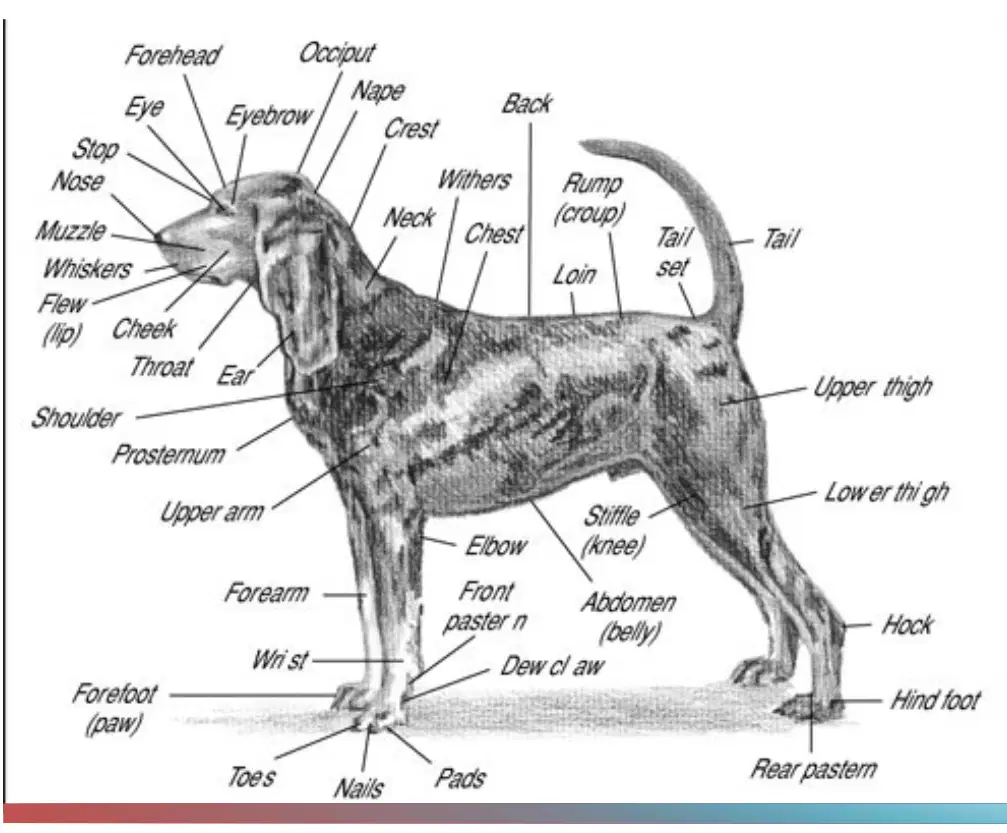
Refer to the labeled dog diagram. Which set lists the five primary external regions used to organize canine anatomy?
Head, Neck, Trunk, Limbs, Tail
Skull, Spine, Ribs, Hips, Paws
Muzzle, Stop, Jowl, Ear, Occiput
Chest, Abdomen, Back, Hock, Stifle

On the overview diagram, which landmark best helps a clinician specify an injury on the front limb just above the paw?
Forefoot (paw)
Wrist
Elbow
Stifle (knee)
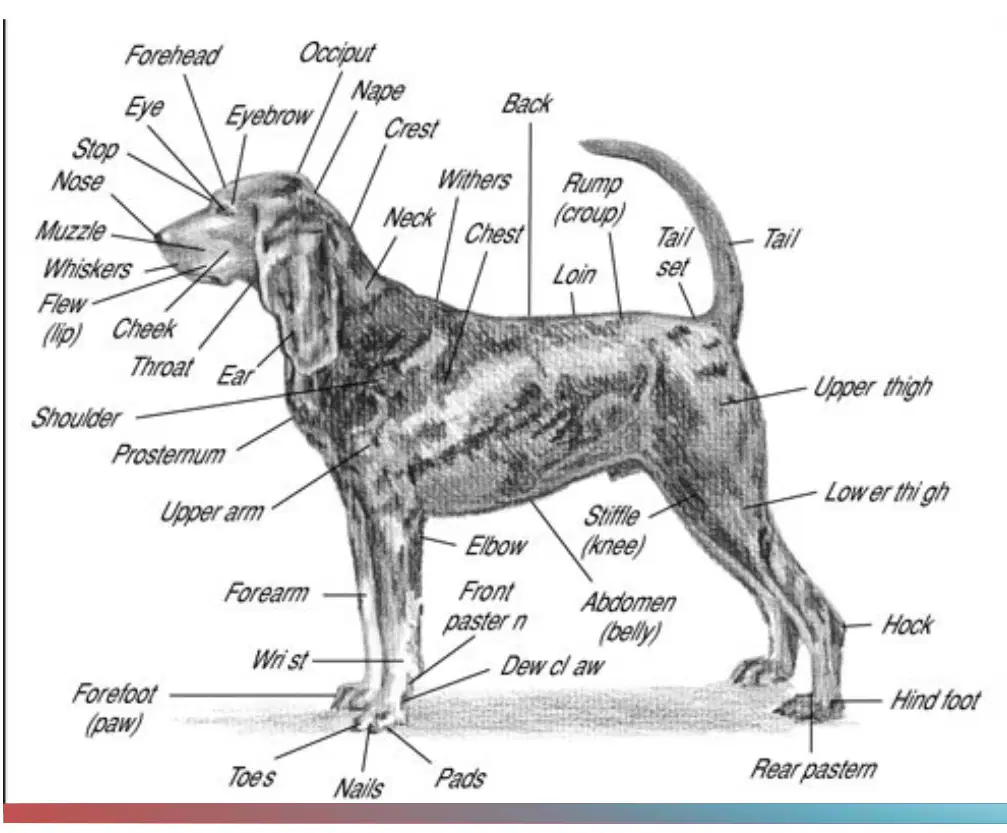
According to the overview slide, why are external landmarks clinically useful?
They determine coat color patterns.
They assist in identifying injury locations and physical abnormalities.
They are used only for breed standards and shows.
They indicate the dog's nutritional status.
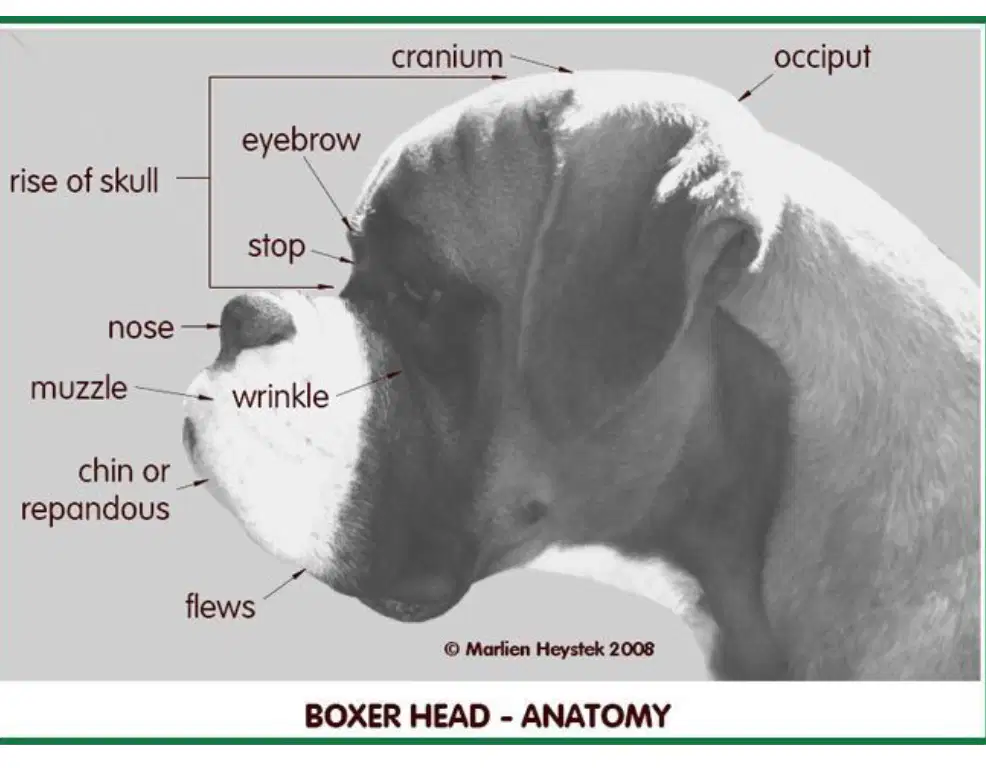
Using the head diagram, which label indicates the bony prominence at the back of the skull?
Cranium
Occiput
Rise of skull
Eyebrow
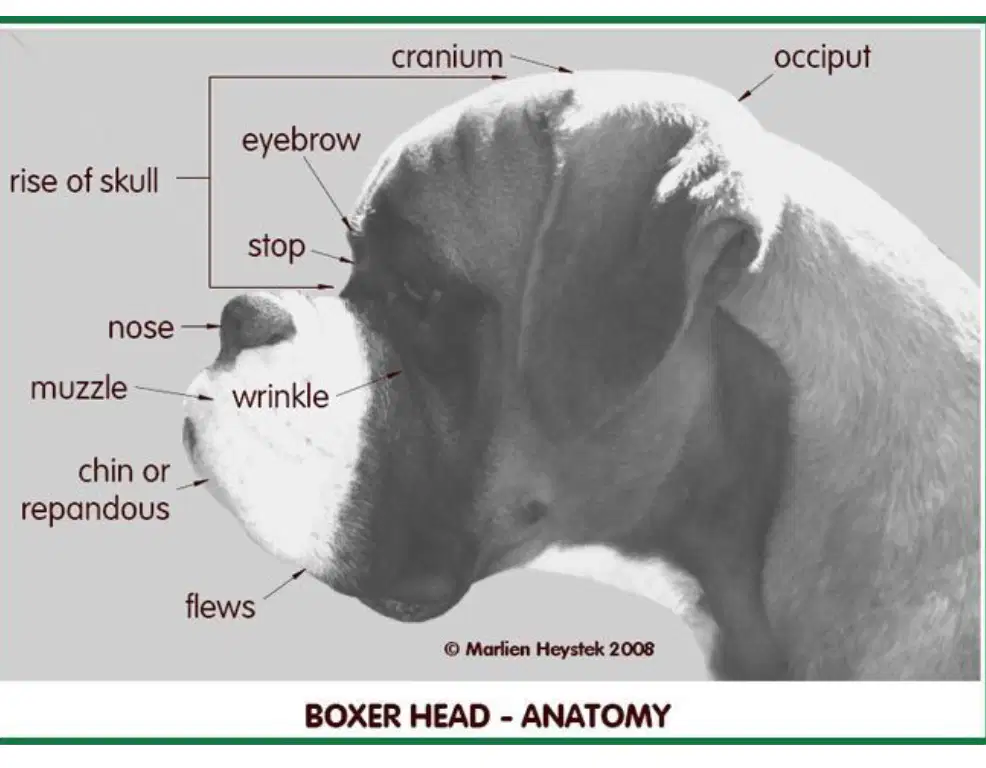
A laceration is described as being at the 'stop.' Where should you look during examination?
At the indentation between the muzzle and the forehead
On the loose skin of the lower jaw
At the point where the ear attaches to the head
On the external portion including nose and mouth
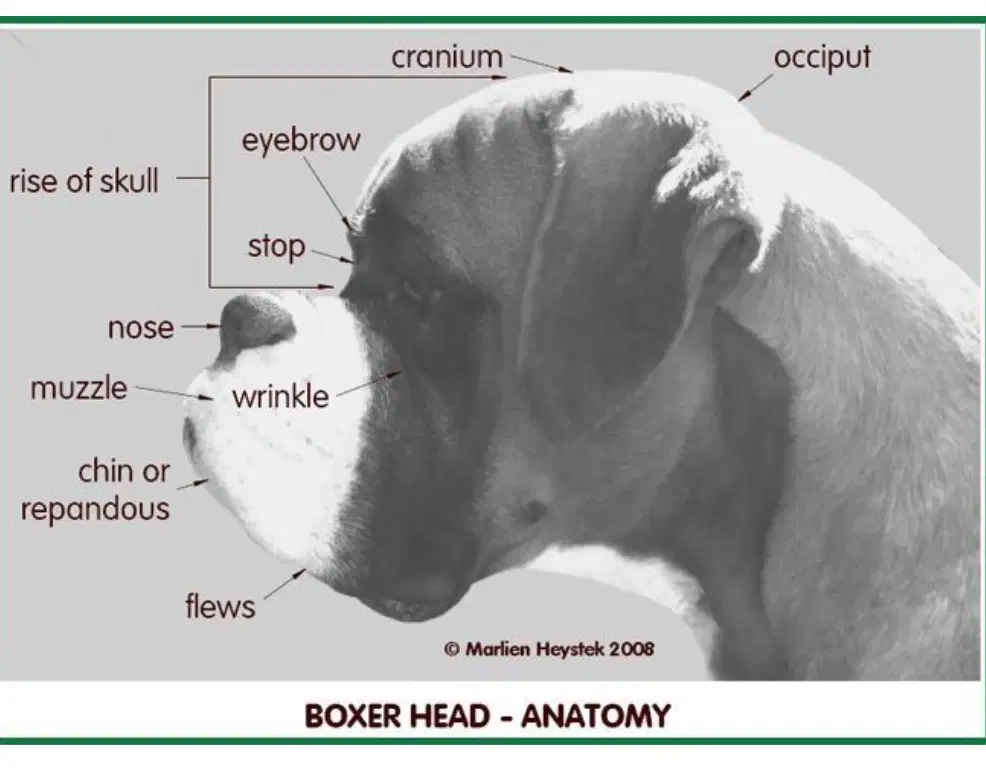
When documenting swelling at the base of the ear on the head diagram, which term best specifies the location?
Ear base
Eyebrow
Wrinkle
Chin
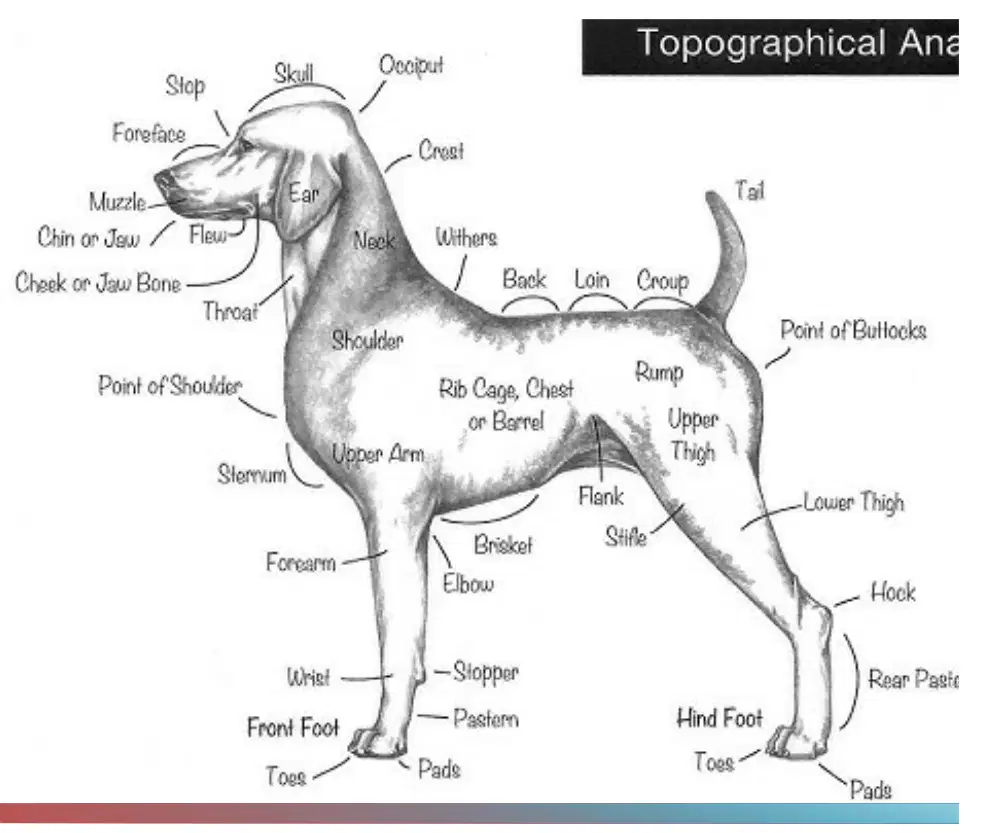
[DOK 1] In the diagram of the dog’s trunk, which structure is defined as the ridge between the shoulder blades?
Withers
Brisket
Flank
Loin
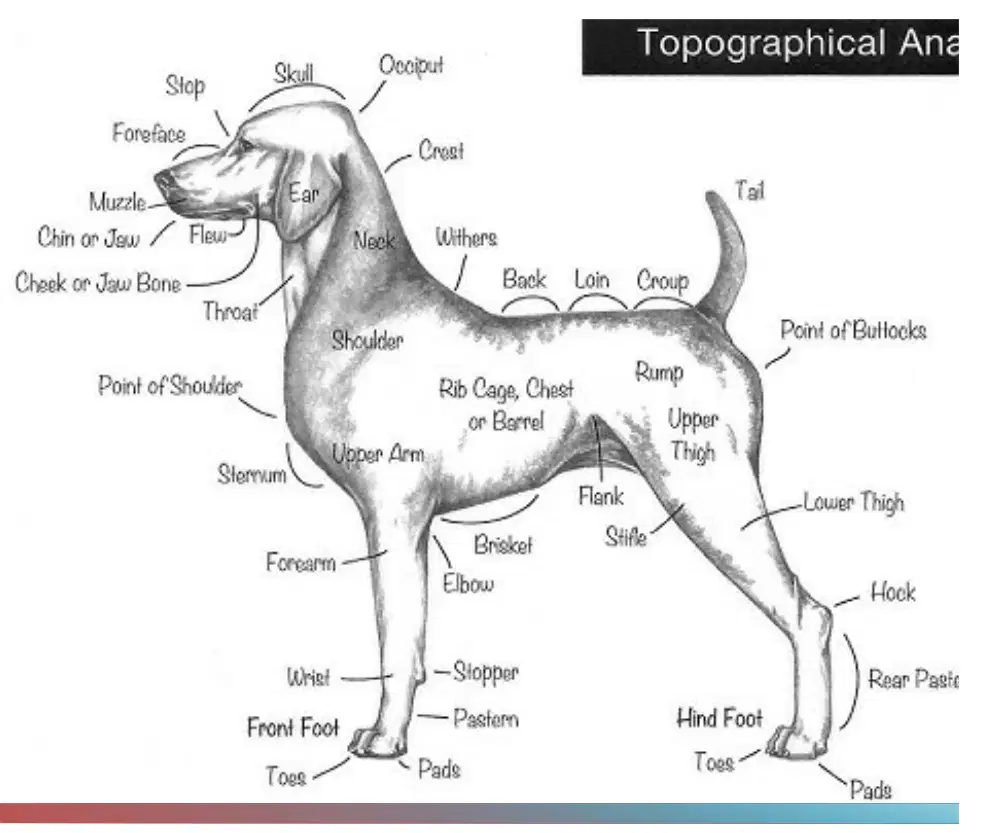
[DOK 1] According to the labeled trunk diagram, which term refers to the rounded part of the chest and abdomen?
Barrel
Croup
Rump
Sternum
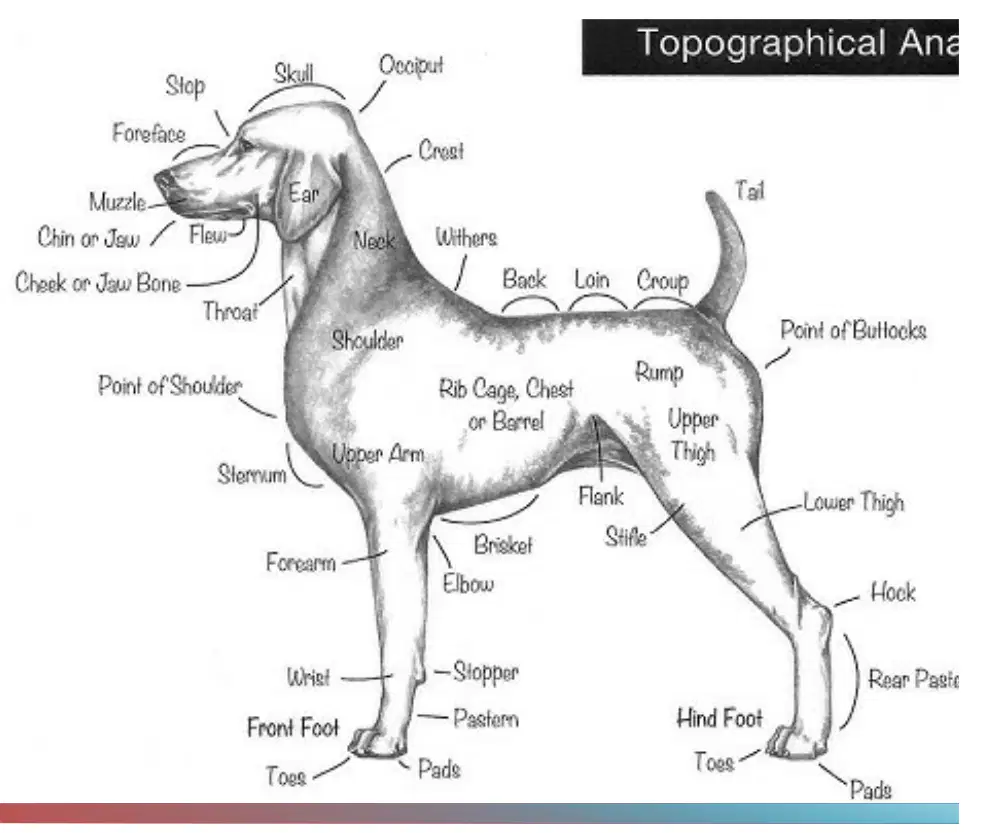
[DOK 2] A veterinary note mentions swelling 'between the last rib and the hind leg.' Which labeled trunk region is most precisely affected?
Flank
Withers
Brisket
Crest
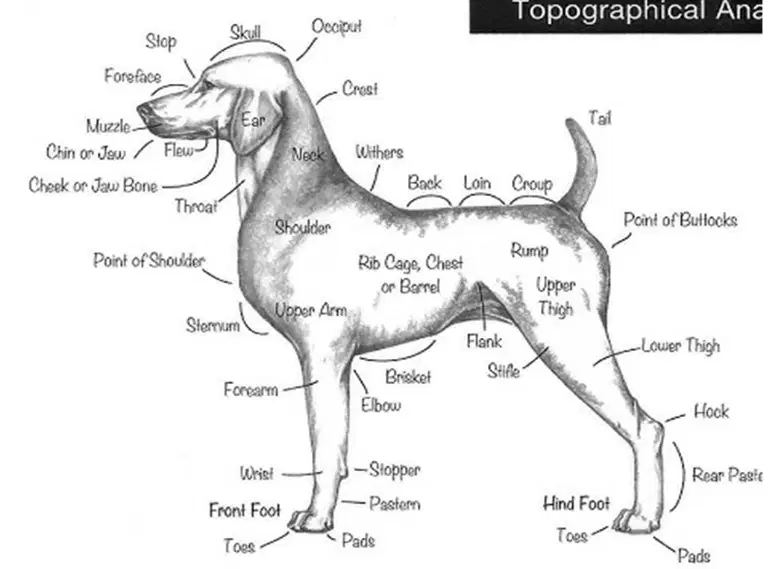
[DOK 1] In the limbs diagram, which joint is the canine equivalent of the human knee?
Stifle
Hock
Elbow
Wrist
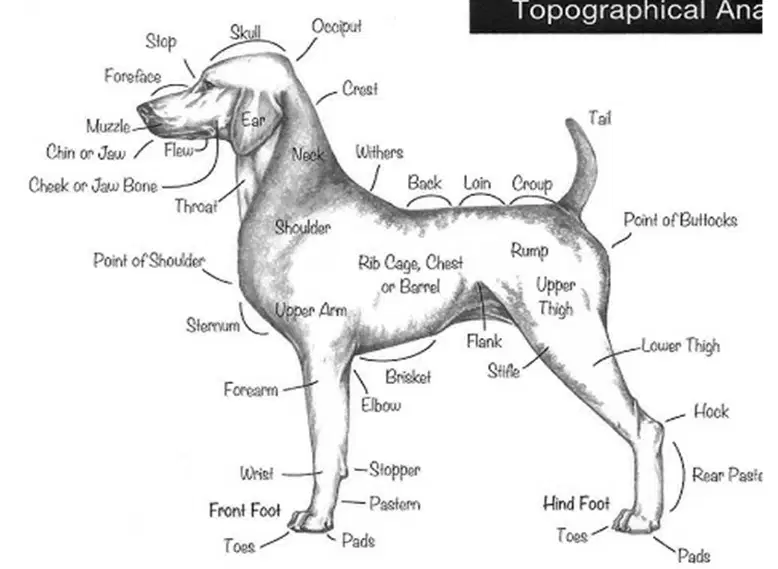
[DOK 1] The ankle joint of the hind limb is labeled as which structure?
Hock
Pastern
Stifle
Upper thigh
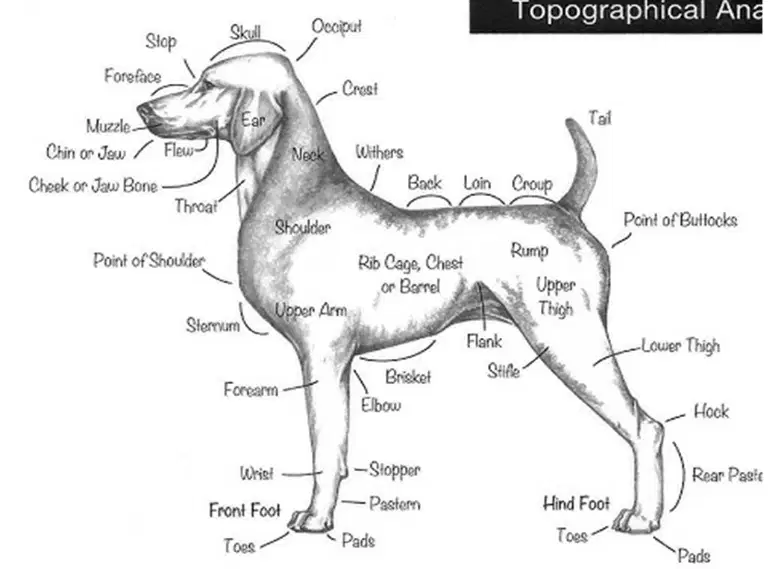
[DOK 2] A technician records an injury 'between the fetlock and the hoof pad' on the forelimb. Which labeled area best matches this description?
Pastern
Dewclaw
Pads
Point of shoulder
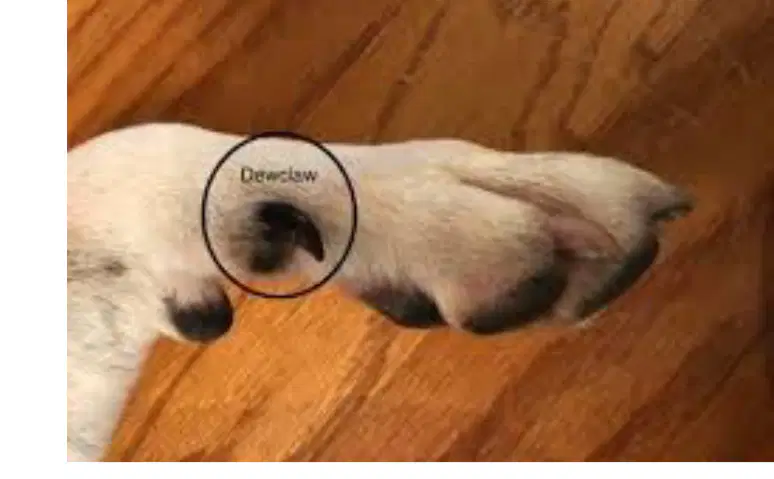
[DOK 3] You are fitting protective gear for a working dog. Which combination best protects shock-absorbing structures on the feet while leaving the rudimentary digit higher on the paw uncovered for flexibility?
Booties covering the pads but not the dewclaw
Wraps that immobilize the stifle and hock
A chest plate over the brisket and barrel
A sleeve that only covers the pastern
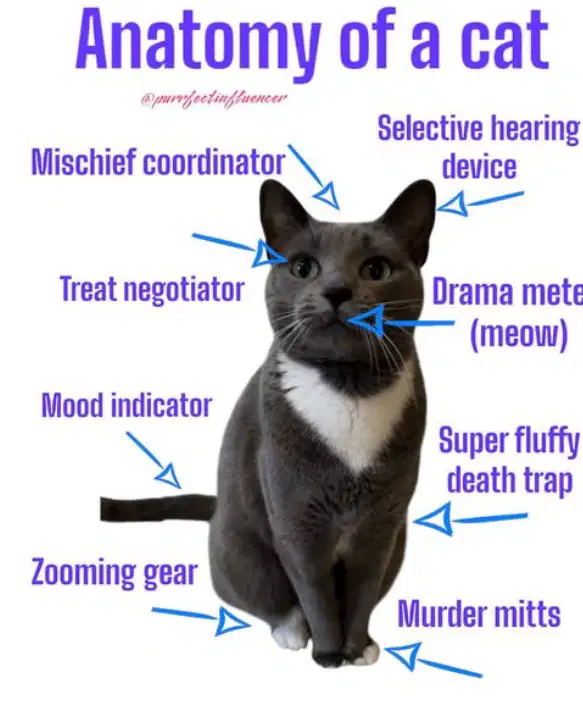
Refer to the overview diagram of a cat’s body. Which statement best summarizes why a cat’s body structure enhances agility?
A compact, flexible build supports quick, precise movements
A heavy, rigid frame stabilizes the trunk during rest
An elongated, stiff spine prevents rapid turns
Wide, immobile joints limit range of motion to conserve energy
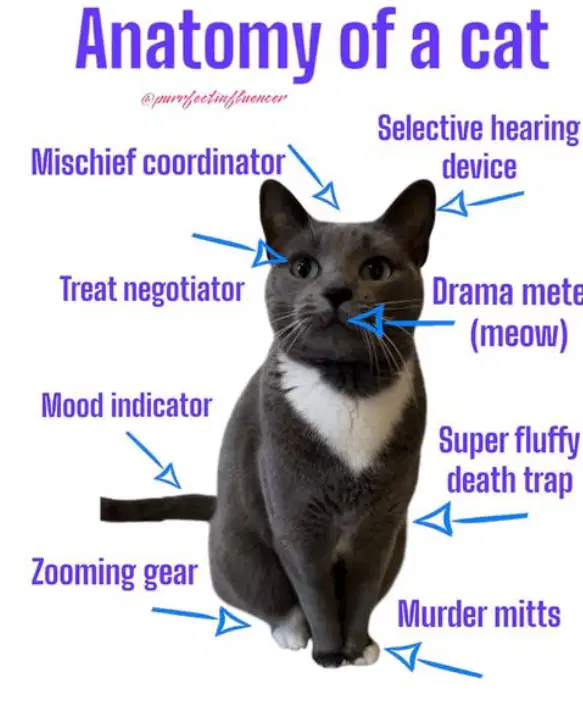
According to the overview, into which primary external regions is the feline body divided?
Head, Neck, Trunk, Limbs, Tail
Crown, Thorax, Abdomen, Paws, Fluke
Skull, Back, Hips, Paws, Fin
Snout, Collar, Chest, Wings, Tail
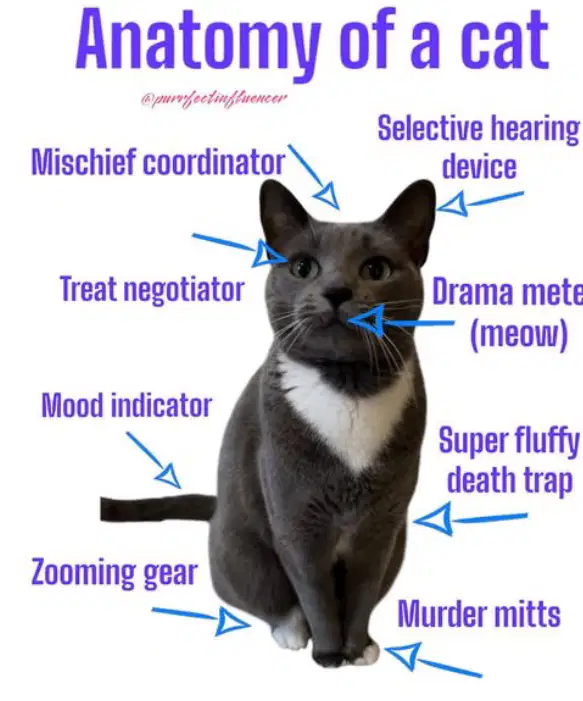
Which feature of the feline skeleton most directly supports increased balance and precision movement?
Highly mobile spine
Fused tail vertebrae
Locked knee joints
Broad, inflexible rib cage
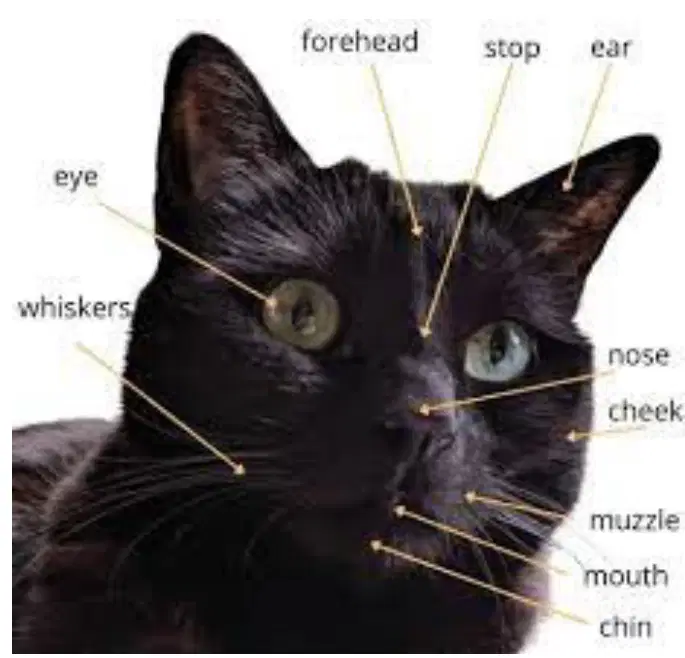
On the head diagram, where would you locate the whisker pad relative to other features?
On each side of the muzzle near the nose
Above the ears at the top of the skull
Directly beneath the chin at the jawline
Centered between the eyes on the forehead
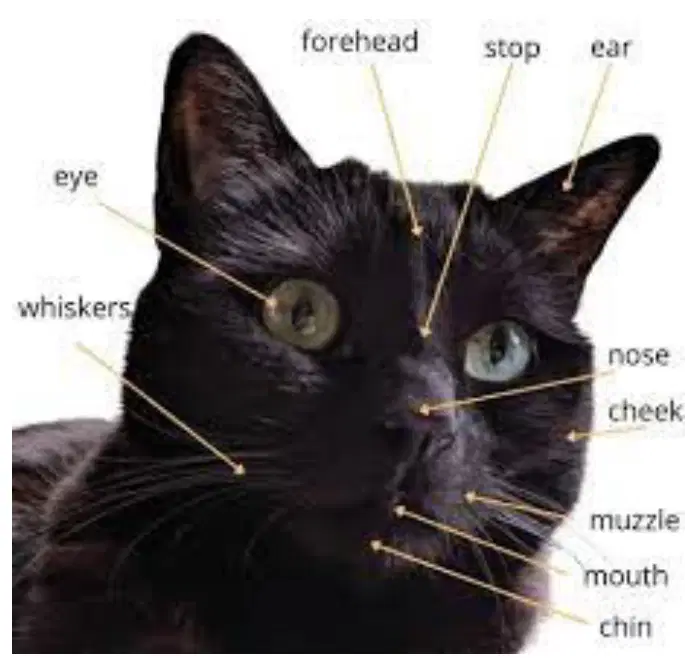
A student argues that the chin is part of the muzzle because both are near the mouth. Using the definitions provided, which reasoning best evaluates this claim?
Incorrect; the chin is the lower portion of the jaw, while the muzzle includes the broader area around the nose and mouth
Correct; the chin and muzzle are interchangeable terms referring to the same region
Partially correct; the chin is only the upper portion of the muzzle near the nose
Indeterminate; the terms vary by individual cat and lack standard definitions
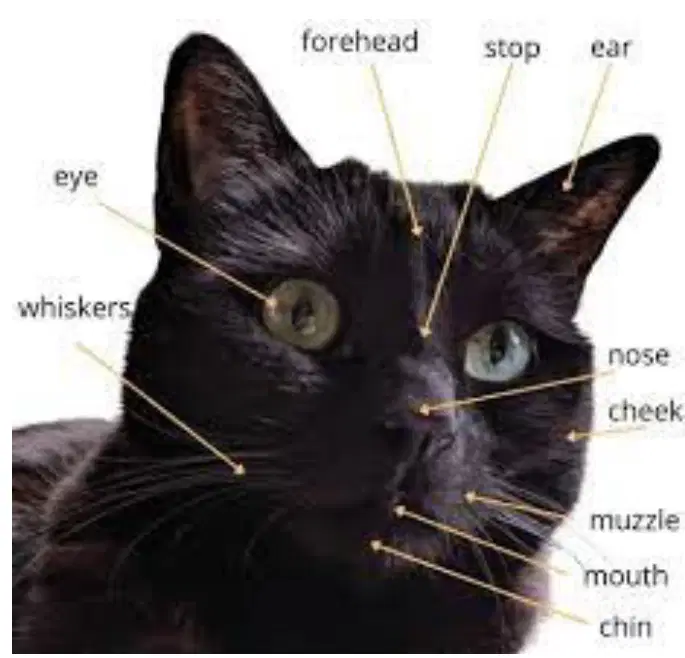
Which pair correctly links a head region with its precise location?
Forehead — between the eyes and ears
Ear Base — tip of the ear farthest from the skull
Muzzle — lower portion of the jaw
Whisker Pad — above the ears at the crown
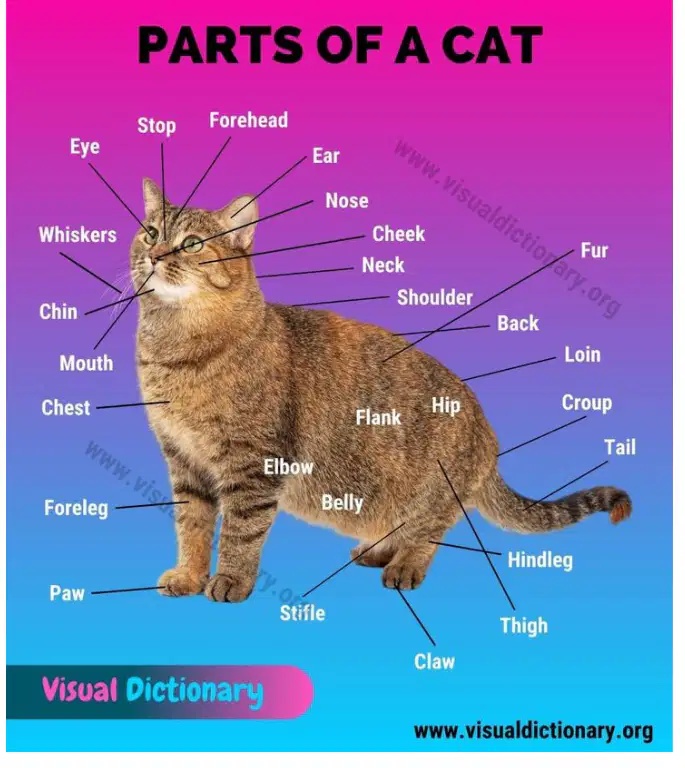
Refer to the labeled cat diagram. Which region is defined as the muscular area that supports the forelimb?
Shoulder
Flank
Abdomen
Loin
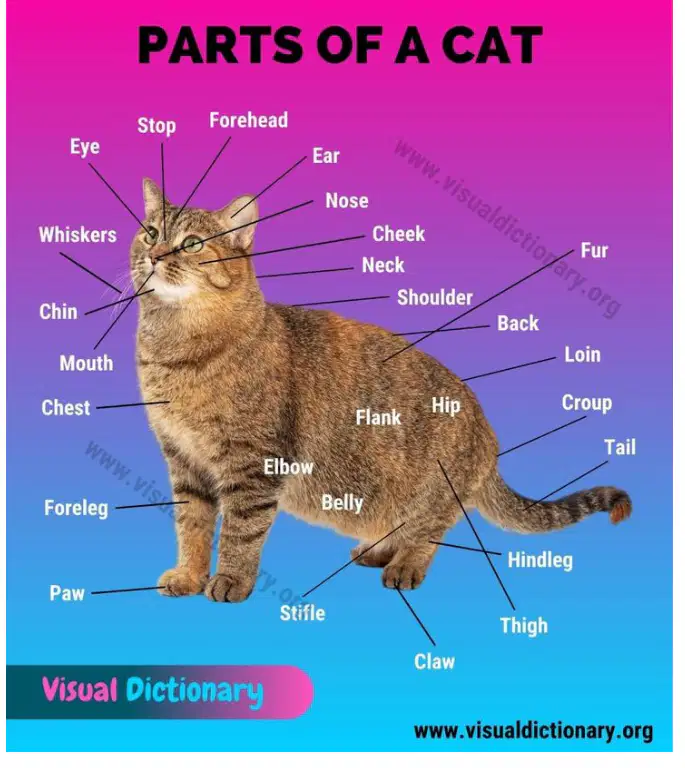
In the trunk diagram, what is the area between the ribs and the hind leg called?
Loin
Flank
Back
Croup
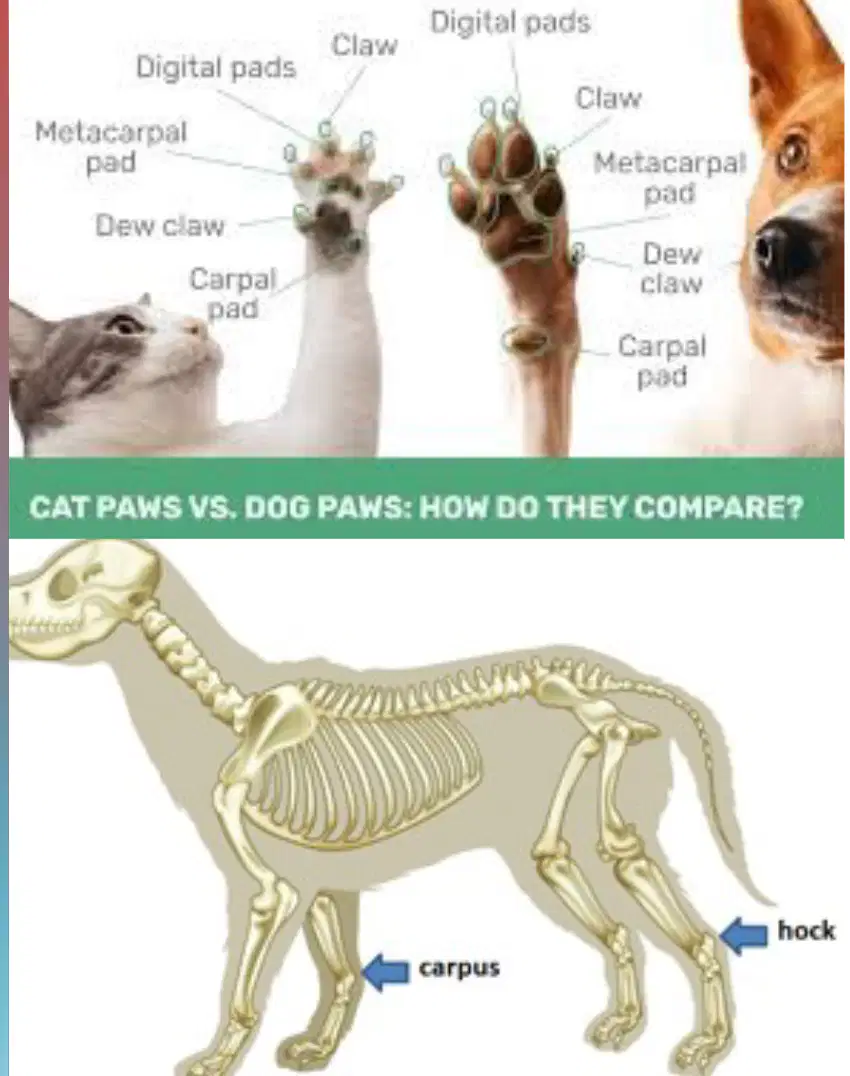
Looking at the paw and skeleton visuals, which structure is the wrist joint of the forelimb?
Hock
Carpus
Metacarpal pad
Dew claw
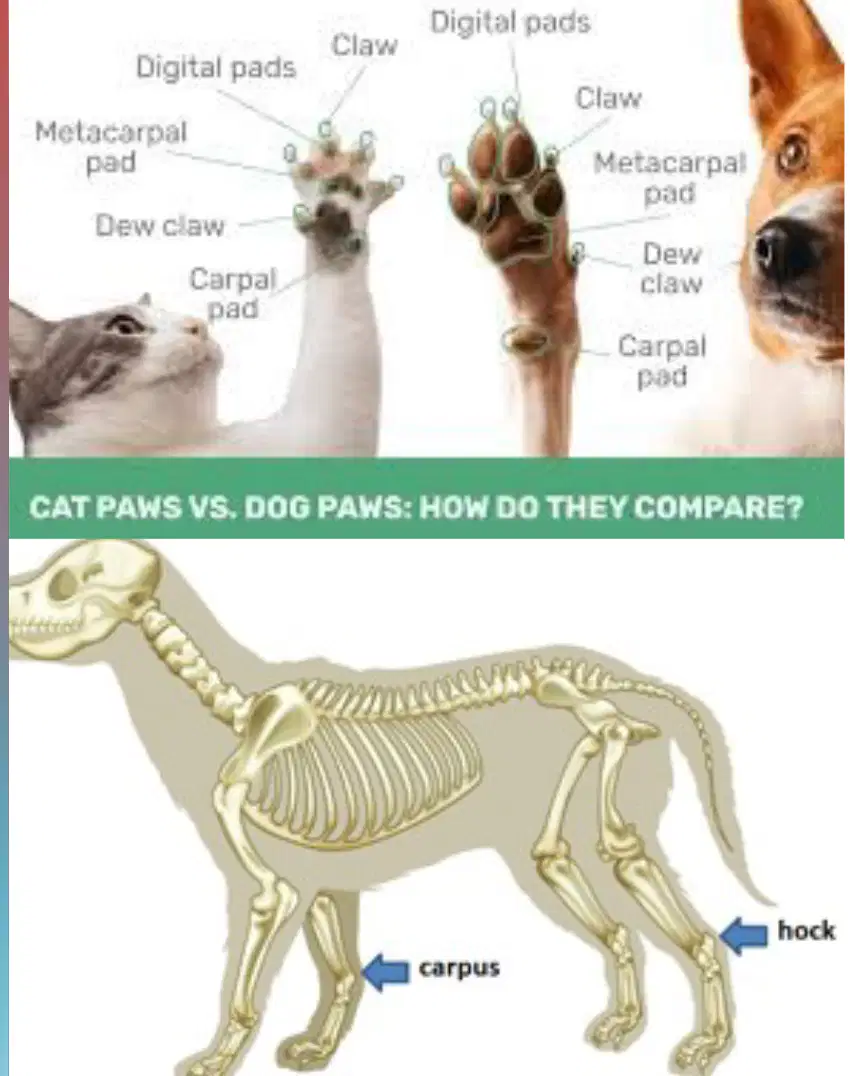
Which statement best describes the metacarpal pad shown on the underside of the paw?
It is the central pad located on the underside of the paw.
It is the small pad at the tip of each toe.
It is the heel pad of the hind limb above the hock.
It is the bony wrist joint connecting radius and ulna.
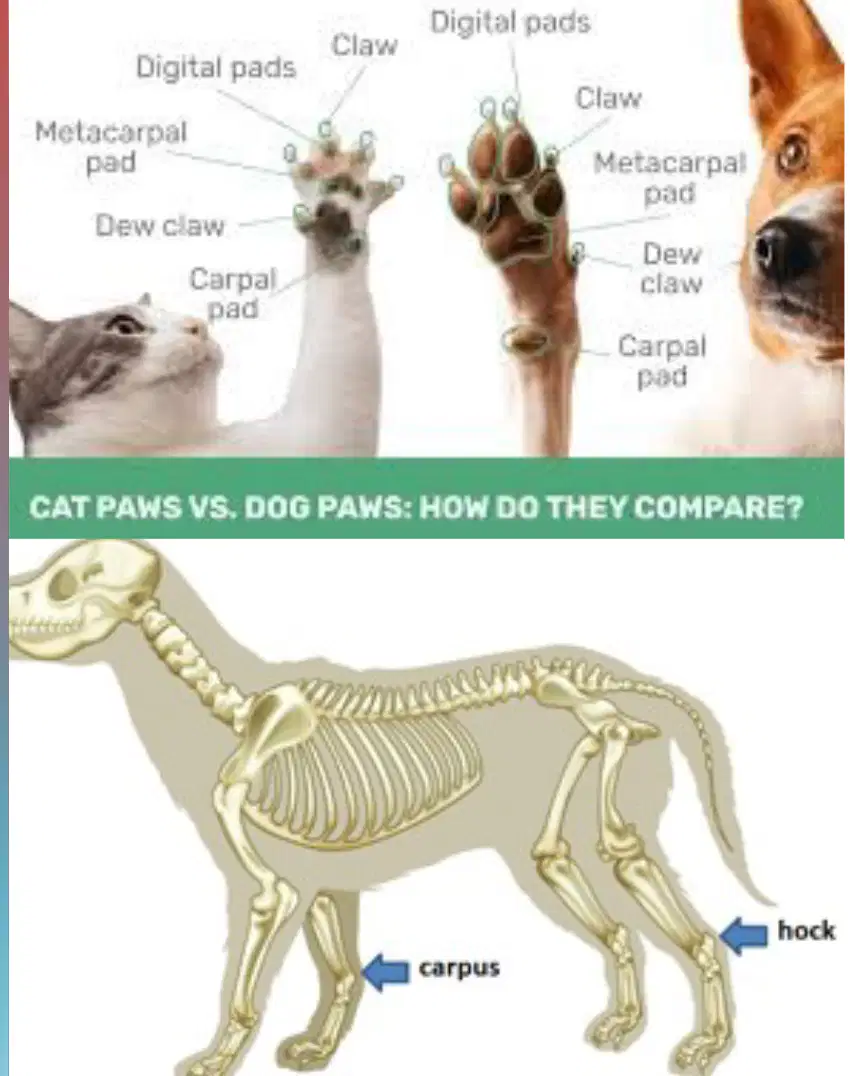
A veterinarian observes a cat with difficulty flexing the ankle of the hind limb, as indicated on the skeleton diagram. Which anatomical structure is most likely affected?
Carpus
Hock
Metacarpal pad
Loin
Based on the comparison summary, which statement best describes canine movement design?
Canines are built primarily for flexibility and stealth in short bursts.
Canines are built for endurance and varied movement across distances.
Canines are optimized for vertical climbing rather than running.
Canines are designed mainly for stillness to conserve energy.
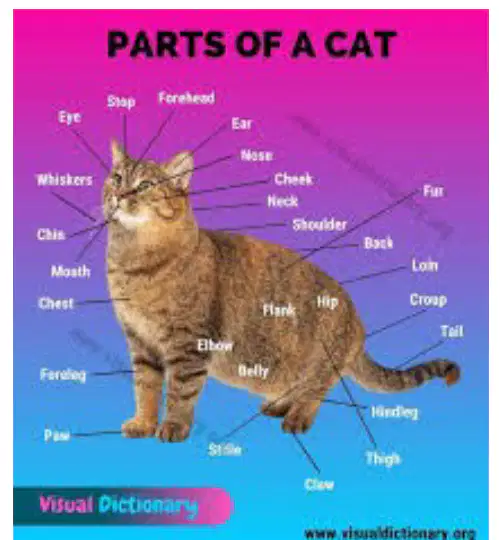
Use the labeled cat and dog diagrams to identify a shared anatomical region name present on both species.
Stifle (knee)
Whiskers
Brisket
Point of rump
Which feature is more emphasized in felines compared with canines, according to the section focus?
Endurance over long distances
Flexibility and stealth for agile movement
Heat dissipation during sprinting
Load-bearing across uneven terrain
A technician needs to describe a skin lesion found on the lateral thigh of a dog during an exam. According to the veterinary application points, why is precise anatomical terminology important here?
It reduces the need for physical exams by replacing them with photos.
It enhances professional communication and supports thorough documentation.
It ensures the animal will remain anesthetized throughout restraint.
It primarily improves billing accuracy for the clinic.
According to the veterinary application slide, which action is most directly improved by knowledge of external anatomy during handling?
Selecting vaccine types for a community clinic
Improving restraint technique to maximize patient comfort
Determining the best diet for senior pets
Predicting genetic coat color patterns
Based on the review focus for external anatomy, which set lists regions that can be observed on both canines and felines?
Pinna, muzzle, tail
Claws, whisker pad, retractable tendons
Fetlock, dewlap, beak
Hoof wall, comb, gizzard
Why is accurate anatomical terminology critical in a clinical setting when discussing canine and feline cases?
It allows precise communication among staff to avoid errors in care and procedures.
It replaces the need for physical examinations entirely.
It ensures owners can treat their pets without professional guidance.
It is only used for academic tests and not in real practice.
Identify a key difference often noted between canine and feline limb structure when planning handling or restraint.
Cats typically have more flexible forelimbs and retractable claws, while dogs generally do not have retractable claws.
Dogs have wings attached to the forelimbs, while cats have none.
Cats lack elbow joints, while dogs have two in each forelimb.
Dogs possess prehensile tails for climbing, whereas cats do not.
DoK 1—Recall: Which external feature of cattle is located between the ears at the top of the head and is used for halter control and restraint?
Muzzle
Poll
Withers
Crest
DoK 1—Recall: What is the primary location and function of the brisket in cattle?
Chest area between the front legs; supports limb movement and protects vital organs
Hindquarter above the tailhead; main muscle area and injection site
Ridge between the shoulder blades; used for measuring height and saddle fit
Between ribs and hips; major muscle group for power and movement
DoK 1—Recall: The muzzle is found at the nose and mouth. Which combination of functions is associated with it?
Chewing only
Grazing, breathing, and tasting
Halter control and restraint
Milk production
DoK 2—Skill/Concept: A veterinarian needs a site related to shock absorption in the lower hind leg joint. Which structure best matches this need?
Hock
Knee
Stifle
Hoof
DoK 2—Skill/Concept: When measuring the height of a cow for fitting equipment, which anatomical landmark provides the correct reference point?
Rump
Withers
Loin
Forehead
DoK 2—Skill/Concept: You are checking for signs of calving readiness at the base of the tail. Which external feature are you assessing?
Tailhead
Rump
Switch
Paralumbar fossa
DoK 3—Strategic Thinking: A producer wants to improve power and movement by conditioning a major muscle group located between the ribs and hips. Which area should training target, and why?
Rump; it is the hindquarter above the tailhead used mainly as an injection site
Loin; it lies between ribs and hips and is a major muscle group for power and movement
Brisket; it is in the chest and protects vital organs during exercise
Withers; it is used for height measurement rather than locomotion

DoK 3—Strategic Thinking (visual reference): For a safe subcutaneous injection in the loose skin under the neck that aids thermoregulation, which labeled area on the diagram should be used?
Dewlap
Brisket
Udder/Scrotum
Poll
Which external feature is located at the top of the head between the horns and is used for halter placement?
Poll
Withers
Muzzle
Forehead
According to the anatomy notes, which region is the midsection that contains the rumen and major organs?
Loin
Barrel
Flank
Brisket
Which description best matches the withers on a goat or sheep?
Joint on hind leg aiding movement
Top of shoulder; primary height measurement point
Side region near belly for auscultating rumen sounds
Below the fetlock, absorbs impact during walking
A student needs to listen for rumen sounds during a health check. Which external region should they place the stethoscope on?
Flank
Pastern
Rack
Bridge of nose
Which structure is identified as the joint on the hind leg that provides support and movement?
Pastern
Hock
Stifle
Cannon bone

In the diagram of the Boer goat, which labeled area lies between the ribs and hips and is a strong muscle for movement?
Loin
Rump
Rack
Hip
Which option correctly pairs the organ system with its external structure in goats/sheep?
Circulatory system — withers
Digestive system — barrel
Skeletal system — muzzle
Reproductive system — poll
Herd managers are advised to keep this base-of-tail area clean to prevent infection, especially in docked animals. Which feature is being described?
Udder/Scrotum
Tail Dock
Dew claw
Throat
[DoK 1] Which external feature of the horse is located behind the ears and serves as a pressure point for the halter and bridle?
Crest
Poll
Withers
Croup
[DoK 1] The withers are best described as which location on a horse?
Upper neck ridge that stores fat
Top of the rump that adds strength and balance
Area between the shoulder blades used to determine saddle fit and height
Base of the tail used to assess tone and hygiene
[DoK 1] What function is attributed to the fetlock according to the material?
Primary propulsion muscle for forward motion
Joint above the hoof that absorbs shock
Protective covering that produces the hoof wall
Upper hind leg muscle housing the stifle
[DoK 2] A veterinarian checks the base of the horse’s tail to evaluate tone and cleanliness. Which anatomical term matches this practice?
Dock
Croup
Flank
Loin
[DoK 2] Which pair correctly matches a structure with its primary role in movement as stated in the material?
Shoulder — absorbs shock above the hoof
Gaskin — propels forward motion
Barrel — determines saddle fit and height
Crest — houses heart and lungs
[DoK 2] Which feature is most directly used to determine a horse’s measured height?
Crest
Withers
Point of hip
Cannon
[DoK 3] A horse shows tenderness at the ring-like area where the leg meets the hoof, which nourishes the growing hoof. Which care priority is most justified by this symptom?
Evaluate the coronet because it produces the hoof wall and is highly sensitive
Examine the hock because it is equivalent to the human ankle
Massage the crest to reduce fat storage at the upper neck ridge
Assess the croup to restore balance at the top of the rump
[DoK 3] During a gait analysis, a handler notes weak propulsion from the hind limb and focuses on strengthening the upper hind leg muscle responsible for forward motion. Which structure should the conditioning program target?
Fetlock
Gaskin
Withers
Dock
Which external feature of a pig is the nose area used for rooting and sensing?
Jowl
Snout
Flank
Ham
The jowl in pigs is best described as which of the following?
The lower hind leg joint supporting standing
The fatty cheek that stores fat and protects the jaw
The belly region including mammary glands in sows
The soft side area used for respiration checks
Which structure is the major muscle of the upper hind leg important for movement and meat production?
Ham
Hock
Pastern
Shoulder
A student observes the soft side area of a pig to assess breathing. Which anatomical region is being checked?
Underline
Flank
Forearm
Hock
Which option correctly matches the structure with its function: provides flexibility below the fetlock and absorbs shock?
Tail
Pastern
Shoulder
Dewclaw

In the diagram of the pig, which labeled region supports forward motion as a muscle group located near the front of the body?
Shoulder
Hock
Ham
Underline
Which statement best describes the dewclaw of a pig?
Located on the nose and used for sensing smells
Found on the back of the legs above the main hooves; provides stability
Forms the belly region and contains mammary glands
A curled appendage indicating the pig is content
Which external structure sits on top of a chicken’s head and helps regulate body temperature while signaling health status?
Wattle
Comb
Hackle
Ear lobe
Which part is located below the beak and assists with cooling and mate attraction?
Wattle
Breast
Cloaca/vent
Back
Identify the function best matched to the beak.
Opening for waste and egg laying
Neck feathers that show breed and sex traits
Mouth part used for pecking and feeding
Lower leg indicating age and strength
A student examines the feathered area around a chicken’s neck to judge breed and sex traits. Which term names this feature?
Hackle
Back
Wing
Thigh
Which statement best explains the role of the shank in poultry evaluation?
It is a bony growth used for defense in roosters.
It is the lower leg that indicates age and strength.
It is the chest muscle used for flight and meat cuts.
It is the opening for waste and eggs.

In the photo of the chicken’s legs, which labeled structure is the bony growth used for defense in roosters?
Claw
Toe
Spur
Hock
Which pairing of part and primary function is correct?
Back—opening for waste and egg laying
Breast—large chest muscle for flight and meat cut
Wing—supports wings and feathers
Cloaca/vent—regulates body temperature and shows health
Which statement best captures one practical benefit of knowing external animal anatomy?
It improves animal handling, restraint, and safety.
It replaces the need for any restraint equipment.
It guarantees animals will never be injured.
It eliminates the need for professional training.
A technician must give a subcutaneous shot in the proper region. Which reason from the summary explains why external anatomy knowledge is essential here?
It ensures correct injection and examination sites.
It increases show-ring judging scores.
It speeds up feed conversion efficiency.
It prevents the need for vaccination schedules.
Which outcome directly supports clearer teamwork with veterinary professionals?
Building communication skills with veterinarians.
Learning to identify breeds by color patterns only.
Practicing restraint without any terminology.
Avoiding documentation to save time.
Understanding external anatomy strengthens a student’s ability to speak precisely about body regions. Which benefit in the summary names this effect?
Strengthens anatomical vocabulary and confidence.
Reduces all risk during transport.
Allows injections anywhere on the body.
Replaces routine physical exams.
During a barn check, a handler quickly notices swelling on a limb and reports it accurately. Which listed benefit best explains this quick response?
Aids in identifying injuries or abnormalities quickly.
Eliminates the need for restraints entirely.
Guarantees perfect healing without treatment.
Focuses only on internal organ assessment.
Which statement best explains why knowing external anatomy is important when handling animals?
It helps handlers identify body parts to handle animals safely and effectively.
It allows handlers to predict the animal’s genetic traits without testing.
It eliminates the need for any restraint equipment during handling.
It ensures animals always remain calm regardless of environment.
A student must describe two external parts of a chosen animal. Which response best meets the requirement?
Dog: ear (on the head; detects sound) and paw (at the end of each limb; supports weight and aids movement).
Dog: heart (in the chest; pumps blood) and stomach (in the abdomen; digests food).
Fish: gills (inside the body; store oxygen) and spine (internal; controls balance).
Bird: brain (in the skull; thinks) and liver (in the body cavity; filters toxins).
How can knowledge of external anatomy help prevent injuries to animals or handlers during routine care?
By guiding where to place hands and equipment to avoid sensitive areas and reduce stress.
By allowing handlers to skip training because animals will self-direct.
By replacing observation so handlers do not need to monitor behavior.
By ensuring animals never require restraint regardless of species.