
 Worksheets
Ethernet LANs and MAC Addressing
Total questions: 108
Worksheet time: 54mins
In Ethernet LANs, which OSI model layers does Ethernet operate at for providing local data connectivity using frames and physical signaling?
Layers 2 and 1
Layers 3 and 2
Layers 4 and 3
Layers 7 and 6
Which statement best describes how an Ethernet device prepares data for transmission according to the MAC layer process?
It places the data into an IP packet and appends a port number for transport.
It places the data into a MAC frame with source and destination MAC addresses and control information.
It encrypts the data with a session key before encapsulating it into an HTTP message.
It converts the data directly into analog signals without addressing.
CSMA-CD is used by Ethernet to share the LAN medium. What happens when the MAC detects carrier traffic before transmitting?
It immediately transmits using higher priority to preempt others.
It waits a fixed 10 ms and then transmits regardless of the medium state.
It calculates a Binary Exponential Backoff interval and retries later.
It drops the frame and reports an error to the application.
According to the text, which inbound frames will a NIC in normal (non-promiscuous) mode accept and process?
Any frame on the wire regardless of destination address
Frames addressed to its own unicast MAC, the broadcast MAC (FF:FF:FF:FF:FF:FF), or subscribed multicast groups
Only frames that match the subnet’s default gateway MAC
Only frames using locally administered addresses
How long is a MAC address and what is its most common display format for human readability?
32 bits, shown as four dotted decimal numbers
48 bits, shown as six hexadecimal pairs separated by colons (e.g., 01:23:45:67:89:ab)
64 bits, shown as eight hexadecimal pairs separated by hyphens
128 bits, shown as colon-separated IPv6 groups
What does the first 24 bits of a globally unique MAC address represent, and who assigns it?
Host-specific serial number assigned by the manufacturer
Organizationally Unique Identifier assigned centrally by the IEEE
Locally administered identifier assigned by the network administrator
A multicast group identifier assigned dynamically by switches
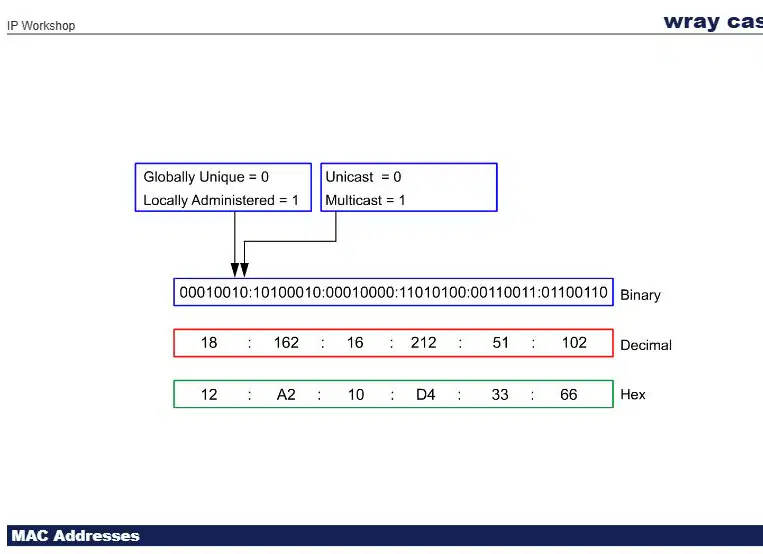
Which bits in the first octet of a MAC address indicate addressing scope and traffic type, respectively?
Most significant bit for multicast/unicast; least significant bit for global/local
Least significant bit for global/local; second least significant bit for multicast/unicast
Second least significant bit for globally unique vs locally administered; least significant bit for unicast vs multicast
A parity bit for error detection; a priority bit for QoS
Which description correctly contrasts locally administered and globally unique MAC addresses?
Locally administered addresses are assigned by the IEEE; globally unique addresses are configured by network administrators for a single LAN.
Locally administered addresses are set by network administrators (often in software) and need only be unique within the local network; globally unique addresses are assigned by a central authority (the IEEE) and are usually burnt into adaptors at manufacture.
Both types are always burnt into hardware and must be globally unique across all networks.
Globally unique addresses can be reused on multiple NICs by the same vendor as long as they are on different LANs.
Which bit pattern in the first octet of an Ethernet MAC address indicates that the frame is multicast or broadcast traffic?
00 in the least significant bit
01 in the least significant bit
10 in the most significant bit
11 in the most significant bit
An IPv4 multicast address of 224.0.0.9 maps to which Ethernet multicast MAC address according to the given example?
01-00-5e-00-00-09
33-33-00-00-00-09
ff-ff-ff-ff-ff-ff
00-00-5e-00-00-09
Which protocol pair is correctly matched with its listed Ethernet multicast address prefix from the examples?
Spanning Tree Protocol (802.1d) — 01-80-c2-00-00-00
Ethernet OAM (IEEE 802.3ah) — 01-80-c2-00-00-02
VLAN Trunking Protocol (VTP) — 33-33-xx-xx-xx-xx
IPv6 Multicast — 01-00-5e-xx-xx-xx
Based on the diagram of a repeater, what is the collision domain behavior when repeaters interconnect wire segments?
Each segment becomes its own collision domain and collisions do not propagate
The entire interconnected network remains a single collision domain
Only half of the network shares a collision domain; the rest is isolated
Collision domains are created per host rather than per segment
According to the bridge diagram, how does a MAC bridge handle a frame sent from host B on Segment 1 to host D on Segment 2?
It drops the frame because bridges do not forward between segments
It forwards the frame to Segment 2 because the destination is on Segment 2
It broadcasts the frame to both segments regardless of destination
It forwards only if the source and destination are on the same segment
Which statement best differentiates a repeater from a MAC bridge in Ethernet networks?
A repeater makes forwarding decisions using MAC addresses; a bridge simply amplifies signals
A repeater operates at the physical layer to boost signals; a bridge links LAN segments using MAC-based decisions
Both devices operate at the application layer to extend LANs
Both devices isolate collision domains by default
Given the limits on the number of repeaters in a LAN, which practical reason from the text explains why bridges may be preferred for extending LANs?
Bridges work at the physical layer and therefore are cheaper than repeaters
Bridges can discriminate between local and non-local LAN traffic using filter tables, reducing unnecessary forwarding
Bridges always convert IPv4 multicast to IPv6 multicast to save bandwidth
Bridges eliminate the need for MAC addresses by using IP routing tables
Which statement best describes the forwarding behavior of an Ethernet hub?
It examines MAC addresses and forwards frames only to the correct port.
It repeats any inbound signal out of all other ports without inspection.
It buffers frames and forwards them only when the destination is idle.
It filters collisions and forwards only properly constituted frames.
According to the material, why are Ethernet hubs limited to 10 Mbit/s when using 10baseT but unsuitable for 100baseT unless in full-duplex mode?
Hubs support only full-duplex operation required by 10baseT.
Hubs operate only in half-duplex, which restricts them to one transmitter at a time.
Hubs can learn MAC addresses only at 10 Mbit/s.
Hubs require fiber links to run at 100 Mbit/s.
When an Ethernet switch first starts and its filter table is empty, what happens to the first frame it receives from a host?
It is dropped because the destination is unknown.
It is flooded out of all ports while the switch learns the source MAC address.
It is forwarded to the default gateway only.
It is queued until the destination MAC is learned from ARP.
What is the role of a switch's filter table once MAC addresses have been learned?
Forward frames only if the destination IP is known.
Decide whether to forward a received frame out a specific port or flood it when the destination is unknown.
Encrypt frames before forwarding them to prevent collisions.
Translate MAC addresses into hostnames for delivery.
Which statement about aging entries in a switch filter table is correct?
Entries never age out to preserve history of all devices seen.
Entries age out after exceeding a configurable threshold to remove devices no longer connected.
Entries are removed only when the switch reboots.
Entries are deleted whenever a collision is detected on any port.
In the diagram showing a switch with multiple attached hosts, which domains are illustrated for that single switch?
One broadcast domain and one collision domain for all ports combined.
One broadcast domain with each switchport forming its own collision domain.
Multiple broadcast domains and one collision domain per pair of hosts.
No broadcast domain because switches block all broadcasts.
Which devices propagate collisions and which device types do not, according to the text?
Bridges and switches propagate collisions; hubs do not.
Hubs and repeaters propagate collisions; bridges and switches do not.
Routers propagate collisions; hubs and switches block them.
All Ethernet devices propagate collisions equally.
What MAC destination address identifies an Ethernet broadcast frame, and what happens when a switch receives it?
FF:FF:FF:FF:FF:FF; it is flooded out of all switchports.
00:00:00:00:00:00; it is dropped to prevent loops.
The switch's own MAC; it is sent to the management VLAN only.
The default gateway's MAC; it is forwarded to the router interface only.
In 10 Mbit/s Ethernet, what specifically defines a late collision, and who handles the retransmission when it occurs?
A collision detected after the first 64 bytes (512 bits) have been transmitted; higher layers handle retransmission
Any collision detected before 64 bytes are sent; the NIC always retransmits
A collision detected after the full frame is sent; the hub repeats the frame
Any collision on full‑duplex links; the switch schedules a retry
Which condition is a common cause of late collisions on Ethernet links?
Full‑duplex/half‑duplex mismatch
Using Category 6 cabling
Oversized MTU on full‑duplex links
Spanning Tree convergence
A network intermittently experiences late collisions after a cabling change. Based on typical causes, which troubleshooting step is MOST justified first?
Verify duplex settings on both ends of the link for mismatches
Disable CSMA/CD on all NICs
Lower the Ethernet speed to 1 Mbit/s
Replace all switches with hubs
According to the description of legacy Ethernet ring configuration, what was the purpose of terminating resistors?
To prevent signals reflecting back along the segment
To boost signal power for longer distances
To split the ring into multiple collision domains
To enforce token passing for media access
Which drawback was associated with the early Ethernet ring-style configuration described?
Limited transmission distance due to high impedance on a single line
Inability to connect more than one station per segment
Requirement for managed switches on every node
Incompatibility with CSMA/CD
In a modern star configuration using an Ethernet switch, what is the typical device count per LAN segment and what benefit does this provide?
Two devices per segment (user station and switch port); less transmission noise and lower impedance
Multiple devices per shared segment; higher collision rates for efficiency
One device per segment; increased noise to detect collisions earlier
Three devices per segment; built‑in redundancy without switches
Why does the star configuration used with Ethernet switches support higher data throughput, such as 100baseT services?
It leverages full‑duplex transmission techniques on individual switch ports
It reintroduces a complete physical ring for faster token passing
It relies on hubs to amplify collisions for better utilization
It removes the need for CSMA/CD by using a single shared medium
Which statement best describes the relationship between DIX Ethernet and Ethernet II?
DIX is an open IEEE standard that replaced Ethernet II in 1980
DIX (Digital, Intel, Xerox) originated the proprietary Ethernet that became known as Ethernet II
Ethernet II is a wireless extension of the DIX standard
Ethernet II is a later IEEE 802.3 revision of DIX
Open standards Ethernet is formally defined by which family and why is it nicknamed “802”?
IETF RFC family, numbered after the first cable specification
ISO 7498 family, named after the OSI model layer count
IEEE 802 family, named after a February 1980 meeting
ANSI X3 family, named after the 3 working groups
In the IEEE standards process for Ethernet, what was the focus of Working Group 1 compared with Groups 2 and 3?
WG1: physical and MAC layers; WG2: routing; WG3: application protocols
WG1: system physical layer and MAC; WG2: Logical Link Control (LLC); WG3: MAC layer standards (now 802.3)
WG1: security; WG2: cabling; WG3: power systems
WG1: wireless; WG2: token ring; WG3: FDDI
Both Ethernet II and IEEE 802.3 frames begin with a preamble. What key difference exists in their preamble fields?
Ethernet II uses a 62-bit preamble and two stop bits; 802.3 uses a 7-byte preamble plus a 1-byte Start Frame Delimiter
Ethernet II has no preamble; 802.3 uses an 8-byte preamble
Ethernet II and 802.3 both use a 7-byte preamble but only 802.3 adds a CRC
Ethernet II uses a shorter preamble than 802.3 by 4 bytes
Which field immediately follows the destination MAC address and distinguishes Ethernet II from IEEE 802.3?
Ethernet II uses a 2-byte EtherType; 802.3 uses a 2-byte Length
Ethernet II uses a 4-byte EtherType; 802.3 uses a 6-byte Length
Both use a 2-byte EtherType/Length that is always identical
Ethernet II inserts an LLC header while 802.3 does not
What is the role of the IEEE 802.2 LLC/SNAP header in 802.3 frames?
It replaces the CRC field to improve error detection
It identifies the upper-layer protocol being carried using an 8-byte header placed within the payload
It reduces the minimum payload size from 46 bytes to 38 bytes
It converts 802.3 frames into Ethernet II frames
What are the minimum and maximum payload sizes specified by Ethernet II and 802.3, and how does 802.2 LLC/SNAP affect 802.3’s usable payload?
Minimum 46 bytes, maximum 1500 bytes; 802.3 can actually carry up to 1492 bytes due to LLC/SNAP overhead
Minimum 64 bytes, maximum 1518 bytes; 802.3 can actually carry 1518 bytes
Minimum 32 bytes, maximum 2048 bytes; 802.3 can carry 2048 bytes with LLC/SNAP
Minimum 46 bytes, maximum 1492 bytes; LLC/SNAP increases it to 1500 bytes
How can you distinguish an Ethernet II frame from an IEEE 802.3 frame by examining the EtherType/Length field value?
Ethernet II always has values of 1500 or less; 802.3 always has values of 2048 or above
Ethernet II has values of 2048 (0x0800) or above for supported protocols; 802.3 uses values of 1500 or less representing length
Ethernet II uses odd numbers only; 802.3 uses even numbers only
Ethernet II and 802.3 share the same range; only the CRC reveals the difference
In the Ethernet XbaseY naming, what does the letter X represent?
The physical medium used (e.g., UTP, fiber)
The maximum gross data rate in Mbit/s
Whether the system uses baseband or broadband
The connector type (e.g., 8P8C)
Which statement best describes the meaning of “base” in XbaseY for Ethernet?
It indicates baseband transmission with no frequency division multiplexing.
It indicates broadband transmission using multiple RF channels.
It indicates balanced signaling over twisted pairs.
It indicates that the cable has a solid core conductor.
What is the technically accurate description of what is commonly (but incorrectly) called an RJ45 Ethernet plug?
An 8P8C plug using a TIA/EIA-568A/B pin-out
An 8P6C plug using a telephone pin-out
An RJ11 plug using a T568A pin-out
A 6P6C plug using an 8P8C pin-out
According to the material, which cabling categories are most commonly used for 10/100baseT and which for 1000baseT and above?
Cat3 for 10/100baseT; Cat4 for 1000baseT and above
Cat5/Cat5e for 10/100baseT; Cat6 for 1000baseT and above
Cat6 for 10/100baseT; Cat3 for 1000baseT and above
Cat5e for all speeds up to 10G with no exceptions
Which TIA/EIA-568-B guidance is stated for horizontal cabling in commercial buildings?
Use T568A at the wall outlet and T568B at the patch panel only.
Either T568A or T568B can be used consistently for horizontal wiring from wall socket to data closet.
Always mix T568A and T568B to minimize crosstalk.
Use T568B only for fiber-optic runs.
When should a straight-through cable be used in a LAN according to the text?
To connect like devices such as switch-to-switch trunk links
To connect end-user elements to infrastructure elements, such as a PC to a switch
To connect two routers directly without intermediaries
To connect two PCs directly together
Which scenario correctly requires a cross-over cable?
Connecting a user’s PC to a hub
Connecting a router to a LAN switch
Creating a trunk link between two switches
Connecting a printer to a switch
What is the functional purpose of the ‘cross-over’ in a cross-over cable as described?
It swaps the RX and TX pairs so the TX of one device connects to the RX of the other.
It bonds two pairs to double throughput.
It shields the pairs to reduce interference.
It converts between baseband and broadband signaling.
Refer to the T568A pin-out. Which wire color is assigned to Pin 1 for T568A?
White/Green
White/Orange
Blue
Brown
In the T568B standard, which pair number corresponds to the Blue conductor?
Pair 1
Pair 2
Pair 3
Pair 4
Which statement correctly matches cable Category 6 with its typical use according to the table?
Category 6 supports 10 Mbit/s Ethernet
Category 6 is not currently recognised by TIA/EIA
Category 6 supports Gigabit Ethernet using 4 pairs
Category 6 supports 100 Mbit/s Fast Ethernet only
According to the category table, what bandwidth (MHz) is associated with Category 5e?
16 MHz
20 MHz
100 MHz
250 MHz
For a straight-through cable used in 10BASE-T/100BASE-TX, what happens to Pair 2 between connectors in T568B to T568B wiring?
Pair 2 is crossed to Pair 3
Pair 2 remains straight (Pair 2 to Pair 2)
Pair 2 is crossed to Pair 1
Pair 2 is unused
In a 10BASE-T/100BASE-TX crossover cable using T568A on one end and T568B on the other, which pair is crossed with Pair 2?
Pair 1
Pair 3
Pair 4
Pair 5
Which configuration describes a Gigabit T568B crossover where all four pairs are crossed?
Only Pairs 2 and 3 are crossed
Pairs 1–4 are all crossed pair-for-pair
Only Pair 1 is crossed; others straight
Pairs 1 and 4 are unused
Which color corresponds to Pair 3 in the T568B scheme?
White/Blue and Blue
White/Green and Green
White/Orange and Orange
White/Brown and Brown
What is the typical maximum distance for 10GBase-SR according to the Ethernet Physical Layer table?
< 100 m
550 m
< 3 km
40 km
Which Ethernet variant first enabled Gigabit services over twisted pair cable?
1000Base-X
1000Base-T
10GBase-T
100Base-T
Which cable type is specified for 100Base-T according to the table?
Coax (thick or thin)
Cat 3 or 5
Cat 5
Cat 6 or 6a
According to the physical layer table, what duplex modes are supported by 10Base-T?
Half only
Full only
Half or full
Duplex not defined
Which wavelength range (in nm) is associated with 1000Base-LX/LH?
770–860 nm
1270–1355 nm
1310 nm fixed
1550 nm fixed
What is the reach of 10GBase-ER over single mode fiber as listed?
< 10 km
40 km
< 3 km
550 m
Which historical statement about Ethernet speeds is supported by the text?
Early Ethernet started at 100 Mbit/s using twisted pair
Early Ethernet started around 2.6 Mbit/s on coaxial cable
Gigabit Ethernet was first provided on Cat 6 copper only
10GBase-X was introduced in 1990
Which ANSI/TIA-568 test verifies that each conductor in a cable is connected to the correct pin at both ends?
Propagation Delay
Wire Map
Return Loss
Cross Talk
In ANSI/TIA-568 testing, which metric measures how long a signal takes to travel from the transmitter to the receiver over a cable section?
Insertion Loss
Propagation Delay
Delay Skew
Cable Length
Which statement best describes Return Loss in copper cabling tests?
It is the attenuation introduced by cable length and is expressed in meters.
It is the measure of losses induced by the cable between transmitter and receiver in dB.
It is the measure of the signal reflected back by the receiver due to impedance mismatch.
It is the time difference between pairs arriving at the receiver over a 100 m cable.
According to the material, what delay skew value over a 100 m cable is considered excellent?
Less than 25 ns
Between 25 and 50 ns
Exactly 45 ns
Greater than 50 ns
Which combination correctly lists examples of crosstalk tests under ANSI/TIA-568?
NEXT/FEXT, PSNEXT, ELFEXT, PSELFEXT
RTT, Jitter, Latency, Throughput
Attenuation-to-Crosstalk Ratio, SNR, BER, MTBF
Ping, Traceroute, SNMP, Syslog
In structured wiring, what is the role of the Horizontal Distribution Frame (HDF)?
It is the central facility where the high-density multi-port data switch is located.
It provides wall and floor socket terminations on the same floor and connects towards the MDF.
It is used only for fiber optic terminations and excludes twisted pair.
It is a testing device used to measure insertion loss in the field.
Based on the structured wiring rules, what is the maximum permanent solid-core link length between distribution frames, excluding patch leads?
100 m
95 m
90 m
85 m
Which statement aligns with ANSI/TIA-568 structured cabling guidance for twisted pair systems?
Total channel length can be 100 m, consisting of up to 90 m solid-core between DFs plus up to 10 m braided patch leads.
Solid-core runs may extend to 110 m as long as patch leads are under 5 m.
Patch leads must be at least 5 m each to maintain cross talk limits.
Engineers should fully untwist pairs when re-terminating to reduce impedance.
According to the passage, what networking role is traditionally provided by layer 3 internetworking systems such as IP, IPX, and AppleTalk?
Providing long-distance ‘wide area’ connectivity between separate LANs
Handling collision detection within a single Ethernet segment
Establishing physical cabling standards for copper and fiber
Encrypting application payloads end to end
Which statement best explains how combining Layer 2 and Layer 3 enables communication across multiple LANs?
Layer 3 overlays the LANs and routes traffic out of one local network to devices on other interconnected LANs
Layer 2 eliminates the need for routing by expanding the broadcast domain globally
Layer 3 replaces Ethernet frames with IP packets so switches can forward them farther
Layer 2 assigns additional logical network identifiers so hosts can communicate without routers
A network uses IEEE 802.3 Ethernet locally but must reach hosts on other LANs. Based on the text, which process occurs after a Layer 3 system is overlaid on the LAN?
Ethernet frames continue to carry data locally, and Layer 2 frames can encapsulate Layer 3 packets for delivery to the router
Ethernet is disabled and all links convert to IP-only transmission without frames
Switches begin performing all routing decisions using MAC address tables alone
Frames are fragmented by switches so each hop can rebuild the packet headers
Refer to the diagram. What do the green and red paths respectively illustrate in the context of the text?
Green shows Layer 2 communication within a single LAN; red shows Layer 3 routing between separate LANs
Green shows Layer 3 across a WAN; red shows Layer 2 bridging inside a campus
Green indicates encrypted tunnels; red indicates unencrypted local switching
Green represents IP packet forwarding; red represents Ethernet broadcast flooding
In Ethernet LANs, each device operates with two different addresses that are considered bound together to allow communication over the wider network. Which pair correctly describes these two layers?
Layer 1 physical port number and Layer 2 MAC address
Layer 2 MAC address and Layer 3 IP address
Layer 3 IP address and Layer 4 TCP port
Layer 2 VLAN ID and Layer 3 subnet mask
Which statement best describes the permanence of address assignment for a typical Ethernet host?
Both MAC and IP addresses are permanently burned into the network adapter.
The MAC address is temporary and changes with each reboot, while the IP address is permanent.
The MAC address is permanently assigned to the Ethernet adaptor, while the IP address is assigned only temporarily and may change with subnet movement.
Both MAC and IP addresses are temporary and change whenever the host transmits.
A LAN and its devices form an IP subnet. What must be true of the IP addresses assigned within that LAN?
They can be allocated from any public range as long as they are unique globally.
They must all be allocated from the same contiguous block of addresses valid for that subnet.
They must match the hexadecimal form of each device's MAC address.
They must be assigned only through DHCP; static assignment is invalid in a subnet.
Consider a broadcast multiaccess Ethernet network. An IP host wants to send data to a destination IP on the same LAN but does not know the destination MAC address. What protocol is used to discover the binding between the IP and MAC addresses?
Reverse Address Resolution Protocol (RARP)
Neighbor Discovery (ND) for IPv4
Address Resolution Protocol (ARP)
Internet Control Message Protocol (ICMP)
When ARP is initiated, how is the initial request delivered at Layer 2 on Ethernet?
As an Ethernet frame unicast to the last known MAC of the destination
As an Ethernet frame addressed to the broadcast MAC address with the target hardware address set to all 1s
As a TCP segment encapsulated directly in IP and then broadcast
As a multicast Ethernet frame to a vendor-specific group address
Which fields are included in the payload of an ARP request, according to the description?
Only the target IP address to be resolved
The sending device's MAC and IP addresses and the target IP address to be resolved
Only the sending device's IP address; the MAC is learned later
The target MAC and target IP addresses, both already known
What is the primary purpose of an ARP cache on an IP host?
To permanently store all MAC-to-IP bindings on the LAN to avoid future ARP traffic
To store details of recently resolved addresses so ARP is not needed for every message
To hold routing table entries learned from routers on the LAN
To map VLAN IDs to default gateways for faster switching
Which statement about ARP’s operational scope is correct?
ARP functions across routed networks without limitation because routers forward broadcasts.
ARP works only in network types that support a broadcast facility, such as Ethernet, classified by Cisco as Broadcast Multiaccess Networks (BMNs).
ARP works only on point-to-point links and fails on LANs with broadcast capability.
ARP is designed to resolve IPv6 addresses to MAC addresses on Ethernet.
IPv4 uses a 32-bit address that is notionally split into a network part and a host part. Which statement best describes the role of the network part?
It uniquely identifies a host within the subnet to which it is connected.
It identifies the network and subnet to which the host is connected.
It encodes routing metrics such as cost and delay.
It indicates multicast group membership.
In classful addressing, what is the traditional mask for a Class B IPv4 network?
255.0.0.0
255.255.0.0
255.255.255.0
255.255.255.255
According to the classful system, which first-octet range corresponds to Class C IPv4 networks?
1–127 (127 used as loopback)
128–191
192–223
224–239
An IPv4 address and a mask are combined using a logical AND to find the network portion. Which result occurs for the bits representing the host ID after this operation?
They remain unchanged from the address.
They are set to 1 to indicate broadcast.
They are reset to 0 by the mask.
They toggle between 0 and 1 depending on parity.
Which IPv4 address class is reserved for multicasting and is identified by first octet values in the range 224–239?
Class B
Class C
Class D
Class E
Class A networks have a first octet value of 1–127 (with 127 used as loopback). What is the corresponding traditional classful mask for Class A?
255.0.0.0
255.255.0.0
255.255.255.0
255.255.255.255
Given the example address 132.48.0.6 and a Class B mask, what is the resulting network address after ANDing with the mask?
132.48.0.0
132.0.0.0
132.48.0.6
0.0.0.0
Which statement about Class E addresses is correct according to the classful model?
They are assigned to very large public networks.
They are used for private addressing only.
They have never been assigned and are considered experimental with first octet 240–254.
They are reserved exclusively for loopback testing with first octet 127.
Which statement best describes Variable Length Subnet Masking (VLSM)?
A method that fixes subnet masks to /8, /16, or /24 only
A classful addressing scheme that expands broadcast domains
A technique that allows subnet masks of different lengths to match host and network needs
A routing protocol that automatically assigns IP addresses
In VLSM notation, what does the number after the slash indicate in an address like 192.168.0.0/24?
The number of host bits in the subnet
The number of bits used for the network and subnet IDs
The total number of usable host addresses
The class of the IP network
Why are /30 masks typically used for point-to-point links?
They provide the maximum number of host addresses for growth
They only provide two usable host addresses and minimize wasted addresses
They eliminate the need for routing protocols on the link
They allow broadcast traffic to traverse multiple routers efficiently
A subnet requires enough address space for ten users. According to the text, which mask length could satisfy this while minimizing waste?
/30 because it provides 2 usable hosts
/28 because it provides 14 usable hosts
/24 because it provides 254 usable hosts
/16 because it provides 65,534 usable hosts
On the diagram showing 192.168.0.0/24 divided into /29 subnets, what is the total number of /29 subnets produced from the /24?
8 subnets
16 subnets
32 subnets
64 subnets
According to the yellow table summarizing mask sizes for 192.168.0.0/24, how many usable hosts does a /27 subnet provide?
62 usable hosts
30 usable hosts
14 usable hosts
2 usable hosts
Within the 192.168.1.0/24 space, the 2nd /28 subnet is 192.168.1.16/28. What is the last usable host address in that subnet?
192.168.1.30
192.168.1.31
192.168.1.17
192.168.1.29
Which three parameters must an IPv4 host have configured to operate correctly on a network?
A valid IP address, a valid subnet mask, and a default gateway address
A MAC address, a DNS zone file, and a loopback address
A broadcast address, a CIDR summary route, and an ARP cache
A VLAN ID, an IPv6 link-local address, and an MTU value
According to the dotted decimal equivalents listed, which subnet mask corresponds to the /24 prefix length?
255.255.0.0
255.255.255.0
255.255.255.128
255.255.255.224
Which statement best defines a valid IP address for a host?
Any address not equal to 0.0.0.0
An address that falls within the usable range assigned to the host’s current subnet
Any address that matches the router’s interface address
An address that uses a Class C network regardless of subnetting
What is the role of the default gateway address on a host?
It is the IP address of the host’s DNS resolver
It is the broadcast address used to reach all devices on the subnet
It is the IP address of the router interface connected to the subnet
It is the virtual IP address used for redundancy across switches
Which dotted decimal mask matches a /27 (VLSM) network?
255.255.255.128
255.255.255.192
255.255.255.224
255.255.255.248
In the Internet Protocol (TCP/IP) Properties dialog shown in the figure, which fields must be completed when using “Use the following IP address”?
IP address only
IP address and subnet mask only
Subnet mask and default gateway only
IP address, subnet mask, and default gateway
Which subnet mask from the list is typically associated with Class B networks when not subnetted?
255.0.0.0
255.255.0.0
255.255.255.0
255.255.255.252
What primary function does the Dynamic Host Configuration Protocol (DHCP) provide to client devices?
Encrypts IP traffic between hosts
Allocates IP configuration parameters such as IP address and subnet mask
Resolves hostnames to IP addresses via DNS
Provides default routes to external networks only
In the illustrated network, RouterB is labeled as DHCP Server. Which statement aligns with that role?
RouterB assigns dynamic IP parameters to clients through DHCP exchanges
RouterB only forwards DNS queries to a public resolver
RouterB blocks all broadcasts to prevent DHCP traffic
RouterB acts solely as a default gateway without serving addresses
Which Cisco IOS command globally enables the router’s DHCP service in the provided configuration sequence?
ip dhcp pool wray
service dhcp
ip dhcp excluded-address 192.168.151.1
default-router 192.168.151.1
In the sample Cisco DHCP configuration, why is the address 192.168.151.1 excluded?
To prevent it from being used as a client lease because it is the router interface address
Because the address is outside the 192.168.151.0/24 network
To reserve it for DNS services only
Because DHCP requires the first usable address to be excluded by rule
Given the pool configuration: network 192.168.151.0 255.255.255.0 and default-router 192.168.151.1, which parameter will DHCP clients receive in addition to an IP address?
Only a DNS server address
Only a subnet mask
A default gateway of 192.168.151.1
An MTU value of 1500 bytes by default

