
 Worksheets
A1-CHAPTER 4 TEST 2025-26
Total questions: 254
Worksheet time: 12hrs 11mins
Select all of the following equations in point-slope form.
y - 2 = 5(x - 2)
3x + 2y = 12
y + 2 = 1/4(x + 4)
y = 4x + 6
2y = 5x - 7
Write the equation in point-slope form
for the line that contains the points
(3, -5) and (5, - 1)
y - 5 = 2(x + 3)
y + 5 = 2(x - 3)
y - 3 = 2(x + 5)
y + 3 = 2(x - 5)
What is the equation in Point-Slope form
of the line that goes through
the point (6,1) and has a slope of -3?
y - 6 = -3(x - 1)
y + 6 = -3(x + 1)
y - 1 = -3(x - 6)
y + 1 = -3(x + 3)
The line with the equation
y + 1 = -3(x - 5),
contains the point (5, -1)
and has a slope of _______.
-1
1
-3
5
y - 3 = 2(x + 4),
the line has a slope of 2 and contains what point?
Write the equation in point-slope form
of the line that passes through the point
(4, -7) and has a slope of -1/4.
y + 7 = -1/4(x - 4)
y - 4 = -1/4(x + 7)
y + 7 = 4(x - 4)
y - 7 = -1/4(x - 4)
Write the equation of the line
in Point-Slope form that goes through
the point (10, 5) and has a slope of -3
y - 5 = -3(x - 10)
y= -3x + 35
y + 5= -3(x + 10)
y= -3x - 35
(-2, -1); m= -3
(4, -7); m = -1/4
Write an equation in point-slope form of the line that passes through the given point and has the given slope: (–2, –1); m = –3
y - 1 = - 3 (x - 2)
y +2 = - 3 (x + 1)
y + 2 = - 3 (x + 1)
y + 1 = - 3 (x + 2)
Write an equation in point-slope form of the line that passes through the given point and has the given slope: (1, 3); m = 5
y - 3 = 5 (x - 1)
y - 1 = 5 ( x - 3)
y + 3 = 5 (x + 1)
y + 1 = 5 ( x + 3)

CHOOSE BEST ANSWER
A
B
C
D

Write the equation of the line in point-slope form using the top point on the graph.
y - 2 = 1/2(x - 8)
y + 2 = 1/2(x - 8)
y + 2 = 1/2(x + 8)
y - 2 = -2(x + 8)

Which equations describe the line? Select EACH correct answer.
y - 1 = -4(x - 6)
y - 2 = -4(x + 1)
y - 6 = -4(x - 1)
y + 6 = -4(x - 1)
y + 1 = -4(x - 2)

Write the equation of the line using the higher point on the graph.
y+1=−31(x−5)
y+1=31(x−5)
y−5=31(x+1)

What is the equation of the line?
y = 5
y = -5
x = -5
y = -4
Find the x - intercept for the equation: 3x + 2y = 12
-4
2
4
-2
Find the y-intercept of the equation 3x + 2y = 12
4
6
-6
-2
Find the x-intercept for the equation 5x + 4y = 20
5
4
-4
-5
Find the y-intercept for the equation 5x + 4y = 20
-5
5
-4
4
Find the x-intercept of the equation x + y = -8
0
-5
-8
-2
Find the y-intercept of the equation x + y = -8
-8
-2
4
0
Find the x-intercept of the equation x - 4y = 8
4
-4
8
-8
Find the y-intercept of the equation x - 4y = 8
8
2
-2
1/2
Find the x-intercept of the equation 5x = 15 - 3y
-3
-5
5
3
Find the y-intercept of the equation 5x = 15 - 3y
5
-5
15
-15
Find the x-intercept of the equation y + 8 = 2x
1
-2
4
-4
Find the y-intercept of the equation y + 8 = 2x
-8
2
-2
8
Find the x-intercept of the equation 4y = 12 + 6x
12
-2
6
2
Find the y-intercept of the equation 4y = 12 + 6x
-2
-3
3
2
If a line has a slope of 3/4 a line that is parallel has a slope of what?
3/4
4/3
-3/4
-4/3
If a line has a slope of -5/6 a line that is parallel has a slope of what?
-5/6
6/5
5/6
-6/5
If a line has a slope of 3 a line that is parallel has a slope of what?
3
1/3
-3
-1/3
If a line has a slope of 2/3 a line that is perpendicular has a slope of what?
-3/2
3/2
2/3
-2/3
If a line has a slope of -1/7 a line that is perpendicular has a slope of what?
7
-7
-1/7
1/7
If a line has a slope of 4/7 a line that is perpendicular has a slope of what?
-7/4
7/4
4/7
-4/7
If a line has a slope of 1/10 a line that is parallel has a slope of what?
1/10
-1/10
10
-10
If a line has a slope of 7/3 a line that is parallel has a slope of what?
7/3
-7/3
3/7
-3/7
If a line has a slope of 7/3 a line that is perpendicular has a slope of what?
-3/7
3/7
7/3
-7/3
If a line has a slope of 6 a line that is perpendicular has a slope of what?
-1/6
1/6
6
-6
If a line has a slope of 1/23 a line that is perpendicular has a slope of what?
-23
23
1/23
-1/23
If a line has a slope of 62/63 a line that is parallel has a slope of what?
62/63
-62/63
-63/62
63/62
If a line has a slope of 1000 a line that is parallel has a slope of what?
1000
-1000
1/1000
-1/1000
If a line has a slope of -8/9 a line that is perpendicular has a slope of what?
9/8
-9/8
8/9
-8/9
If a line has a slope of 0 a line that is perpendicular has a slope of what?
undefined
0
-1
1
y = 3x - 3
These lines are...
6x + y = 2
These lines are...
y = 3/2x + 9
These lines are...
What is the slope of this line?
y = 2/3x + 6
These lines are...
Slopes of parallel lines are...
opposite reciprocals.
opposites.
identical.
always 7.

y = 4x + 9
These lines are...
y = 2x - 7 ?
y = x + 9 ?
y = 2x - 7 ?
m = 3/4
m = 3/4
m = 4
What is the slope of a line perpendicular to 5?
5
1/5
-1/5
-5
What is the slope of a line perpendicular to -10/3
-10/3
10/3
3/10
-3/10
Parallel lines cross one another, or intersect.
true
false
Are these lines parallel?
y = (-1/2)x + 1
y = (1/2)x - 5
YES
NO
y = 12x + 4
y = 12x +14
y = 4x + 2
y = (-1/4)x + 12
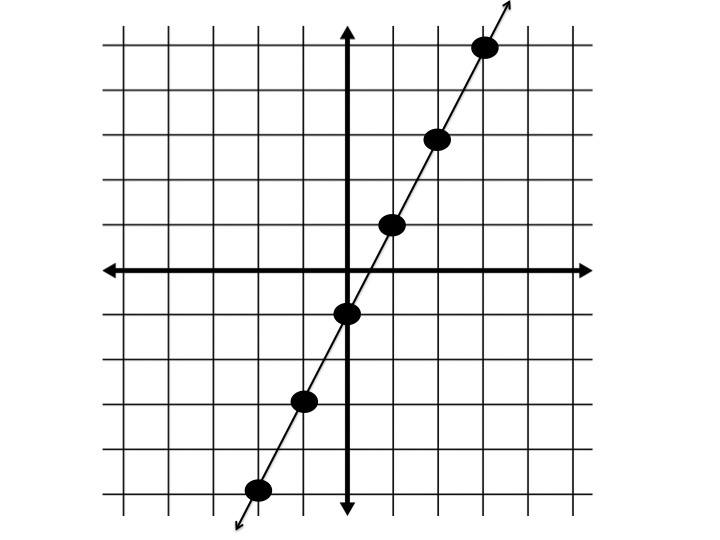
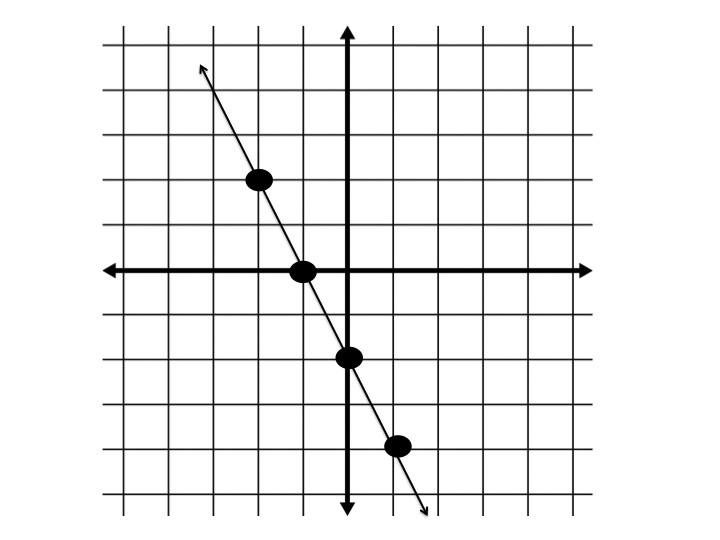


3x + y = 5
3x + 8y = 24
2x + y = 6


Give the y-intercept
What's the definition of y-intercept?
Where the graph crosses the x axis
where the graph crosses the y axis
Generally, how do you solve for the y-intercept?
Set x=0, then solve
Set y=0, then solve
At the x intercept the value of y is _______.
1
0
x
y
At the y intercept the value of x is _______________
x
y
1
0
How many points do you need to graph a linear equation?
0
1
2
3
Too many!
The point where the line crosses the x-axis is called the:
origin
x-intercept
y-intercept
slope
The point where the line crosses the y-axis is called the:
origin
x-intercept
y-intercept
slope

Graph


Graph


Graph


-3x + 2y = 18
Which of the following lines is PARALLEL to the graph of y = -6x + 3 and goes through the point (-1,4)?
y=1/6x +25/6
y = 1/6x + 4
y = -6x - 2
y = -6x + 4
Which is the equation of the line that is parallel to the graph of y = 5x + 7 and has a y-intercept at (0, -2)?
y = 5x - 2
y = -2x + 7
y = 5(x - 2)
y = -1/5x - 2
Determine the equation of a line perpendicular to y=-3x-2 and going through the point (9, 2), in slope-intercept form.
y=31x−3
y=−31x−9
y=31x−1
y=−3x−9
y = -2x + 4
and runs through the point (-3, 2 )
y = -6x + 2
These lines are...
y = 3/2x + 9
These lines are...
y = 2/3x + 6
These lines are...
Which of the following lines goes through the point (0, 4) and is PARALLEL to y = 5x - 3?
y=51x−3
y=5x−7
y=5x+4
y=−5x−3
Write the equation of a line PERPENDICULAR to y = -1/3x + 5 and passes through the point (6,4)
y=−31x+14
y=3x+22
y=−31x−10
y=3x−14
Write an equation that is PARALLEL to the line y = x - 5 through (1, -2)
y=−3x+1
y=x−3
y=x+1
y=3x+1
Write the equation of a line PERPENDICULAR to y = -2x + 1 that passes through the point (2, 3).
y=−21x+21
y=21x+2
y=−2x+7
y=−2x+8
Write an equation of a line that passes through the point (-9,2) and is perpendicular to the line y = 3x - 12
y = (-1/3)x - 1
y = (1/3)x - 2
y = -3x + 12
y = 3x - 1
Which is the equation of the line that is PARALLEL to the graph of y = 5x + 7 and has a y-intercept at (0, -2)?
HINT: PLUG (0,-2) AND THE PARALLEL SLOPE INTO y=mx+b. SOLVE FOR b AND REWRITE THE EQUATION IN y=mx+b.
y = 5x - 2
y = -2x + 7
y = 5(x - 2)
y = -1/5x - 2
Slopes of parallel lines are...
opposite reciprocals.
opposites.
identical.
always 7.
Select the two lines that are parallel.
y=4x−2
y=−41x
y=−4x+1
None are parallel.
What is the slope of this line?
y = 1/3x - 4 through (-3, 2)
y = -3x + 4
Which of the following lines is PARALLEL to the graph of y = -6x + 3 and goes through the point (-1,4)?
y=1/6x +25/6
y = 1/6x + 4
y = -6x - 2
y = -6x + 4
Write the equation of the line that passes through (5, 8) and is parallel to the line y = 4x – 10.
y = 4x + 28
y = 4x - 12
y = −41x + 28
y = −41x − 12
Write an equation of a line that is perpendicular to y=3x+4 and passes through (-9, 8).
y=31x+5
y=31x+11
y=−31x+5
y=−31x+11
Which of the following lines is PARALLEL to the graph of y = -6x + 3 and goes through the point (-1,4)?
y=1/6x +25/6
y = 1/6x + 4
y = -6x - 2
y = -6x + 4
Which is the equation of the line that is parallel to the graph of y = 5x + 7 and has a y-intercept at (0, -2)?
y = 5x - 2
y = -2x + 7
y = 5(x - 2)
y = -1/5x - 2
Which of the following lines is PARALLEL to the graph of y = -6x + 3 and goes through the point (-1,4)?
y=1/6x +25/6
y = 1/6x + 4
y = -6x - 2
y = -6x + 4
Which of the following equations has a graph PARALLEL to the line y = 4x + 7 and has an x-intercept of -2?
y = 4x - 2
y = 4x + 8
y = 7/2x + 7
y = -1/4x + 1/2
Which of the following represents the equation of the line passing through (-4, 5) PERPENDICULAR to the line y = -1/2x + 5/2?
y = 2x + 13
y = 2x + 5
y = -1/2x + 3
y = -1/4x + 11/2
Which equation describes a line that is perpendicular to the line y = -2/7x + 4/7 and contains the point (-6, 5)?
y = 7/2x + 26
y = 7/2x - 16
y = 7/2x - 26
y = 7/2x + 16
Which equation is parallel to the x-axis and goes through the point (2, 5)?
x = 2
x = 5
y = 2
y = 5
Write the equation of a line that is perpendicular to the x-axis and goes through the point (-3, 3).
x = 3
x = -3
y = 3
y = -3
Write an equation for a line perpendicular to
y = -5x + 3 through (-5, -4)
y = -3x + 1/5
y = -3x - 1/5
y = 1/5x - 3
y = -1/5x - 3
Write the equation of a line PERPENDICULAR to y = -2x + 1 that passes through the point (2, 3).
y=−21x+21
y=21x+2
y=−2x+7
y=−2x+8
Which of the following lines is PARALLEL to the graph of y=6x−3 ?
y=−6x+5
y=−61x−3
y=6x+1
y=61x−3


What is the equation of the red graph pictured?
y = -4
x = -4
y = 4
x = 4

What is the equation of the red graph pictured?
y = 3
x = 3
y = -3
x = -3
Does the following equation represent a vertical line, a horizontal line, or neither?
x = 4
vertical
horizontal
neither
Does the following equation represent a vertical line, a horizontal line, or neither?
y = −3
vertical
horizontal
neither
(-3,5)?
(6, 7) ?
Slope of 0

Which is the correct graph for y = 3?
A
B
C
D
Identify the following as vertical, horizontal or neither
A line that has an undefined slope
Vertical
Horizontal
Neither
Identify the following as vertical, horizontal or neither
A line in the form of
y=#
Vertical
Horizontal
Neither
Identify the following as vertical, horizontal or neither
A line in the form of
x=#
Vertical
Horizontal
Neither
What is the slope of the line y=−2 ?
2
-2
undefined
0
What is the slope of the line x=−2 ?
2
-2
undefined
0
The line x=2 is...
a vertical line with slope of 0
a vertical line with an undefined slope
a horizontal line with an undefined slope
a horizontal line with a slope of 0
a straight line with a slope of 2.
The line y=−3 is...
a vertical line with slope of 0
a vertical line with an undefined slope
a horizontal line with an undefined slope
a horizontal line with a slope of 0
a straight line with a slope of -3.

Which is the correct graph for x = −4?
A
B
C
D

What is the equation for the line in graph above.
x = 2
x = -2
y = -2
y = 2

What is the equation for the line in graph above.
x = 3
x = -3
y = 2
y = 3

What is the equation for the line in graph above.
x = 4
x = -4
x = 5
y = 5

What is the equation for the line in graph above.
x = -2
x = 2
y = 2
y = -2
Find the graph for the equation below,
y = 5


Find the graph for the equation,
x = −5


Find the graph of the equation,
x = 0


Select all of the following equations in point-slope form.
y - 2 = 5(x - 2)
3x + 2y = 12
y + 2 = 1/4(x + 4)
y = 4x + 6
2y = 5x - 7
Write the equation in point-slope form
for the line that contains the points
(3, -5) and (5, - 1)
y - 5 = 2(x + 3)
y + 5 = 2(x - 3)
y - 3 = 2(x + 5)
y + 3 = 2(x - 5)
What is the equation in Point-Slope form
of the line that goes through
the point (6,1) and has a slope of -3?
y - 6 = -3(x - 1)
y + 6 = -3(x + 1)
y - 1 = -3(x - 6)
y + 1 = -3(x + 3)
The line with the equation
y + 1 = -3(x - 5),
contains the point (5, -1)
and has a slope of _______.
-1
1
-3
5
y - 3 = 2(x + 4),
the line has a slope of 2 and contains what point?
Write the equation in point-slope form
of the line that passes through the point
(4, -7) and has a slope of -1/4.
y + 7 = -1/4(x - 4)
y - 4 = -1/4(x + 7)
y + 7 = 4(x - 4)
y - 7 = -1/4(x - 4)
y - 3 = 2(x + 4),
which of the following is true?
m= 5
(2, 4)
y - 2= 5(x - 4)
y - 4= 5(x - 2)
y- 5 = 4(x - 2)
y - 2 = 4(x - 5)
m= 3
(1, 7)
y - 7 = 3( x - 1)
y - 1 = 3( x - 7)
y - 3 = 3( x - 1)
y - 1 = 7( x - 3)
m= 3
(1, 7)
y - 7 = 3( x - 1)
y - 1 = 3( x - 7)
y - 3 = 3( x - 1)
y - 1 = 7( x - 3)
Write the equation in point-slope form of the line that passes through the given point and has the given slope:
(-2, -1); m= -3
y + 1 = -3(x - 2)
y + 1 = -3(x + 2)
y - 1 = 3(x - 1)
y + 2 = -3(x + 1)
Select the equation represents a line with a slope of 2
that passes through the point (9,−6)
y+6=2(x−9)
y−6=2(x+9)
y−6=2(x−9)
y+6=2(x+9)
(8,−1) and (−5,6)
Find the equation of the line passing through the given points in point-slope form using the first point to write the equation.
y+1=−127(x−8)
y−1=−127(x−8)
y+1=−127(x+8)
y−1=−127(x+8)
(−9,−3) and (3,0)
Find the equation of the line passing through the given points in point-slope form using the first point to write the equation.
y+3=41(x−9)
y−3=41(x−9)
y+3=41(x+9)
y−3=41(x+9)
(−4,3) and (5,2)
Find the equation of the line passing through the given points in point-slope form using the first point to write the equation.
y−3=91(x+4)
y−3=−91(x−4)
y+3=−91(x+4)
y−3=−91(x+4)
(−1,0) and (−6,9)
Find the equation of the line passing through the given points in point-slope form using the first point to write the equation.
y=−95(x+1)
y=−59(x+1)
y+6=−59(x+9)
y+6=−59(x−9)
Write the equation of the line with slope -2 through the point (7, −1).
y = −2x + 15
y = −2x − 15
y = −2x + 13
y = −2x − 13
Write the equation of the line with a slope of 2/3 that goes through the point (-6,10).
y−6=32(x−10)
y+6=32(x+10)
y+10=32(x−6)
y−10=32(x+6)
Which equation in standard form has a graph that passes through the point (−4,2) and has a slope of 29 ?
9x−2y=36
9x−2y=26
9x−2y=−40
9x−2y=−10
Write the equation of the line with slope -2 through the point (7, −1).
y = −2x + 15
y = −2x − 15
y = −2x + 13
y = −2x − 13
Write the equation of the line with slope -2 through the point (7, −1).
y = −2x + 15
y = −2x − 15
y = −2x + 13
y = −2x − 13
Write the equation of a line given:
m = 2/3 through the point (-6, 1)
y = 2/3 x + 7
y = 2/3 x + 6
y = 2/3 x + 5
y = 2/3 x + 4
Write the equation of a line given:
m = -1/2 through the point (-6, 1)
y = -1/2 x - 3
y = -1/2 x - 2
y = -1/2 x - 1
y = -1/2 x
Write the equation of a line given:
m = 2 through the point (2, 5)
y = 2x
y = 2x + 1
y = 2x + 2
y = 2x + 3
Write the equation of a line given:
m = -1 through the point (2, 3)
y = -x + 3
y = -x + 4
y = -x + 5
y = -x + 6
Write the equation of a line given:
m = -2 through the point (3, -1)
y = -2x + 3
y = -2x + 4
y = -2x + 5
y = -2x + 6
Write the equation of a line given:
m = 5/4 through the point (8, 9)
y = 5/4 x + 1
y = 5/4 x
y = 5/4 x - 1
y = 5/4 x + 2
Write the equation of a line given:
m = -4/3 through the point (-9, 7)
y = -4/3 x - 2
y = -4/3 x - 3
y = -4/3 x - 4
y = -4/3 x - 5
Write the equation of a line given:
m = 3/2 through the point (-2, 0)
y = 3/2 x + 3
y = 3/2 x + 4
y = 3/2 x + 5
y = 3/2 x + 6
Write the equation of a line given:
m = 1/4 through the point (8, 5)
y = 1/4 x + 3
y = 1/4 x + 4
y = 1/4 x + 5
y = 1/4 x + 6
Write the equation of a line given:
m = 1 through the point (-5, -7)
y = x - 1
y = x - 2
y = x - 3
y = x - 4
y = 1/3x - 4 through (-3, 2)
5x + y = -10
3x + y = 12
2x + 2y = 6
4x + 3y = 9
y + 2 = 3x
5x - y = 6
3y -9 = 18x
7x+ 2y = 20
x + y = 4
8x + 4y= 16
Solve for y:
3y -9 = 18x
y=18x-3
y=2x-3
y=-26x+3
y=6x+3
x + y = 4
Solve for "y"
3(y + 4x) = 12
y = -4x + 4
y = -12x + 12
y = 4x - 4
y = 0
If you are solving for "y" in this equation:
-7x + 5y = 3,
What is the FIRST step?
Add 7x to both sides
Divide by 5 both sides
Divide by -7 both sides
Subtract 3 to both sides
4x - 10y = 20
y-int = -10
y-int = 2
y int = -2
y -int = -10
3x + 8y = 24
3x + y = 5
Identify the x-intercept of the following linear equation written in standard form.
-8x - 4y = 8
(-1, 0)
(0, -1)
(-2, 0)
(0, -2)
Identify the y-intercept of the following linear equation written in standard form.
9x + 3y = -18
(0, -6)
(-6, 0)
(-2, 0)
(0, -2)
What is the x-intercept of the following function?
2x−5y=10
(a)
What is the y-intercept of the following function?
2x−5y=10
(a)
(8,10), (3, -4), (0, 8), (4, -3), (9, 0)
4x + 2y = -12
3x + y = 5
3x + 8y = 24

Identify the x-intercept of the following linear equation written in standard form.
-8x - 4y = 8
(-1, 0)
(0, -1)
(-2, 0)
(0, -2)
Identify the y-intercept of the following linear equation written in standard form.
9x + 3y = -18
(0, -6)
(-6, 0)
(-2, 0)
(0, -2)
Identify the x-intercept of the following linear equation written in standard form.
-3x + 2y = - 24
(8, 0)
(0, 8)
(0, -12)
(-12, 0)
5x + y = 5
Get in standard form: 31y=54x+2
−54x+31y=2
54x−31y=2
4x−3y=2
12x−5y=−30
Get in standard form: 3x−1=0.5y
3x−0.5y=−1
3x+0.5y=1
6x−y=2
6x−y=1
Get in standard form: −2x+5y=3
In standard form
2x−5y=−3
5y−2x=3
x−25y=−23
Get in standard form: 4x−2=32y
4x−32y=2
4x+32y=−2
12x−2y=6
6x−y=3
7x + 2y = 9
Which equation is written in standard form?
y = 3x - 5
3x + 16 = 5y
5x + 7y = -12
Which equation is written in standard form?
6y = x + 5
y-1 = 7(x - 2)
y = 1/2x + 15
2x + 3y = 18
Put this into standard form:
y = 3x + 2
y + 3x = 2
3x + y = 2
3x - y = -2
3x - 2y = 2
Put this into standard form:
8x = 9y + 10
8x - 10 = 9y
9y - 8x = 10
8x + 9y = 10
8x - 9y = 10
Put this into standard form:
3x = 7y - 5
3x - 7y = -5
3x - 7y = 5
3x + 7y = 5
3x + 7y = -5
Put this into standard form:
14x + 23 = -5y
14x + 5y = 23
14x - 5y = 23
14x + 5y = -23
14x - 5y = -23
Write the standard form of the equation for the line:
y = 1/4 x + 4
x + 4y = 8
x - 4y = -16
y = x + 16
4y + x = 8
Which equation is the correct standard form for 1 = -4x + 9y ?
4x - 9y = -1
4x + 9y = 1
4x + 9y = -1
y = 94x + 91
What would you have to do to change the following equation to STANDARD form?
41x+2y = −3
Nothing; it is already in standard form
Add 3 to both sides so the right side is zero
Subtract 1/4 x from both sides to get the x on the right
Multiply everything by 4 to get rid of the fraction
4x - 10y = 20
y-int = -10
y-int = 2
y int = -2
y -int = -10
3x + 8y = 24
3x + y = 5
Identify the x-intercept of the following linear equation written in standard form.
-8x - 4y = 8
(-1, 0)
(0, -1)
(-2, 0)
(0, -2)
Identify the y-intercept of the following linear equation written in standard form.
9x + 3y = -18
(0, -6)
(-6, 0)
(-2, 0)
(0, -2)
What is the x-intercept of the following function?
2x−5y=10
(a)
What is the y-intercept of the following function?
2x−5y=10
(a)
(8,10), (3, -4), (0, 8), (4, -3), (9, 0)
4x + 2y = -12
3x + y = 5
3x + 8y = 24
Identify the x-intercept of the following linear equation written in standard form.
-8x - 4y = 8
(-1, 0)
(0, -1)
(-2, 0)
(0, -2)
Identify the y-intercept of the following linear equation written in standard form.
9x + 3y = -18
(0, -6)
(-6, 0)
(-2, 0)
(0, -2)
Identify the x-intercept of the following linear equation written in standard form.
-3x + 2y = - 24
(8, 0)
(0, 8)
(0, -12)
(-12, 0)
5x + y = 5

