
 Worksheets
Page 1
Total questions: 15
Worksheet time: 8mins
A 50-year-old female complains of intermittent productive cough for the last 6-8 months. She does not report any weight loss. On examination, she has scattered wheeze bilaterally. She has smoked hukka for last 30 years. Which of the following is the most appropriate investigation for a definitive diagnosis?
Chest X-ray
CT chest
Echocardiogram
PEFR
Spirometry
A 22-year-old asymptomatic male has a pre travel requirement to get tested for latent TB. He was vaccinated with BCG at birth. Which of the following tests would be the most appropriate for screening this patient?
CT Chest
Gene xpert MTB
IGRA
PCR TB
Montoux test
A 35-year-old woman presents to your clinic with a history of recurrent episodes of coughing, wheezing, and shortness of breath, particularly at night and in the early morning. She has had few emergency department visits for breathlessness in the past year. On physical examination, she has diffuse wheezing and a prolonged expiratory phase. Which of the following is the most appropriate management for the above patient?
Antibiotics and Short-acting beta agonists
Inhaled corticosteroids and antibiotics
Long-acting beta-agonists and anti-muscarinic
Oral corticosteroids and antibiotics
Short-acting beta-agonists and inhaled corticosteroids
A 30 years old female presents to the clinic with menstrual irregularity, constipation and weight gain for the last 6 months. She is unmarried and sexually inactive. Which of the following is the most appropriate first-line investigation for this patient?
Serum cortisol
Stool occult blood
Thyroid profile
Ultrasound abdomen
Ultrasound pelvis
A 32-year-old female presents to the clinic for conception advice following her recent marriage. She has been diagnosed with essential hypertension for the past 2 years. She is compliant with her medicines and follows up regularly. On examination, her blood pressure is 125/75 mm Hg and her pulse is 72 beats/min. Which of the following anti-hypertensive should be discontinued in this patient?
Amlodipine
Enalapril
Hydralazine
Methyldopa
Prazosin
A 20-year-old female presents to the clinic with diffuse joint pain and pain in small joints of hand bilaterally for last 6 months. She has 1 hour of morning stiffness. Which of the following is diagnostic for this condition?
Anti-cyclic citrullinated peptide
RA factor
C-Reactive Protein
Erythrocyte sedimentation rate
Serum Vitamin D
A 22-year-old woman presents to the clinic with burning micturition, urgency, and bilateral flank pain. On examination, she has a low-grade fever, a blood pressure of 140/90 mmHg, and a heart rate of 100 bpm. Her urine detailed report shows WBC 10–12/hpf, RBC 0–1/hpf, nitrite positive. Which of the following is the most appropriate next step in the management of this patient?
Azithromycin 500 mg once daily for 5 days
Cefixime 400 mg stat
Cranberry sachet for 1 week
Fosfomycin 3gm stat
Levofloxacin 500 mg stat
A 17-year-old male presents to the clinic with low-grade fever and general malaise for 1 week. On examination, he has tonsillar hypertrophy, bilateral cervical lymphadenopathy, and a soft, non-tender abdomen with splenomegaly. His CBC shows atypical lymphocytes. Which of the following is the gold standard test for diagnosing this patient’s condition?
Blood cultures
Dengue antigen
ESR
Mono spot test
MP ICT
A 20-year-old patient presents to the clinic with a fever, sore throat and a maculopapular rash for 2 days. The rash started on the face and spread to the trunk and extremities. Which of the following is the most likely diagnosis in this case?
Chicken pox
Measles
Rosacea
Tinea corporis
A 65-year-old woman with a history of diabetes presents with fever, chills, and flank pain for 3 days. She also complains of dysuria and increased urinary frequency. On physical examination, she is febrile with a temperature of 38.5°C, and there is tenderness on palpation of the right costovertebral angle. Laboratory workup shows leukocytosis and pyuria. Urine culture is pending. Which of the following is the most likely diagnosis?
Acute cystitis
Pyelonephritis
Ureteral stone
Bacterial endocarditis
Appendicitis
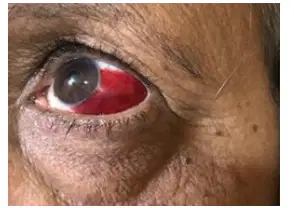
A 56-year-old male, known hypertensive, presents to the clinic with redness of his right eye for last 1 day. Which of the following is the most appropriate management for this patient?
Cold compresses and antihistamines
Give pilocarpine drops and refer
Prescribe topical steroids
Reassure
Refer immediately to ophthalmologist
A 34-year-old female presents with the following routine blood investigations; TSH:<0.05, FT4: 7 microgram/dl, FT3: 90 ng/dl. What is your provisional diagnosis?
Primary hypothyroidism
Hyperthyroidism (thyrotoxicosis)
Subclinical hyperthyroidism
Euthyroid state
An 80-year-old male presents to the clinic with complaints of fatigue, weakness, and unsteady gait for the past few months. He also reports a decreased appetite and weight loss. On examination, he has pale skin, a smooth tongue, and decreased sensation in his lower extremities. He has difficulty with heel-to-toe walking and has a positive Romberg sign. Which of the following nutritional deficiency is the most likely cause of the above condition?
Iron
Vitamin B12
Vitamin C
Vitamin D
Zinc
An 82-year-old male presents to the clinic with increasing drowsiness for last 48 hours. There is a history of a fall in the bathroom a week back. He is a known hypertensive and takes enalapril 5 mg and aspirin 150 mg once daily. Which of the following is the most likely cause of his drowsiness?
Electrolyte imbalance
Hypotension
Stroke
Subdural hematoma
Transient ischemic attack
A newly wed woman presents to the clinic with the complaint of being unable to have intercourse due to excessive pain. She has regular periods and minimal mucoid vaginal discharge. Which of the following is the most appropriate diagnosis in this case?
Cervical dysplasia
Imperforate hymen
Pelvic Inflammatory Disease
Somatization
Vaginismus

