
Font size
 Worksheets
Japanese revision
Total questions: 113
Worksheet time: 57mins
Which Japanese word means "red"?
Aka
Ao
Midori
Kiiro
In the season vocabulary provided, which term means "autumn"?
Aki
Haru
Natsu
Fuyu
Which pair correctly matches the season with its Japanese word?
Winter — Fuyu
Spring — Aki
Summer — Haru
Autumn — Natsu
Which verb is used for items worn on your head, such as a cap or hat?
Kaburimasu (kabutte imasu)
Kimase (kite imasu)
Hakimasu (haite imasu)
Tsukemasu (tsukete imasu)
Pick the item that correctly pairs with shimase/shite imasu (to add onto an outfit).
Nekutai (neck tie)
Kyappu (cap)
Zubon (trousers)
Kutsu (shoes)
Which verb is used for things you attach or put on, like a wristwatch or perfume?
Tsukemasu (tsukete imasu)
Kakemasu
Hakimasu (haite imasu)
Kimase (kite imasu)
According to the list, which item commonly uses suru/keru (interchangeable) when worn?
Masuku (mask)
Megane (glasses)
Jaketto (jacket)
Kutsu (shoes)
Which verb is used for items that hang or lean on, such as glasses or sunglasses?
Kakemasu
Kaburimasu
Hakimasu
Tsukemasu
Select the correct verb for clothing worn above the waist, like a jacket or shirt.
Kimasu (kite imasu)
Hakimasu (haite imasu)
Kaburimasu
Shimasu (shite imasu)
Which clothing item belongs to the "above the waist" category listed for kimasu?
Shatsu (shirt)
Zubon/Pantsu (trousers)
Sukato (skirt)
Kutsu (shoes)
For trousers or pants, which verb is appropriate according to the guide?
Hakimasu (haite imasu)
Kimasu (kite imasu)
Kaburimasu
Tsukemasu
Which of the following is correctly matched: item and verb?
Kyappu — Kaburimasu
Megane — Hakimasu
Nekutai — Tsukemasu
Kutsu — Kimasu
In the adjectives list, what does "segatakai" mean?
Tall (height)
Short (height)
Tall (nose)
Long
Choose the correct meaning of "hanagatai".
Tall (nose)
Short (nose)
Round
Slim/long
Which adjective corresponds to "short (nose)"?
Hanagahikui
Hanagatai
Segahikui
Nagai
Recall: In Japanese, which type of adjective drops い before adding くて to link two adjectives?
い-adjective
な-adjective
る-verb
Noun
Recall: Which type of adjective drops な before adding で to link two adjectives?
い-adjective
な-adjective
う-verb
Adverb
Skill/Concept: Choose the correct way to link the adjectives "strict" (きびしい) and "scary" (こわい) using the rule for い-adjectives.
きびしいでこわい
きびしいくてこわい
きびしできてこわい
きびしくてこわい
Recall: Which vocabulary item means "cool"?
かわいい
かっこいい
げんき
しずか (な)
Skill/Concept: Using the rule for な-adjectives, select the correct way to link "serious" (まじめ) and "cool" (かっこいい).
まじめくてかっこいい
まじめにてかっこいい
まじめでかっこいい
まじめはてかっこいい
Recall: In the 'te form song' chart, verbs ending with いちり change to which て-form ending?
いて
いで
って
んで
Recall: According to the chart, how do verbs ending with びみ に change in the て form?
→いて
→んで
→いで
→して
Recall: Which special verb shown changes to いって in the て form?
いきます
します
きます
ぎます
Recall: Which is NOT listed as a use of the て form?
Joining sentences that end in verbs
Forming the present continuous
Giving polite requests (Please do~)
Marking past tense by itself
Skill/Concept: Choose the correct て form to make a request: "Please make breakfast."
あさごはんをつくってください
あさごはんをつくりください
あさごはんをつくてください
あさごはんをつくんでください
Recall: What does から mean in time expressions given?
until
from
and then
please
Recall: What does まで mean in time expressions given?
from
until
because
with
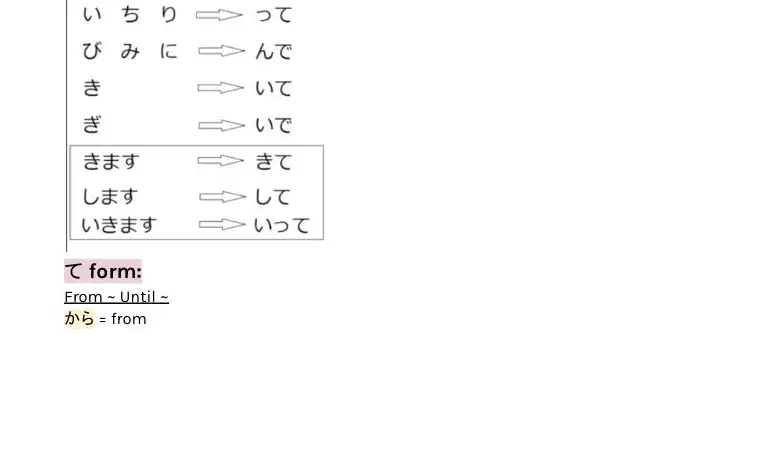
Strategic Thinking: A verb ends with ぎ in present polite stem before ます. Using the chart, which て form ending should you choose?
→いて
→いで
→って
→んで
Recall: In Genkouyoushi rules, where does the punctuation mark go at the end of a sentence?
Last box, bottom left quadrant
First box, top right quadrant
Last box, bottom right quadrant
Middle box, top left quadrant
Skill/Concept: According to Genkouyoushi rules, how should a new paragraph be started?
Two blank boxes as an indent
One blank box as an indent (each idea/paragraph = one line)
Start on a new page without indent
Begin with a comma in the top right quadrant
Recall: In Genkouyoushi, where is a comma placed?
Bottom right quadrant
Top left quadrant
Bottom left quadrant
Top right quadrant
Strategic Thinking: You are writing an introduction letter on Genkouyoushi. Which sequence best follows the sentence ideas provided?
Ask about the other person, then end with より, your name, then introduce yourself
Start with はじめまして and introduce yourself; ask about the other person; talk about yourself; end with より, your name
Begin with hobbies; then greeting; then sender; then age
Start with a question; then comma; then title; then sender
According to Genkouyoushi rules, where should small characters (excluding っ) be written within a box?
Top right quadrant
Bottom left quadrant
Center of the box
Bottom right quadrant
Which rule correctly describes how to mark the end of a line sentence in Genkouyoushi?
Place the punctuation in the first box of the next line
Leave the last box blank and write punctuation above the line
Put the punctuation mark in the last box in the bottom right quadrant
Write the punctuation in the margin outside the boxes
Choose the correct formula to express a time in Japanese as described in the notes.
AM/PM + minutes + o'clock
o'clock + AM/PM + minutes
AM/PM + ___ o'clock + ___ minutes
minutes + o'clock + AM/PM
Which pairing correctly matches the Japanese term to its meaning?
ごご = AM
ごぜん = PM
ごご = PM
ご = midnight
What does はん・半 indicate when telling time in Japanese?
Quarter past
Half past
Quarter to
Exact o'clock
According to the Minutes Rule, which pattern is highlighted for forming certain minute readings?
Voiced sound + missing character + っぷん
Special sound + missing character + っぷん
Long vowel + kanji + ぷん
Double consonant + はん
Which sentence correctly applies the grammar pattern Noun を Verb to mean “I eat sushi” in Japanese?
わたしはすしをたべます。
わたしはすしがたべます。
わたしはたべますすし。
すしはわたしをたべます。
Select the correct English meaning of the verb みます from the daily routine ‘ru’ verbs list.
to watch/see
to drink
to make
to buy
Which verb is classified as an ‘u’ verb in the daily routine list?
たべます
おきます
よみます
ねます
Identify the irregular verb meaning “to do.”
ききます
きます
します
つくります
Choose the correct present tense form for “to wake up.”
おきました
おきません
おきます
ねます
What is the negative form of きがえます (get dressed)?
きがえません
きがえました
きがえないです
きがえませんでした
Which option best translates のみます from the ‘u’ verbs list?
to sleep
to drink
to listen
to read
Pick the correct English meaning of ききます.
to buy
to listen
to take (a photo/ear)
to make
Which verb belongs to the ‘ru’ verbs group?
ねます
つくります
のみます
よみます
Select the correct past tense for あさごはんをたべます (eat breakfast).
あさごはんをたべました
あさごはんをたべません
あさごはんをたべるでした
あさごはんがたべました
Choose the correct present tense to say “go to school/work.”
がっこうにいきます/しごとにいきます
がっこうにいきました/しごとにいきました
がっこうにいきません/しごとにいきません
がっこうにいくです/しごとにいくです
Identify the correct negative form of べんきょうします (study).
べんきょうしません
べんきょうしないです
べんきょうではありません
べんきょうしませんでした
Which pair correctly matches present and past tense for かえります (go home)?
かえります/かえりました
かえります/かえりません
かえります/かえったです
かえります/かえりでした
Select the sentence that correctly uses を with the verb to mean “watch TV.”
テレビをみます
テレビがみます
テレビはみました
テレビをみませんでした
Which option expresses “wash the dishes” in past tense?
さらをあらいました
さらをあらいません
さらがあらいました
さらはあらいました
Choose the correct negative form for ねます (go to sleep).
ねません
ねませんでした
ねないです
ねませんです
Using the から/まで pattern explained, which sentence best says “I work from 9 o’clock until 5 o’clock” (use はたらきます)?
わたしはくじからごじまではたらきます。
わたしはくじまでごじからはたらきます。
わたしはごじからくじまではたらきます。
わたしははたらきますからくじまでごじ。
According to the rules provided, which is NOT a listed use of the て-form?
Joining sentences that end in verbs
Forming the present continuous (〜ています)
Making a polite request (〜てください)
Forming the past tense of verbs
Choose the correct て-form rule for a verb whose stem ends with 「き」 before ます.
き→いて
き→って
き→んで
き→して
Which mapping correctly converts いきます to its て-form based on the chart?
いきます→いって
いきます→いんで
いきます→いまして
いきます→いて
Which option shows the correct て-form result when the character before ます is 「し」?
して
って
んで
いて
In the adjective table, what is the present form of “scary”?
こわい
こわかった
こわくない
こわじゃない
Select the correct past form of “easy/nice” (やさしい).
やさしいでした
やさしかった
やさしくない
やさしだった
Which option correctly gives the negative form of “happy” うれしい?
うれしくない
うれしない
うれしじゃない
うれしかった
Identify the correct past form of “interesting” おもしろい.
おもしろくない
おもしろかった
おもしろでした
おもしろいでした
Which is the correct negative form for “tall/expensive” たかい?
たかかった
たかくない
たかいじゃない
たかくなかった
Choose the correct present form for “bad.”
わるかった
わるい
よくない
わるくない
Which option shows the correct negative form of the な-adjective “quiet” しずか?
しずかくない
しずかない
しずかじゃない
しずかかった
Based on the table, which pairing is correct for the adjective meaning “fun”?
Present: たのしい / Past: たのしくない
Present: たのしい / Past: たのしかった
Present: たのしい / Past: たのしかったです
Present: たのかった / Past: たのしい
Which rule correctly forms the past tense of a Japanese i-adjective?
Remove い and add だった
Keep い and add です
Remove い and add かった
Remove な and add でした
How do you make a Japanese i-adjective negative?
Remove な and add じゃない
Remove い and add くない
Add ない after the adjective without changes
Replace the adjective with でした
Which change makes a Japanese na-adjective past tense?
Remove な and add だった
Remove い and add かった
Add くない after the adjective
Attach ます to the adjective
Which form makes a Japanese na-adjective negative?
Add くない
Add ません
Use じゃない after the adjective (remove な)
Add だった after the adjective
Which Japanese word means “sunny”?
あめ
はれ
ゆき
あらし
What is the Japanese word for “rainy”?
あめ
ゆき
かぜ
きりさめ
Choose the best translation for “windy.”
かぜがつよい
あめ
くもり
つゆ
Which term corresponds to “drizzle”?
あらし
きりさめ
はれ
ふだん
In the frequency list, which word means “always”?
ぜんぜん
いつも
ときどき
よく
Which frequency adverb means “never”? Note: these expressions require the negative form of the verb later in the sentence.
えいえん
あまり
ぜんぜん
ふだん
Which option correctly matches “sometimes” to its Japanese equivalent?
よく
たいてい
ときどき
えいえん
Which Japanese adjective means “hot/humid”?
ひえびえとする
むしあつい
すずしい
うすぐらい
Recall the meaning of the forecast-ending particle in Japanese: In weather prediction sentences, which term is used to show uncertainty meaning “probably/should be…”?
どうですか
でしたか
でしょうか
でしょう
Which Japanese expression asks “What is it like?” or “How is it?” when discussing the weather?
どうですか
でしたか
でしょうか
のち
Match each time expression to its English meaning in the context of weather reports.
きょう = today
あした = tomorrow
きのう = yesterday
おととい = the day before yesterday
あさって = the day after tomorrow
Choose the correct Japanese for “this evening” used in weather forecasts.
けさ
こんばん
いま
あとで
Identify the correct weather term: Which option corresponds to “snow” in Japanese?
はれ
あめ
くもり
ゆき
Application: You are writing a brief forecast. Which choice correctly uses the particle that expresses wondering about future conditions: “I wonder what it will be like?”
どうですか
でしたか
でしょう
でしょうか
Strategic Thinking: A forecast says, “あした、かぜでしょう。のち、あめ。” Based on the terms provided, what is the most accurate interpretation?
Tomorrow will probably be windy; after that, rain.
Tomorrow is windy; before that, rain.
Yesterday was probably windy; after that, rain.
This evening will be windy; after that, thunder.
Strategic Thinking: You hear “けさ、ゆき。こんばん、はれでしょう。” What plan best matches the forecast?
Expect snow this morning and it will probably be clear this evening.
Expect rain this morning and it will probably be cloudy this evening.
It was clear this morning and will probably be windy this evening.
It will probably snow tomorrow morning and be clear yesterday evening.
Recall: What is the Japanese for “Lightning”?
かみなり
ひかり
にじ
ひょう
Skill/Concept: Which pair correctly matches the symbol/term with Japanese: rainbow and hail?
にじ (rainbow) and ひょう (hail)
にじ (hail) and ひょう (rainbow)
ひかり (rainbow) and かみなり (hail)
ゆき (rainbow) and あめ (hail)
Recall: Which term means “now” in these weather expressions?
いま
まえ
あと
ときどき
Skill/Concept: Which choice best represents “minimum temperature” in Japanese?
さいこうきおん
きおん
さいていきおん
マイナス-°C
Recall from Unit 3 introduction: Which Japanese word refers to “hobbies”?
きょうみ
しゅみ
じゃない
てんき
Skill/Concept: In talking about interests and dislikes, which option correctly pairs “interests” and “dislikes” in Japanese?
きょうみ (interests) and じゃない (dislikes)
しゅみ (interests) and きょうみ (dislikes)
きょうみ (interests) and しゅみ (dislikes)
じゃない (interests) and きょうみ (dislikes)
Which Japanese word most closely means “to love/like a lot” when describing preferences?
すこしすき
だいすき
あまりすきじゃない
ぜんぜんすきじゃない
Choose the expression that means “don’t really like.”
だいきらい
すこしすき
あまりすきじゃない
ぜんぜんすきじゃない
In the sentence しゅみ は なん ですか? what is the function of しゅみ?
It marks the topic and means hobby.
It is a verb meaning ‘to read.’
It is a particle meaning ‘object.’
It means ‘interest’ as a verb.
Select the correct reply to Q) (Activity as a noun/object) が すきですか。 to say “No, I don’t like [activity].”
はい、activity が すきです。
いいえ、activity が すきじゃないです。
はい、activity は なん です。
いいえ、activity に きょうみ があります。
What does きょうみ mean in this lesson’s vocabulary?
Free time, leisure time
Hate/Despise
Interest or an interest in
Hobby
Which sentence correctly expresses “My interest is manga” using the lesson’s structure?
(私の) きょうみ は まんが です。
(私の) しゅみ は まんが です。
(私の) ひまなとき は まんが です。
(私の) まんが に きょうみ があります。
When using ひまなとき (free time), which form must the activity take according to the notes?
Noun form only
Verb form
Adjective form
It can be any form; no rule given
Which option best translates the example: 私はひまなときにほんをよみます。
I read manga in my free time.
I read a book in my free time.
I write a book in my free time.
I have free time to read.
What do the particles や and も indicate as explained in the section?
Direction and location
Object of the verb and topic
‘And’ (listing some items, etc.) and ‘also’
Ownership and possession
In the three model sentences, which particle means “and (listing everything/exhaust all options)”?
や
と
も
に
Match the hobby vocabulary to its meaning: ありがみ, りょうり, おんがく, べんきょう
Origami; cooking; music; study
Music; study; origami; cooking
Cooking; origami; study; music
Origami; study; cooking; music
Which Japanese term in the hobby list refers specifically to “computer games”?
スポーツ
コンピューターゲーム
かいもの
ピアノ
Choose the correct kanji reading for “to eat.”
飲む (nomu)
聞く (kiku)
食べる (taberu)
書く (kaku)
Which particle indicates the ‘object’ affected by the verb, according to the sentence structures?
に
の
は
を
Select the sentence that correctly uses に to indicate direction/location/time.
バスをいきます。
バスでいきます。
学校にいきます。
えいごはじょうずです。
Which expression is used to say someone is skilled or good at (not used to talk about yourself)?
へた
にがて
じょうず
とくい
Which expression is used to say “I am good at English,” when talking about your own skill?
えいご が じょうず です。
えいご が とくい です。
えいご が へた です。
えいご が にがて です。
Choose the best translation for: ぼくは にがい たべもの が にがて です。
I like bitter food.
I am skilled at eating bitter food.
I don’t like / can’t eat bitter food.
I often eat bitter food.
Strategic thinking: You want to say “I go by bus” using the correct particle for location of action. Which sentence matches the provided structure?
バスをいきます。
バスにいきます。
バスでいきます。
バスはいきます。
Strategic thinking: You are describing mixed preferences: “I like fish and meat, and I also like vegetables.” Which particles should fill the blanks? わたしは さかな (___) にく が すきです。 わたしは さかな (___) にく が すきです。 わたしも さかな (___) にく が すきです。
や, と, に
と, や, も
と, と, に
と, や, も

