
NEW
Font size
 Worksheets
Ancient Egypt Review
Total questions: 32
Worksheet time: 16mins
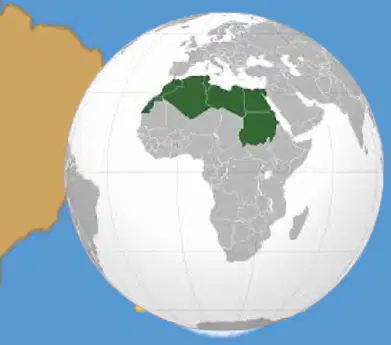
Which river was central to the development of ancient Egyptian civilization?
Tigris River
Nile River
Amazon River
Indus River
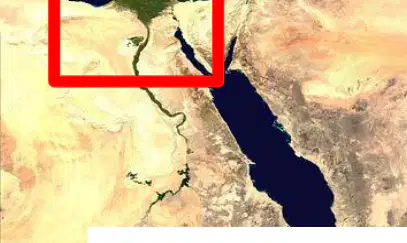
What best explains why the Nile River Delta was important for farming?
It provided steep mountain terraces for crops
It contained some of the most fertile farmland on Earth
It was a dry plateau ideal for storage
It had constant cold temperatures that preserved seeds
The term “delta” in geography is linked to which idea from another language, and why?
Latin word for water because deltas are wetlands
Greek letter delta because its triangular shape resembles the landform
Arabic word for river because deltas form at river sources
Hebrew letter aleph because deltas point north
Which statement best describes the Nile River’s flow and destination?
It flows north to south and empties into the Red Sea.
It flows south to north and empties into the Mediterranean Sea.
It flows east to west and empties into the Western Desert.
It flows west to east and empties into the Sinai Peninsula.
Ancient Egypt was divided to match the river’s flow. What are the correct locations of Upper and Lower Egypt?
Upper Egypt = North; Lower Egypt = South
Upper Egypt = East; Lower Egypt = West
Upper Egypt = South; Lower Egypt = North
Upper Egypt = West; Lower Egypt = East
Which set lists two resources the Nile provided that directly supported daily life?
Gold and spices
Water and transportation
Coal and timber
Silver and wool
Why did predictable Nile flooding help agriculture in Ancient Egypt?
It washed away all crops, forcing people to replant each year.
It brought rich fertile soil across the land, improving farming.
It made the land too salty for most plants to grow.
It shortened the growing season to only one month.
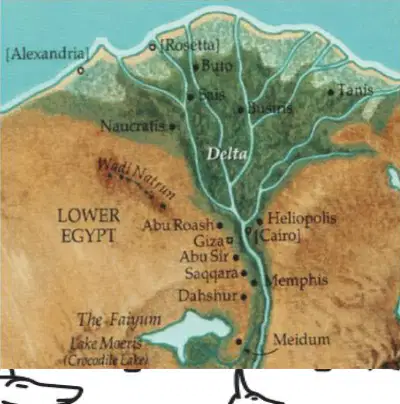
What feature forms where a river carries so much sediment that waves and tides cannot remove it?
Estuary
Oasis
Delta
Plateau
During which months did the Nile’s annual flooding occur, and what were the three agricultural seasons recognized by ancient Egyptians?
Flooding from March to May; seasons were Planting, Trading, Resting
Flooding from June to September; seasons were Flooding, Growing, Harvest
Flooding from October to December; seasons were Wet, Dry, Market
Flooding from January to March; seasons were Flooding, Building, Harvest
How did the surrounding environment influence Ancient Egypt’s early interactions with neighbors?
Lush forests encouraged constant trade and migration.
Dry, arid land isolated them until they expanded northward.
High mountains forced them to settle along the Red Sea only.
Frequent snow made travel to other regions easier.
What are the three main time periods into which Egypt’s dynasties are organized?
Early, Classical, and Late Empires
Old, Middle, and New Kingdoms
Bronze, Iron, and Hellenistic Ages
Delta, Nile, and Sahara Eras
Which statement best describes Ancient Egypt during the Old, Middle, and New Kingdoms?
Egypt was divided among many rival rulers and lacked a central authority.
Egypt was usually united under a single ruler and enjoyed a stable government.
Egypt was controlled by foreign empires during all three periods.
Egypt had no dynasties and changed leaders randomly.
Which statement best explains why the Old Kingdom is called the “pyramid age” (2700–2200 BCE)?
Most famous pyramids were constructed during this time for pharaohs’ tombs.
Pyramids first appeared in the New Kingdom and were later copied.
Pyramids were used mainly as marketplaces and meeting halls.
Pharaohs banned tomb building and focused on temples only.
Which ruler is linked with uniting Upper and Lower Egypt around 3100 BCE, setting the stage for Egypt’s kingdoms?
Menes I (Narmer)
Tutankhamun
Ramses II
Amenhotep IV (Akhenaton)
Which development marks a major change during the Middle Kingdom (2040–1650 BCE)?
Pharaohs shifted from pyramid tombs to cliff-cut tombs in the Valley of Kings.
Thebes was abandoned and Egypt split permanently.
Geometry was invented to build the first pyramids.
Trade and interaction stopped with neighboring regions.
In the Middle Kingdom, which area became the capital as Egypt was united by Mentuhotep I?
Thebes in Lower Egypt
Memphis in Upper Egypt
Giza in the Delta
Abydos in Nubia
Which leaders are identified with the New Kingdom period?
Hatshepsut and Ramses II
Menes I and King Djoser
Mentuhotep I and Khufu
Narmer and Amenemhat I
A builder in the Old Kingdom would most likely rely on which skill to construct monuments like the Step Pyramid of Djoser?
Geometry for precise planning and measurement
Calligraphy for recording hymns
Navigation for long sea voyages
Medicine for embalming procedures
DoK 1 — Which statement best describes where most people in ancient Egypt lived?
They lived near the Nile River and its delta.
They clustered in desert oases far from rivers.
They settled mostly along the Mediterranean coast.
They lived primarily in mountainous highlands.
DoK 2 — Based on the description of social classes, what does social mobility in ancient Egypt most clearly mean?
Ambitious people in lower classes could move to a higher social position.
Everyone stayed in the class in which they were born for life.
Only priests could change classes by taking religious vows.
People changed classes only by moving to a different city.
DoK 1 — Approximately how many people lived in ancient Egypt at its peak?
About 5 million people
About 500,000 people
About 15 million people
About 50 million people
DoK 2 — Which role best illustrates women holding high-ranking positions in ancient Egyptian society?
Serving as priestesses, supervisors, or administrators
Working only as farmers without pay
Acting solely as entertainers at festivals
Serving in the army as foot soldiers
DoK 3 — Considering how leaders were viewed, which conclusion best explains why pharaohs had strong authority?
They were considered gods and combined religious and political roles.
They were elected every year by a popular vote.
They controlled only the army and had no religious duties.
They ruled as governors appointed by foreign empires.
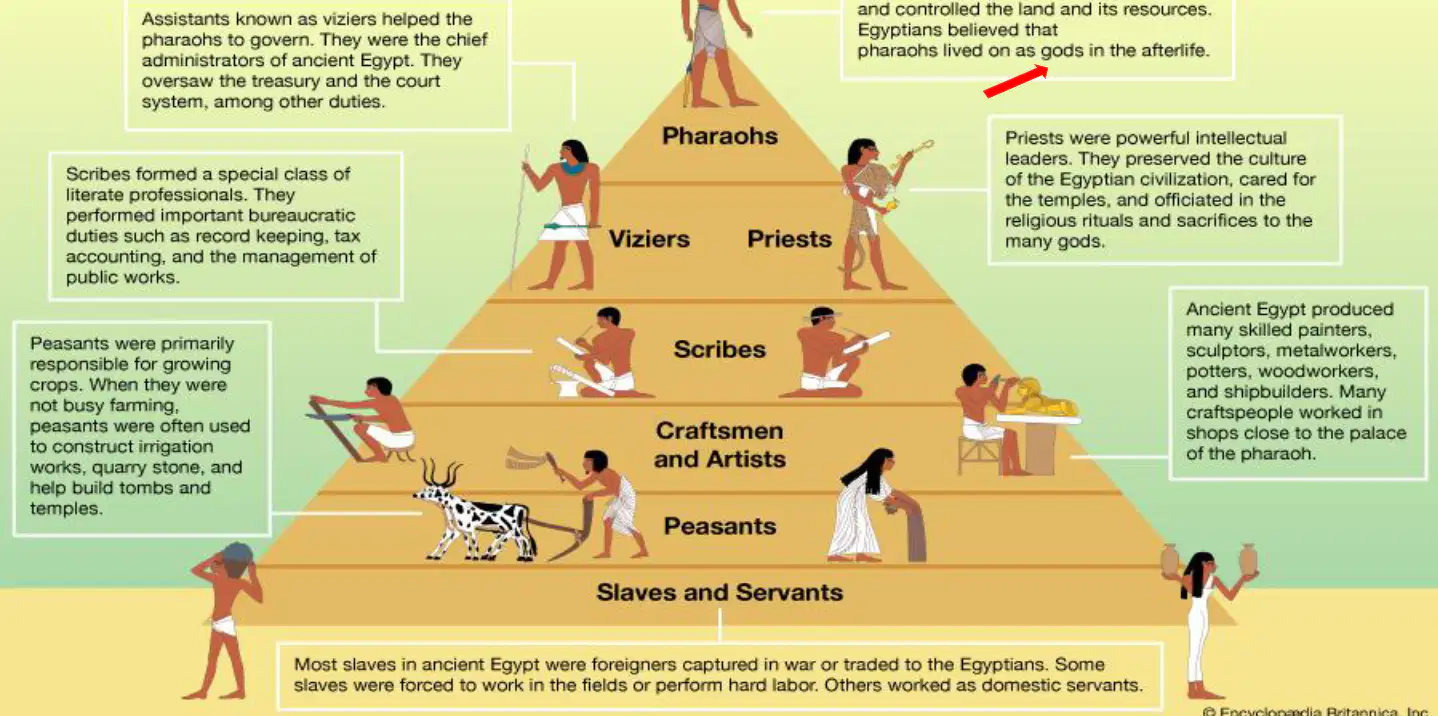
Refer to the social pyramid diagram of ancient Egypt. Which group sat at the very top of the hierarchy and made the laws while controlling the land and its resources?
Viziers
Pharaohs
Priests
Scribes

Study the social pyramid image. If a massive temple needed records of taxes and public works to be managed, which group would most likely be assigned that responsibility, and why?
Priests, because they cared for temples and led religious rituals
Scribes, because they were literate professionals handling records and tax accounting
Peasants, because they primarily grew crops and built irrigation works
Slaves and servants, because they performed domestic tasks after capture in war
DoK 1 — Recall: What was the main purpose of mummification in ancient Egypt?
To preserve the body so the soul could live on in the afterlife
To decorate tombs for celebrations
To mark the end of the farming season
To identify the person’s social class
DoK 2 — Skill/Concept: Which pair correctly matches a step of mummification with its action?
Embalming — drying out the body; Wrapping — covering with linen strips
Embalming — placing in a tomb; Wrapping — removing organs
Embalming — painting the coffin; Wrapping — drying the body with salt
Embalming — performing burial rites; Wrapping — placing items for the afterlife

DoK 1 — Recall: Which statement best identifies what the Rosetta Stone contained that helped scholars understand ancient Egyptian writing?
It showed pictures of pharaohs with their names carved beneath them.
It presented the same message written in Greek, Demotic, and Hieroglyphs.
It listed all known hieroglyph symbols with their English meanings.
It described how scribes made papyrus from reeds.
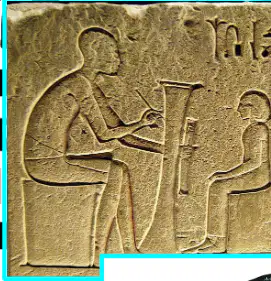
DoK 2 — Skill/Concept: Scribes in ancient Egypt mainly used which materials or surfaces to record writing? Choose the best answer based on the description.
Clay tablets only, because papyrus was reserved for art.
Walls and papyrus paper made from the papyrus reed, and sometimes tablets.
Metal plates, since hieroglyphs could not be carved into stone.
Silk scrolls imported from Asia.
In the ancient world, Egyptians had a reputation for being skilled in medicine.
Which of the following Egyptian achievements would be the BEST evidence to support the statement above?
Geometry
Hieroglyphs
Mummification
Irrigation

Which river is located in the area circled?
Tigris River
Euphrates River
Indus River
Nile River
What term describes the method of supplying water to crops using channels or ditches?
Irrigation
Domestication
Migration
Cultural diffusion

