
Font size
 Worksheets
DAY 45-PWD-FOUNDATIONS PLASTERING POINTING
Total questions: 15
Worksheet time: 11mins
Imagine you are building a small house. If you want the foundation to be shallow, what should you make sure about its depth and width?
The depth should be less than or equal to the width.
The depth should be more than the width.
The depth should be double the width.
The depth should be half the width.
Which of these is a special type of shallow foundation?
Grillage foundation
Suspended slab
Pile cap
Pier foundation
What is a floating foundation?
A foundation that floats on water
A foundation where the weight of excavated earth equals the load of the building
A foundation made of wood
A foundation built above ground
What is the width range of cracks in black cotton soil?
100 to 150 mm
50 to 100 mm
200 to 250 mm
10 to 20 mm
What can happen if there is a variation in the height of the water table under the ground?
Moisture can be withdrawn from the sub soil.
The soil becomes colder.
The soil turns into sand.
The soil grows more plants.
How far should fast growing and water seeking trees be planted from a building to prevent foundation problems?
2 meters
4 meters
8 meters
1 meter
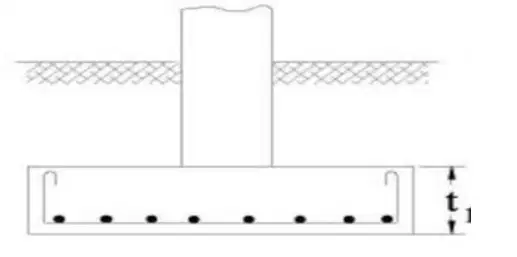
Identify the given type of foundation.
Stepped footing
Simple footing
Sloped footing
Shallow footing
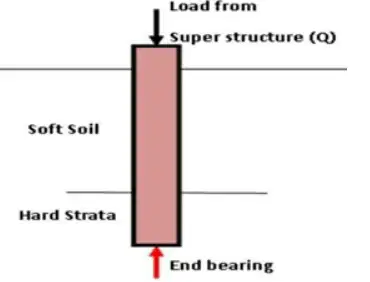
Identify the type of foundation shown:
Compaction pile
Anchor pile
End bearing pile
Sheet pile
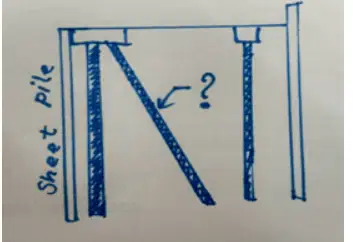
Identify the missing data.
Fender pile
Batter pile
Uplift pile
Bulkhead
The (a) is suitable for caissons of Open Well type.
a) Steel
b) Timber
c) Reinforced cement concrete
d) Cast-iron
A ______ caisson is open at top and closed at bottom, whereas, a ______ caisson is open at top as well as bottom.
(a)
In plastering, the 1st coat is called ___________ and its thickness should be _______ mm.
a) Undercoat, 6-9
b) Floating coat, 6-9
c) Floating coat, 10-15
d) Undercoat, 10-15
(a)
Mud plastering does not require curing.
a) True
b) False
(a)
(a) type of Pointing is formed by steel or iron rod with a concave edge.
Which types of foundation should be adopted when the ground is sloping and it is economical to provide Foundation at the same level.
a) Simple foundation
b) Pad foundation
c) Stepped foundation
d) Pier foundation
(a)

