
 Worksheets
Chapter Objectives
Total questions: 138
Worksheet time: 1hrs 11mins
Which statement best describes the medullary cavity in long bones?
A peripheral canal in flat bones containing synovial fluid
A central cavity in the shaft of long bones surrounded by compact bone
A space within the periosteum that stores cartilage
A depression on the epiphysis that houses ligaments
What tissue lines the medullary cavity?
Periosteum
Endosteum
Epimysium
Synovium
Red bone marrow is characterized as which type of tissue?
Adipose storage tissue
Hematopoietic tissue
Elastic connective tissue
Fibrocartilaginous tissue
Where is red bone marrow primarily located?
Within the spongy bone
Inside the periosteal layer
Between articular cartilage plates
In the synovial joint capsule
Which of the following is produced by red bone marrow?
Synovial fluid and chondrocytes
Hemoglobin, red and white blood cells, and thrombocytes
Keratin and melanocytes
Collagen fibers and osteoclasts
What is the main function of yellow bone marrow?
Hematopoiesis
Calcium deposition
Fat storage
Synovial fluid production
After early adolescence, approximately what happens to red bone marrow?
It becomes the periosteum of long bones
It is gradually replaced by about half yellow bone marrow
It converts to synovial tissue in joints
It fully ossifies into compact bone
Which statement best describes cartilage in the skeletal system?
A rigid, calcified tissue that stores calcium
A smooth, rubbery, blue‑white connective tissue acting as a shock absorber and forming flexible parts like the outer ear
A fibrous tissue that only covers the ends of long bones
A vascular tissue that produces red blood cells
Articular cartilage primarily functions to:
Produce synovial fluid within the joint
Cover bone surfaces where they meet to allow smooth movement and prevent bones from rubbing against each other
Attach muscles to bones at tendinous insertions
Store calcium within the joint capsule
In the knee joint, the meniscus is best described as:
A bursa filled with synovial fluid that reduces friction
A curved, fibrous cartilage present in some joints, including the knee
A ligament that connects the femur to the tibia
A layer of articular cartilage that lines the entire joint capsule
Which structure in the lateral knee view is directly associated with cushioning and reducing friction outside the joint capsule?
Meniscus
Bursa
Epiphysis
Foramen
Which term identifies the shaft of a long bone?
Epiphysis
Diaphysis
Foramen
Process
The proximal epiphysis of the femur is located:
Farthest from the body’s midline
Nearest to the body’s midline
Within the diaphysis of the bone
Inside a foramen near the joint
What is a foramen in bone anatomy?
A projection serving as a muscle attachment site
An opening through which blood vessels, nerves, and ligaments pass
The wider end of a long bone
A pad of fibrous cartilage within a joint
Which statement accurately contrasts a process and an epiphysis?
A process is an opening for neurovascular structures, whereas an epiphysis is a surface projection for muscle attachment.
A process is a normal projection on the bone surface that commonly serves as an attachment for a muscle or tendon; an epiphysis is the wider end of a long bone.
A process is the shaft of a long bone; an epiphysis is an opening through the bone.
A process and an epiphysis are both cavities within the medullary canal.
Which statement best defines bone in the context of tissue classification?
Bone is a type of epithelial tissue specialized for secretion
Bone is a connective tissue composed of a mineralized extracellular matrix
Bone is primarily nervous tissue that transmits impulses
Bone is muscular tissue adapted for contraction
Compact (cortical) bone is most accurately described as which of the following?
A highly porous lattice that reduces weight and houses marrow
A dense, strong outer layer that provides structural support and protection
A cartilaginous layer that cushions joints and permits slight movement
A thin periosteal membrane covering the articular surfaces
Spongy (cancellous) bone is characterized by which feature?
Dense lamellae that resist bending forces
Trabecular architecture forming a lattice with spaces for marrow
Elastic fibers that permit extensive stretching
Continuous osteonal systems without interspaces
Which function is primarily associated with red bone marrow?
Storage of triglycerides as an energy reserve
Production of blood cells through hematopoiesis
Secretion of synovial fluid for joint lubrication
Formation of articular cartilage at bone ends
Yellow bone marrow differs from red bone marrow mainly in which way?
Yellow marrow is cartilaginous while red marrow is osseous
Yellow marrow primarily stores fat; red marrow primarily produces blood cells
Yellow marrow forms compact bone; red marrow forms spongy bone
Yellow marrow is found only in the skull; red marrow only in long bones
A clinician expects more hematopoietic activity in which location of a long bone?
Within the compact cortical shaft
In the cancellous regions containing red marrow
Inside the articular cartilage at the joint
Within the periosteum lining the outer surface
Consider a patient with severe anemia. Which targeted change within bone tissues would most directly improve oxygen-carrying capacity?
Increase adipocyte storage within yellow marrow
Enhance osteoclast resorption in compact bone
Expand hematopoietic stem cell activity in red marrow
Thicken periosteal connective tissue
Which pairing correctly matches tissue type with its structural role in bones?
Compact bone — lightweight lattice for metabolic exchange
Spongy bone — dense barrier against external stress
Red marrow — hematopoiesis within trabecular spaces
Yellow marrow — formation of synovial membranes
Which statement best describes articular cartilage in synovial joints?
It lines the medullary cavity and stores yellow marrow
It covers bone surfaces at joints to reduce friction and absorb shock
It forms the epiphyseal line after growth plates fuse
It connects muscle to bone across the joint
In long bones, the diaphysis is defined as the:
Distal end of the bone containing spongy tissue
Proximal epiphysis that articulates with adjacent bones
Shaft of the bone composed primarily of compact bone
Opening that allows passage of nerves and vessels
The meniscus found in certain joints primarily functions to:
Provide a site for hematopoiesis within the joint
Deepen the articular surface to improve fit and distribute load
Anchor tendons directly to the diaphysis
Seal the synovial cavity to prevent fluid exchange
Which anatomic landmark is correctly matched with its description?
Epiphysis—central shaft where cortical bone predominates
Foramen—bony projection serving as a lever or attachment for tissues
Process—rounded opening allowing passage of structures
Epiphysis—end of a long bone that participates in joint formation
A foramen in bone is most accurately described as a:
Depression where a tendon attaches
Projection for muscle attachment
Hole that transmits vessels or nerves
Thickened ridge at the metaphysis
Which scenario best illustrates the role of articular cartilage during movement?
It increases friction to stabilize the joint during extension
It cushions opposing bone surfaces to limit wear during repetitive flexion
It ossifies to lock the joint once growth stops
It secretes synovial fluid to lubricate ligaments
During a knee injury, damage to the medial meniscus would most likely lead to:
Reduced ability to transmit forces evenly across the joint surface
Loss of red marrow production in the femoral shaft
Impaired formation of the epiphyseal line
Decreased ligament elasticity throughout the body
Which pair distinguishes two key regions of a long bone?
Diaphysis—spongy interior; Epiphysis—compact shaft
Diaphysis—central shaft; Epiphyses—expanded ends involved in joints
Diaphysis—opening for neurovascular bundles; Epiphyses—projecting ridges
Diaphysis—articular cartilage layer; Epiphyses—meniscal wedges
Which classification of joints is characterized by dense connective tissue with little to no movement, exemplified by sutures in the skull?
Fibrous joints
Cartilaginous joints
Synovial joints
Elastic joints
Fontanelles in the infant skull are best described as:
Freely movable synovial cavities between cranial bones
Fibrous membrane-filled gaps allowing skull flexibility during birth and growth
Cartilage pads that fuse the mandible to the maxilla
Osseous bridges that complete the cranium at birth
Which statement accurately distinguishes cartilaginous joints from fibrous joints?
Cartilaginous joints are united by cartilage and allow limited movement; fibrous joints are united by dense connective tissue and are mostly immobile
Cartilaginous joints are immobile and formed by ligaments; fibrous joints are slightly movable and formed by cartilage
Cartilaginous joints and fibrous joints both allow free movement but differ in synovial fluid presence
Cartilaginous joints only occur in the skull; fibrous joints only occur in the limbs
Which example corresponds to a cartilaginous joint in the axial skeleton?
Coronal suture
Pubic symphysis
Glenohumeral joint
Interphalangeal joint
The sternum’s connection to adjacent rib cartilage represents which joint type and functional characteristic?
Fibrous joint with no movement
Cartilaginous joint permitting limited movement
Synovial joint with free movement
Elastic joint allowing extensive stretching
Which pair correctly matches a synovial joint subtype with its principal movement capability?
Ball-and-socket—biaxial pivoting only
Hinge—multiaxial circumduction
Ball-and-socket—multiaxial movement including rotation
Hinge—immobile fusion
Identify the core components common to synovial joints that enable free movement.
Fibrous sutures, fontanelles, and osseous plates
Articular cartilage, synovial membrane producing synovial fluid, and a fibrous joint capsule
Elastic ligaments, marrow cavities, and periosteal sheaths
Intervertebral discs, meningeal membranes, and trabecular bone
Which joint type primarily protects organs by forming rigid enclosures rather than facilitating movement?
Synovial joints
Fibrous joints
Cartilaginous joints
Ball-and-socket joints
Select the best explanation for why ball-and-socket joints like the shoulder are more prone to dislocation than hinge joints like the elbow.
They lack a joint capsule
Their multiaxial range of motion and shallow sockets reduce inherent stability
They have no articular cartilage
They are stabilized exclusively by bone without soft tissues
Which structure in a synovial joint reduces friction between articulating surfaces during movement?
Periosteum
Synovial fluid secreted by the synovial membrane
Compact bone lamellae
Fibrous suture tissue
In terms of functional classification, which statement about sutures versus pubic symphysis is most accurate?
Both are freely movable (diarthroses)
Sutures are immovable (synarthroses); pubic symphysis is slightly movable (amphiarthrosis)
Sutures are slightly movable (amphiarthroses); pubic symphysis is immovable (synarthrosis)
Both are cartilaginous joints with limited movement
A patient experiences pain at the knee. Which reasoning best supports classifying the knee as a synovial hinge joint rather than a cartilaginous joint?
The knee is formed by fibrous tissue between tibia and femur
It possesses a joint capsule with synovial membrane, articular cartilage, and permits primarily flexion-extension
It is immobile and united entirely by dense connective tissue
It is composed of elastic cartilage connecting bones without a cavity
Which division of the skeleton primarily protects the brain, spinal cord, and thoracic organs?
Appendicular skeleton
Axial skeleton
Pelvic girdle
Pectoral girdle
In the shoulders, which bone is commonly referred to as the collarbone?
Scapula
Clavicle
Acromion
Humerus
Which pairing correctly matches each forearm bone with its relative size description from the instructional text?
Radius—larger, longer; Ulna—smaller, shorter
Ulna—larger, longer; Radius—smaller, shorter
Radius—thicker proximally; Ulna—thicker distally
Ulna—shorter in the upper arm; Radius—longer in the upper arm
According to the material, what is the olecranon?
A carpal bone forming the wrist tunnel
The distal tip of the radius known as the funny bone
The proximal tip of the ulna commonly called the funny bone
An extension of the scapula articulating with the clavicle
Which set lists components of the shoulder region described in the text?
Clavicle, scapula, acromion
Humerus, radius, ulna
Sternum, xiphoid process, ribs
Metacarpals, phalanges, carpals
How many carpal bones form the wrist, and what passage do they create?
Five; metacarpal canal
Eight; carpal tunnel
Seven; tarsal tunnel
Fourteen; digital tunnel
Which statement about phalanges of the fingers is accurate based on the text?
Each finger has two phalanges: proximal and distal
There are 10 phalanges total in the hand
Each finger has three phalanges—distal, middle, and proximal—while the thumb has two
The thumb has three phalanges like the other fingers
Which group correctly identifies the bones forming the palms of the hand?
Phalanges
Metacarpals
Carpals
Ulna and radius
Which bones are specifically responsible for transmitting vibrations from the tympanic membrane to the inner ear?
Cranial sutures
Auditory ossicles (malleus, incus, stapes)
Maxilla and mandible
Zygomatic arches
Which group of bones forms the protective case around the brain?
Facial bones
Thoracic vertebrae
Cranial bones of the cranium
Auditory ossicles
Which statement best describes the functional role of the thoracic cavity?
It houses the brain and supports facial expression.
It encloses the heart and lungs within a rib-protected space.
It contains the ossicles and regulates hearing intensity.
It forms the pelvic girdle that anchors lower limbs.
True ribs are distinguished from false ribs primarily because true ribs:
Do not attach to the sternum at all
Attach directly to the sternum via their own costal cartilage
Attach to the sternum through shared cartilage or not at all
Are the shortest ribs and found only posteriorly
Floating ribs are classified as a subset of false ribs because they:
Connect to the sternum with elongated cartilage
Attach to the sternum only through the manubrium
Do not attach to the sternum anteriorly
Form the superior border of the thoracic inlet
Which set of bones primarily determines the contours of the nose, cheeks, and jaws?
Cranial bones
Auditory ossicles
Facial bones
Thoracic vertebrae
Which combination correctly matches rib type to its anterior attachment pattern?
True ribs—no anterior attachment; False ribs—direct sternum attachment; Floating ribs—shared cartilage
True ribs—direct sternum attachment; False ribs—shared cartilage; Floating ribs—no sternum attachment
True ribs—shared cartilage; False ribs—no sternum attachment; Floating ribs—direct sternum attachment
True ribs—attach to vertebrae only; False ribs—attach to clavicle; Floating ribs—attach to scapula
Which statement correctly distinguishes the cranium from the facial bones?
The cranium contains ear ossicles, whereas facial bones protect the brain.
The cranium forms the braincase, whereas facial bones shape the mouth, nose, and cheeks.
Facial bones connect ribs to the sternum, whereas the cranium anchors shoulder girdles.
Facial bones form the spinal column, whereas the cranium completes the thoracic cavity.
Which bone forms the anterior portion of the shoulder girdle and articulates with the sternum at the manubrium?
Clavicle
Scapula
Acromion
Humerus
In the upper limb, which paired bones run parallel in the forearm, with one located laterally (thumb side) and the other medially?
Radius and ulna
Humerus and radius
Clavicle and scapula
Metacarpals and carpals
The prominent bony projection at the proximal end of the ulna that forms the point of the elbow is called the:
Olecranon
Acromion
Coracoid process
Radial head
Which structure is the lateral extension of the scapula that forms the highest point of the shoulder?
Acromion
Glenoid cavity
Coronoid process
Olecranon
Identify the correct sequence of bones from proximal to distal within a single digit of the hand.
Proximal phalanx → middle phalanx → distal phalanx
Metacarpal → distal phalanx → middle phalanx
Carpal → proximal phalanx → metacarpal
Radius → metacarpal → distal phalanx
Which group of small, irregularly shaped bones forms the wrist and articulates with the radius and metacarpals?
Carpals
Phalanges
Metacarpals
Tarsals
A patient reports pain at the base of the thumb after a fall on an outstretched hand. Which bone of the wrist is most clinically associated with this mechanism and lies among the carpals?
Scaphoid (a carpal)
Olecranon (ulna)
Acromion (scapula)
Patella (knee)
During supination of the forearm, which bone rotates around the other to position the palm anteriorly?
Radius rotates around the ulna
Ulna rotates around the radius
Humerus rotates around the scapula
Clavicle rotates around the acromion
Which primary function is attributed to the spinal column in human anatomy?
Facilitating gas exchange across vertebral surfaces
Protecting the spinal cord while providing axial support
Producing erythrocytes within intervertebral disks
Regulating endocrine secretions from vertebral bodies
How many individual vertebrae make up the typical adult human spinal column before sacral and coccygeal fusion is considered?
24
26
30
33
Which structure separates adjacent vertebral bodies and contributes to shock absorption and flexibility of the spinal column?
Costal cartilage
Meniscus
Intervertebral disk
Synovial capsule
Identify the correct pairing of vertebral region with its characteristic number of vertebrae.
Cervical—7; Thoracic—12; Lumbar—5
Cervical—8; Thoracic—10; Lumbar—6
Cervical—7; Thoracic—14; Lumbar—4
Cervical—6; Thoracic—12; Lumbar—6
Which component is part of the typical vertebra’s posterior arch and encloses the vertebral foramen?
Vertebral body
Lamina
Intervertebral disk
Transverse foramen
Which statement best distinguishes the sacrum from the lumbar vertebrae?
The sacrum is a single fused bone formed from multiple vertebrae, whereas lumbar vertebrae remain separate and large for weight bearing.
The sacrum has spinous processes that are bifid, while lumbar vertebrae lack processes.
The sacrum contains intervertebral disks between its segments, while lumbar vertebrae are fused.
The sacrum articulates directly with the skull, while lumbar vertebrae do not.
A patient presents with a herniated structure compressing a spinal nerve between two vertebral bodies. Which structure is most likely involved?
Articular facet
Intervertebral disk nucleus pulposus
Transverse process
Spinous process
Which region of the vertebral column articulates with the ribs and contributes to the thoracic cage?
Cervical
Thoracic
Lumbar
Coccygeal
Which structure forms the cup-shaped hip socket that articulates with the head of the femur?
Acetabulum
Glenoid fossa
Obturator foramen
Intercondylar notch
The sacroiliac joint connects which two components of the bony pelvis?
Sacrum and ilium
Ischium and pubis
Sacrum and femur
Ilium and acetabulum
Which midline fibrocartilaginous joint unites the left and right pubic bones?
Pubic symphysis
Patellofemoral joint
Tibiofibular syndesmosis
Sacroiliac joint
Which bone bears the medial malleolus at the ankle?
Tibia
Fibula
Talus
Calcaneus
Which lower-leg bone is primarily responsible for lateral ankle stability and forms the lateral malleolus?
Fibula
Tibia
Talus
Navicular
Which bone is a sesamoid embedded in the quadriceps tendon that protects the anterior knee?
Patella
Fibula
Tibia
Femoral condyle
Arrange the long bones from proximal to distal in the lower limb starting at the hip.
Femur → Tibia/Fibula → Tarsals → Metatarsals → Phalanges
Tibia/Fibula → Femur → Metatarsals → Tarsals → Phalanges
Femur → Tarsals → Tibia/Fibula → Metatarsals → Phalanges
Femur → Tibia/Fibula → Metatarsals → Phalanges → Tarsals
Which tarsal bone directly articulates with the tibia at the ankle joint to transmit body weight to the foot?
Talus
Calcaneus
Navicular
Cuboid
Which heel bone forms the posterior part of the foot and serves as the attachment for the Achilles tendon?
Calcaneus
Talus
Cuboid
Navicular
Metatarsals are best described as which of the following?
Five long bones forming the midfoot that articulate with tarsals proximally and phalanges distally
Seven short bones comprising the hindfoot and ankle
Three bones forming each toe distal to the tarsals
Two bones of the lower leg that articulate with the femur
Which statement correctly differentiates the tibia from the fibula?
The tibia is the weight-bearing medial bone; the fibula is the slender lateral bone contributing to ankle stability
Both bones are equal in weight-bearing and lie medially
The fibula is medial and bears most body weight; the tibia is lateral and non–weight-bearing
The tibia articulates only with the talus; the fibula articulates with the femur
In the pelvis, which paired bones along with the sacrum create a basin that supports the axial skeleton and transfers weight to the lower limbs?
Two hip bones (ilium, ischium, pubis) and the sacrum
Two femurs and the coccyx
Two patellae and the sacrum
Two tibiae and the ilium
Which term describes loss of joint mobility due to fusion of bones or stiffening of the joint structures?
Ankylosis
Bursitis
Synovitis
Subluxation
Adhesive capsulitis most accurately refers to which condition?
Frozen shoulder with stiffening of the capsule
Inflammation of a bursa near the shoulder
Cartilage softening of the glenoid
Partial dislocation of the humeral head
Which term describes hardening or stiffness of a joint often from degenerative changes?
Arthrosclerosis
Chondromalacia
Osteoarthritis
Spondylosis
A fluid-filled swelling behind the knee caused by synovial fluid herniation is called:
Baker's cyst
Ganglion cyst
Bursa hypertrophy
Meniscal cyst
Which condition is defined as inflammation of a bursa, commonly at the shoulder, elbow, or hip?
Bursitis
Synovitis
Arthritis
Tendinitis
Chondromalacia best matches which description?
Abnormal softening of cartilage
Inflammation of synovial membrane
Degenerative bone spurs
Fibrous ankylosis of a joint
Which statement correctly differentiates a sprain from a strain?
Sprain involves ligaments; strain involves muscle or tendon
Sprain involves tendons; strain involves ligaments
Sprain and strain are identical injuries
Sprain is only chronic; strain is only acute
Synovitis is the inflammation of which joint component?
Synovial membrane
Articular cartilage
Ligamentous capsule
Meniscal fibrocartilage
A complete displacement of a bone from its joint is called:
Dislocation
Subluxation
Sprain
Ankylosis
Which condition refers to a partial displacement of a bone within a joint?
Subluxation
Dislocation
Ankylosis
Arthrosclerosis
Which arthritis is characterized by progressive degeneration of articular cartilage and formation of osteophytes?
Osteoarthritis
Rheumatoid arthritis
Gout
Pseudogout
Spondylosis primarily involves degenerative changes in which region?
Spine
Shoulder girdle
Hip joint
Knee joint
Gout results from deposition of which crystals within joints?
Monosodium urate
Calcium pyrophosphate
Hydroxyapatite
Calcium oxalate
Pseudogout is most accurately associated with deposition of which crystals?
Calcium pyrophosphate
Monosodium urate
Calcium oxalate
Magnesium ammonium phosphate
Which arthritis is an autoimmune inflammatory disease often producing pannus and joint deformity?
Rheumatoid arthritis
Osteoarthritis
Gout
Bursitis
Ankylosing spondylitis primarily affects which structures early in the disease course?
Sacroiliac joints and spine
Glenohumeral joint
Temporomandibular joint
Interphalangeal joints alone
Juvenile idiopathic arthritis is best defined as:
Chronic inflammatory arthritis of childhood with unknown cause
Degenerative cartilage wear in adolescents
Crystal-induced arthritis in children
Septic arthritis due to Staphylococcus aureus
Which finding most strongly distinguishes rheumatoid arthritis from osteoarthritis?
Autoimmune synovial inflammation versus mechanical cartilage wear
Presence of tophi versus absence of crystals
Acute onset after trauma versus chronic gradual onset
Primary involvement of menisci versus involvement of ligaments
A runner develops anterior knee pain due to softened patellar cartilage. Which term applies?
Chondromalacia patellae
Bursitis of the prepatellar bursa
Synovitis of the knee
Ankylosis of the patellofemoral joint
Which condition would most likely present with warmth, swelling, and pain localized to the synovial lining rather than the cartilage or ligaments?
Synovitis
Sprain
Chondromalacia
Ankylosis
Which condition specifically refers to a herniated disk in the spinal column?
Protrusion of nucleus pulposus through the annulus fibrosus
Inflammation of vertebral facet joints
Degeneration of articular cartilage in the hip
Partial dislocation of the sacroiliac joint
Lumbago is best defined as which of the following?
Acute neck spasm due to whiplash
Low back pain localized to the lumbar region
Neuropathic pain radiating down the arm
Thoracic rib pain following compression
Spondylolisthesis involves which pathologic change of the vertebrae?
Anterior or posterior displacement of a vertebra over the one below it
Fusion of adjacent vertebrae due to ossification of ligaments
Collapse of the vertebral body from osteoporosis
Inflammatory erosion of the vertebral endplates
Which statement accurately characterizes spina bifida?
Congenital defect resulting from incomplete closure of the vertebral arches
Autoimmune inflammation targeting intervertebral disks
Traumatic fracture of the pars interarticularis
Age-related narrowing of the spinal canal
Identify the abnormal curvature described as an excessive outward (posterior) curvature of the thoracic spine.
Kyphosis
Lordosis
Scoliosis
Spondylosis
Which abnormal spinal curvature is defined by a lateral deviation of the vertebral column?
Kyphosis
Lordosis
Scoliosis
Ankylosis
A patient presents with accentuated inward curvature of the lumbar spine. Which term best describes this finding?
Kyphosis
Lordosis
Scoliosis
Spondylolisthesis
Which condition refers to bone tissue death due to disrupted blood supply?
Osteitis
Avascular necrosis
Periostitis
Osteomalacia
A localized bone inflammation that does NOT primarily involve infection is best termed:
Osteomyelitis
Osteitis
Paget's disease
Radiculopathy
Which disorder is characterized by softening of bones due to defective mineralization in adults?
Rickets
Osteomalacia
Osteopenia
Osteoporosis
Bacterial infection of bone and bone marrow is called:
Periostitis
Osteitis
Osteomyelitis
Multiple myeloma
Which condition involves abnormal bone remodeling with enlarged, deformed bones?
Paget's disease
Osteochondroma
Radiculopathy
Spinal stenosis
Inflammation of the membrane covering the bone surface is termed:
Periostitis
Osteitis
Osteoporosis
Osteonecrosis
Pain or dysfunction caused by compression or irritation of a spinal nerve root is known as:
Spinal stenosis
Radiculopathy
Clubfoot
Short stature
In children, defective mineralization of growing bones leading to deformities is known as:
Rickets
Osteomalacia
Paget's disease
Osteopenia
Narrowing of the spinal canal that can compress the cord or nerve roots is termed:
Spinal stenosis
Scoliosis
Kyphosis
Radiculopathy
Which term describes a height significantly below average due to skeletal growth disturbances?
Osteopenia
Short stature
Clubfoot
Osteochondroma
Congenital deformity in which the foot is turned inward is referred to as:
Talipes (clubfoot)
Kyphosis
Lordosis
Spondylolisthesis
Primary bone cancer most often arising from plasma cells in the marrow is:
Multiple myeloma
Osteosarcoma
Chondrosarcoma
Osteochondroma
A benign cartilage-capped bony growth near growth plates is termed:
Osteochondroma
Multiple myeloma
Osteitis
Paget's disease
Which statement best distinguishes osteoporosis from osteopenia?
Osteopenia is more severe bone density loss than osteoporosis
Osteoporosis is advanced loss of bone density; osteopenia is mild-to-moderate reduction
Both terms describe infection-related bone loss
Osteoporosis refers only to pediatric bone softening
A fracture with no skin wound is classified as what type?
Open (compound)
Closed (simple or complete)
Comminuted
Pathologic
Which fracture involves bone splintering or crushing into multiple fragments?
Comminuted fracture
Closed fracture
Incomplete fracture
Buckle fracture
Which fracture type is depicted when the break occurs at an angle across the shaft?
Transverse fracture
Oblique fracture
Greenstick fracture
Pathologic fracture
In an incomplete fracture, which statement is accurate?
Bone breaks into two separate pieces
Bone does not break into two separate pieces and occurs primarily in children
There is an open wound in the skin
The bone is splintered or crushed
A greenstick fracture is defined as:
Compression at the cortex causing buckling without complete break
One side of the bone is broken and the other side is bent
An infection-related fracture under normal strain
A complete transverse break through the bone
The fracture where the affected side of the bone is compressed and buckles but does not break is called:
Greenstick fracture
Buckle (torus) fracture
Comminuted fracture
Oblique fracture
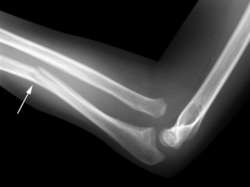

What type of fracture is this?
Compound
Simple
Greenstick

What type of fracture does not break through the skin?
Compound Fracture
Simple Fracture
Complete Fracture
Incomplete Fracture
A 2 year child fell off the trampoline and landed on his outstretched right arm. Due to the child's long lasting wimpers in pain, the parents took him to the doctor. The X-ray revealed a significant bending of the bone with a minimal fracture. This is called a ____________fracture.
comminuted
spiral
compression
greenstick