
 Worksheets
REVIEW Unit 3 TEST Electrons in Matter
Total questions: 28
Worksheet time: 1hrs 8mins
What is an electron dot structure?
An element symbol surrounded by dots representing its valence electrons.
An element symbol surrounded by its innermost electrons.
An element symbol with a positive charge.
A filled noble gas in brackets plus the remaining electron configuration expressed by filled orbitals.
Which of the following statements expresses Hund's rule?
Electrons in orbitals must possess opposite spins.
Single electrons with the same spin must occupy each equal-energy orbital before additional electrons with opposite spins can occupy the same orbitals.
Electrons with the same spin fill all orbitals.
P orbitals may contain up to six electrons.
How many electrons can an orbital contain?
1
2
3
4
What is the electron configuration for Nitrogen?
1s2 2s1 2p3
1s2 2s4 2p3
2s2 2s2 2p3
1s2 2s2 2p3
The outermost electrons are known as?
Electrons
Excluded Electrons
Valence electrons
Ionely Electrons
What is the lowest energy state of an atom called?
the ground state
the excited state
the solid state
the chaotic state
The concept that all moving particles have wave characteristics is attributed to ___________.
de Broglie
Thomson
Heisenberg
Bohr
What is the biggest difference between the Bohr model and the quantum model of the atom?
How electrons move around the nucleus
How much mass electrons have
They are identical
In the quantum model, electrons do not have wave like properties
What is Heisenberg uncertain of?
The velocity of a particle
Whether there is an electron in the box
The velocity and position of a particle at the same time
The velocity and the nucleus
What are the 4 energy sublevels?
a, b, c, d
s,p,d,f
s., q, r, f
c, h, e, m
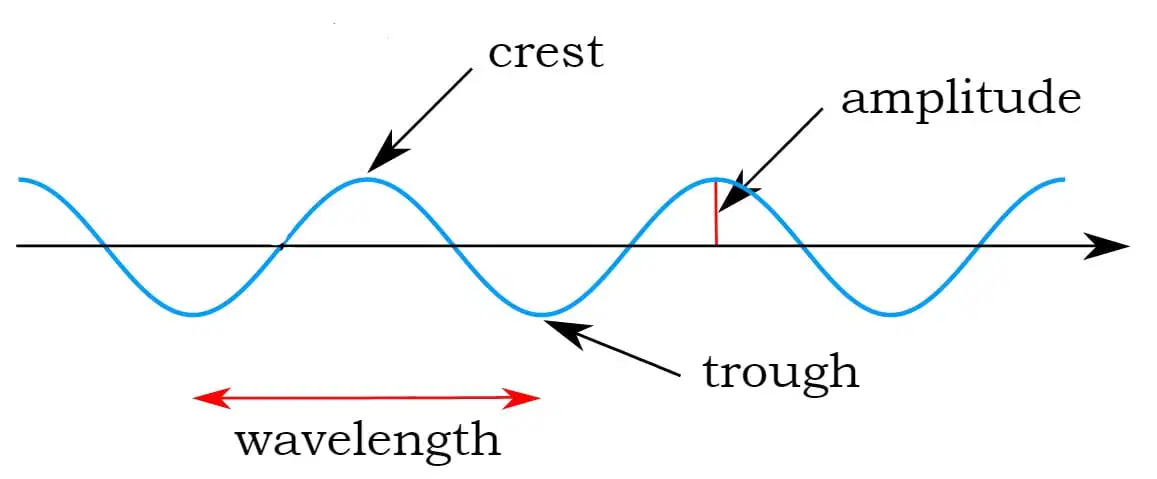
The wavelength of a wave is measured from
origin to trough
origin to crest
crest to crest
crest to trough
What is the wavelength of a radio wave having a frequency of 3.75 x 10⁷ Hz?
Formula: Wavelength = speed of light ÷ frequency
Speed of light= 3.00 × 10⁸ m/s
.08 m
.80 m
8.0 m
80 m
What is a QUANTUM?
An important reason for the wave like properties of light
The minimum amount of energy that an atom can gain or lose
Something discovered by Einstein
Why solar panels work

Why do neon signs light up?
Neon is always a bright color in nature in gas form
Neon gas is releasing energy
It means that neon is very reactive
All gasses release the same color to release energy
What is the energy of a photon from the violet portion of the Sun’s light if it has a frequency of 7.230 × 10¹⁴ s-1?
Formula: Energy of photon, E= h ×v
Known: ν = 7.230 × 10¹⁴ s-1
h = 6.626 × 10⁻³⁴ J•s
7.791 × 10⁻¹⁹ J
4.791 × 10⁻¹⁹ J
4.732 × 10⁻¹⁹ J
4.991 × 10⁻¹⁹ J
What element does this electron configuration represent: 1s2 2s2 2p4 ?
Oxygen
Potassium
Gold
Hydrogen
What element does this electron configuration represent: 1s2 2s2 2p6 3s2 3p6 4s1
Iron
Oxygen
Phosphorous
Potassium
What element does this electron configuration represent: 1s1 ?
Carbon
Helium
Hydrogen
Lithium
Which statement best represents the PAULI exclusion principle?
a maximum of two electrons can occupy a single orbital, but only if the electrons have opposite spins.
each electron occupies the lowest energy orbital available.
single electrons with the same spin must occupy each equal-energy orbital before additional electrons with opposite spins can occupy the same energy level orbitals.
electrons must do same flips before entering an orbital
A maximum of two electrons can occupy a single orbital, but only if the electrons have opposite spins in pair.
Hund's rule
Pauli Exclusion Principle
Aufbau Principle
All of them
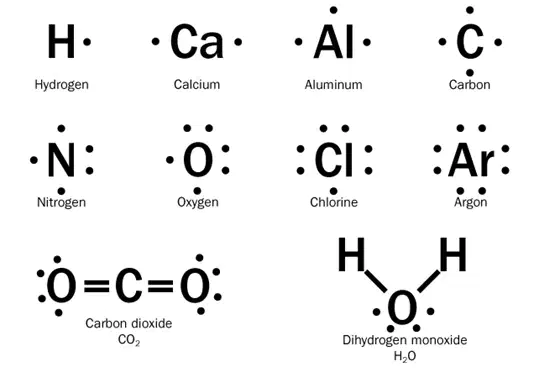
How do electron dot structures represent valence electrons?
Each dot represents 4 valence electron
Each dot represents 3 valence electron
Each dot represents 2 valence electron
Each dot represents 1 valence electron
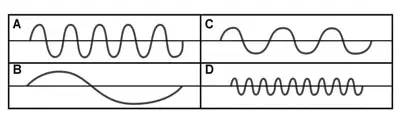
Which diagram shows a wave with the highest energy? (see picture)
Wave A
Wave B
Wave C
Wave D
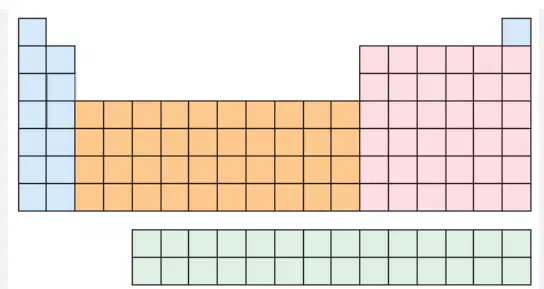
Which is TRUE about the Periodic Table block colors and the orbitals they represent?
Blue= p orbital,
Pink= s orbital, Orange= d orbital,
Green= f orbital
Blue= d orbital,
Pink= f orbital, Orange= s orbital, Green= p orbital
Blue= s orbital,
Pink= p orbital, Orange= d orbital, Green= f orbital
None of them
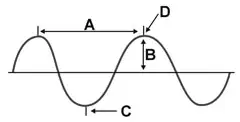
See picture: IDENTIFY the parts of the WAVE.
A= Wavelength
B= Crest
C= Trough
D= Amplitude
A= Wavelength
B= Amplitude
C= Trough
D= Crest
A= Crest
B= Amplitude
C= Trough
D= Wavelength
None of them is correct
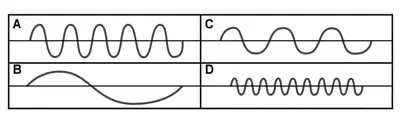
(see picture) Which diagram shows a wave with the highest frequency?
Wave D
Wave C
Wave B
Wave A

The rule that is broken in the following diagram is
Hund's Rule
Pauli's Exclusion Principle
Aufbau Principle

The RULE that is VIOLATED in this diagram is
Aufbau Principle
Hund's Rule
Pauli's Exclusion Principle

(see picture) The rule that is VIOLATED in this diagram is
Aufbau Principle
Hund's Rule
Pauli's Exclusion Principle

